Four psalms in the Hebrew Bible. Four psalms in the Greek. And not one boundary in the same place. The Greek joins Psalms 114 and 115 into one, then cuts Psalm 116 in half, then runs on unchanged — and the two operations cancel so exactly that the numbering comes out the far side still one behind, just as it went in. A reader checking only the numbers either side would never know anything had happened. Inside that stretch is something stranger still: a verse number the Greek Psalter does not use. Rahlfs prints Psalm 115 as verses 1, 2, 3, 4, 6, 7, 8, 9, 10 — there is no verse 5, and it is the only gap in the whole Greek Psalter. The empty slot lines up with Hebrew Psalm 116:14, and that verse is a repeat: 116:14 and 116:18 are identical, letter for letter and accent for accent. The Hebrew prints the line twice; the Greek carries it once. And the same psalm does it a second time. The mechanism is checkable. The cause — a shorter Hebrew scroll, or a copyist's eye slipping between two identical lines — is not. See the method →
Psalms 114:1–117:2 (selections)
Hebrew · Greek (Rahlfs’ Psalter) · ESVThe Greek joins Psalms 114 and 115 into a single psalm numbered 113. Then it cuts Psalm 116 in half, making two psalms out of one. Then it runs on with Psalm 117 unchanged. Four go in, four come out, and every seam has moved.
And the arithmetic is exact in all three places. Hebrew 114 has 8 verses and 115 has 18: 8 + 18 = 26, and Greek 113 has 26. Hebrew 116 has 19 verses; Greek 114 has 9 and Greek 115 runs to 10: 9 + 10 = 19. Hebrew 117 has 2; Greek 116 has 2. Nothing is added or lost anywhere in this stretch. The same material is divided at different points.
⚠️ And the two operations cancel each other exactly. The Greek Psalter has been running one number behind the Hebrew since Psalm 10. Here it merges (which would put it two behind) and then splits (which puts it back). So the numbering comes out the far side of this stretch exactly one behind, just as it went in — Greek 116 is Hebrew 117, and the offset carries on undisturbed to Psalm 147. A reader who only checked the numbers either side of these four psalms would never know anything had happened.
⚠️ There is a verse number the Greek Psalter simply does not use. Rahlfs prints Psalm 115 as verses 1, 2, 3, 4, 6, 7, 8, 9, 10. There is no verse 5. The number is skipped rather than the text renumbered. The same gap stands in the CATSS morphological Psalms files held here as well, so it is upstream of this library’s own processing. Those two files are the same textual base in two serialisations, not two independent witnesses, and this page does not present them as corroboration from a second edition. No second critical edition of the Greek Psalter is held here.
⚠️ And the empty slot is exactly what makes the two books balance.
The Greek Psalter file holds 2,534 verse labels. Seven belong to Psalm 151, which the Hebrew Psalter does not carry. One more — 144:13a — is not a plain number at all, and it is the only such label in the file.
2,534 − 7 − 1 = 2,526 plain-numbered verses carrying text.
Add the one empty number back: 2,527 numbered verse slots.
The Hebrew Psalter has 2,527 verses.
Two things worth stating precisely, because the same total arrives by two different routes and they are not the same quantity. 144:13a is a populated verse — it is subtracted here because it carries no plain number, not because it is empty. And counting simply the keys that fall in chapters 1 to 150, lettered one included, also gives 2,527. The figure compared with the Hebrew above is the first one: numbered slots, arrived at by summing the highest verse number in each of the 150 chapters.
Two psalms have been run together, one has been cut in two, and one verse number has been left standing empty — and the two books still land on the same total, to the verse. Slot for slot across this unit: Hebrew’s 47 verses answer 47 Greek numbered slots, 46 of them populated.
⚠️ And there is one more place where the Greek runs short — exactly one. Across the forty-six populated slots of this unit the Greek runs longer than the Hebrew everywhere, from 1.14 times to 3.17 times, which is what Greek always does: it writes its articles as separate words and Hebrew does not. One slot breaks the pattern. At Hebrew 116:17 the Greek of Rahlfs 115:8 is four words against seven — the only slot in the unit where the Greek is shorter at all.
The missing slot corresponds to Hebrew Psalm 116:14 — and that verse is a repeat. Hebrew 116:14 and 116:18 are identical, letter for letter and accent for accent: I will pay my vows to the Lord in the presence of all his people. The Hebrew prints that line twice; the Greek carries it once, at 115:9, and leaves the earlier number empty rather than shifting everything up.
⚠️ And the same thing happens a second time in the same psalm. The line and I will call on the name of the Lord also stands twice in the Hebrew — at 116:13 and again at 116:17. Rahlfs carries it once, at 115:4, and his 115:8 is a single short clause where the Hebrew has two. So both of this psalm’s repeated lines appear once in the Greek — though not by a consistent rule, since in one case it is the first occurrence that survives and in the other the second.
What that does and does not prove. It is a real and checkable pattern. Whether the Hebrew scroll behind the Greek was shorter, or a copyist’s eye slipped between two identical lines, cannot be decided — both would leave exactly this trace. This page reports the mechanism and declines the explanation.
The Shape of the Passage
SequenceThe merge is the more interesting of the two, because here the Hebrew half-agrees. Almost every psalm in the book carries a paragraph mark at its close — 144 of 150. Psalm 114 is the only psalm outside the book-ending positions that does not. So at this one seam, the Hebrew’s own layout is doing something unusual in the same place the Greek declines to divide. That is a real convergence, and it is worth noticing that the Psalter’s other merge point — Psalms 9–10 — has no such agreement at all.
The split, by contrast, falls on a genuine hinge. Psalm 116 turns at verse 9 from narrating the rescue to responding to it, and that is exactly where the Greek makes its cut. Whether the Greek tradition found the division or made it cannot be established, and this page does not guess.
These four psalms sit inside the Egyptian Hallel (Psalms 113–118), sung at Passover. They are also the stretch that carries the Psalter’s only psalm-splitting — the counterpart to the merge at Psalms 9–10.
Author
He writes the Exodus as comedy and means it seriously. Psalm 114 has the sea running away and the hills jumping like lambs, then turns and interrogates them: what ails you, O sea? No other psalm handles the Exodus this way, and the punchline is a command to the whole earth to tremble.
He is willing to be rude about other people\u2019s gods. Psalm 115\u2019s idol satire is not gentle: mouths that cannot speak, eyes that cannot see, throats that make no sound. And the conclusion is aimed at the worshippers, not the statues — those who make them become like them.
And he repeats himself deliberately. Psalm 116 says I will pay my vows to the LORD in the presence of all his people twice, in identical words. In a psalm about keeping a promise, saying the promise twice is not padding. The Greek tradition carried it once.
Audience
People at a Passover table. These sit in the group sung at the festival meals — the Egyptian Hallel. Psalm 114 is the Exodus, and it is being sung by people re-enacting it annually.
People surrounded by better-funded religion. Why should the nations say, “Where is their God?” is the complaint of a minority whose God has no image to point to. Psalm 115 answers by describing the competition in unflattering physical detail.
And someone who nearly died. Psalm 116 is the most personal of the four: the snares of death encompassed me… I will walk before the LORD in the land of the living. The public vow-paying at the end is the point — a private rescue discharged in public.
Orient on the Hallel, on idol polemic, and on the Greek Psalter's numbering.
Search by topic: Hallel; Egyptian Hallel; Passover liturgy; idols and idolatry; vows; Sheol and the silence of the dead; Septuagint Psalter numbering.
Which articles are relevant?
- Anchor Bible Dictionary — “Hallel,” “Passover,” “Idol, Idolatry,” “Vow,” “Dead, Abode of the.”
- Dictionary of the OT: Wisdom, Poetry & Writings (IVP) — “Hallel,” “Thanksgiving Psalms,” “Worship,” “Exodus imagery.”
- NIDOTTE / TDOT — לֹעֵז (lōʿēz, of strange speech), עֲצַבִּים (ʿăṣabbîm, idols), נֶדֶר (neḏer, vow), חָסִיד (ḥāsîd, faithful one).
- On the Greek — the NETS introduction to Psalms, and any table of the Hebrew/Greek psalm numbering. This stretch is where the table gets complicated.
Bibliography surfaced:
- Frank-Lothar Hossfeld and Erich Zenger, Psalms 3 (Hermeneia) — covers Psalms 101–150, so it is available for this stretch.
- John Goldingay, Psalms 90–150; Robert Alter, The Book of Psalms.
- NETS Psalms — for the Greek text and its numbering.
A festival playlist, a standard polemic, and what an empty verse number means.
First the liturgical setting. Then the numbering, which is the hardest thing on this page and the most rewarding.
Which parallels shed light on these psalms?
These are festival psalms with a fixed job. Psalms 113–118 form the group sung at the pilgrim feasts and at the Passover meal. That setting explains the abrupt turns in tone — Exodus narrative, idol satire, personal thanksgiving and a two-verse summons to the nations sit together because they were used together, not because one argument runs through them.
The idol polemic of Psalm 115 is a recognised form, not an outburst. The same argument — itemising the sense organs a statue has and cannot use — appears at Psalm 135, Isaiah 44 and Jeremiah 10. It is a set piece, which makes its final line the distinctive part: the charge is not that idols are useless but that their makers come to resemble them.
And Psalm 114 is describing something the audience did annually. The Exodus is narrated in the third person and in the past, but the people singing it at Passover were re-enacting it. The last verse switches to the present imperative — tremble, O earth — which pulls the whole thing into the room.
- Psalm 135:15–18; Isaiah 44:9–20; Jeremiah 10:3–5 — the same idol polemic. A standard form used with unusual bite here.
- Exodus 14–15 and Joshua 3–4 — the sea and the Jordan, the two events Psalm 114:3 puts in one line. Forty years apart in the narrative; one breath in the psalm.
- Matthew 26:30 / Mark 14:26 — when they had sung a hymn, they went out to the Mount of Olives. On the usual reconstruction that hymn was the Hallel, which would place these psalms in the upper room. The Gospels do not name them, and the identification is inference.
- Ancient Near Eastern cult statue rituals (witnesses, not Scripture) — ceremonies for the opening of a statue’s mouth and eyes. Psalm 115 is denying precisely what such rites claimed to accomplish.
Rahlfs’ Greek Psalter numbers Psalm 115 as 1, 2, 3, 4, 6, 7, 8, 9, 10. There is no verse 5. The number is skipped, not reassigned. Editions in liturgical use, and the Latin tradition dependent on the Greek, handle it differently.
The empty slot corresponds to Hebrew Psalm 116:14. And that verse is a duplicate. Hebrew 116:14 and 116:18 are the same line — I will pay my vows to the Lord in the presence of all his people — and not merely similar: identical letter for letter, including the accent marks. The Greek carries the line once, at 115:9, and leaves the earlier number vacant.
And the same psalm does it twice. The clause and I will call on the name of the Lord also appears twice in the Hebrew — 116:13 and 116:17. Rahlfs carries it at 115:4 and not at 115:8, where his verse is a single short clause against the Hebrew’s two. Both of the psalm’s repetitions are represented once in the Greek — and not by any consistent rule, since the surviving copy is the first occurrence in one case and the second in the other.
What this is evidence of, and what it is not. The pattern is real and anyone can check it. But two quite different histories would leave exactly this trace: a Hebrew scroll behind the Greek that genuinely lacked the repetitions, or a copyist whose eye jumped from one identical line to the next. Nothing in the evidence distinguishes them, and no published apparatus for the Greek Psalter permits the kind of early-versus-late judgement that this library’s Job pages could make. The mechanism is reportable; the cause is not.
A word used once in the Bible, a line printed twice, and the origin of hallelujah.
Read 116:14 and 116:18 side by side in Hebrew. They are the same line.
“Of strange speech” — and it occurs nowhere else in the Hebrew Bible. The Egyptians are identified not by cruelty or by power but by being unintelligible. Rahlfs renders it βαρβάρου — from which our word barbarian comes, and which in Greek meant exactly the same thing: someone whose speech sounds like noise. Two languages, the same idea, independently.
“I will pay my vows to the Lord.” The two verses are byte-for-byte identical in the Hebrew — every letter and every accent. In a psalm about discharging a promise made under threat of death, saying it twice is doing something. Rahlfs carries the line once, at 115:9, and leaves 115:5 as an unused number.
“Idols” — and the word is built on a root meaning to shape, but that root also carries the sense of pain, grief, toil. The noun is a small insult before the sentence even starts. Rahlfs has τὰ εἴδωλα, images — the word that will pass into Christian usage and into English as idol.
“Faithful one, devoted one” — formed from ḥeseḏ, the covenant loyalty word. The famous verse is precious in the sight of the Lord is the death of his ḥāsîḏîm — and precious (yāqār) means costly. The sense is closer to “their death is not cheap to him” than to “he is pleased by it.”
“Praise Yah” — an imperative plus the short form of the divine name. Rahlfs does not translate it; he transliterates: αλληλουια, and that Greek spelling is the reason English says hallelujah at all. Note where he puts it: in the Greek the word often stands at the head of the following psalm rather than at the foot of the one it closes in Hebrew — a small relocation that shifts where psalms appear to begin.
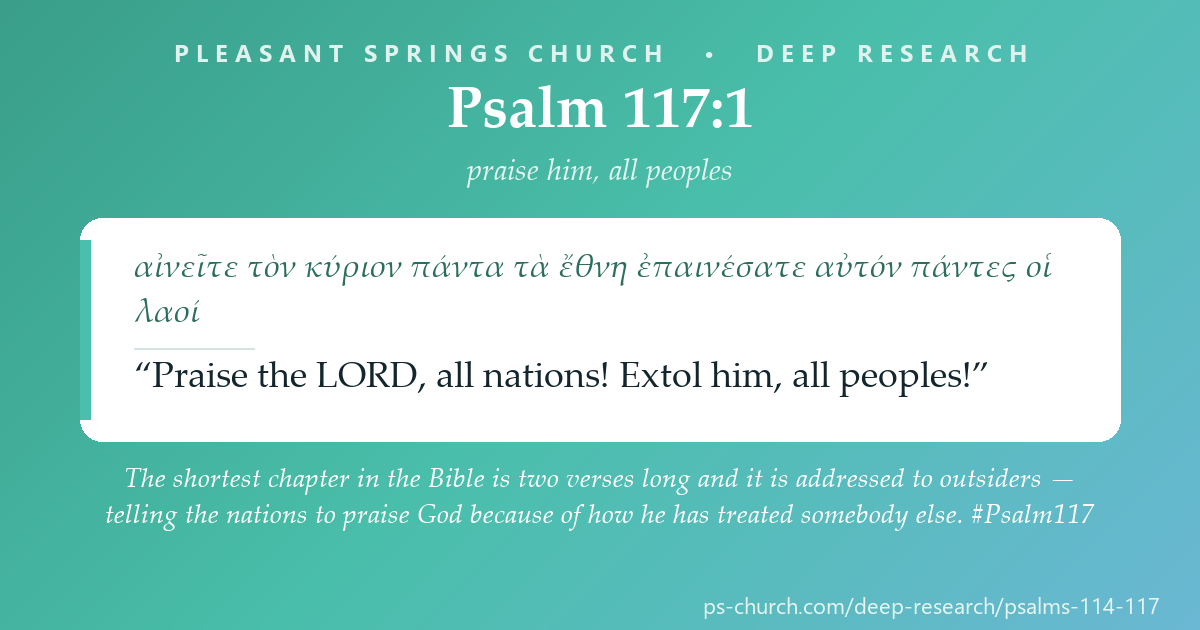
“All the peoples.” The shortest chapter in the Bible is addressed to outsiders — two verses telling the nations to praise Israel’s God, on the grounds of his loyalty to Israel. The logic is unexpected: you should praise him because of how he has treated us. Paul quotes this verse in Romans 15:11 in exactly that argument.
Counted here, not assumed:
- The arithmetic holds in all three places. Hebrew 114 (8 verses) + 115 (18) = 26 = Greek 113. Hebrew 116 (19) = Greek 114 (9) + Greek 115 (10 slots). Hebrew 117 (2) = Greek 116 (2). Nothing added, nothing lost — only divided differently. And the merge leaves two positive traces. Every Greek chapter from 110 to 118 opens with αλληλουια as its first word — except that Rahlfs 113:9, which is where Hebrew Psalm 115 begins, does not. In the Greek it is not the start of a psalm.
⚠️ And the Hebrew layout agrees with the Greek here, and only here. This Hebrew text closes 144 of its 150 psalms with a section marker on the last verse. Six carry none — Psalms 41, 72, 89, 106, 150 and Psalm 114. Five of the six are book boundaries. Psalm 114 is the one that is not — and it is exactly the psalm the Greek runs straight on into the next. The reverse does not hold: where the Greek splits Psalm 116, the Hebrew carries a marker only at verse 19, the psalm’s end, and nothing at verse 9 where the Greek divides. Of the four places in the Psalter where the two numbering systems disagree about where a psalm ends, this is the only one where the Hebrew layout and the Greek division point the same way. The page reports the agreement and draws nothing from it. - Rahlfs prints no Psalm 115:5. Verified directly: the verses present are 1, 2, 3, 4, 6, 7, 8, 9, 10 — nine verses over ten numbered slots, and the only gap in the whole Greek Psalter.
- Hebrew 116:14 and 116:18 are identical strings — every consonant, vowel and accent. Checked by direct comparison, not by eye.
- Rahlfs’ 115:8 carries one clause where Hebrew 116:17 has two, and the missing clause — and I will call on the name of the Lord — is present in the Greek at 115:4, where the Hebrew also has it (116:13). Both repetitions in this psalm are carried once.
- The offset comes out unchanged. One merge and one split, and the Greek is one behind on both sides of the stretch.
- Psalm 114 is the only psalm away from the book divisions lacking the closing paragraph mark — at the very seam the Greek declines to divide. 144 of the 150 psalms carry that mark.
A hymn in an upper room, and two verses Paul needed.
Read Psalm 117 and then Romans 15:8–12. Paul is building a case and this is one of his bricks.
Which cross-references matter?
- Psalm 117:1 → Romans 15:11. Paul stacks four Old Testament texts to prove that Gentiles were always meant to praise God, and this is the third. He quotes the Greek, and the two-verse psalm is doing real work in his argument.
- Psalm 116:10 → 2 Corinthians 4:13. I believed, and so I spoke. Paul follows the Greek here, where the Hebrew is more difficult; the verse is his warrant for preaching under affliction.
- Matthew 26:30 / Mark 14:26. When they had sung a hymn… On the standard reconstruction this is the Hallel, which would put Psalms 115–118 on Jesus’ lips hours before the arrest. The Gospels do not identify it; the inference is strong and it is an inference.
- Psalm 115:4–8 beside Psalm 135:15–18. Nearly the same lines. The Psalter makes this argument twice.
- Exodus 14:21 and Joshua 3:16 → Psalm 114:3. The sea and the Jordan in one line. Two generations apart, treated as one act.
- Psalm 116:13 and the Passover cups. I will lift up the cup of salvation. The psalm sits in the Passover liturgy and mentions a cup; readers have long connected it with the meal. Stated, and nothing built on it here.
Where the discussion is, and four open questions.
Hossfeld and Zenger cover this stretch; NETS for the Greek.
Commentaries & studies:
- Hossfeld and Zenger, Psalms 3 (Hermeneia) — on Psalms 101–150, so it covers all four.
- John Goldingay, Psalms 90–150 — on the Hebrew, and careful about 116.
- Robert Alter, The Book of Psalms — on Psalm 114’s wit.
- NETS Psalms — for the numbering and the gap as printed.
Four things reported as unsettled:
- Why Greek Psalm 115 has no verse 5. The mechanism is clear — a line the Hebrew prints twice appears once. Whether the Greek translator’s Hebrew scroll lacked it, or a copyist’s eye skipped between identical lines, cannot be determined.
- Whether the merge or the division is earlier at 114/115. The Greek joins; the Hebrew divides but withholds its usual closing mark. The convergence is real; its direction is not recoverable.
- Whether the Greek found or made the split in Psalm 116. The cut falls on a genuine hinge in the poem, which is consistent with either.
- Whether the Hallel is the hymn of Matthew 26:30. Widely assumed, nowhere stated.
A missing verse number, and a two-verse psalm aimed at outsiders.
Name what you learned, why it matters, and one concrete response.
What should we carry away — and do?
- Chapter and verse numbers are navigation, not revelation. Four psalms here, four there, and every seam in a different place — plus a verse number the Greek Psalter simply does not use. The text is older than the numbers, and the numbers disagree without the text disagreeing.
- The repetition in Psalm 116 is the point of the psalm. I will pay my vows to the Lord in the presence of all his people — said twice, identically. A man rescued from death says the same sentence twice because he means to be held to it.
- The idol satire ends by turning on the reader. Not idols are useless but those who make them become like them. You come to resemble what you worship — which is a warning to worshippers of anything, and Psalm 115 aims it at people who thought they were safe.
- One concrete response. Psalm 117 takes two verses to tell the nations to praise God, and the reason it gives is his steadfast love toward us. Tell someone outside the family what God has done inside it. That is the entire psalm.
Psalm 117 · to share
Hebrew + Greek (Rahlfs) + ESVEvery Deep Research page traces its passage across the whole sweep — the Old Testament, the Second-Temple world between the testaments (historical witnesses, not Scripture), and the New Testament. Follow the thread:
Pleasant Springs Church — Deep Research
Research method after Michael S. Heiser’s Bible Research Method (examine dictionaries → ancient literature → important words → textual connections → academic publications → share), with the Pleasant Springs “Author & Audience” foundation. Scripture set in the Hebrew, the Greek editions named on each page and the ESV (Old Testament), and the Greek New Testament and the ESV (New Testament), per the practice of Pleasant Springs Church. Psalms 114–117 research grounded in Hossfeld and Zenger (Psalms 3, Hermeneia — which does cover 101–150), Goldingay and Alter. Text: Hebrew from the Masoretic text as printed in the editions consulted — Sefaria’s Miqra according to the Masorah; no critical apparatus was consulted for the Hebrew. Greek from Rahlfs’ Greek Psalter (CATSS digitization of Rahlfs 1931). The standing caution for this shelf applies: the asterisk method used in this library’s Job studies is unavailable in the Psalms, so these pages say “Rahlfs’ Greek Psalter reads…” and never call a Greek reading early or late. ⚠️ Everything numerical on this page was computed rather than repeated. The three mappings were checked by verse arithmetic (8+18=26; 19=9+10; 2=2). The absence of Rahlfs 115:5 was verified by listing the populated verse slots — 1, 2, 3, 4, 6, 7, 8, 9, 10 — and Hebrew 116:14 and 116:18 were compared as strings and are identical including cantillation. A second shortfall in the same psalm was verified and is reported here for the first time on this site: Rahlfs’ 115:8 carries only σοι θύσω θυσίαν αἰνέσεωσ where Hebrew 116:17 has a second colon, and I will call on the name of the Lord — a colon the Hebrew also carries at 116:13 and which the Greek does have at its 115:4. So both of Psalm 116’s repeated lines are represented once in the Greek, though not by a uniform rule (the surviving copy is the first occurrence in one case, the second in the other). The cause is explicitly declined: a shorter Hebrew Vorlage and a copyist’s eye skipping between identical lines would leave the same trace, and no published apparatus for the Greek Psalter permits adjudication. The gap is reported only as it stands in the Greek Psalter held here. No second critical edition of the Greek Psalter is on disk, so this page makes no claim about what any other edition prints. The paragraph-marker observation is stated with its control: Psalm 114 is the only psalm away from the book-ending positions lacking the closing mark, which 144 of 150 psalms carry — a genuine convergence with the Greek merge, and explicitly contrasted with Psalms 9–10, where no such agreement exists. Lōʿēz is noted as a biblical hapax. The identification of the Hallel with the hymn of Matthew 26:30 is labelled an inference the Gospels do not make. Typology is handled per the house position: what the text says, what the New Testament itself draws, and what we see from this side of the cross — with the seeing left to the reader.
Scripture quotations marked ESV are from the ESV® Bible (The Holy Bible, English Standard Version®), © 2001 by Crossway, a publishing ministry of Good News Publishers. ESV Text Edition: 2016. Used by permission. All rights reserved. The ESV text may not be quoted in any publication made available to the public by a Creative Commons license, and the ESV may not be translated in whole or in part into any other language. www.esv.org
|
Did this study bless you today? 💚 Give to Support PS Church100% of gifts go to the General Fund — thank you. |