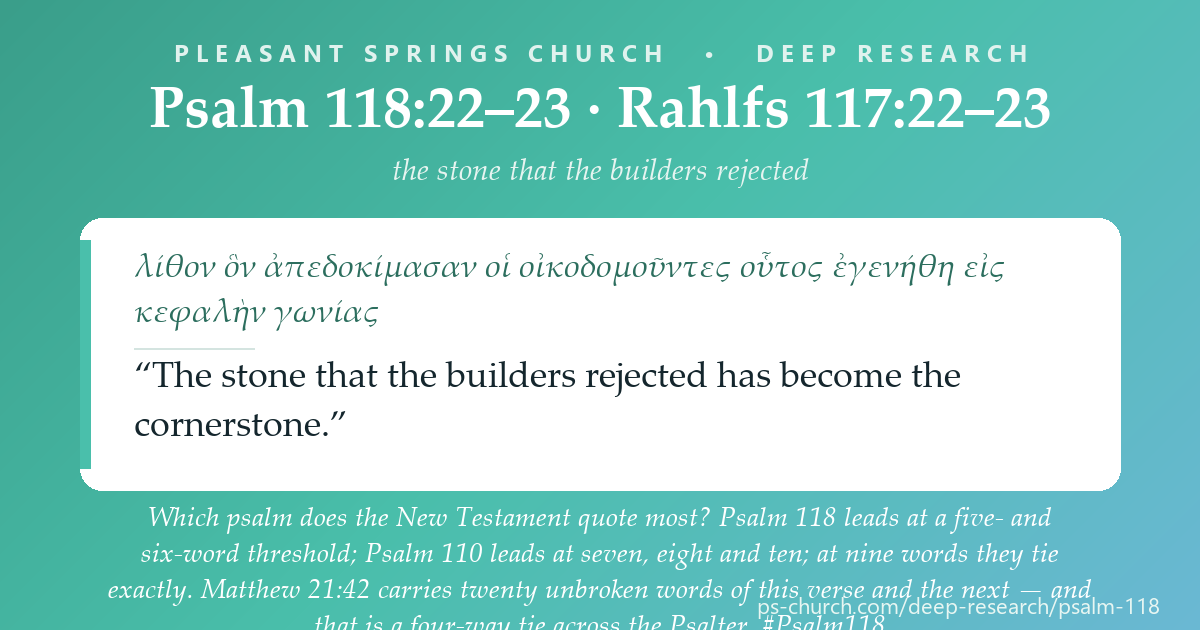
Which psalm does the New Testament quote most? The answer flips depending on how long a shared run you insist on. Sweeping every psalm of the Greek Psalter against all 7,927 verses of the Greek New Testament: at a five-word and a six-word threshold Psalm 118 leads; at seven, eight and ten Psalm 110 leads; and at nine words they are exactly level, six verses each. The psalm that tops the five-word table is neither of them — it is Psalm 84, and all nineteen of its hits are one liturgical formula, twelve of them in Revelation. Psalm 118's eleven verses fall in six books and include all four Gospels; Psalm 110's ten fall in five and do not include John. Along the way: the twenty-word run in Matthew 21 that turns out to be a four-way tie, why Hosanna did not come through the Greek psalm, and why the middle-chapter-of-the-Bible claim is off. See the method →
Psalm 118
Hebrew · Greek (Rahlfs’ Psalter) · ESVEvery psalm of Rahlfs’ Greek Psalter was swept against all 7,927 verses of the SBL edition, and for each threshold L the count is the number of New Testament verses sharing an unbroken run of at least L words:
• L = 5 — Rahlfs 83 (our Psalm 84) 19 · Rahlfs 117 (our Psalm 118) 11 · Rahlfs 109 (our Psalm 110) 10
• L = 6 — Psalm 118 — 11 · Psalm 110 — 10
• L = 7 — Psalm 110 — 9 · Psalm 118 — 6
• L = 8 — Psalm 110 — 9 · Psalm 118 — 6
• L = 9 — Psalm 110 — 6 · Psalm 118 — 6. A dead tie.
• L = 10 — Psalm 110 — 6 · Psalm 118 — 4
Psalm 118 leads at five and six. Psalm 110 leads at seven, eight and ten. At nine they are level.
⚠️ And the psalm that tops the L = 5 table is an artefact. All nineteen of Rahlfs 83’s hits are the same liturgical formula — εἰς τοὺς αἰῶνας τῶν αἰώνων, twelve of them in Revelation alone — plus one coincidental five-word string in John 20:28. Nothing there is a quotation of Psalm 84. Set formulaic runs aside and Psalm 118 leads at five.
⚠️ The two psalms are also spread differently. At five words, Psalm 118’s eleven New Testament verses fall in six books — Matthew, Mark, Luke, John, Hebrews and 1 Peter. Psalm 110’s ten fall in five — Matthew, Mark, Luke, Acts and Hebrews. Psalm 118 is the one all four Gospels carry.
⚠️ What this page does with that. It does not crown either psalm. The honest statement is that most quoted is not a property of a psalm but of a psalm and a threshold together, and that anyone who states the superlative without stating the bar has hidden a choice. Every figure above is a count of New Testament verses, not of citations: a quotation running across two verses is counted twice, and this page says so rather than presenting the counts as passages. The runs were measured under one normalisation applied to both sides — accents stripped, final sigma folded, movable nu and elision resolved.
The Shape of the Passage
Structure — a frame that is real, and a chiasm that is not⚠️ The chiasm is not real. Psalm 118 is often set out as a mirror with verse 22 or verse 14 at the centre. Scored by shared distinctive vocabulary against size-matched reshuffles of the psalm’s own verses, a concentric reading fails at every centre tested. No mirror is drawn here.
⚠️ What holds the psalm together instead is repetition you can hear. The refrain for his steadfast love endures forever closes each of the first four verses and the last. It occurs 41 times in the Hebrew Bible, and five of the 41 are in this psalm.
An orthographic trap worth recording: a naive consonantal search for the opening formula misses Psalm 107:1, which alone in the Hebrew Bible spells the first word without its usual vowel letter. Any count of this formula that does not state its spelling rule will be off by one.
No Hebrew heading; Rahlfs 117:1 opens with one word that has no Hebrew counterpart here. Psalm 118 is 198 Hebrew words in 29 verses, and the English and Hebrew verse numbers agree throughout.
Author
Anonymous, and speaking as one man in a crowd. Out of my distress I called on the Lord… all nations surrounded me. The psalm moves between a congregation that answers in chorus and a single voice that nearly died.
It uses the short form of the divine name more than any other chapter in the Bible. Six occurrences of the bare two-letter name, at verses 5 twice, 14, 17, 18 and 19. Counted as an exact consonantal form, standing alone rather than inside hallelujah.
And it is typographically plain. No Selah, no acrostic, no ketiv/qere, no special letter-forms and no inverted nun.
Two verses of it are the same verse. Verse 1 and verse 29, identical down to the accents. In the Greek the two differ by a single word, because Rahlfs puts hallelujah at the head of the psalm and not at the foot.
Audience
Three groups, called by name. Let Israel say… let the house of Aaron say… let those who fear the Lord say. The psalm writes the congregation’s line into the text three times over.
People at a gate. Open to me the gates of righteousness, that I may enter through them and give thanks to the Lord.
People carrying branches. Bind the festal sacrifice with cords, up to the horns of the altar. Where the Hebrew has that line, Rahlfs 117:27 has συστήσασθε ἑορτὴν ἐν τοῖς πυκάζουσιν — hold a feast among the leafy ones. The page reports both and adjudicates neither.
And, centuries later, a crowd on a road. Save us, we pray, O Lord! Blessed is he who comes in the name of the Lord. Two consecutive verses of this psalm, and all four Gospels carry the second of them.
Orient on the Hallel, on the rejected stone, and on Hosanna.
Search by topic: Egyptian Hallel; Hosanna; cornerstone; entrance liturgy; thanksgiving psalm.
Which articles are relevant?
- Anchor Bible Dictionary — “Hallel,” “Hosanna,” “Cornerstone,” “Entrance Liturgies.”
- Dictionary of the OT: Wisdom, Poetry & Writings (IVP) — “Thanksgiving,” “Liturgy,” “Book of Psalms V.”
- NIDOTTE / TDOT — אֶ֭בֶן (ʾeḇen, stone), הוֹשִׁ֘יעָ֥ה (hōšîʿāh, save), יָּ֑הּ (yāh).
- On the Greek — the NETS Psalms introduction, with Rahlfs 117:22–26 read beside the Gospel citations rather than an English psalm beside an English Gospel.
- On Hosanna — any treatment that notes the Gospels transliterate the Hebrew rather than following the Greek psalm, which translates it.
Bibliography surfaced:
- John Goldingay, Psalms 90–150; Robert Alter, The Book of Psalms.
- Frank-Lothar Hossfeld and Erich Zenger, Psalms 3 (Hermeneia).
- Albert Pietersma, NETS Psalms — for the Greek as printed.
A verse shared three ways — and shared differently in Hebrew and in Greek — a word the Gospels did not take from the Greek, and three claims that fail.
Every overlap below was measured in the language stated. The Greek of Exodus and of Isaiah arrived on this shelf after the page was first written, so the overlap below is now measured in BOTH languages — and they do not agree.
Which parallels shed light on this psalm?
Psalm 118:14 is not a quotation of Exodus 15:2. It is an overlap — and it is not the tidy three-way one this page used to print.
In Hebrew, the run is six words with Exodus and three with Isaiah. Exodus 15:2 and Psalm 118:14 carry the same six consonantal words in the same order — my strength and my song is Yah, and he has become my salvation. Isaiah 12:2 carries the clause too, but with the double divine name יָּה יְהֹוָה standing inside it, so its longest unbroken run with the psalm is three words, not six — my strength and my song is Yah, then the extra name, then the rest. Identical under the qere and under the ketiv — the added name is not a ketiv/qere matter.
In Greek the ranking inverts, and the word that breaks the Hebrew run is the word that makes the Greek one. Greek Isaiah collapses the double name to a single κύριος, and that word opens a six-word unbroken run shared with the Greek psalm: κύριος καὶ ἐγένετό μοι εἰς σωτηρίαν (Rahlfs 117:14 · Isaiah 12:2). Greek Exodus 15:2 reaches only four — ἐγένετό μοι εἰς σωτηρίαν — because it does not render my strength and my song at all. It reads βοηθὸς καὶ σκεπαστής, a helper and a protector, where the psalm reads ἰσχύς μου καὶ ὕμνησίς μου.
And the Greek six is unique. Screened against all 30,348 Greek Old Testament verse units this shelf screens, Rahlfs 117:14’s deepest contact anywhere is six words and the tie band is one: Isaiah 12:2, and nothing else. ⚠️ THE FOUR-WORD COUNT IN THIS NOTE HAS MOVED FROM FOUR TO THREE, AND THE PAGE PRINTS BOTH. It read: “The four-word tail stands in four places: Exodus 15:2, Isaiah 12:2, Rahlfs 117:14, and Odes 1:2 — the last being the Song of Moses copied out as the first Ode, which is Exodus 15 again. Odes is a witness, not Scripture, and it is named here only so the count of four is not mistaken for four independent places.” The caveat was correct and the shelf has now acted on it rather than carrying it as a footnote. On 2026-08-30 the Odes were taken out of the screening corpus — they remain on disk — because ten of the fourteen canticles are second copies of passages already in the corpus, of which Ode 1 is Exodus 15, and two are New Testament text. So the four-word tail stands in THREE places in the 30,348 rows screened — Exodus 15:2, Isaiah 12:2 and Rahlfs 117:14 — and in a fourth row on the disk, which is Exodus 15:2 written out a second time. The six-word figure and its tie band of one are unaffected: Ode 1:2 never reached six, and Isaiah 12:2 was and remains the sole partner at that depth.
Printed until 30 August 2026: “The same six Hebrew words… stand at Exodus 15:2, at Isaiah 12:2 and here,” with the note “Tested in Hebrew only. The Greek of Exodus and of Isaiah is not held by this library, so this page says nothing about how either reads.”
Two things were wrong, and only one of them was the corpus’s fault. The Greek gap was real and has closed — Greek Isaiah arrived 19 August 2026 and Greek Exodus on 30 August 2026, taking this shelf from 44 CATSS files (23,061 verse units) to 64 files, 30,637 verse units on disk and 30,348 screened. But the Hebrew claim was never right: Isaiah 12:2 does not carry the same six words in an unbroken row, and running the measurement rather than repeating the commonplace is what showed it. The page had asserted a symmetry it had measured on only one of the three sides.
What replaces it. Hebrew: six with Exodus, three with Isaiah. Greek: six with Isaiah at a tie band of one, four with Exodus. The two languages rank the two parallels in opposite orders, and the reason is a single divine name that the Hebrew adds and the Greek absorbs. Calling any one of the three the source is still a decision, not a measurement — but the decision now has to answer to two witnesses that disagree.
And Hosanna does not come through the Greek psalm. The Hebrew of 118:25 is הוֹשִׁ֘יעָ֥ה נָּ֑א, and the Gospels write it as a Greek transliteration of those Hebrew sounds. Rahlfs 117:25 does not transliterate. It translates — σῶσον δή. So whatever route the word took into the Gospels, it was not this Greek verse.
- Exodus 15:2 → Psalm 118:14. Six identical Hebrew words — and only four in Greek.
- Isaiah 12:2 → Psalm 118:14. Three Hebrew words (the double divine name breaks the row) — but six in Greek, tie band one.
- Psalm 118:22–23 → Matthew 21:42. Twenty unbroken Greek words.
- Psalm 118:6 → Hebrews 13:6. Nine words — and not Psalm 56:11, where the margins often send it.
- Psalm 118:1 → Psalms 106:1, 107:1, 136:1. The hodu formula, with the Psalm 107 spelling trap.
“Psalm 118 is the middle chapter of the Bible, with 594 chapters either side.” It is chapter 596 of 1,189. The arithmetic that makes it the centre does not work on any chapter count this library can reproduce.
“Psalm 118:8 is the middle verse of the Bible.” On the scope measurable here it is verse 15,938 of 31,133. Not the middle.
“All four Gospels quote the rejected stone.” All four Gospels do quote Psalm 118 — but John touches only verse 26. The stone saying is in Matthew, Mark and Luke, and not in John. And Acts 4:11, which everyone reads as the same citation, shares only three words with the Greek psalm — it is a restatement, not a reproduction.
A stone, a shout, a short name, and a verb that goes the other way.
Every count below was run on this library’s own texts and is stated with its scope, so a reader can repeat it and get the same number or show that it is wrong.
“Stone.” The Greek of this verse is ten words, and Matthew, Mark and Luke each reproduce all ten. 1 Peter 2:7 reproduces nine of them. Acts 4:11 is usually listed with those four and does not belong there on this measure: it shares three words with the Greek psalm and restates the rest.
“Save!” With the particle after it, this is the Hebrew behind Hosanna. Rahlfs 117:25 renders it into Greek rather than carrying it across as a sound. The Gospels carry it across as a sound.
“Yah.” The short form of the divine name, standing alone. Psalm 118 carries six of them — more than any other chapter in the Hebrew Bible. At 118:5 the Hebrew uses it twice and Rahlfs 117:5 names the Lord once.
“They were extinguished.” Where the Hebrew says the fire among thorns went out, Rahlfs 117:12 has ἐξεκαύθησαν, they were kindled. The two verbs point opposite ways, and this page reports both and adjudicates neither.
“Blessed is he who comes.” With the three words after it, this six-word run stands in Matthew 21:9, Matthew 23:39, Mark 11:9, Luke 13:35 and John 12:13. Luke 19:38 is the measured exception: it carries the words in a different arrangement and the unbroken run there is three, not six.
The rule. Every psalm of the Greek Psalter, taken as one token stream, against all 7,927 verses of the SBL edition. For each threshold L, count the New Testament verses that share an unbroken run of at least L tokens. One normalisation both sides: accents stripped by Unicode decomposition, final sigma folded, movable nu resolved before accent-stripping, elision resolved.
The result. L=5: Ps 84 — 19, Ps 118 — 11, Ps 110 — 10. L=6: 118 — 11, 110 — 10. L=7: 110 — 9, 118 — 6. L=8: 110 — 9, 118 — 6. L=9: 110 — 6, 118 — 6. L=10: 110 — 6, 118 — 4.
The disqualification. Psalm 84’s nineteen are one doxological formula — twelve of them in Revelation — plus one coincidence at John 20:28. None is a quotation of Psalm 84.
The longest single run in the book, and why it is not a Psalm 118 record. Matthew 21:42 carries twenty unbroken words of Rahlfs 117:22–23. Sweeping the whole Psalter at L = 20 returns four psalms, not one: Psalm 2 at Acts 4:26, Psalm 16 at Acts 2:26, Psalm 45 at Hebrews 1:9, and Psalm 118 at Matthew 21:42. A four-way tie.
What the page does not claim. No null test applies — this is a census of the whole Greek Psalter against the whole Greek New Testament, not a sample. And the counts are of verses, not of citations: a quotation spanning two New Testament verses is counted twice.
Eleven New Testament verses in six books, and the ones that do not belong on the list.
Runs are longest unbroken sequences of tokens measured on the SBL edition against the CATSS text, under one normalisation applied to both sides.
Where does the New Testament take up this psalm?
In six books, and all four Gospels are among them. At a five-word threshold, eleven New Testament verses reach Psalm 118: three in Matthew, three in Mark, two in Luke, one in John, one in Hebrews and one in 1 Peter.
Everything the New Testament reaches for is in nine verses of the psalm. Verses 22, 23, 25 and 26 carry all of it, and verse 6 carries the Hebrews citation.
And two familiar entries do not survive measurement. Acts 4:11 shares three words with the Greek of 118:22 and restates the rest in its own words. Luke 19:38 carries the blessing of 118:26 rearranged, so its unbroken run is three rather than six.
- Psalm 118:22–23 → Matthew 21:42. 20 words. Both verses, back to back, unbroken.
- Psalm 118:22 → Mark 12:10 · Luke 20:17. 10 words each. And Mark 12:11 is verse 23 entire, and nothing else.
- Psalm 118:22 → 1 Peter 2:7. 9 words — one short of the whole verse.
- Psalm 118:26 → Matthew 21:9 · 23:39 · Mark 11:9 · Luke 13:35 · John 12:13. 6 words each.
- Psalm 118:6 → Hebrews 13:6. 9 words. Not Psalm 56:11.
- Psalm 118:22 → Acts 4:11. 3 words. A restatement, not a reproduction.
- Psalm 118:26 → Luke 19:38. 3 words. The one Gospel blessing that is rearranged.
- Psalm 118:22 → Romans 9:33 · Ephesians 2:20 · 1 Peter 2:6. Traps. These route through Isaiah, not this psalm.
What is settled, what is contested, and what this page refuses to decide.
What is the state of the discussion?
Settled: that Psalm 118 is among the two or three psalms the New Testament reaches for most. Which of them is first is not settled, because it depends on a threshold nobody states.
Settled: that Hebrews 13:6 quotes this psalm and not Psalm 56. Nine words against a margin’s worth of habit.
Contested, and left contested: the direction of the overlap at 118:14 between this psalm, Exodus 15 and Isaiah 12. Three texts carry the same six words; which came first is not a question a word-count can answer.
Not verified here, and flagged as such: the identity of the hymn sung at the Last Supper, and the exact composition of the Egyptian Hallel. Both are questions about liturgical practice rather than about the text, and this library holds no source that settles either. The page does not repeat the usual assertion.
- Hossfeld and Zenger, Psalms 3 (Hermeneia) — on Psalm 118 and the Hallel.
- Goldingay, Psalms 90–150 — on the entrance liturgy.
- The NETS Psalms volume — for 117:12, 117:27 and 117:28 read as translation.
Where this lands.
What is worth carrying out of Psalm 118?
Superlatives hide a choice. Ask which psalm the New Testament quotes most and the answer is Psalm 118 or Psalm 110 depending on where you set the bar — and at nine words they are exactly level. The number was never the point; the threshold was.
The psalm ends where it started. Verse 29 is verse 1 again, character for character. Everything in between — the nations, the bees, the gate, the stone — is bracketed by one sentence about steadfast love.
One concrete response. Read verses 22 to 26 aloud and notice how much of it you already know by heart from somewhere else. Five verses of one psalm carry almost everything the New Testament took from it.
Every Deep Research page traces its passage across the whole sweep — the Old Testament, the Second-Temple world between the testaments (historical witnesses, not Scripture), and the New Testament. Follow the thread:
Pleasant Springs Church — Deep Research
Research method after Michael S. Heiser’s Bible Research Method (examine dictionaries → ancient literature → important words → textual connections → academic publications → share), with the Pleasant Springs “Author & Audience” foundation. Scripture set in the Hebrew, the Greek editions named on each page and the ESV (Old Testament), and the Greek New Testament and the ESV (New Testament), per the practice of Pleasant Springs Church. Psalm 118 research grounded in Goldingay (Psalms 90–150), Hossfeld and Zenger (Psalms 3), Pietersma (NETS) and Alter. Text: Hebrew from the Masoretic text as printed in the editions consulted — Sefaria’s Miqra according to the Masorah; no critical apparatus was consulted for the Hebrew, and this psalm carries no ketiv/qere, no Selah and no special letter-forms. Greek from Rahlfs’ Greek Psalter (CATSS digitization); Greek New Testament from the SBL edition. The standing caution for this shelf applies: these pages say “Rahlfs’ Greek Psalter reads…” and never call a Greek reading early or late. ⚠️ The threshold table, stated so it can be repeated. Each of the 151 Greek psalms was taken as a single token stream and compared against all 7,927 SBLGNT verses; for each threshold L the figure is the number of NT verses sharing an unbroken run of at least L tokens. One normalisation applied to both sides: the MorphGNT movable-nu marker resolved first, then accents stripped by Unicode decomposition, final sigma folded, apostrophes stripped and elision resolved. Results — L=5: Ra 83 (MT 84) 19, Ra 117 (MT 118) 11, Ra 109 (MT 110) 10. L=6: 117 = 11, 109 = 10. L=7: 109 = 9, 117 = 6. L=8: 109 = 9, 117 = 6. L=9: 109 = 6, 117 = 6. L=10: 109 = 6, 117 = 4. At L=20 exactly four psalms register at all: Ra 2, Ra 15, Ra 44 and Ra 117. These are counts of New Testament verses, not of citations — a quotation spanning two verses counts twice — and no significance test applies, because this is a census rather than a sample. ⚠️ Why the L=5 leader is set aside. All nineteen of Rahlfs 83's hits are the formula εἰς τοὺς αἰῶνας τῶν αἰώνων (Rev ×12, Gal 1:5, Php 4:20, 1 Tim 1:17, 2 Tim 4:18, 1 Pet 4:11, 1 Pet 5:11) plus a coincidental string in John 20:28. The page names the psalm and the reason rather than quietly dropping it from the table. ⚠️ Hebrew word counts on this page split on whitespace and maqqef, exclude Masoretic section markers, count a ketiv/qere pair once, and require a token to carry at least one Hebrew letter. That rule reproduces a Psalter total of exactly 19,586 words and 2,527 verses. Psalm 118 = 198 words in 29 verses; verses 1 and 29 are byte-identical after cleaning, cantillation included. ⚠️ Absolute negatives are scoped. Hebrew claims are scoped to the thirty-nine book corpus in Sefaria’s MAM and to the spelling counted — an orthographic note the page prints, because a naive search for this psalm’s opening formula misses Psalm 107:1. Greek Old Testament claims are scoped to the CATSS files held here, which as of 30 August 2026 is 64 files — 30,637 verse units on disk, 30,348 of them screened — Greek Isaiah arrived 19 August 2026 and Greek Exodus, Leviticus, Numbers, Joshua and the deuterocanon on 30 August 2026. ⚠️ The 289-row gap between held and screened is the Odes, taken out of the screening corpus on 2026-08-30 while staying on the disk: two of the fourteen canticles are New Testament text (Ode 9 is Luke 1, Ode 13 is Luke 2) and ten are second copies of passages already in the corpus — among them Ode 1, which is Exodus 15, the very passage this page counts. Every Greek count on this page is a screened count and says so. The 118:14 overlap was reported as a Hebrew result only until that date and is now measured in both languages, which is what showed that the Hebrew and the Greek rank the two parallels in opposite orders — and that the page’s old “same six Hebrew words in three places” was wrong about Isaiah. Deuterocanonical files (Odes, Sirach, Judith, Maccabees and the rest) are measurement witnesses, not Scripture, and are labelled so wherever a hit lands in one. ⚠️ What was not verified. The identity of the hymn sung at the Last Supper and the composition of the Egyptian Hallel — both left unasserted. No Qumran manuscript, no Cairo Geniza fragment, no Syriac, no Vulgate or Gallican Psalter, no Aquila, Symmachus or Theodotion, and no critical apparatus for any text compared. Verse counts verified in all three columns (Hebrew 29, Rahlfs 29, ESV 29 — the English offset for this psalm is zero). Typology is handled per the house position: what the text says, what the New Testament itself draws, and what we see from this side of the cross — with the seeing left to the reader.
Scripture quotations marked ESV are from the ESV® Bible (The Holy Bible, English Standard Version®), © 2001 by Crossway, a publishing ministry of Good News Publishers. ESV Text Edition: 2016. Used by permission. All rights reserved. The ESV text may not be quoted in any publication made available to the public by a Creative Commons license, and the ESV may not be translated in whole or in part into any other language. www.esv.org
|
Did this study bless you today? 💚 Give to Support PS Church100% of gifts go to the General Fund — thank you. |