The longest chapter in the Bible is built on a machine. Twenty-two stanzas, one for each letter of the Hebrew alphabet; eight verses in every stanza; and every one of those eight verses begins with that stanza's letter. Twenty-two times eight is a hundred and seventy-six — exactly the number of verses. And it is executed perfectly: checked here letter by letter across all 176 verses, there is not one exception, which is worth saying plainly, because the Psalter's other acrostics do slip. Running inside that machine is a second one: eight different words for what God has said, worked through the whole poem in strikingly even measure — and the most frequent of them is not law but testimonies. An acrostic cannot survive translation, so the Greek tradition did the next best thing: Rahlfs prints all twenty-two Hebrew letter names at the stanza heads — and does this for no other psalm in the book. This is part 1 of 6, covering aleph through daleth. See the method →
Psalm 119:1–32 (selections)
Hebrew · Greek (Rahlfs’ Psalter) · ESV⚠️ And it is executed perfectly. Checked here letter by letter across all 176 verses: there is not a single exception. That is worth stating flatly, because this library’s other acrostic pages report the opposite — Psalms 9–10 collapses for ten verses in the middle, and Psalm 145 is missing a letter altogether. Psalm 119 does not slip once.
There is a second machine running inside the first. The psalm has a set of words for God’s instruction — conventionally eight of them: law, testimonies, precepts, statutes, commandments, judgements, word and saying — and it works them through the whole poem. Counted here, they are strikingly even: testimonies 29, law 25, word 25, statutes 23, judgements 23, commandments 22, precepts 21, saying 20. No single term dominates. The psalm is deliberately refusing to settle on one word for what God has said.
⚠️ The common claim that every verse contains one of the eight is very nearly true, and it is not true. Verified by direct search: exactly four verses contain none of them — 3, 37, 90 and 122. Two of those (3 and 37) use way instead, which is sometimes counted as a ninth term. Two verses — 90 and 122 — have no word for God’s instruction at all. Four out of a hundred and seventy-six is a remarkable achievement and it is not a hundred and seventy-six out of a hundred and seventy-six, and this page says so.
⚠️ And the Greek does something here it does nowhere else in the Psalter. An acrostic cannot survive translation — Greek has a different alphabet and different words. So Rahlfs’ Greek Psalter prints the Hebrew letter names, transliterated, at the head of every stanza: α# αλφ, β# βηθ, γ# γιμαλ, and on through all twenty-two. Verified across the whole book: this is the only psalm in Rahlfs so marked. Psalms 25, 34, 37, 111, 112 and 145 are acrostics too, and none of them carries a single letter name. The tradition could not reproduce the device, so it labelled it — and it did that here and only here.
The Shape of the Passage
SequenceWhich is a fair description of a life spent with a text rather than an essay about one. The constraint is the point: you do not get to stop when you run out of things to say, because there are still fourteen letters to go. The form obliges the poet to keep going past the natural end of his material — and what comes out on the far side of that obligation is some of the most-quoted material in the Psalter.
One thing to notice from the very first stanza. It begins in the third person, about those who walk blamelessly — and by verse 5 it has turned into I, and the third person never returns. The psalm describes the blessed man for four verses and then spends a hundred and seventy-one wishing it were him.
Psalm 119 is studied here in six parts, by stanza. This is part 1, covering aleph through daleth, and it carries the shared apparatus — the acrostic, the eight terms, and the Greek stanza headings — which the later parts refer back to rather than repeat.
Author
He set himself a task most poets would refuse. A hundred and seventy-six verses under a double constraint — the right letter, eight times running, twenty-two times over — and he does not miss once. Whoever wrote this had time and meant to spend it.
He will not settle on one word for what God has said. Eight terms, used a comparable number of times each, cycled through the whole poem. The effect is that no single word gets to be the word — law, word, promise, precepts, testimonies all say it, and none says it alone.
And he is in trouble. By the third stanza princes are plotting against him; by the fourth his soul clings to the dust. This is not a serene poem about loving Scripture. It is somebody holding on to a text while things go badly, for a hundred and seventy-six verses.
Audience
People memorising. An alphabet is a memory device, and eight verses per letter is a teaching unit. The psalm is shaped to be learned in pieces — which is exactly how this study takes it.
The young. How can a young man keep his way pure? is the psalm\u2019s only direct question of that kind, and it comes early. Somebody expected this to be taught to people at the start of their lives.
And people with no power. The speaker is a sojourner, plotted against by princes, clinging to the dust. What he has instead of standing is a text, and the psalm is a long demonstration of what that is worth.
Orient on torah piety, acrostics, and the vocabulary of instruction.
Search by topic: Psalm 119; torah piety; acrostic psalms; law in the Old Testament; wisdom and torah; the eight synonyms.
Which articles are relevant?
- Anchor Bible Dictionary — “Psalms, Book of,” “Acrostics,” “Law (OT),” “Torah.”
- Dictionary of the OT: Wisdom, Poetry & Writings (IVP) — “Psalm 119,” “Torah Psalms,” “Acrostic,” “Wisdom and Psalms.”
- NIDOTTE / TDOT — the eight terms themselves: תּוֹרָה, עֵדוּת, פִּקּוּדִים, חֻקִּים, מִצְוֺת, מִשְׁפָּטִים, דָּבָר, אִמְרָה. Read all eight before deciding they are synonyms.
- On the Greek — the NETS introduction to Psalms, and note how few Greek words carry the Hebrew’s eight.
Bibliography surfaced:
- Hossfeld and Zenger, Psalms 3 (Hermeneia) — covers Psalms 101–150.
- John Goldingay, Psalms 90–150; Robert Alter, The Book of Psalms.
- Kent Aaron Reynolds, Torah as Teacher: The Exemplary Torah Student in Psalm 119 — a monograph on this psalm alone.
What the form is for, and what the Greek did when it could not copy it.
The apparatus explained here applies to all six parts of this study.
Which parallels shed light on this psalm?
An acrostic claims completeness and aids memory. Both matter here. Praise or petition from the first letter to the last is a way of saying nothing has been left out — and eight verses per letter is a unit small enough to learn. Psalm 119 is the most elaborate example of the form in the Bible by a wide margin: the other acrostics give one verse per letter, or two.
It is a wisdom poem in the shape of a prayer. The vocabulary of the two ways, the blessed man, the contrast with the wicked — all of it belongs with Psalm 1, which this psalm opens by echoing. But Psalm 1 describes the blessed man from outside; Psalm 119 is spoken by somebody trying to become him.
And the eight terms are not eight synonyms. They overlap heavily, and they are not interchangeable: ʿēḏûṯ means testimony, something witnessed to; ḥōq is an engraved decree; dāḇār is simply a spoken word. The psalm is describing one thing from eight angles, which is a different claim from having eight names for it.
- Psalm 1 → Psalm 119:1–3. Blessed… who walk in the law of the Lord. Psalm 119 opens by restating the Psalter’s opening. See the Psalms 1–2 study.
- Psalms 19:7–11. The other great torah psalm, which uses six of the same terms in six consecutive lines. Psalm 119 is that passage extended to a hundred and seventy-six verses.
- Deuteronomy 6:6–9 → Psalm 119:11. These words shall be on your heart. The psalm is doing what Deuteronomy commanded, and says so with a verb for hiding treasure.
- Joshua 1:8 and Psalm 1:2. Meditate day and night. The verb is the same one used across Psalm 119 — and it means muttering aloud, not silent reflection.
An acrostic is untranslatable, and the Greek tradition knew it. You cannot carry twenty-two Hebrew initials into a language with a different alphabet and different words for everything.
So Rahlfs’ Greek Psalter does the next best thing: it names the letters. At the head of each stanza it prints an ordinal and a transliterated Hebrew letter name — α# αλφ at verse 1, β# βηθ at verse 9, γ# γιμαλ at 17, on through κβ# θαυ at verse 169. All twenty-two are there.
⚠️ And this happens in no other psalm. Verified by scanning the entire Greek Psalter for those letter names: they occur in this psalm and in no other. Psalms 25, 34, 37, 111, 112 and 145 are all acrostics in Hebrew, and Rahlfs marks none of them. The tradition was capable of flagging the device and chose to do it once.
Two things follow, and they pull in different directions. Somebody in the Greek tradition plainly knew this psalm was alphabetic and wanted readers to know. And equally plainly, that knowledge was not applied across the book — which is why this library’s Psalm 145 page can say that the Greek there gives no sign of tracking the alphabet, and can now say it as a measured observation rather than an assumption. The silence at 145 is a silence in a tradition that was demonstrably able to speak.
Eight words for one thing, and the one the psalm uses most.
Count the eight terms yourself in any stanza. The distribution is the finding.
“Blessed, happy.” The word the Psalter opens with — and Psalm 119 begins with it too, deliberately. Of the thirty-one occurrences in the Psalter, this is the one that starts the longest chapter in the Bible. See the Psalms 1–2 study, where the same word forms the envelope around the Psalter’s doorway. Rahlfs has μακάριοι.
“I have stored up, hidden away.” The verb is used of hoarding treasure and of hiding something valuable — not of memorising. The image is a man burying something where it cannot be taken from him. Rahlfs reads ἔκρυψα, I concealed, which keeps the sense exactly.
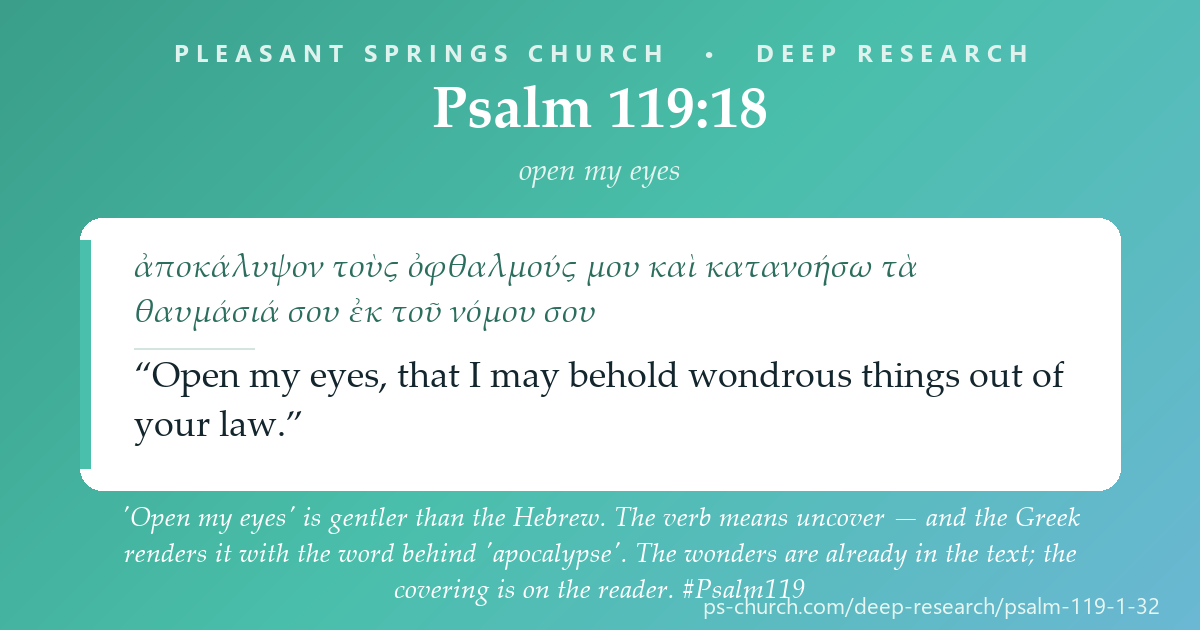
“Uncover, unveil” — an imperative, and a strong one; the root is used of stripping something bare. Not “open my eyes” so much as “take the covering off”, which assumes there is one. Rahlfs renders it ἀποκάλυψον — the verb behind the word apocalypse. The request is for a revelation, and the thing to be revealed is already in the text.
“Instruction, teaching” — from a root meaning to point, to direct. “Law” is a serviceable translation and a narrowing one: the word covers teaching of every kind, including a mother’s (Proverbs 1:8). Counted here, it occurs 25 times in the psalm — second most of the eight, and not by much. Rahlfs uses νόμος, law, which narrows it further.
“Testimony, witness.” Counted here, this is the psalm’s most frequent term — 29 occurrences, ahead of tōrāh. Which is worth noticing, since Psalm 119 is usually described as a psalm about the law. The word means something witnessed to, a formal deposition — God’s instruction as evidence given, not merely rules issued.
“Way” and “path.” The psalm opens on way and keeps returning to it, and at verses 3 and 37 it stands where one of the eight terms would be expected — which is why some count it a ninth. The last verse of this section is where the two ideas meet: I will run in the way of your commandments when you enlarge my heart.
Counted here, not assumed:
- 176 verses, 22 stanzas, 8 verses each — and the acrostic is flawless. Verified letter by letter across the whole psalm: zero exceptions. Compare Psalms 9–10 and Psalm 145, where the scheme fails.
- The eight terms, counted: testimonies 29, law 25, word 25, statutes 23, judgements 23, commandments 22, precepts 21, saying 20. The most frequent is testimonies, not law.
- Exactly four verses contain none of the eight — 3, 37, 90 and 122. Verses 3 and 37 use way instead; verses 90 and 122 have no term at all. The frequent claim that every verse has one is very nearly right and is not right.
- Rahlfs prints all 22 Hebrew letter names at the stanza heads — and does so in no other psalm in the Psalter. Verified across the whole book.
- The Greek Psalter numbers this psalm 118, one behind, as it has since Psalm 10. Both have 176 verses.
The Psalter's first verse, restated at its longest chapter.
Read Psalm 1:1–2 and then Psalm 119:1–2. The second is quoting the first.
Which cross-references matter?
- Psalm 1:1–2 → Psalm 119:1–3. Blessed… who walk… in the law of the Lord. The longest psalm opens by restating the first one — see the Psalms 1–2 study.
- Psalm 19:7–11 → the whole of Psalm 119. Six of the eight terms in five verses, with sweeter than honey. Psalm 119 will use that image too (verse 103).
- Deuteronomy 6:6 → Psalm 119:11. These words shall be on your heart. The psalm reports compliance, using a verb for hiding treasure.
- Psalm 119:18 and Luke 24:31–32, 45. Uncover my eyes. On the Emmaus road their eyes are opened and he opens the Scriptures to them — the psalm’s petition and its answer use the same two ideas together. Stated; the seeing is left to the reader.
- Psalm 119:32 and 2 Corinthians 6:11. You enlarge my heart / our heart is wide open. The same physical metaphor for freedom.
Where the discussion is, and three open questions.
Reynolds for the monograph treatment; Hossfeld and Zenger for the commentary.
Commentaries & studies:
- Kent Aaron Reynolds, Torah as Teacher — a full-length study of this psalm.
- Hossfeld and Zenger, Psalms 3 (Hermeneia); John Goldingay, Psalms 90–150.
- Robert Alter, The Book of Psalms — frank about what the constraint costs the poetry.
- NETS Psalms, with Rahlfs — for the Greek and the stanza headings.
Three things reported as unsettled:
- Whether the eight terms are meaningfully distinct. They overlap heavily and are not simply interchangeable. Whether the psalm intends eight distinct aspects or is varying its vocabulary for the form’s sake is argued, and cannot be settled from usage alone.
- When the psalm was written. Its torah piety is often placed late, but the argument is from content rather than from language, and that kind of dating is contested.
- Who supplied the Greek stanza headings, and when. That they are there is certain; that they go back to the original translator is not. Marginal apparatus can migrate into a text over time.
A hundred and seventy-six verses, and not one slip.
Name what you learned, why it matters, and one concrete response.
What should we carry away — and do?
- The form obliges the poet to keep going. Twenty-two letters, eight verses each — you cannot stop when you run out of things to say. Some of the most-quoted lines in the Psalter come from the far side of that obligation, which is an argument for structured practice over waiting to feel like it.
- The most frequent word is testimonies, not law. Counted, not assumed. The psalm is less about rules issued than about evidence given — something witnessed to, which asks to be believed as well as obeyed.
- The psalm turns to the first person in verse 5 and never turns back. It describes the blessed man for four verses and then spends a hundred and seventy-one wishing it were him. This is not a poem by somebody who has arrived.
- One concrete response. Verse 18 asks God to take the covering off his eyes so that he can see what is already in the text. Pray that before reading, rather than after failing to understand.
Psalm 119:18 · to share
Hebrew + Greek (Rahlfs) + ESVEvery Deep Research page traces its passage across the whole sweep — the Old Testament, the Second-Temple world between the testaments (historical witnesses, not Scripture), and the New Testament. Follow the thread:
Pleasant Springs Church — Deep Research
Research method after Michael S. Heiser’s Bible Research Method (examine dictionaries → ancient literature → important words → textual connections → academic publications → share), with the Pleasant Springs “Author & Audience” foundation. Scripture set in the Hebrew, the Greek editions named on each page and the ESV (Old Testament), and the Greek New Testament and the ESV (New Testament), per the practice of Pleasant Springs Church. Psalm 119 research grounded in Reynolds (Torah as Teacher), Hossfeld and Zenger (Psalms 3, Hermeneia), Goldingay and Alter. This is part 1 of a six-part study of the psalm, divided by stanza; the shared apparatus is set out here and referred to rather than repeated in parts 2–6. Text: Hebrew from the Masoretic text as printed in the editions consulted — Sefaria’s Miqra according to the Masorah; no critical apparatus was consulted for the Hebrew. Greek from Rahlfs’ Greek Psalter (CATSS digitization of Rahlfs 1931). The standing caution for this shelf applies: the asterisk method used in this library’s Job studies is unavailable in the Psalms, so these pages say “Rahlfs’ Greek Psalter reads…” and never call a Greek reading early or late. ⚠️ Three claims on this page were computed rather than repeated. (1) The acrostic was verified letter by letter across all 176 verses — 22 stanzas of 8, zero exceptions, which is stated as a deliberate contrast with Psalms 9–10 and Psalm 145. (2) The eight terms were counted on consonantal text (so that defective and plene spellings both register): testimonies 29, law 25, word 25, statutes 23, judgements 23, commandments 22, precepts 21, saying 20 — and the page reports that testimonies, not law, is the most frequent. The widespread claim that every verse contains one of the eight is corrected here: exactly four verses contain none — 3, 37, 90 and 122 — with 3 and 37 carrying dereḵ instead, and 90 and 122 carrying no term of any kind. (3) Rahlfs’ twenty-two transliterated Hebrew letter names were verified present at every stanza head, and the whole Greek Psalter was then scanned for those names to confirm they occur in this psalm alone — Psalms 25, 34, 37, 111, 112 and 145 are acrostic and carry none. That verification is what allows the Psalm 145 page to describe the Greek’s silence there as evidenced rather than assumed. Whether the headings go back to the original translator is flagged as unknown, since marginal apparatus migrates. Typology is handled per the house position: what the text says, what the New Testament itself draws, and what we see from this side of the cross — with the seeing left to the reader.
Scripture quotations marked ESV are from the ESV® Bible (The Holy Bible, English Standard Version®), © 2001 by Crossway, a publishing ministry of Good News Publishers. ESV Text Edition: 2016. Used by permission. All rights reserved. The ESV text may not be quoted in any publication made available to the public by a Creative Commons license, and the ESV may not be translated in whole or in part into any other language. www.esv.org
|
Did this study bless you today? 💚 Give to Support PS Church100% of gifts go to the General Fund — thank you. |