Psalm 145 works through the Hebrew alphabet from the first letter to the last — and the alphabet has twenty-two letters while the psalm has twenty-one verses. Exactly one letter is missing. Between verse 13 and verse 14, where nun should stand, there is nothing — and the rest of the scheme is flawless, so this is not a poet losing count. The Greek Psalter has a verse at precisely that point, and it is the only verse in the entire book numbered with a letter: Rahlfs prints it 13a, out of some two and a half thousand verses that all carry plain numbers. A Psalms scroll from Qumran has a line there too, and so does the Syriac. The obvious conclusion is that the Hebrew lost a line — and two things stand in the way of saying so. The Greek verse is not itself evidence of a nun: it reads pistos, and the letter appears only when you translate the Greek back into Hebrew. And the extra verse's second half is word for word the second half of verse 17 — which is exactly what a genuine repetition looks like, and exactly what a later filling-in would look like too. See the method →
Psalms 144:1–145:21 (selections)
Hebrew · Greek (Rahlfs’ Psalter) · ESV⚠️ The Greek Psalter has something at that exact point — and it is the only verse in the whole book numbered with a letter. Rahlfs prints a verse he calls 13a: the Lord is faithful in his words, and devoted in all his works. Every other verse in his Psalter, all 2,500-odd of them, has a plain number. This one has a letter after it — a printed acknowledgement that the editor did not know where to file it.
So: one letter missing from the Hebrew, one extra verse in the Greek, in the same place. The obvious conclusion is that the Greek preserves a line the Hebrew lost. Many scholars hold exactly that, and there is real support: a Psalms scroll from Qumran has a line here, and so does the Syriac.
⚠️ But two things have to be said before that conclusion is comfortable, and this page says both.
First, the Greek verse is not itself evidence of a nun. It begins πιστός — and Greek has no nun, is not written in an acrostic here, and gives no sign anywhere that its translator was tracking the alphabet. The letter nun appears only when the Greek is translated back into Hebrew, where faithful would naturally be neʾĕmān — which does begin with nun. That step is a reconstruction, and it should be named as one. The Qumran and Syriac witnesses are the substantial part of the case; the Greek alone would not establish it.
Second, there is a counter-case, and it is checkable on this page. Compare the second half of the extra verse with the second half of verse 17. They are the same line — καὶ ὅσιος ἐν πᾶσι τοῖς ἔργοις αὐτοῦ against καὶ ὅσιος ἐν πᾶσιν τοῖς ἔργοις αὐτοῦ, differing by a single letter that Greek adds or drops for euphony. So the extra verse could be a genuine line the Hebrew lost — or a later filling-in, built by borrowing the second half of verse 17 and supplying a new first half that starts with the right letter.
Both readings account for all the evidence, and this page does not choose between them. What it will not do is call the Greek verse “the missing nun line” as though that were settled.
The Shape of the Passage
SequenceOne thread runs between them and out to the front of the book. Psalm 144 closes on ʾašrê, blessed, used twice in one verse — blessed are the people whose God is the Lord. That is the word that opens Psalm 1 and closes Psalm 2, where this library’s study of the Psalter’s doorway traces the envelope it makes. The Psalter says it at the front and says it again near the end.
The acrostic’s gap sits in the middle of the second psalm and is invisible in translation. Nothing is missing from the sense; the poem reads perfectly without a nun line. The only reason anyone notices is that they were counting.
This library has already worked a broken acrostic at Psalms 9–10, where the alphabet collapses across ten verses. This one is different: a single clean omission in an otherwise perfect scheme.
Author
He can execute an acrostic, which makes the gap conspicuous. Twenty-one letters run in order without a single stumble — no doubling, no reversal, nothing like the wreckage of Psalms 9–10. Whatever happened at nun, it did not happen because the poet could not keep count.
He blesses God for military skill and then asks what a human being even is. Psalm 144 puts who trains my hands for war and man is like a breath within four verses of each other. The confidence and the smallness are held together, not resolved.
And he reuses his own material. Psalm 144 is visibly assembled — lines from Psalm 18, a question from Psalm 8, a storm-theophany that appears elsewhere. This is composition by quotation, and it was evidently not thought a defect.
Audience
People who wanted the war to end. Psalm 144’s last four verses are the most domestic in the Psalter: full barns, healthy livestock, daughters like pillars, and no cry of distress in our streets. The prayer for God to split the heavens is a prayer for an ordinary week.
People memorising. An acrostic is a memory device before it is anything else. Psalm 145 became one of the most-used psalms in Jewish daily prayer, recited three times a day in the traditional liturgy — which is exactly the use an alphabet is built for.
And people who noticed the gap. The rabbis discussed it; the Greek tradition has something there; Qumran and the Syriac have something there. This was not discovered by modern scholarship — it has been an open question for a very long time.
Orient on acrostics, on the Psalms scrolls, and on the versions.
Search by topic: acrostic psalms; Psalm 145; Qumran Psalms scroll (11QPsª); Peshitta; textual criticism of the Psalter; Ashrei.
Which articles are relevant?
- Anchor Bible Dictionary — “Acrostics,” “Dead Sea Scrolls,” “Versions, Ancient (Syriac),” “Textual Criticism (OT).”
- Dictionary of the OT: Wisdom, Poetry & Writings (IVP) — “Acrostic,” “Hymns,” “Psalms: Text and Versions,” “Kingship of God.”
- NIDOTTE / TDOT — נֶאֱמָן (neʾĕmān, faithful), תְּהִלָּה (təhillāh, praise), חָסִיד (ḥāsîd), אַשְׁרֵי (ʾašrê).
- On the Greek — the NETS introduction to Psalms. Note that Rahlfs’ verse numbering itself is the evidence here, and it is worth understanding what a lettered verse number signifies in a printed edition.
Bibliography surfaced:
- Hossfeld and Zenger, Psalms 3 (Hermeneia) — covers 101–150, so it reaches both psalms.
- Peter W. Flint, The Dead Sea Psalms Scrolls and the Book of Psalms — for the Qumran evidence and what it can and cannot establish.
- John Goldingay, Psalms 90–150; Robert Alter, The Book of Psalms.
What a lettered verse number means, and how far the witnesses actually get us.
This is a textual-criticism page more than a cultural one. The interesting material is in how the evidence is weighed.
Which parallels shed light on these psalms?
Psalm 144 is a patchwork, and openly so. Verses 1–2 draw on Psalm 18; verse 3 asks Psalm 8’s question in shorter words; verses 5–8 use the storm-theophany that appears across the Psalter. Ancient composition regularly worked this way, and the joins are not concealed. The one part that is not borrowed is the ending — the barns and the daughters and the quiet streets.
Psalm 145 became liturgy. In traditional Jewish practice it is recited three times daily, framed by two other verses, and known by the word that opens that frame — ʾašrê. Very few psalms have had that kind of continuous life.
And the alphabet is a completeness claim. Praise from ʾalep to taw — which is why a missing letter in a psalm about praising God for everything has struck readers as worth explaining, and why the versions may have felt pressure to supply one.
- Psalm 18:2, 34, 46 → Psalm 144:1–2. The rock, the training for battle, the deliverer. The overlap is extensive and verbatim in places.
- Psalm 8:4 → Psalm 144:3. What is man that you are mindful of him? — asked again in fewer words, and with a bleaker answer: a breath… a passing shadow.
- Psalms 25, 34, 37, 111, 112, 119 and Lamentations 1–4 — the other alphabetic poems. Psalms 25 and 34 have irregularities of their own, which is worth knowing before treating any single gap as decisive.
- 11QPsª (the great Psalms scroll from Qumran) and the Syriac Peshitta (witnesses, not Scripture) — both have a line at this point. This, rather than the Greek on its own, is the substance of the case.
The shorthand is convenient and it smuggles in a conclusion. Three things need separating.
(1) The Hebrew gap is a fact. Psalm 145 has twenty-one verses covering twenty-one letters; nun is the one absent, between verses 13 and 14. Verified here letter by letter.
(2) The Greek verse is a fact. Rahlfs prints it, numbers it 13a, and that is the only lettered verse number in his entire Psalter — verified by checking every verse label in the book. A lettered number is an editor’s way of saying “this exists and I cannot number it normally.”
(3) The nun is not a fact. It is a reconstruction. The Greek reads πιστός. Greek does not have the letter nun, and the Greek text here is not acrostic and carries no marking of the alphabet — though the Greek Psalter is capable of it: at Psalm 119, and only there, it prints the twenty-two Hebrew letter names at the stanza heads. The nun appears only when you translate the Greek back into Hebrew and choose neʾĕmān — a good choice, a natural choice, and still a choice. The Qumran scroll and the Syriac carry far more weight here than the Greek does.
And then there is the counter-case, which is visible in the codex above. The extra verse’s second half is verse 17’s second half — the same words, differing only by a letter Greek adds and drops freely. That is consistent with a genuine line the Hebrew lost (poets repeat themselves; this very psalm-pair repeats ʾašrê) and equally consistent with someone building a replacement out of material already in the psalm.
The honest summary: something stood here in more than one ancient tradition, the Hebrew we have does not carry it, and whether it was lost or added cannot be settled. No published apparatus for the Greek Psalter permits the early-versus-late judgement that would decide it — the method this library used in Job is unavailable here.
A word that is not in the text, and the line that appears twice.
Read the extra Greek verse and verse 17 side by side. Their second halves are the same line — and that is why the question stays open.
“Faithful, trustworthy” — from the root behind amen. This word is not in the Hebrew text of Psalm 145. It is what the Greek’s πιστός would most naturally have been if the verse stood in Hebrew — and it begins with nun, which is the letter the acrostic is missing. That is the whole argument, and it runs through a retroversion. The page prints the reasoning rather than the conclusion.
“A praise.” Psalm 145 is the only psalm in the book with this as its title — and the plural of this word, təhillîm, is the Hebrew name of the whole book. The Psalms are “Praises,” and exactly one of them is called “A Praise.” It stands eleven psalms from the end.
“Blessed, happy.” Psalm 144 ends by saying it twice in one verse — blessed are the people to whom such things fall; blessed are the people whose God is the Lord. This is the word that opens Psalm 1 and closes Psalm 2, forming the envelope traced on this library’s Psalms 1–2 page. Rahlfs varies here, using a verb for the first and μακάριος for the second.
“Devoted, loyal” — the adjective from ḥeseḏ, covenant love. The phrase and devoted in all his works is the shared line: it stands in verse 17, where the Hebrew has it too, and again in the Greek’s extra verse, where the Hebrew has nothing. That repetition is the single most important observation on this page, because it is what keeps the question open.
“Who trains my hands for war.” The psalm blesses God as an instructor in combat — and eleven verses later asks him for full barns and quiet streets. Rahlfs’ superscription adds something the Hebrew does not have: πρὸς τὸν Γολιαδ, “against Goliath.” The Greek tradition supplied an occasion; the Hebrew gives none.
Counted here, not assumed:
- Psalm 145 has 21 verses and covers 21 letters. Verified letter by letter: ʾalep through taw in order, with nun the single omission, between verses 13 and 14. No other irregularity anywhere in the psalm.
- The first letter falls on the second word, because verse 1 opens with the title təhillāh ləDāwiḏ. The Hebrew counts the title as part of verse 1 — the convention that offsets 62 of the 150 psalms against English.
- 144:13a is the only lettered verse number in the entire Greek Psalter. Verified by scanning every verse label in the book: out of roughly 2,500 verses, exactly one carries a letter.
- The extra verse’s second half and verse 17’s second half are the same line, differing by one letter that Greek adds or omits for sound. Verified by direct comparison.
- Rahlfs’ superscription to Psalm 144 adds “against Goliath.” The Hebrew title has no occasion at all.
- Psalm 145 is the only psalm titled təhillāh — the singular of the book’s Hebrew name.
A psalm built from other psalms, and a verse the New Testament never needed.
Read Psalm 144:3 beside Psalm 8:4. The question is the same and the answer is darker.
Which cross-references matter?
- Psalm 18:2, 34 → Psalm 144:1–2. My rock… who trains my hands for war. Psalm 144 opens by quoting Psalm 18, and does not hide it.
- Psalm 8:4 → Psalm 144:3. What is man? Psalm 8 answers crowned with glory; Psalm 144 answers a breath, a passing shadow. The same question twice, with two different endings.
- Psalm 145:15–16 → Psalm 104:27–28. The eyes of all look to you… you open your hand. Nearly the same couplet in both.
- Psalm 145:18 → Deuteronomy 4:7. The Lord is near to all who call on him. What Moses claimed as Israel’s distinctive, the psalm extends to all who call.
- Psalm 144:15 → Psalms 1:1 and 2:12. ʾAšrê — the envelope word. See the Psalms 1–2 study, where it opens and closes the Psalter’s doorway.
- The extra verse is not quoted in the New Testament. Worth stating plainly: no New Testament writer cites it, so nothing in Christian doctrine depends on how the question is resolved. The stakes here are textual, not theological.
The state of the question, and what would be needed to settle it.
Flint on the scrolls; Hossfeld and Zenger on the psalms; NETS and Rahlfs on the Greek.
Commentaries & studies:
- Peter W. Flint, The Dead Sea Psalms Scrolls and the Book of Psalms — the standard treatment of the Qumran evidence.
- Hossfeld and Zenger, Psalms 3 (Hermeneia) — covers 101–150.
- John Goldingay, Psalms 90–150 — weighs the gap carefully.
- NETS Psalms, with Rahlfs — and note that Rahlfs 1931 is a working edition rather than a full critical one, as its own English translator concedes; the Göttingen Psalter is in progress to replace it.
Three things reported as unsettled:
- Whether the Hebrew lost a line or the versions gained one. Qumran and the Syriac have something here; the Greek has something here; the Hebrew does not. The shared second half with verse 17 is consistent with either. Not decidable on present evidence.
- Whether the Greek tradition was tracking the acrostic here. It demonstrably could: in Psalm 119 — and, in Rahlfs, in that psalm alone — the Greek prints all twenty-two Hebrew letter names at the heads of the stanzas, transliterated, because Greek cannot reproduce the device. At Psalm 145 there is no such marking, and none at any other alphabetic psalm either. So the silence here is real, and it is a silence in a tradition that was capable of speaking.
- What the original nun line said, if there was one. Neʾĕmān is the natural retroversion and it is a retroversion. The wording is a reconstruction, not a recovered text.
A gap nobody would notice without counting.
Name what you learned, why it matters, and one concrete response.
What should we carry away — and do?
- The gap is invisible unless you count. Psalm 145 reads perfectly without a nun line — no broken sense, no missing thought. It takes an alphabet to reveal that anything is absent at all, which is a useful thing to know about how texts are studied.
- An editor who prints “13a” is telling you something. One verse in about 2,500 carries a letter instead of a plain number. That is a scholar declining to pretend he knows. The apparatus of a critical edition is itself a form of honesty.
- And nothing doctrinal is riding on it. The disputed line says the Lord is faithful in his words — which the surrounding psalm says several other ways, and which no New Testament writer needed to quote. A genuinely open textual question, with nothing at stake in it, is a good place to learn how the evidence is weighed.
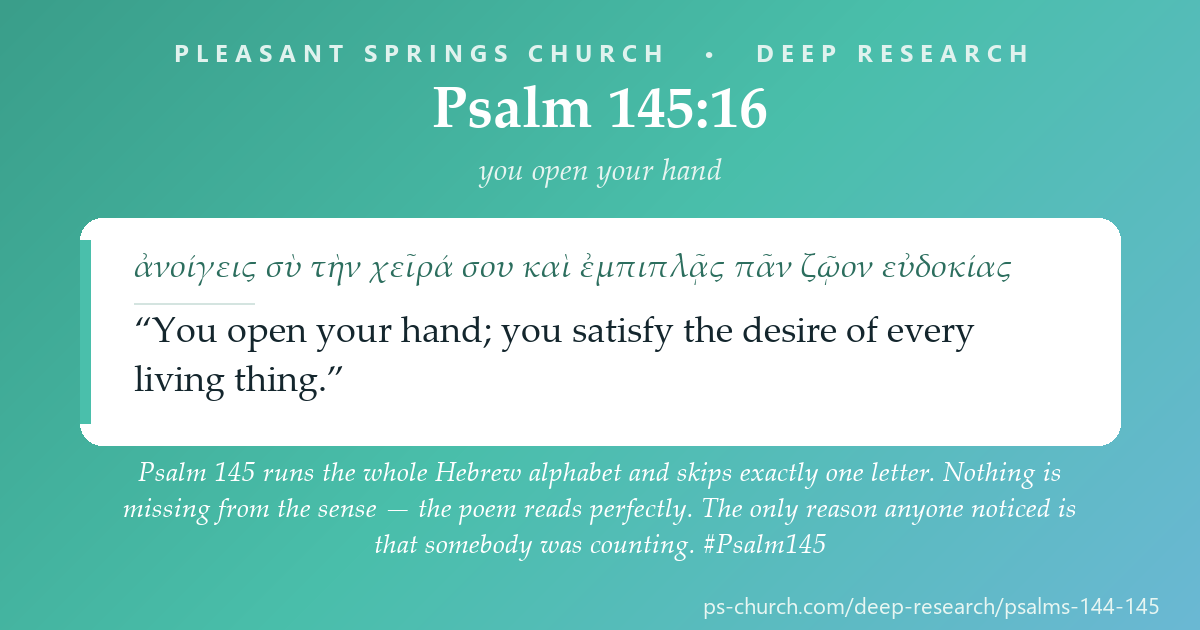
- One concrete response. Psalm 145 was built to be said daily and has been for a very long time. Say it through once, slowly, and notice that the verse you would have called the climax — you open your hand; you satisfy the desire of every living thing — arrives in the ordinary course of the alphabet, with no emphasis at all.
Psalm 145:16 · to share
Hebrew + Greek (Rahlfs) + ESVEvery Deep Research page traces its passage across the whole sweep — the Old Testament, the Second-Temple world between the testaments (historical witnesses, not Scripture), and the New Testament. Follow the thread:
Pleasant Springs Church — Deep Research
Research method after Michael S. Heiser’s Bible Research Method (examine dictionaries → ancient literature → important words → textual connections → academic publications → share), with the Pleasant Springs “Author & Audience” foundation. Scripture set in the Hebrew, the Greek editions named on each page and the ESV (Old Testament), and the Greek New Testament and the ESV (New Testament), per the practice of Pleasant Springs Church. Psalms 144–145 research grounded in Flint (The Dead Sea Psalms Scrolls and the Book of Psalms), Hossfeld and Zenger (Psalms 3, Hermeneia), Goldingay and Alter. Text: Hebrew from the Masoretic text as printed in the editions consulted — Sefaria’s Miqra according to the Masorah; no critical apparatus was consulted for the Hebrew. Greek from Rahlfs’ Greek Psalter (CATSS digitization of Rahlfs 1931). The standing caution for this shelf applies, and it bites hard here: the asterisk method used in this library’s Job studies — which could separate older Greek from later supplement — is unavailable in the Psalms, which is precisely why the question on this page cannot be closed. ⚠️ Both central claims were computed, not repeated. The Psalm 145 acrostic was verified letter by letter: 21 verses, ʾalep–taw in order, nun the single omission, no other irregularity. And every verse label in the entire Greek Psalter was scanned to confirm that 144:13a is the only lettered verse in the book. ⚠️ The page deliberately refuses the shorthand “the nun line.” The Greek reads πιστός; Greek has no nun, and the Greek here is neither acrostic nor marked for the alphabet — although the Greek Psalter does mark one acrostic, Psalm 119, with all twenty-two Hebrew letter names, and (verified across the book) marks no other, so the silence at 145 is evidenced rather than assumed. The nun exists only in retroversion (neʾĕmān), and the page names that as a reconstruction while crediting 11QPsª and the Syriac as the real weight of the case. ⚠️ The counter-case is printed rather than suppressed: 13a’s second colon and 144:17’s second colon are the same line (verified directly; they differ only by movable nu), so the plus is equally consistent with a secondary fill built on v.17. Both readings are stated and neither is adopted. It is also noted plainly that no New Testament writer quotes the disputed verse, so nothing doctrinal rides on the outcome. Rahlfs’ addition of against Goliath to the Psalm 144 superscription is reported as a Greek plus with no Hebrew counterpart. Typology is handled per the house position: what the text says, what the New Testament itself draws, and what we see from this side of the cross — with the seeing left to the reader.
Scripture quotations marked ESV are from the ESV® Bible (The Holy Bible, English Standard Version®), © 2001 by Crossway, a publishing ministry of Good News Publishers. ESV Text Edition: 2016. Used by permission. All rights reserved. The ESV text may not be quoted in any publication made available to the public by a Creative Commons license, and the ESV may not be translated in whole or in part into any other language. www.esv.org
|
Did this study bless you today? 💚 Give to Support PS Church100% of gifts go to the General Fund — thank you. |