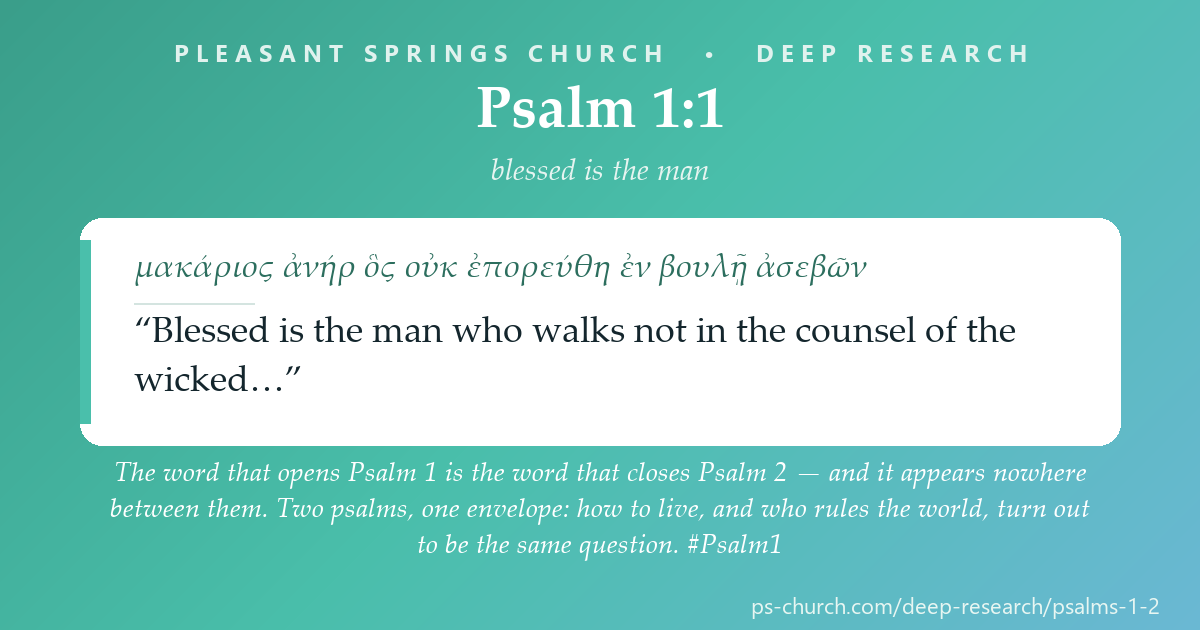
The Psalter does not begin with a prayer. It begins with a man, a tree and a warning — and then, without transition, with an international crisis and a coronation. One psalm has a tree; the other has armies. They are not an odd pairing. They are stitched together. The word that opens the first is the word that closes the second — ashrê, blessed — and it occurs thirty-one times in the Psalter but only twice here: the very first word of Psalm 1 and the very last line of Psalm 2, with nothing between. Both psalms end on the same verb, to perish. Both closing lines use the same noun, way. And these are the only two psalms in the whole book with no title in either the Hebrew or the Greek — everything from Psalm 3 onward carries a heading. Psalm 1 asks how a person should live; Psalm 2 asks who rules the world; and the two end on the same two words. The Psalter opens by refusing to treat those as separate questions. It also opens by telling you to read rather than to pray — nobody actually prays until Psalm 3. See the method →
Psalms 1:1–2:12 (selections)
Hebrew · Greek (Rahlfs’ Psalter) · ESVThey are not a pairing. They are stitched. The word that opens the first is the word that closes the second: ʾašrê, blessed — and it occurs thirty-one times in the whole Psalter but only twice in these two psalms, at the very first word of Psalm 1 and the very last line of Psalm 2. An envelope. The two closing verses share more: both end on the same verb, ʾāḇaḏ, to perish — the way of the wicked will perish (1:6), you will perish in the way (2:12) — and both carry dereḵ, way, which appears four times across the pair and in both closing lines.
Three threads, all of them checkable, tying a wisdom poem to a royal one. Psalm 1 asks how a person should live; Psalm 2 asks who rules the world. The Psalter opens by refusing to separate the two questions.
⚠️ These are the only two psalms in the book with no title in either tradition. Most psalms carry a superscription — a psalm of David, to the choirmaster, and so on. Psalm 3 begins “A psalm of David, when he fled from Absalom his son” and the Greek has it too. Psalms 1 and 2 have nothing — no heading in the Hebrew, none in Rahlfs’ Greek. They simply start. Whether that means they were composed as an introduction, or were left bare because they were already understood to be one, is argued and cannot be settled from the text.
⚠️ And it means neither of the Psalter’s two numbering traps bites here — which makes this the right page to explain them once. (1) The Greek numbers the psalms differently. Because the Greek joins Psalms 9 and 10 into one, it runs one behind the Hebrew for most of the book: our Psalm 51 is its Psalm 50. Psalms 1–8 are the stretch where the two agree, so Psalm 1 is Psalm 1 in both. (2) In Hebrew the title is usually verse 1, so Hebrew and English verse numbers diverge in 62 of the 150 psalms — fifty-eight by one verse and four by two. Psalms 1 and 2 have no title, so they are numbered identically in Hebrew, Greek and English. This page needs no hedges. Later ones will.
⚠️ The last line of Psalm 2 is one of the hardest in the Psalter, and the Greek read it another way entirely. The Hebrew is naššəqû-ḇar — usually “kiss the son.” The difficulty is that ḇar is the Aramaic word for son; the Hebrew word is bēn, and this very psalm uses bēn five verses earlier (2:7). Proposals include “kiss the son,” “do homage sincerely” (taking bar as pure), and various emendations. Rahlfs’ Greek Psalter reads δράξασθε παιδείας — “take hold of instruction.” No son, and no kiss. The same verse also supplies a subject the Hebrew leaves unstated (κύριος, “lest the Lord be angry”) and an adjective the Hebrew does not have (ὁδοῦ δικαίας, “the righteous way”). This page reports the readings and settles none of them.
The Shape of the Passage
InclusioAnd two more threads run the same way. The verb ʾāḇaḏ, to perish, closes both psalms — the way of the wicked will perish (1:6) and you will perish in the way (2:12). And dereḵ, way, occurs four times across the pair (1:1, 1:6 twice, 2:12), including in both of those closing lines. Rahlfs’ Greek preserves all three: μακάριος at 1:1 and μακάριοι at 2:12, ἀπολεῖται and ἀπολεῖσθε, ὁδός throughout.
What that does to the reading. Psalm 1 sets two ways before an individual; Psalm 2 sets two ways before the nations — and both end by saying the wrong one perishes and the right one is blessed. The private question and the political one turn out to be the same question at different scale. Whether the two were composed together, or joined later by an editor who left them untitled to mark them off, is argued and this page does not decide.
This opens the Psalms shelf. The library already treats Psalm 2 on its own, and works the whole research method through Psalm 1. This page reads the two together, which is a different job.
Author
Whoever placed these two here left them bare on purpose or left them bare by accident, and we cannot tell which. What is observable is that they are the only two psalms untitled in both traditions, that they share three vocabulary threads, and that everything after them carries headings. The Psalter is an edited book — five collections with doxologies at the seams — and this is where the editing is most visible.
He opens with instruction rather than prayer. A book of prayers begins by telling you to read: his delight is in the law of the Lord, and on it he meditates day and night. Before you say anything to God, you are told to listen — and only in Psalm 3 does anybody actually pray.
And he puts the individual before the empire. One man and a tree, then the nations in uproar. The order is the argument: the question of how to live is not a smaller version of the question of who rules; the two psalms end on the same two words.
Audience
People about to read a hundred and fifty prayers. These two are the doorway, and they set the terms: there are two ways, the world is contested, and the outcome is already decided. Everything that follows — including the psalms that scream at God — is read inside that frame.
People living under somebody else\u2019s empire. Psalm 2 is not a comfortable poem. Kings conspire, and the answer from heaven is laughter and a single sentence about a hill in Jerusalem. For readers with no army, that is either absurd or everything.
And people who needed permission to be ordinary. Psalm 1’s blessed man does nothing heroic. He avoids three kinds of company, reads, and stays near water. The Psalter opens not with a hero but with a habit.
Orient on the shape of the Psalter, on the two ways, and on royal psalms.
Search by topic: Psalms, book of; Psalter — editing and shape; superscriptions; the two ways; torah piety; royal psalms; enthronement; Zion; anointed / messiah.
Which articles are relevant?
- Anchor Bible Dictionary — “Psalms, Book of,” “Psalm Titles,” “Kingship,” “Messiah,” “Zion,” “Wisdom.”
- Dictionary of the OT: Wisdom, Poetry & Writings (IVP) — “Psalms 1,” “Psalms 2,” “Editorial Criticism,” “Torah,” “Royal Psalms,” “Two Ways.”
- NIDOTTE / TDOT — אַשְׁרֵי (ʾašrê), דֶּרֶךְ (dereḵ), הָגָה (hāģāh, to mutter / meditate), תּוֹרָה (tōrāh), נָשַׁק (nāšaq, to kiss).
- On the Greek — the NETS introduction to Psalms. Note what it does not contain: unlike Job, Greek Psalms has no asterisked material, because the Greek and Hebrew agree at verse level almost everywhere. See the caution below.
Bibliography surfaced:
- Gerald H. Wilson, The Editing of the Hebrew Psalter — the study that put the shape of the book on the agenda, and the source of most discussion of Psalms 1–2 as an introduction.
- Frank-Lothar Hossfeld and Erich Zenger, Psalms 2 and Psalms 3 (Hermeneia) — note that the Hermeneia set covers Psalms 51–100 and 101–150; there is no Hermeneia volume for Psalms 1–50.
- John Goldingay, Psalms 1–41; Robert Alter, The Book of Psalms (translation and commentary).
Coronation language, a tree by a canal, and what kind of Greek text this is.
First the royal setting of Psalm 2. Then a caution about the Greek Psalter that governs every page on this shelf.
Which parallels shed light on these psalms?
Psalm 2 is coronation language, and the region had a great deal of it. Egyptian enthronement texts have the god address the new pharaoh as son; Assyrian royal oracles promise the king the submission of the nations. The conventions are shared; what is done with them is not. In Psalm 2 the nations’ revolt is answered by laughter rather than by conquest, and the decisive act is a declaration — I have set my King — not a battle.
The tree of Psalm 1 is an irrigated tree, not a wild one. The Hebrew has it transplanted beside palģê mayim — channels, the cut watercourses of an irrigation system. It is not a picture of a tree that happened to grow well; it is a picture of a tree somebody put there, next to water somebody dug. Compare Jeremiah 17:5–8, which uses the same image at length and sets it against a shrub in the desert.
And the meditation is out loud. Hāģāh is not silent reflection — it is the word used of a lion growling over prey (Isaiah 31:4) and of a dove moaning (Isaiah 38:14). Muttering is closer than meditating. The blessed man is audible.
- Jeremiah 17:5–8 — the same tree, at greater length, with its opposite. Whether Jeremiah is quarrying the psalm or both draw on a common image is argued, and the page does not decide.
- Egyptian and Assyrian enthronement texts (ancient Near Eastern — witnesses, not Scripture) — for divine sonship as coronation language. Useful for showing the convention; not evidence about what the psalm means by it.
- 2 Samuel 7:14 — I will be to him a father, and he shall be to me a son, the dynastic promise standing behind Psalm 2:7. The Psalm 2 study works this ground.
- Joshua 1:8 — this Book of the Law shall not depart from your mouth, but you shall meditate on it day and night. Almost the same sentence as Psalm 1:2, with the same verb and the same phrase, spoken to a national leader rather than a private man.
This library’s Job studies could say something these pages cannot. In Job the ancient Greek translation was substantially shorter than the Hebrew, Origen filled the gaps from Theodotion in the third century, and the critical editions mark his supplements with an asterisk. That let those pages say plainly: this reading is ancient; that one was added later.
None of that is available for the Psalms, and the reason is arithmetic. The Greek Psalter agrees with the Hebrew at verse level almost exactly — 2,526 populated verses against the Hebrew’s 2,527. There was no shortfall for anyone to fill, so there are no asterisks to consult. The standard scholarly English of the Greek Psalms contains no mention of asterisks, obeli, Origen or the Hexapla at all.
The Psalter’s textual problem is the opposite of Job’s. Not deficit but abundance: something like 1,300 Greek Psalter manuscripts, revised and re-revised for liturgical use over centuries. The standard edition — Rahlfs, 1931 — is a working edition rather than a full critical one, and its own translator into English says as much; a new Göttingen edition is in progress to replace it.
So these pages will say “Rahlfs’ Greek Psalter reads…” and never “the Septuagint says.” Where a reading is worth reporting, it is reported as that edition’s. What this shelf will not do is tell you a Greek reading is early or late — because in the Psalter, unlike in Job, nobody can.
A word that makes an envelope, a verb that is louder than it looks, and one crux.
Read 1:2 and 2:1 together — the same verb, the blessed man and the raging nations. Then read the last line of each psalm side by side.
“Blessed, happy” — and it is not the usual word for God blessing someone (that is bāraḵ). ʾAšrê is an exclamation about a person’s condition: how fortunate the one who… It occurs thirty-one times in the Psalter, and exactly twice in these two psalms — the first word of 1:1 and the last line of 2:12, with nothing between. That is the envelope. Rahlfs has μακάριος and μακάριοι, the word the Beatitudes will use.
“To mutter, growl, murmur.” Usually translated meditate, which makes it sound silent, and it is not. The same verb is used of a lion growling over its prey (Isaiah 31:4) and of a dove moaning (Isaiah 38:14). And it is the same verb the nations do in 2:1 — the peoples mutter in vain. One man mutters the law; the nations mutter emptiness. The link is Hebrew-only: Rahlfs uses μελετάω at both, which keeps it.
“Transplanted.” Not growing and not planted from seed — the word implies a tree lifted and set deliberately somewhere better. Beside palģê mayim, channels of water — a dug irrigation system, not a riverbank. The image is of cultivation, not of luck.
The crux. Usually rendered “son” — but that is the Aramaic word; the Hebrew is bēn, and this psalm used bēn five verses earlier (2:7). Why Aramaic here is not agreed. Bar can also mean pure, clean (as at Psalm 24:4), which gives “do homage sincerely”; other proposals emend the text. Rahlfs’ Greek reads δράξασθε παιδείας, “take hold of instruction” — no son and no kiss at all. The page reports the options and settles none.
“To perish.” The last significant word of both psalms. The way of the wicked will perish (1:6); you will perish in the way (2:12). Rahlfs keeps the pairing with ἀπολεῖται and ἀπολεῖσθε. Together with ʾašrê and dereḵ, this is the third thread binding the two psalms.
“Way, road.” Four occurrences across the two psalms, and it appears in both closing lines. Psalm 1 is built on it — the way of sinners, the way of the righteous, the way of the wicked — and Psalm 2 ends by putting the kings on one of them. “The two ways” is not a device imported by commentators; it is the vocabulary the psalms themselves repeat.
Counted here, not assumed:
- Verse counts agree exactly: Psalm 1 = 6 verses, Psalm 2 = 12, in both columns.
- ʾAšrê occurs 31 times in the Psalter — and in these two psalms only at 1:1 and 2:12. Nothing between them uses it.
- Both psalms are untitled in both traditions. No Hebrew superscription, no Greek heading. Psalm 3 by contrast has a title in both, and in Hebrew that title is verse 1.
- Therefore neither numbering trap bites on this page. The Greek/Hebrew psalm-number offset begins later (the Greek joins Psalms 9 and 10, and runs one behind from there); and the title-as-verse-1 offset affects 62 of the 150 psalms — 58 by one verse, 4 by two — but not these. Psalms 1 and 2 number identically in Hebrew, Greek and English.
- Dereḵ occurs four times across the pair (1:1, 1:6 twice, 2:12), and ʾāḇaḏ closes both psalms.
A sentence Joshua heard, a tree Jeremiah reused, and two psalms the apostles read as one.
Read Joshua 1:8 beside Psalm 1:2. Then Jeremiah 17:5–8 beside Psalm 1:3.
Which cross-references matter?
- Joshua 1:8 → Psalm 1:2. You shall meditate on it day and night — the same verb, the same phrase, the same object. What was said to a man commanding an invasion is here said of anybody.
- Jeremiah 17:5–8 beside Psalm 1:3–4. The tree by water and its opposite, worked at greater length. The direction of borrowing is argued and this page does not decide it.
- Psalm 2:1–2 → Acts 4:25–26. The disciples pray the psalm back after the arrest of Peter and John, quoting it in Greek and applying the nations and the peoples to the coalition against Jesus. It is the earliest surviving Christian reading of Psalm 2, and it reads it as being about a specific week.
- Psalm 2:7 → Acts 13:33; Hebrews 1:5; 5:5. This ground belongs to the Psalm 2 study, which treats the sonship decree in detail. Noted here only so the reader knows where to go.
- Psalm 1:1 and Matthew 5:3–11. The Beatitudes open with the Greek word Rahlfs uses here, μακάριος, in the same construction — a pronouncement about who is fortunate rather than a wish. The page notes the shared form and leaves the seeing to the reader.
- Psalm 1:3 and Revelation 22:1–2. A tree beside water that yields its fruit in season. The Psalter opens and the canon closes with the same picture; stated, and nothing built on it.
Where the discussion is, and four things this page leaves open.
Wilson on the shape of the Psalter; Goldingay and Alter on the text.
Commentaries & studies:
- Gerald H. Wilson, The Editing of the Hebrew Psalter — the standard starting point for reading Psalms 1–2 as a deliberate introduction.
- John Goldingay, Psalms 1–41 — careful on the Hebrew and unusually frank about 2:12.
- Robert Alter, The Book of Psalms — on the poetics, and on why meditate is a weak rendering of hāģāh.
- Hossfeld and Zenger, Psalms 2 / Psalms 3 (Hermeneia) — excellent, but note they cover Psalms 51–150 only. There is no Hermeneia volume on Psalms 1–50, so it cannot be cited for this page.
Four things reported as unsettled:
- Whether Psalms 1 and 2 are one psalm or two. They are untitled in both traditions and share three vocabulary threads; some ancient witnesses to Acts 13:33 cite Psalm 2:7 as from the first psalm. The page reports the linkage as observable and the question of original unity as open.
- What bar means at 2:12. Son (Aramaic), purely/sincerely, or something the text has lost. Rahlfs’ Greek offers no help — it reads “take hold of instruction” and has neither a son nor a kiss.
- Whether Psalm 1 was written as an introduction or promoted to the position. Its untitled state is consistent with either.
- The direction of borrowing between Psalm 1 and Jeremiah 17. The image is shared; priority is argued.
One word holding a hundred and fifty prayers together.
Name what you learned, why it matters, and one concrete response.
What should we carry away — and do?
- The Psalter opens by telling you to read, not to pray. A hundred and fifty prayers, and the first thing said is his delight is in the law… and on it he meditates day and night. Nobody prays until Psalm 3. Listening comes first, and the book is arranged to make that unavoidable.
- And the meditation is out loud. The verb is used of a lion growling and a dove moaning. Whatever Psalm 1:2 describes, it is audible — closer to muttering your way through a text than to contemplating it.
- The private question and the political one are the same question. One psalm about a man and a tree; one about kings and armies — and they end on the same two words: something perishes, and somebody is blessed. The Psalter refuses to let personal piety and public power be separate subjects.
- One concrete response. The blessed man is defined first by three things he does not do, and they slow down: walk, stand, sit. Notice what you have stopped merely passing and started sitting down in.
Psalm 1:1 · to share
Hebrew + Greek (Rahlfs) + ESVEvery Deep Research page traces its passage across the whole sweep — the Old Testament, the Second-Temple world between the testaments (historical witnesses, not Scripture), and the New Testament. Follow the thread:
Pleasant Springs Church — Deep Research
Research method after Michael S. Heiser’s Bible Research Method (examine dictionaries → ancient literature → important words → textual connections → academic publications → share), with the Pleasant Springs “Author & Audience” foundation. Scripture set in the Hebrew, the Greek editions named on each page and the ESV (Old Testament), and the Greek New Testament and the ESV (New Testament), per the practice of Pleasant Springs Church. Psalms 1–2 research grounded in Wilson (The Editing of the Hebrew Psalter), Goldingay (Psalms 1–41) and Alter. This is the first page of the Psalms shelf. Text: Hebrew from the Masoretic text as printed in the editions consulted — Sefaria’s Miqra according to the Masorah; no critical apparatus was consulted for the Hebrew. Greek from Rahlfs’ Greek Psalter (CATSS digitization of Rahlfs 1931). ⚠️ A standing caution for this whole shelf, stated here once: the method this library used in Job — distinguishing the older Greek from Origen’s third-century supplement by its asterisks — is not available in the Psalms. The Greek Psalter agrees with the Hebrew at verse level almost exactly (2,526 populated verses against 2,527), so there was no shortfall to fill and there are no asterisks; the standard scholarly English of Greek Psalms mentions asterisks, obeli, Origen and the Hexapla not once. The Psalter’s difficulty is the reverse — roughly 1,300 Greek manuscripts, revised repeatedly for liturgical use. Rahlfs 1931 is a working edition rather than a full critical one (its own English translator says so) and a Göttingen replacement is in progress. Therefore these pages say “Rahlfs’ Greek Psalter reads…” and never “the Septuagint says,” and will never call a Greek reading early or late. Counts verified in both columns: Psalm 1 = 6 verses, Psalm 2 = 12, identical either side; ʾašrê 31 times in the Psalter and exactly twice here (1:1, 2:12) with nothing between; dereḵ four times across the pair; ʾāḇaḏ closing both psalms — the three threads on which the envelope reading rests. Both psalms are untitled in both traditions, checked against Psalm 3, which carries a title in both and whose title is verse 1 in Hebrew. Consequently neither of the Psalter’s numbering traps bites here, and the page explains both once for the shelf: the Greek runs one behind from Psalm 10 onward because it joins Psalms 9 and 10; and the Hebrew title-as-verse-1 convention offsets 62 of the 150 psalms against English (58 by one verse, 4 by two). ⚠️ 2:12 is reported as a crux and not resolved: naššəqû-ḇar is usually “kiss the son,” but bar is Aramaic where the psalm used Hebrew bēn five verses earlier; “do homage sincerely” and various emendations are also proposed; and Rahlfs’ Greek reads “take hold of instruction,” with neither son nor kiss, also supplying a subject and an adjective the Hebrew lacks. Deliberate de-duplication: the sonship decree of 2:7 and its New Testament use belong to the library’s existing Psalm 2 study and are not re-argued here; this page reads the two psalms together, which is a different question. Typology is handled per the house position: what the text says, what the New Testament itself draws, and what we see from this side of the cross — with the seeing left to the reader.
Scripture quotations marked ESV are from the ESV® Bible (The Holy Bible, English Standard Version®), © 2001 by Crossway, a publishing ministry of Good News Publishers. ESV Text Edition: 2016. Used by permission. All rights reserved. The ESV text may not be quoted in any publication made available to the public by a Creative Commons license, and the ESV may not be translated in whole or in part into any other language. www.esv.org
|
Did this study bless you today? 💚 Give to Support PS Church100% of gifts go to the General Fund — thank you. |