Four psalms with nothing in common except that this shelf had never quoted them: a creation hymn, the last third of a lament, a prayer with a story attached to its heading, and a thanksgiving that changes person halfway through. Before a word of this page was written, all 56 verses were screened twice, and so was the whole Psalter. Psalm 43:5 and Psalm 42:12 share fourteen consecutive words at tie band 1 — and nothing else in the 2,527 verses of the Hebrew Psalter goes that deep with anything. The verb that carries it exists nowhere in the Bible outside this one poem. On the Greek side the deepest contact in the four psalms is Psalm 33:6 against 2 Thessalonians 2:8, five words, tie band 1 — a pairing no commentary makes — while Hebrews 11:3 and 2 Peter 3:5, the two verses every reader would name, measure 0 and 1. And Gethsemane, the most famous allusion in the passage, measures 1. See the method →
Psalms 33 · 43 · 54 · 66 (selections)
Hebrew · Greek (CATSS / Rahlfs, Ψαλμοί) · ESVWhat this page measured before it wrote anything. All 56 verses were screened twice: the Hebrew against the whole Masoretic corpus with single-word matches not counted, and the Greek against all 7,927 verses of the Greek New Testament. Then the whole Psalter — 2,527 Masoretic verses — was screened the same way, so that the four psalms could be placed against their own book rather than described in the abstract. Two results decided what this page says.
★ One. Psalm 43:5 and Psalm 42:12 share fourteen consecutive words at tie band 1, and nothing else in the Psalter goes that deep. Screened verse by verse, no verse of the Hebrew Psalter shares more than fourteen consecutive words with any other verse of the Hebrew Bible, and the maximum is reached exactly twice — by the two halves of that one pair, each the other’s only partner. The next deepest are eleven: Psalm 14:2 with Psalm 53:3, and Psalm 18:31 with 2 Samuel 22:31. Psalm 43:5 is not printed in the codex above, deliberately. The refrain and its two earlier occurrences are already printed on Psalms 42–43, and this page does not reprint an English text the shelf already carries. The measurement is reported here; the verse is read there.
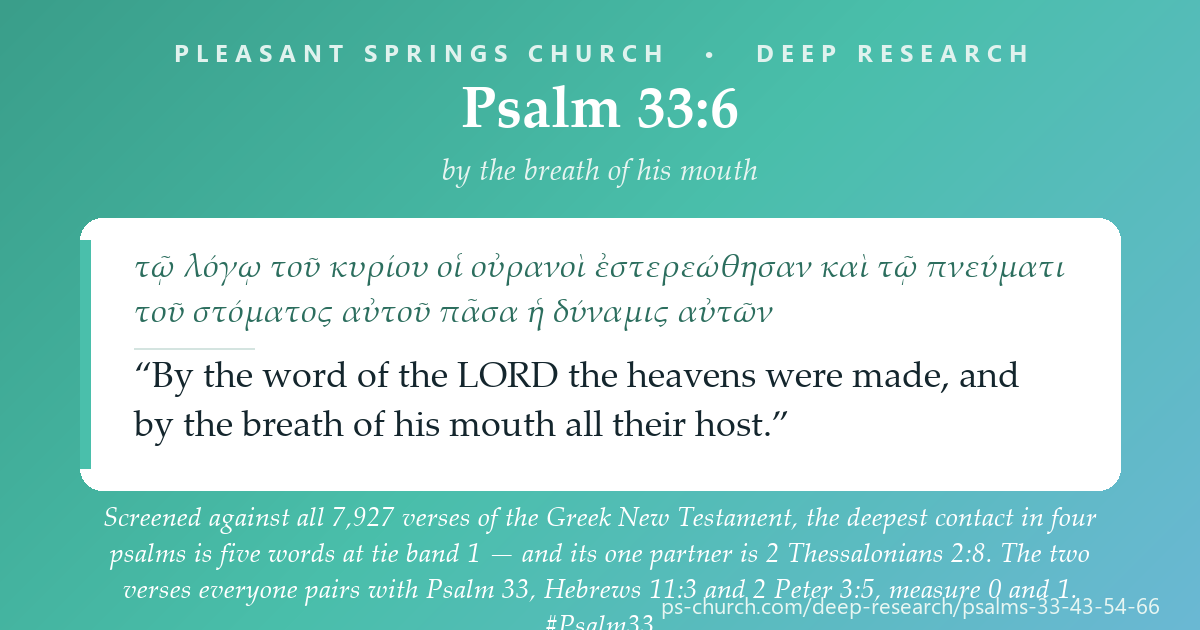
★ Two. The deepest Greek contact in the four psalms is Psalm 33:6 against 2 Thessalonians 2:8 — five words, tie band 1 — and it runs both ways. 2 Thessalonians 2:8, screened against all 30,348 Greek Old Testament verse units held here, has exactly one deepest partner and it is this verse. Isaiah 11:4, the verse every commentary names for 2 Thessalonians 2:8, measures four. And the two New Testament verses a reader would name for Psalm 33 — Hebrews 11:3 and 2 Peter 3:5 — measure 0 and 1. Nothing here says who read whom. It says where the words are.
⚠️ Versification: the Greek psalm number is one lower on every row of this page, and inside the psalms there is exactly one offset. In the Septuagint the book is Ψαλμοί (Psalmoi), and its numbering runs one behind the Hebrew from Psalm 9/10 through Psalm 147, because Greek Psalm 9 joins Hebrew 9 and 10. So ESV/Hebrew 33 = Rahlfs 32, 43 = 42, 54 = 53, 66 = 65 throughout. Inside the psalms, three of the four number identically in all three columns — Psalm 33 is 22 verses in Hebrew, Greek and English; Psalm 43 is 5; Psalm 66 is 20, because its Hebrew verse 1 carries the heading and the first line together. Psalm 54 is the exception. Hebrew and Greek number the two-line superscription as verses 1 and 2; the ESV prints it as an unnumbered heading; so ESV 54:1 = Hebrew 54:3 = Rahlfs 53:3, and the two-verse offset runs to the end of the psalm. ⚠️ And Psalm 42, which this page cites constantly, has an offset of its own and is cited here by its HEBREW number, because the pair it makes with Psalm 43 is a Hebrew measurement: the Hebrew numbers the heading as verse 1 and the ESV does not, so Hebrew 42:12 = ESV 42:11 = Rahlfs 41:12 and Hebrew 42:6 = ESV 42:5 = Rahlfs 41:6. Every label above is the ESV number with the Hebrew and Rahlfs numbers printed beside it.
⚠️ And numbering parity is not textual parity. Six real divergences between the columns are printed above and adjudicated in none: a third line at 33:10 the Hebrew does not have, a heading at 43:1 the Hebrew does not have, mercy for righteousness at 33:5, created for stood firm at 33:9, my youth for my joy at 43:4, and a third-person verb turned second person at the last line of Psalm 54.
The Shape of the Passage
Four separate poems — four shapes, and deliberately not one shapeThese four psalms sit inside four studies already on this shelf: Psalms 32–34, Psalms 42–43, Psalms 52–55 and Psalms 65–67. Between them those four pages print exactly three verses from these chapters — Psalm 33:1, Psalm 43:5 and the heading line of Psalm 66 — and all four chapters still read as dark on the shelf’s own coverage map, because each of those three rows carries a label the reference resolver refuses. This page closes the four chapters properly and says what a screen of the whole Psalter shows about them. None of those three verses is reprinted here. Fifteen other verses are printed instead, and Psalm 43:5, Psalm 33:1 and Psalm 66:1 are deliberately left where they already stand.
Author
Four psalms, at least three different hands, and the measurement will not merge them. Psalm 33 has no heading in Hebrew at all. Psalm 43 has none either, and reads as the third strophe of the poem that begins at Psalm 42 — which is headed of the sons of Korah. Psalm 54 is headed of David with a story attached. Psalm 66 is headed a song, a psalm and names nobody. The Greek supplies “of David” for both of the untitled ones, which is a fact about the Greek and not about the authorship.
What can be said about the writing itself is that these four write very differently, and it is countable. Screened against the whole Hebrew Bible with single-word matches not counted, Psalm 33 produces 2 zeros in 22 verses (9.1%) — it ranks 95th of the 126 psalms of eight verses or more, well below the Psalter’s own rate. Psalm 66 produces 7 in 20 (35.0%). The Psalter as a whole runs 624 of 2,527, 24.7%. Psalm 33 is built out of phrases the rest of Scripture also uses. Psalm 66 is not.
And whoever wrote Psalm 66 reached for words nobody else reached for. Sixteen of its word forms occur in exactly one verse of the Hebrew Bible — נִשְׂמְחָה, מוּעָקָה, לָרְוָיָה, מֵיחִים and twelve more — and three of the four verses that carry the rarest of them come out at zero on the run screen. The counter-measurement is printed in Stage 4, because that rate is close to ordinary for the Psalter and does not by itself explain the zeros.
Audience
People who sang. Two of the four carry a musical direction — to the choirmaster, with stringed instruments, a song, a psalm — and Psalm 33 opens by telling its hearers what instruments to use and how to play them: the lyre, the ten-stringed harp, play skilfully. That is not a private devotion. It is an instruction to a room.
People who could hear a courtroom and a battlefield without being told. Psalm 43 opens with šopṭēnî and rîbāh rîbî — judge me, plead my plea — two words from legal procedure standing at the head of a prayer. Psalm 54 asks God to vindicate me by your might, which is the same idiom. Psalm 33 spends two verses (33:16–17) on why cavalry does not work. None of it is explained.
People for whom the Red Sea was a thing that had happened to them. Psalm 66:6 does not say “God once turned the sea into dry land.” It says there did we rejoice in him — a first-person plural about an event centuries old. The audience is expected to include itself in a crossing it did not attend, and then, eight verses later, to listen while a single voice takes over and pays a vow.
Orient on the shape of the Psalter, on the Elohistic collection, on psalm headings and what they are, on the refrain of Psalms 42–43, and on the Greek Psalter.
Search by topic: Psalms, book of; the five books of the Psalter; the Elohistic Psalter; superscriptions and historical headings; Maskil; lamnatseach; selah; hymn of praise; individual thanksgiving; communal lament; todah; Korahite psalms; Ziph and the Wilderness of Judah; the Greek Psalter and its titles; acrostic psalms.
Which articles are relevant?
- The five books of the Psalter. Psalm 33 belongs to Book I (1–41); Psalms 43, 54 and 66 to Book II (42–72). This page covers the four chapters that were still dark on this shelf, which is a fact about the shelf and not about the Psalter; the psalms themselves are not a group and the page does not treat them as one.
- The Elohistic Psalter. Every dictionary treatment of Psalms 42–83 notes that the collection prefers אֱלֹהִים where the rest of the Psalter uses יהוה. Counted here: 245 Elohim-tokens against 44 tokens of the divine name across those forty-two psalms. Psalm 54 carries the name once, at Hebrew 54:8; Psalm 66 does not carry it at all; Psalm 43 does not carry it at all; Psalm 33, which is outside the collection, carries it thirteen times in twenty-two verses.
- Superscriptions, and the thirteen historical ones. Thirteen psalms carry a heading that names an episode from David’s life. Articles will tell you the headings are ancient but probably not original, and that the Greek tradition adds more of them. What this page adds is a measurement of the overlap: only three of the thirteen have their narrative as their single deepest partner in the whole Hebrew Bible, and Psalm 54 is one of them.
- The refrain of Psalms 42–43. Standard reference works treat the two psalms as one poem in three strophes on the strength of the repeated refrain and the missing heading at 43. The question is genuinely open and this page does not close it — but the fourteen-word measurement is the strongest verbatim evidence in the Psalter and it belongs in the discussion.
- Acrostic psalms. Psalms 9–10, 25, 34, 37, 111, 112, 119 and 145 run down the Hebrew alphabet. Psalm 33 has twenty-two verses, the right number, and is not one of them. Stage 4 prints the letters.
- The Greek Psalter. Articles on the Septuagint Psalms will tell you that the psalm numbers run one behind the Hebrew from Psalm 9/10, that the Greek headings are often longer than the Hebrew, and that διάψαλμα stands where סֶלָה stands. Counted here: 71 selah-tokens in the Hebrew Psalter, 72 διάψαλμα in the Greek. The two do not match exactly, and the page reports that rather than rounding it.
Ziph and the wilderness, the ten-stringed harp, silver in the refiner’s fire, the freewill offering, and a sea-crossing said in the first person plural.
Everything in this stage is context, and context is exactly what a run screen cannot see. Where a claim below can be counted it is counted and the number is given; where it cannot, it is marked as background and nothing on the rest of the page rests on it.
What does the surrounding world contribute?
- Ziph. A town and a wilderness in the Judean hill country south-east of Hebron. 1 Samuel tells the story twice — the Ziphites go up to Saul at Gibeah (23:19) and again later (26:1) — and the heading of Psalm 54 quotes the first of the two almost word for word. Measured: three consecutive words, one partner in the whole Hebrew Bible. Which text stands behind which is not something a run screen can tell you, and this page does not guess.
- The ten-stringed instrument. Psalm 33:2 names the kinnor and the nebel ‘aśor. The Greek gives κιθάρα and ψαλτήριον δεκάχορδον, translating the number rather than keeping the term. Background: lyres and harps are attested across the ancient Near East in relief and in inventory lists; what the Hebrew names denoted precisely is not settled and nothing here depends on it.
- The refiner’s crucible. Psalm 66:10 — you have tried us as silver is tried — uses the ordinary vocabulary of metalworking, בחן and צרף. The Greek renders the second with ἐπύρωσας…ὡς πυροῦται τὸ ἀργύριον, “you burned us as silver is burned.” Cupellation — refining silver by driving off lead in a hot hearth — is well attested archaeologically in the Iron Age Levant. That is background and was not measured.
- The freewill offering and the paying of vows. Psalm 54:6 and Psalm 66:13–15 belong to the same institution: a person in trouble vows a sacrifice, is delivered, and comes to the sanctuary to pay. The vocabulary — נְדָבָה, נְדָרַי, burnt offerings, rams, bulls, goats — is the vocabulary of Leviticus 7 and Numbers 30. The second half of Psalm 66 is that transaction, spoken aloud.
- A crossing recited in the first person plural. Psalm 66:6 says there did WE rejoice in him about the sea and the river — the Exodus and, most probably, the Jordan. Liturgical recital that collapses the distance between generations is a habit the Hebrew Bible has elsewhere (Deuteronomy 5:3, 26:5–9), and the psalm does it in one adverb. Measured, and the result is the opposite of what the theme suggests: this verse shares no two consecutive words with any other verse in the Hebrew Bible.
- What was NOT consulted. No Ugaritic, Akkadian or Egyptian hymn text was screened for this page. Not because none is here. Pritchard’s Ancient Near Eastern Texts (3rd edition) is on this disk, and its section V is Hymns and Prayers — the Hymn to the Aton (ANET 369), the Sumero-Akkadian hymns and laments (383–392) — with the Memphite Theology’s creation by the word of Ptah at 4–6. It is here in English translation only, and a run screen cannot cross a translation, so nothing in this stage was measured. Where the literature draws comparisons between Psalm 33’s creation-by-word and Mesopotamian or Egyptian material, this page has nothing measured to add and says nothing.
One verb that exists only inside a single poem, one Greek word that carries the most famous allusion in the passage and also describes Herod at a party, and a hapax about being brought out into abundance.
Every count below is over the corpora held on this disk and is stated with its denominator: 23,204 Masoretic verse units, 30,348 screened Greek Old Testament verse units of the 64 CATSS files held here, and 7,927 Greek New Testament verses. Counts are of word FORMS, not lemmas, unless the entry says otherwise — and where an entry widens to a stem it says so and gives both numbers.
“Why are you bowed down” — hitpolel of שחח, a stem that makes the verb reflexive and iterative. This exact form occurs in exactly three verses of the Hebrew Bible: Psalm 42:6, Psalm 42:12 and Psalm 43:5. Widen the search to every hitpolel form of the root and you get four, and the fourth is Psalm 42:7. The verb that carries the deepest verbatim pair in the Psalter exists nowhere in the Bible outside this one poem. The Greek does not translate it as a verb at all: ἵνα τί περίλυπος εἶ, “why are you deeply grieved.”
“Deeply grieved.” It stands in exactly eight verses of the 30,348 screened Greek Old Testament verse units held here, and three of the eight are the refrain — Rahlfs 41:6, 41:12 and 42:5. The other five are Genesis 4:6, Daniel 2:12, 1 Esdras 8:68, 8:69 and Tobit 3:1 — and both Daniel and Tobit are held here in two recensions, with the word standing in the Old Greek Daniel and the Sinaiticus Tobit and in neither of the others. In the Greek New Testament it stands in four verses: Matthew 26:38 and Mark 14:34 — Gethsemane — and also Mark 6:26, of Herod at his own birthday party, and Luke 18:23, of the rich ruler. Measured: Psalm 43:5 against Matthew 26:38 runs 1, and the one is this word.
“Into dry land.” This form occurs in exactly two verses of the Hebrew Bible: Genesis 1:10 and Psalm 66:6. In Genesis God calls the dry land Earth; in the psalm he turns the sea into it. The Greek uses the ordinary adjective εἰς ξηράν in the psalm and τὴν ξηρὰν γῆν in Genesis 1:10, so the link survives translation in substance if not in form. And the run screen still reports Psalm 66:6 at zero, because one shared word is not two consecutive ones.
Steadfast love, covenant loyalty. Counted across these four psalms: three occurrences in Psalm 33, one in Psalm 66, none in Psalm 43, none in Psalm 54. It is the last noun of Psalm 33 and the last noun of Psalm 66. The Greek gives ἔλεος at every one of the four — and adds a fifth ἔλεος-word at Rahlfs 32:5, where it renders צְדָקָה with ἐλεημοσύνην. Four Hebrew occurrences, five Greek ones, and the extra is a translation choice.
“By the word of the Lord the heavens were established, and by the breath of his mouth all their host.” The Hebrew pair is דָּבָר and רוּחַ; the Greek pair is λόγος and πνεῦμα, both of which carry a great deal of later freight. What is measured is only the second half: τω πνευματι του στοματοσ αυτου, five words, one partner in the whole Greek New Testament. The first half, τῷ λόγῳ τοῦ κυρίου, matches the New Testament at 4 with a tie band of 4 in the neighbouring verse and is a formula. The page does not build a doctrine of the Word out of a run of five, and neither should a reader.
“Rising, standing up, resurrection.” The Greek heading of Psalm 66 reads ᾠδὴ ψαλμοῦ ἀναστάσεως and the Hebrew heading has no counterpart for the last word. Counted across the whole screened Greek Old Testament held here, the noun stands in exactly six verse units: 2 Maccabees 7:14, 2 Maccabees 12:43, Daniel 11:20, Lamentations 3:63, Zephaniah 3:8 and this heading. In the Greek New Testament it stands in forty verses. The word is ordinary Greek for getting up as well as the New Testament’s word for resurrection, the heading gives no context to decide between them, and no apparatus on this disk can date it. The verse itself is printed on Psalms 65–67.
“To saturation, to overflow.” A hapax legomenon: it occurs in exactly one verse of the Hebrew Bible. The ESV renders it “a place of abundance”; the Greek reads εἰς ἀναψυχήν, “to relief, to a breathing-space.” The same verse also carries הִרְכַּבְתָּ, לְרֹאשֵׁנוּ and וַתּוֹצִיאֵנוּ, each of which likewise occurs in one verse only. Four of eight word forms in one verse, unique to it.
“My stronghold, my refuge.” Three verses in the Hebrew Bible: 2 Samuel 22:33, Psalm 31:5 and Psalm 43:2. The Greek gives κραταίωμά μου, “my strength”; the ESV renders the sense rather than the noun, “the God in whom I take refuge.” Three translations, one image: a fortified place.
Three things reported rather than tidied:
- A form count is not a lemma count, and the difference is visible right here. תִּשְׁתּוֹחֲחִי as a form stands in three verses. Widen to every hitpolel form of שחח and you get four. Widen again to every form of the root and you would collect a large and quite different set across Isaiah, Proverbs and Job. The published figure on this page is the form count, because that is what the run engine measures, and quoting a lemma count beside a run figure would compare two different things.
- The Greek New Testament’s use of περίλυπος is the page’s own counter-example and it is printed as one. Matthew 26:38 and Mark 14:34 are, on any reading, the Gospels reaching for the language of the psalm. The measurement is 1. And the same adjective describes Herod when Herodias’s daughter asks for a head (Mark 6:26). A single shared word is compatible with a deliberate allusion and with nothing at all, and this screen cannot tell them apart. The page prints the number and lets the reader keep the allusion if the reader wants it.
- The ἔλεος count in Psalm 33 is five and the חֶסֶד count is three, and both are correct. The Greek uses an ἔλεος-word twice in Rahlfs 32:5 — once for צְדָקָה and once for חֶסֶד. A count of ‘the mercy word’ in the Greek column is therefore not a count of the same thing as a count of חֶסֶד in the Hebrew, and any structural claim built on the Greek count alone would be building on a translator’s decision.
Fourteen consecutive words at tie band 1, five Greek words at tie band 1 with a letter of Paul, and a Red Sea verse that matches nothing.
Three screens produced every figure below. Hebrew: consonantal word forms against the 23,204 verse units of the Masoretic corpus, contiguous runs only, single-word matches NOT counted — so a 0 on this page means “shares no two consecutive words with any other verse,” not “shares nothing”. Every verse reported at 0 below does share individual words, and Psalm 66:6 shares one of them with 353 other verses. Greek Old Testament: over 30,348 screened verse units of the 64 CATSS files held here (30,637 in total; the Odes are excluded, because two of them are Luke 1 and Luke 2 and ten more are second copies of passages already counted). Greek New Testament: against all 7,927 verses of the SBLGNT via MorphGNT, with MorphGNT’s own spelling equivalences applied (ou/ouk/ouch, ek/ex, the movable nu) — so these figures run HIGHER than anything published on this shelf before 30 August 2026 and must not be compared with it. Tie band is printed beside every run.
Which cross-references matter?
- ★ Fourteen words, tie band 1, and it is the deepest pair in the Psalter. Psalm 43:5 and Psalm 42:12 are identical for fourteen consecutive consonantal word forms: מה תשתוחחי נפשי ומה תהמי עלי הוחילי לאלהימ כי עוד אודנו ישועת פני ואלהי. The relation is reciprocal — each is the other’s only partner at that depth. Screened verse by verse across all 2,527 verses of the Hebrew Psalter against the whole Masoretic corpus, nothing else reaches fourteen; the next deepest are eleven (Psalm 14:2 with Psalm 53:3; Psalm 18:31 with 2 Samuel 22:31), then a cluster of six nines. The first refrain, Psalm 42:6, is not identical — it runs 4, tie band 2, and both its partners are the other two refrains, because it ends ישועות פניו rather than ישועת פני ואלהי. Two of the three refrains match perfectly and the first does not, and the page prints that rather than calling all three the same.
- The counter-measurement, printed against the paragraph above. Fourteen is the Psalter’s ceiling, not the Bible’s. Screened the same way across all 23,204 verse units, the Hebrew Bible reaches 29 — 2 Kings 14:9 with 2 Chronicles 25:18, band 1 — and then 26 (1 Kings 14:21 with 2 Chronicles 12:13), 25 (1 Kings 19:10 with 19:14), 22 (Numbers 21:34 with Deuteronomy 3:2), six Kings-against-Isaiah parallels at 21, and fifteen verses at 20 — eleven of them the repeated tribal offerings of Numbers 7. Psalm 43:5 is remarkable inside its own book and ordinary beside the synoptic prose of Kings and Chronicles. The page prints the ranking rather than the flattering slice of it.
- ★ Psalm 33:6 and 2 Thessalonians 2:8, five words, tie band 1, and it holds in both directions. Screened against all 7,927 Greek New Testament verses, Rahlfs 32:6 reaches 5 and has one partner. Screened the other way — 2 Thessalonians 2:8 against all 30,348 screened Greek Old Testament verse units — the result is the same verse, the same 5, the same band of 1. Greek Isaiah 11:4, the passage the commentaries name, measures 4 against 2 Thessalonians 2:8 (του στοματοσ αυτου και). No direction of influence is asserted. A writer with Isaiah 11:4 in mind and a writer with Psalm 33:6 in mind would produce the same four or five words, and this screen cannot separate them.
- And the two verses everybody would name for Psalm 33 measure nothing. Hebrews 11:3 — the universe was created by the word of God — measures 0 against Rahlfs 32:6 and 0 against Rahlfs 32:9: on a screen where single words count, they share no word at all. 2 Peter 3:5 — by the word of God heavens existed long ago — measures 1 against each. The thematic link is real and the verbal link is nil, which is the single most useful thing this page has to say about how to read a cross-reference chart.
- Gethsemane measures 1, and its own deepest Greek Old Testament partner is somewhere else entirely. Matthew 26:38 and Mark 14:34 — my soul is very sorrowful, even to death — against Rahlfs 42:5 run 1, the adjective περίλυπος. Screened against the whole Greek Old Testament, both verses have the same single deepest partner and it is Jeremiah 15:1 at run 4, band 1 (εστιν η ψυχη μου) — a verse nobody claims as the source of anything here. Depth and dependence are different questions.
- Psalm 43:5’s deepest New Testament run is a coincidence and the page names it one. Rahlfs 42:5 runs 4, tie band 1 against Mark 15:34 — μου ο θεοσ μου, the cry from the cross, which is Mark quoting Psalm 22:2 (ESV 22:1). The neighbouring row, Rahlfs 42:4, runs 4, band 1 against Hebrews 1:9, which is quoting Psalm 45:7. Two runs of four at band 1, both with verses that are demonstrably quoting a different psalm. This is what the shelf means when it says a band of 1 is a signal and not a proof.
- Psalm 33 has 22 verses and is not an acrostic, and here are the letters. Screened verse-initial on the first word of each verse, with no prefixes stripped, the initials run: ר ה ש כ א ב כ י כ י ע א מ מ ה א ש ה ל נ כ י. Eleven of the twenty-two letters begin a verse; eleven never do (ג ד ו ז ח ט ס פ צ ק ת). For contrast, Psalm 34 — already on this shelf — walks the alphabet with only ו missing, and Psalm 145 walks it with only נ missing once its opening word תהלה is set aside — on this screen, which strips nothing, Psalm 145 is missing א too. Psalm 33 is Lamentations 5 all over again: the right number of lines and no acrostic at all. ⚠️ The screen is verse-initial only; an acrostic built on cola inside verses would be invisible to it, and Psalm 33 was not checked that way.
- The heading of Psalm 54 against the story it names. Hebrew 54:2 runs 3, tie band 1 against 1 Samuel 23:19 (דוד מסתתר עמנו) and 2 against 1 Samuel 26:1. Of the thirteen historical superscriptions, three have their narrative as their unique deepest partner: Psalm 18:1 at 8, Psalm 54:2 at 3, Psalm 34:1 at 2. Psalm 52:2 tops out at 2 with a tie band of 206; Psalm 60:2 reaches 3 but with a band of 7; Psalm 51:2 runs 3 at a band of 2, and its two partners are 1 Kings 1:11 and 2:13 — where the three shared words are the name itself, אל בת שבע, “to Bathsheba,” and not the narrative the heading points at. Psalm 18 is a special case, since the whole psalm is a second copy of 2 Samuel 22. Set Psalm 18 aside and Psalm 54 carries the deepest verbal tie between any psalm heading and the episode it names.
- Psalm 66 is the isolated one, and the ranking is printed with it. Zeros on the Hebrew screen: Psalm 33, 2 of 22 (9.1%); Psalm 43, 1 of 5; Psalm 54, 2 of 9 (22.2%); Psalm 66, 7 of 20 (35.0%). The Psalter runs 624 of 2,527 (24.7%) and the whole Hebrew Bible runs 2,247 of 23,204 (9.7%). Six of Psalm 66’s seven zeros fall in two blocks — 66:6–8 and 66:10–12 — the Exodus recital and the testing stanza, with verse 9 between them at 2; the seventh stands alone at 66:17. ⚠️ And the counter-measurement: 35.0% ranks Psalm 66 twenty-eighth among the 126 psalms of eight verses or more. Psalm 17 runs 60.0%, Psalm 65 57.1%, Psalm 89 50.9%. Psalm 66 is unusual for these four psalms and unremarkable for the Psalter.
- The lexical explanation is offered and then partly withdrawn, because the numbers withdraw it. Psalm 66 carries 16 word forms that occur in exactly one verse of the Hebrew Bible, across 20 verses — 0.80 per verse, and four of them sit in 66:12, which is a zero. That looks like a mechanism. But the Psalter’s own rate is 2,108 such forms over 2,527 verses, 0.83 per verse — higher. Psalm 43 runs 0.80 and Psalm 54 runs 0.78, and both have low zero counts. Rare vocabulary is visible verse by verse and does not explain the pattern psalm by psalm, and a page that printed only the first half of that paragraph would be arguing rather than measuring.
- Two more coincidences, printed because they are instructive. Rahlfs 65:9 — who set my soul into life — runs 4, tie band 1 against Acts 2:27 (την ψυχην μου εισ), and Acts 2:27 is Peter quoting Psalm 16:10. Rahlfs 32:14 runs 4, band 1 against Acts 19:10, all the residents of Asia heard the word of the Lord. Neither is a citation of anything on this page. Across all 56 rows, one reaches 5, twelve reach 4, thirty-one reach 3, nine reach 2 and three reach only 1. Nothing reaches six.
What was consulted, what was not, what could not be checked, and where this page is weakest.
The commentaries first. Then, at length, the limits — because a page built on measurement is worth exactly what its scope statement is worth, and this one has several large limits, including one sitting directly under its headline.
Commentaries & studies:
- Hans-Joachim Kraus, Psalms 1–59 and Psalms 60–150 (Continental) — the standard form-critical treatment; the fullest discussion in English of the unity of Psalms 42–43 and of the historical superscriptions.
- Frank-Lothar Hossfeld and Erich Zenger, Psalms 2 (Hermeneia) — on Book II, the Elohistic Psalter, and the editorial shaping of the Korahite and Davidic collections.
- Hermann Gunkel, Introduction to Psalms — the genre categories every later treatment argues with: hymn (33), individual lament (43, 54), communal thanksgiving turning individual (66).
- Peter C. Craigie, Psalms 1–50 (WBC) — the most accessible philological notes on Psalms 33 and 43.
- Albert Pietersma and the NETS Psalms — the standard English of the Greek Psalter and the standard discussion of its titles, including the ones the Hebrew has no counterpart for. Nothing on this page substitutes for it.
- Alfred Rahlfs, Psalmi cum Odis (Göttingen) — the critical edition standing behind the Greek column, and the place a reader must go for the apparatus this page does not have.
What this page could not check, and where it is weakest:
- The headline finding is a fact about wording and not about composition, and it is the place this page is most likely to be over-read. Psalm 43:5 and Psalm 42:12 share fourteen consecutive words. That is compatible with the two psalms having been one poem, with a later editor repeating a refrain, with a scribe harmonising one occurrence to the other, and with a fixed liturgical formula used twice. The measurement cannot distinguish those and this page does not try. It is also worth saying that the first refrain, 42:6, differs — and a harmonising scribe is one of several ordinary explanations for a difference like that. No manuscript evidence was consulted on this point at all.
- The 2 Thessalonians result is a measurement of two printed editions, not a discovery about Paul. The run is between the CATSS digitization of Rahlfs and MorphGNT’s SBLGNT. It shows that five consecutive normalised word forms coincide. It does not show that the writer of 2 Thessalonians had Psalm 33:6 in mind, and the standard view — that the allusion is to Isaiah 11:4 — is not refuted by a run figure. τὸ πνεῦμα τοῦ στόματος αὐτοῦ is an ordinary Greek phrase; the reason Isaiah measures 4 rather than 5 is that Greek Isaiah writes διὰ χειλέων where the psalm writes τῷ πνεύματι. A word’s worth of difference, and the page will not build a thesis on it.
- No critical apparatus was consulted, on either side. No BHS or BHQ apparatus, no Göttingen apparatus for the Psalter, no Dead Sea Psalms scrolls (4QPsa-w, 11QPsa), no Peshitta, no Vulgate, no Targum, no Hebrew manuscript collations. Where this page says the columns differ — and it says so six times — it is comparing two printed editions on one hard disk and nothing more. That matters particularly at Hebrew 54:5 (ESV 54:3), where the Masoretic זָרִים (“strangers”) is a well-known variant point that this page did not check and therefore did not discuss.
- The Greek Psalter’s headings could not be dated or stratified here. The Greek supplies a heading for Psalm 33 and for Psalm 43, expands the heading of Psalm 66 with ἀναστάσεως, and renders בִּנְגִינֹת as ἐν ὕμνοις. Whether any of these reflects a Hebrew text, a Greek editorial tradition, or later liturgical use is exactly the question the specialist literature exists to address, and nothing on this disk can settle it. The page reports what is printed and stops.
- The zero count depends on decisions in the normaliser, and a different edition would move it. The Hebrew is one printed edition (Sefaria’s Miqra according to the Masorah), read with the qere, cantillation and vowel points stripped, final letters folded to medial, and maqqef treated as a word separator rather than a weld. That decision matters here: Psalm 66:6 ends נִשְׂמְחָה־בּוֹ and Psalm 33:9 has הוּא־צִוָּה, and welding hyphenated pairs into single tokens would change which verses come out at zero. Every zero on this page is a figure produced by a stated procedure, not a property of the text in the abstract. ⚠️ And this edition prints the Masoretic section markers, which the normaliser reads as tokens. Both halves of the refrain end with a petuchah, {פ}, so the run engine’s raw figure for Psalm 43:5 against Psalm 42:12 is fifteen — fourteen of the fifteen are words, and fourteen is the figure printed everywhere on this page. The same convention makes every zero here slightly conservative: screened again with the markers dropped, the Psalter’s zero rate is 631 of 2,527 rather than 624, and the Hebrew Bible’s is 2,310 of 23,204 rather than 2,247. The four psalms’ own zero counts — 2, 1, 2 and 7 — are identical either way, and Psalm 66’s rank does not move at all; Psalm 33 moves from 95th to 96th.
- Isolation of wording is not isolation of thought. Psalm 66:6 shares no two consecutive words with anything and is about the Red Sea, which the Hebrew Bible is about constantly. A zero on this screen means the sentence was not built out of the same phrases. It does not mean the passage stands outside the Bible’s thought-world, and 66:6 shares בּוֹ with 353 other verses.
- The acrostic screen is verse-initial only and Psalm 33 was not checked any other way. The tool reads the first consonant of the first word of each verse and strips no prefixes. An acrostic built on cola inside verses — which is what Nahum 1:2–8 is — would be invisible to it, and a letter present only once a conjunction is set aside is reported missing on purpose. The claim made above is therefore narrow: Psalm 33 is not a verse-initial acrostic. It is not a claim that no one has ever found a pattern in it.
- The dating and composition questions are named and left open. When any of these four psalms was written; whether Psalms 42–43 were ever one; whether the historical superscriptions are early or are later editorial reading; whether the Elohistic collection was produced by systematic substitution. Every one is live in the literature, none was settled here, and no measurement on this page turns on any of them.
- No direction of influence is asserted anywhere on this page — not between Psalm 43:5 and Psalm 42:12, not between Psalm 33:6 and 2 Thessalonians 2:8, not between Psalm 54’s heading and 1 Samuel 23:19, not between Psalm 66:16 and Acts 13:16, and not between the Hebrew and Greek columns where they differ. Where the Greek has a line the Hebrew does not (33:10) or a heading the Hebrew does not (43:1), both are printed and neither is corrected.
- What the zeros mean, stated once more because the page leans on them. The Hebrew screen was run with single-word matches NOT counted, so a 0 means “shares no two consecutive words with any other verse in the Masoretic corpus.” It does not mean “shares nothing.” The Greek New Testament screen was run the other way, with the unigram fallback on, which is why no row there comes out below 1 — except in the named pair comparisons (Hebrews 11:3), where a 0 does mean no shared word at all.
A psalm that says the same fourteen words twice because saying them once was not enough, and a measurement that keeps pointing at the wrong verse.
Name what you learned, why it matters, and one concrete response.
What should we carry away — and do?
- The deepest thing in the Psalter is a man arguing with himself twice. Fourteen consecutive words, tie band 1, and both halves are the same sentence: Why are you cast down, O my soul? Hope in God. Nothing in 2,527 verses of Hebrew poetry is repeated at that depth — not a doctrine, not a creed, not a title of God, but a man telling his own soul to hope, and then having to tell it again. The Psalter does not think you will get it the first time.
- A thematic link is not a verbal link, and the difference is measurable. Hebrews 11:3 and Psalm 33:6 are about the same thing and share no word at all. Meanwhile Psalm 33:6 and 2 Thessalonians 2:8 share five consecutive words and are about opposite things — making a world and unmaking a man. Any cross-reference chart will show you the first pair and not the second. Ask, every time, whether the shared words are doing the same work.
- Psalm 66 changes from “we” to “I” at verse 13 and never changes back. Ten plural pronouns, then twelve singular, with nothing in between. Corporate praise and one person paying what he promised in the dark are the same psalm, and the seam is visible in the grammar. If you have ever said something to God alone that you then had to say out loud in a room, this psalm is built the way you already live.
- The most quotable line here is the one that matches nothing. Psalm 66:6 — he turned the sea into dry land — sounds borrowed and is not. It shares no two consecutive words with any other verse in the Hebrew Bible. What it does share is one rare word, לְיַבָּשָׁה, with Genesis 1:10. The Exodus verse reaches back past the Exodus to the third day of creation, and it does it with a single word.
- One concrete response. Psalm 43 ends by giving an order to a soul that is not obeying. It is not a feeling; it is a sentence said on purpose to something inside that has stopped listening. This week, when you catch yourself sinking, say the sentence out loud, and then be prepared to say it a second time and a third — because that is exactly what the deepest-measured text in the Psalter does. It is not a failure of faith to need the same words again. It is the shape of the poem.
Psalm 33:6 · to share
Hebrew + Greek (CATSS / Rahlfs 32:6) + ESVEvery Deep Research page traces its passage across the whole sweep — the Old Testament, the Second-Temple world between the testaments (historical witnesses, not Scripture), and the New Testament. Follow the thread:
Pleasant Springs Church — Deep Research
Research method after Michael S. Heiser’s Bible Research Method (examine dictionaries → ancient literature → important words → textual connections → academic publications → share), with the Pleasant Springs “Author & Audience” foundation. Scripture set in the Hebrew, the Greek editions named on each page and the ESV (Old Testament), and the Greek New Testament and the ESV (New Testament), per the practice of Pleasant Springs Church. Psalms 33, 43, 54 and 66 research grounded in Kraus (Continental), Hossfeld and Zenger (Hermeneia), Gunkel, Craigie (WBC) and Pietersma’s NETS Psalms, with every figure on the page re-derived locally. Book name: in the Septuagint the book is Ψαλμοί (Psalmoi). Text: Hebrew from the Masoretic Text (Sefaria, Miqra according to the Masorah), qere read; Greek from Rahlfs’s Septuaginta (CATSS digitization), printed without editorial punctuation and with proper names unaccented; English ESV. ⚠️ Versification — the Greek psalm NUMBER is one lower on every row of this page, and inside the psalms there is exactly one offset, and both were counted rather than assumed. Greek Psalm 9 joins Hebrew 9 and 10, so the Greek numbering runs one behind from there to Psalm 147: ESV/Hebrew 33 = Rahlfs 32, 43 = 42, 54 = 53, 66 = 65. Within the psalms, Psalm 33 carries 22 verses in all three columns, Psalm 43 carries 5 and Psalm 66 carries 20, so every reference to those three means the same verse in Hebrew, Greek and English. Psalm 54 does not: Hebrew and Greek number its two-line superscription as verses 1 and 2 and the ESV prints it as an unnumbered heading, so ESV 54:1 = Hebrew 54:3 = Rahlfs 53:3 and the two-verse offset runs to the end of the psalm. Every codex label above is the ESV number with the Hebrew and Rahlfs numbers beside it. Numbering parity is not textual parity, and six divergences between the columns are printed above and adjudicated in none. Measurement: Hebrew runs were taken against the 23,204 verse units of the Masoretic corpus, consonantal word forms only, contiguous only, never lemmas, Masoretic section markers not counted as words, with single-word matches NOT counted — so a 0 on this page means ‘shares no two consecutive words with any other verse’ and not ‘shares nothing’; 12 of the 56 verses come out at 0, and every one of them does share individual words. Maqqef was treated as a word separator and never as a weld, which is a decision that affects the count. Greek Old Testament figures are over 30,348 screened verse units of the 64 CATSS files held here (30,637 in total; the Odes are excluded, because two of them are Luke 1 and Luke 2 and ten more are second copies of passages already counted). Greek New Testament runs were taken against all 7,927 verses of the SBLGNT via MorphGNT, with MorphGNT’s own spelling equivalences applied (ou/ouk/ouch, ek/ex, the movable nu) — so these figures run higher than anything published on this shelf before 30 August 2026 and must not be compared with it. Tie bands are printed beside every run. ⚠️ The page’s central figures are printed with their own counter-examples beside them: the Psalter’s fourteen is not the Bible’s ceiling — 2 Kings 14:9 and 2 Chronicles 25:18 reach 29 — and Psalm 66’s 35.0% isolation rate ranks only twenty-eighth among the 126 psalms of eight verses or more, behind Psalm 17 (60.0%), Psalm 65 (57.1%) and Psalm 89 (50.9%). The rare-vocabulary explanation for Psalm 66 is offered and then partly withdrawn in Stage 4, because the Psalter’s own once-only-form rate (0.83 per verse) is higher than Psalm 66’s (0.80). ⚠️ No critical apparatus was consulted — no BHS or BHQ, no Göttingen apparatus for the Psalter, no Dead Sea Psalms scrolls, no versions, no manuscript collations — so where this page says the columns differ it is comparing two printed editions on one hard disk. No direction of influence is asserted anywhere on this page. The literary structure printed above is labelled four separate poems, because four psalms from two books of the Psalter are not a composition; no chiasm is claimed and none exists here. The four shape-claims are counts, and the one cross-psalm bracket — that the deepest run in either language has a tie band of 1 — fails for Psalm 54 in Greek and is printed with its failure. Typology is handled per the house position.
Scripture quotations marked ESV are from the ESV® Bible (The Holy Bible, English Standard Version®), © 2001 by Crossway, a publishing ministry of Good News Publishers. ESV Text Edition: 2016. Used by permission. All rights reserved. The ESV text may not be quoted in any publication made available to the public by a Creative Commons license, and the ESV may not be translated in whole or in part into any other language. www.esv.org
|
Did this study bless you today? 💚 Give to Support PS Church100% of gifts go to the General Fund — thank you. |