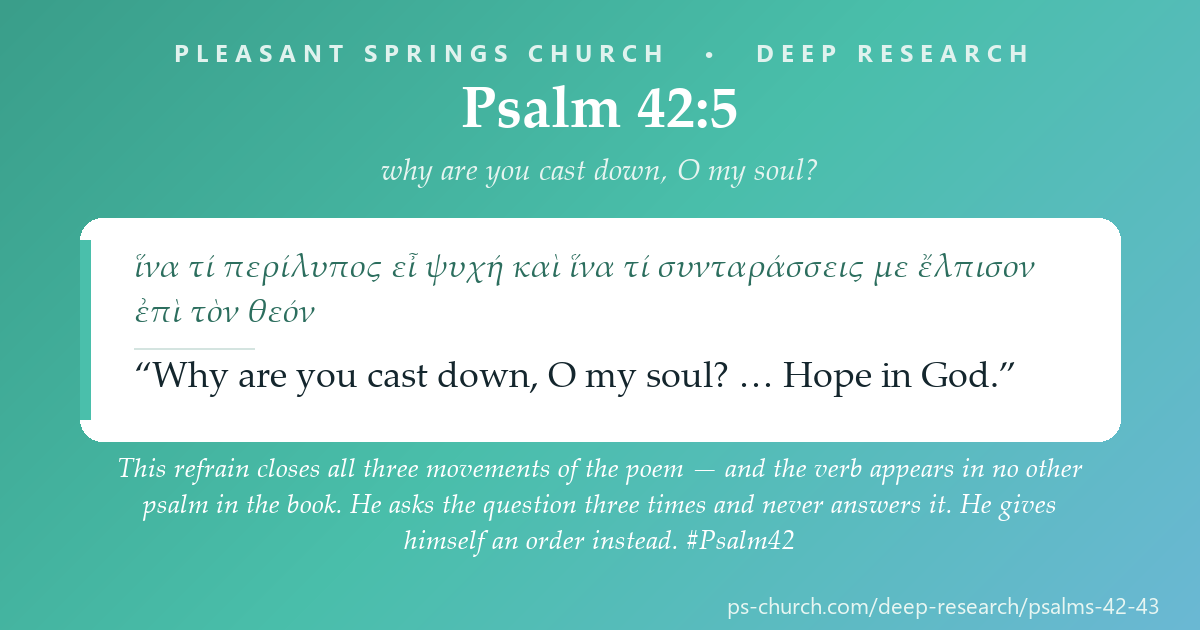
These are printed as two psalms and are almost certainly one poem — and the case does not rest on impression. The refrain "Why are you cast down, O my soul… hope in God" closes each of three movements, at 42:5, 42:11 and 43:5 — and searched across all 150 psalms, its distinctive verb occurs in those three verses and nowhere else in the book. Psalm 43 also has no title, where its neighbours do; the verse numbering quietly confirms it, since Psalm 42 runs one ahead of English because its title counts as verse 1 and Psalm 43 does not. Rahlfs supplies the missing title — the sixth such Greek addition this shelf has verified. And there is one thing only a two-column reading catches: the Hebrew's three refrains are not quite identical — the first ends the salvation of his face, the other two of my face and my God — and the Greek reads my at all three. A translator's ordinary instinct, tidying a refrain that almost repeats. It also removes the evidence. See the method →
Psalms 42:1–43:5 (selections)
Hebrew · Greek (Rahlfs’ Psalter) · ESV⚠️ First, the refrain. “Why are you cast down, O my soul… hope in God” stands at the end of each of the poem’s three movements — 42:5, 42:11 and 43:5. Searched across all one hundred and fifty psalms: the verb tištōḥăḥî occurs in those three verses and nowhere else in the Psalter. A refrain that binds two chapters and appears in no other psalm.
⚠️ Second, Psalm 43 has no title. It opens straight into the poem — “Vindicate me, O God” — while its neighbours on both sides carry superscriptions. Untitled psalms are rare in this part of the book, and the simplest explanation is that 43 never had one because it was never a separate psalm.
There is a small confirming detail in the numbering: Psalm 42 runs one verse ahead of English because its title counts as verse 1; Psalm 43 does not, because it has no title to count.
⚠️ Third — and Rahlfs supplies one for it. The Greek prefixes ψαλμὸς τῷ Δαυιδ, “a psalm of David”, where the Hebrew has nothing. That is the sixth title-plus this shelf has verified, after Psalms 24, 27, 29, 33 and 144 — and it is the pattern already named there: where the Hebrew leaves a psalm bare, the Greek tradition tends to supply something.
⚠️ And the Greek does something else worth catching: its three refrains do not vary.
The Hebrew’s three refrains are not quite identical. The first ends yəšûʿōṯ pānāyw — the salvation of his face. The second and third end yəšŭʿōṯ pānay wēʾlōhāy — the salvation of my face and my God.
Rahlfs reads my face and my God at all three. Verified directly: his first and third refrains are word-for-word identical, and the second differs only in one noun form.
So a variation the Hebrew carries, the Greek does not. Whatever lies behind that, the effect on a reader is the same: the Greek column cannot show you that this refrain did not quite repeat. Whether the Hebrew’s first refrain is an early variant or a copying slip cannot be determined, and this page does not decide.
The Shape of the Passage
RefrainThe refrain is the poem’s argument, not its decoration. Each time, the speaker turns and interrogates himself: why are you cast down, O my soul? He does not answer the question. He gives an instruction instead — hope in God — and then the poem carries on being distressed.
Nothing is resolved between the refrains. The third one is identical to the second, after five more verses. The psalm does not depict a man talking himself out of grief; it depicts a man talking to himself while still in it, three separate times.
And this is where Book II begins. Book I closed at Psalm 41 with a doxology; this is the first psalm of the second collection — and it opens with a man who cannot get to the temple.
Book II opens here. See Psalms 38–41 for the doxology that closed Book I. The refrain count on this page was taken across all 150 psalms.
Author
He is homesick for a building. These things I remember… the throng, the glad shouts, the festal procession. The grief is specific and it has a floor plan.
He interrogates himself three times and never answers. Why are you cast down? Each time he issues an instruction instead of a reply, and each time the poem goes on being distressed.
And he asks to be led rather than rescued. Send out your light and your truth; let them lead me. What he wants is a route back.
Audience
People a long way from where they worship. The northern geography — Jordan, Hermon, Mizar — puts the speaker far from Jerusalem. The psalm is for anyone who can picture the place they cannot get to.
People being asked a question they cannot answer. Where is your God? Quoted twice, and the poem never rebuts it.
And people who needed permission to still be sad at the end. The third refrain is identical to the second. Nothing was fixed in between.
Orient on the five books, on the Korah collection, and on refrains.
Search by topic: Sons of Korah; Book II of the Psalter; refrain and strophe; Mount Hermon and Mizar; pilgrimage; where is your God.
Which articles are relevant?
- Anchor Bible Dictionary — “Korah, Sons of,” “Psalms, Book of,” “Hermon,” “Pilgrimage.”
- Dictionary of the OT: Wisdom, Poetry & Writings (IVP) — “Editorial Criticism,” “Lament,” “Zion,” “Poetics: Refrain.”
- NIDOTTE / TDOT — עָרַג (ʿāraģ, to pant / long), שָׁחַח (šāḥaḥ, to be bowed down), תְּהוֹם (təhōm, deep), יָחַל (yāḥal, to wait / hope).
- On the Greek — the NETS Psalms introduction, and note that Rahlfs supplies a title for Psalm 43 where the Hebrew has none.
Bibliography surfaced:
- Gerald H. Wilson, The Editing of the Hebrew Psalter — on the book divisions and the Korah collection.
- Hossfeld and Zenger, Psalms 2 (Hermeneia) — this volume covers 51–100, so it does not reach Psalms 42–43; use Goldingay here.
- John Goldingay, Psalms 42–89; Robert Alter, The Book of Psalms.
A refrain that binds, and a translator's tidy-up.
The count and the levelling are the two verifiable things on this page.
Which parallels shed light on these psalms?
The geography is northern and specific. The land of Jordan and of Hermon, from Mount Mizar — Hermon is at the far northern edge of Israel’s territory, near the Jordan’s headwaters, and Mizar is otherwise unknown. The psalm places its speaker about as far from Jerusalem as the land allows, which is why the water imagery turns dangerous: he is at the sources of a river, and describes himself as drowning in it.
“Where is your God?” is a taunt with a long life. It appears twice in this poem, and again at Psalm 79:10, Psalm 115:2 and Joel 2:17. It is the standard jeer at a people whose God has no image — and the psalm records it without answering it.
And refrains in Hebrew poetry are usually exact. Which is what makes the small variation here worth noticing, and what makes the Greek’s levelling of it a natural instinct. A translator meeting a refrain that almost repeats will tend to make it repeat.
- Psalm 79:10; 115:2; Joel 2:17 → Psalm 42:3, 10. Where is your God? — the recurring taunt.
- Jonah 2:3 → Psalm 42:7. All your breakers and your waves passed over me — Jonah prays this psalm’s line from inside the fish.
- Psalm 42:5 → Matthew 26:38; John 12:27. My soul is very sorrowful — Rahlfs’ word here is περίλυπος, and that is the word in Gethsemane. Stated; the seeing is left to the reader.
- Psalm 43:3 → Psalm 27:1. Send out your light; the Lord is my light — see Psalms 26–28.
- Psalms 42–49 are the first Korah collection. Book II opens with a group attributed to temple singers, not to David.
The argument that Psalms 42 and 43 are one poem is unusually strong, and it is checkable.
• The refrain occurs three times and nowhere else in the book. Searched across all one hundred and fifty psalms for the distinctive verb tištōḥăḥî — “are you bowed down”. Three hits: 42:5, 42:11, 43:5. Nothing else in the Psalter uses it.
• Psalm 43 has no superscription, where its neighbours do — and the verse numbering confirms it: Psalm 42 runs one ahead of English because its title is counted as verse 1, and Psalm 43 does not, because there is no title to count.
• The three movements are the right length, each closing on the refrain, producing a poem of three balanced strophes rather than one long psalm and one short fragment.
⚠️ Now the part only a two-column reading finds.
The Hebrew’s three refrains are not quite identical. The first ends the salvation of his face; the second and third end the salvation of my face and my God.
Rahlfs has my face and my God in all three. His first and third are word-for-word identical; the second differs only in the form of one noun. The Greek refrains do not vary.
A refrain ought to repeat, and a text where it almost does looks like a text with a slip in it — but whatever lies behind the difference, the Greek column removes the evidence. Whether the Hebrew’s first refrain preserves an older variant, or records a copying error the tradition then kept, cannot be determined from either column — and this page does not decide.
A verb found in three verses, and a taunt asked twice.
Read the three refrains in Hebrew. The first is not quite the same as the other two.
Counted here, not assumed:
- The refrain verb occurs in exactly three verses in the whole Psalter — 42:5, 42:11, 43:5. Searched across all 150 psalms.
- The Hebrew refrains are not identical. The first ends his face; the second and third end my face and my God.
- Rahlfs reads my face and my God in all three, his first and third being word-for-word identical. The Greek refrains do not vary.
- Psalm 43 has no Hebrew title; Rahlfs supplies a psalm of David. The sixth title-plus verified on this shelf — with Psalms 24, 27, 29, 33 and 144.
- Psalm 42 is offset against English by one verse; Psalm 43 is not. 42 has a title to count; 43 does not.
- Taʿărōģ occurs only here and at Joel 1:20.
“Are you bowed down, cast down.” The refrain’s distinctive verb, and it occurs in exactly these three verses and nowhere else in the Psalter — verified across all 150. The root describes being physically bent low. Rahlfs has περίλυπος, deeply grieved — the word used in Gethsemane.
“Pants, longs.” A rare verb, used of an animal in distress — it occurs only here and at Joel 1:20, where the beasts pant for water in a drought. The image is not gentle yearning but an animal in trouble. Rahlfs has ἐπιποθεῖ, which is milder.
“Deep calls to deep.” The same word as the primeval deep of Genesis 1:2 — this library met it at Psalm 36:6, where God’s judgements are called the great deep. Here the speaker is inside it: the waters that measure God’s justice elsewhere are drowning him.
“Wait, hope.” An imperative the speaker addresses to himself, three times. The verb means to wait with expectation — it is not optimism but endurance. Note what the psalm does not do: it never answers its own question. It issues an order and carries on.
“Where is your God?” Quoted twice in the poem, and never rebutted. The taunt recurs at Psalm 79:10, Psalm 115:2 and Joel 2:17 — the standard jeer at people whose God cannot be pointed to. The psalm records the question and answers it only by continuing to address him.
A line prayed from inside a fish, and a word from Gethsemane.
Read Jonah 2:3 and Psalm 42:7. Jonah is quoting.
Which cross-references matter?
- Jonah 2:3 → Psalm 42:7. All your breakers and your waves passed over me. Jonah prays this psalm’s line.
- Matthew 26:38; John 12:27 → Psalm 42:5. Rahlfs’ περίλυπος is the Gethsemane word, and John 12:27’s “now is my soul troubled” stands close to this refrain. Stated; the seeing is left to the reader.
- Psalm 79:10; 115:2; Joel 2:17 → Psalm 42:3, 10. The taunt.
- Joel 1:20 → Psalm 42:1. The only other place the panting verb occurs — of animals in a drought.
- Psalm 36:6 → Psalm 42:7. The deep — see Psalm 36.
- Psalms 38–41 → Psalm 42. Book I ends; Book II begins — see that study.
Three open questions.
Goldingay covers Psalms 42–89; note that Hermeneia’s second volume starts at 51.
Commentaries & studies:
- John Goldingay, Psalms 42–89 — the commentary to use for this stretch.
- Robert Alter, The Book of Psalms; Gerald H. Wilson, The Editing of the Hebrew Psalter.
- NETS Psalms, with Rahlfs — for the supplied title and the levelled refrain.
Three things reported as unsettled:
- Why the Hebrew’s first refrain differs. An older variant, or a copying slip the tradition preserved — and the Greek’s levelling removes the evidence rather than settling it.
- Where Mount Mizar is. Named once in the Bible and otherwise unknown.
- Whether the two chapters were ever separate. The refrain count, the missing title and the three-strophe shape all point one way; the manuscript tradition nonetheless prints two, and this page reports both facts.
A question asked three times and never answered.
Name what you learned, why it matters, and one concrete response.
What should we carry away — and do?
- Nothing is resolved between the refrains. The third is identical to the second, after five more verses of complaint. The psalm does not show a man talking himself out of grief. It shows a man talking to himself while still in it, three separate times.
- He never answers his own question. Why are you cast down? — and instead of a reply he gives an instruction: hope in God. The verb means to wait with expectation. It is endurance, not optimism.
- The homesickness has a floor plan. The throng, the glad shouts, the festal procession. He is not missing God in the abstract; he is missing a building and a crowd he can still picture.
- One concrete response. The poem asks for a route, not a rescue: send out your light and your truth; let them lead me. Ask to be brought back, and be willing for it to take three movements.
Psalm 42:5 · to share
Hebrew + Greek (Rahlfs) + ESVEvery Deep Research page traces its passage across the whole sweep — the Old Testament, the Second-Temple world between the testaments (historical witnesses, not Scripture), and the New Testament. Follow the thread:
Pleasant Springs Church — Deep Research
Research method after Michael S. Heiser’s Bible Research Method (examine dictionaries → ancient literature → important words → textual connections → academic publications → share), with the Pleasant Springs “Author & Audience” foundation. Scripture set in the Hebrew, the Greek editions named on each page and the ESV (Old Testament), and the Greek New Testament and the ESV (New Testament), per the practice of Pleasant Springs Church. Psalms 42–43 research grounded in Goldingay (Psalms 42–89), Alter and Wilson. Note that Hermeneia’s second Psalms volume begins at 51 and does not reach these psalms. Text: Hebrew from the Masoretic text as printed in the editions consulted — Sefaria’s Miqra according to the Masorah; no critical apparatus was consulted for the Hebrew. Greek from Rahlfs’ Greek Psalter (CATSS digitization of Rahlfs 1931). The standing caution for this shelf applies: these pages say “Rahlfs’ Greek Psalter reads…” and never call a Greek reading early or late. ⚠️ The unity argument is built from three computed facts, not from impression. (1) The refrain verb tištōḥăḥî was searched across all one hundred and fifty psalms and occurs in exactly three verses — 42:5, 42:11, 43:5 — and nowhere else in the book. (2) Psalm 43’s lack of a superscription was verified by direct inspection of its first verse, and is corroborated by the numbering: Psalm 42 is offset one verse against English and Psalm 43 is not, because there is no title to count. (3) Rahlfs’ supplied title (ψαλμὸς τῷ Δαυιδ) was verified as having no Hebrew counterpart — the sixth such title-plus recorded on this shelf. ⚠️ The refrain variation was verified by comparing all three verses in both columns: the Hebrew’s first refrain ends pānāyw (his face) against pānay wēʾlōhāy (my face and my God) in the other two, while Rahlfs reads the latter at all three, his first and third being word-for-word identical. The page describes this as an ordinary translator’s instinct, notes that it removes evidence, and explicitly declines to decide whether the Hebrew’s first refrain is an older variant or a preserved slip. Typology is handled per the house position: what the text says, what the New Testament itself draws, and what we see from this side of the cross — with the seeing left to the reader.
Scripture quotations marked ESV are from the ESV® Bible (The Holy Bible, English Standard Version®), © 2001 by Crossway, a publishing ministry of Good News Publishers. ESV Text Edition: 2016. Used by permission. All rights reserved. The ESV text may not be quoted in any publication made available to the public by a Creative Commons license, and the ESV may not be translated in whole or in part into any other language. www.esv.org
|
Did this study bless you today? 💚 Give to Support PS Church100% of gifts go to the General Fund — thank you. |