This is the flattest accusation against God in the Psalter, and it is never withdrawn. You have rejected us… you have made us like sheep for slaughter… you have sold your people for a trifle. Fourteen verses in which God is the grammatical subject of the damage — and then a protest of innocence that almost no other lament makes: we have not forgotten you; we have not been false to your covenant. There is no confession in this psalm and no answer at the end of it. It stops on an imperative. And at verse 18 the two traditions disagree about who did the swerving: the Hebrew says our steps did not depart from your way — a third-person verb, part of the defence — while the Greek reads and you turned our paths aside, second person, God as agent. Inside a psalm already blaming God for everything else, the Greek drops one more charge into the middle of the alibi. Verse 22 is quoted at Romans 8:36 — and the common claim that Paul reproduces the Greek word for word is off by exactly one word. See the method →
Psalm 44:1–26 (selections)
Hebrew · Greek (Rahlfs’ Psalter) · ESV⚠️ And at verse 18 the two traditions disagree about who did the swerving.
The Hebrew reads wattēṭ ʾăšurênû — a third-person feminine verb whose subject is our steps: “nor have our steps departed from your way.” It is part of the psalm’s protest of innocence.
Rahlfs reads ἐξέκλινας τὰς τρίβους ἡμῶν — a second-person aorist active with our paths as its object: “and you turned our paths aside from your way.”
The Hebrew says we did not stray. The Greek says God bent us off the road. In a psalm that is already accusing God of everything else, the Greek adds one more charge — and puts it in the middle of the innocence claim. Reported; neither reading is called earlier.
⚠️ Verse 22 is quoted at Romans 8:36 — and one common way of describing that quotation is slightly too strong.
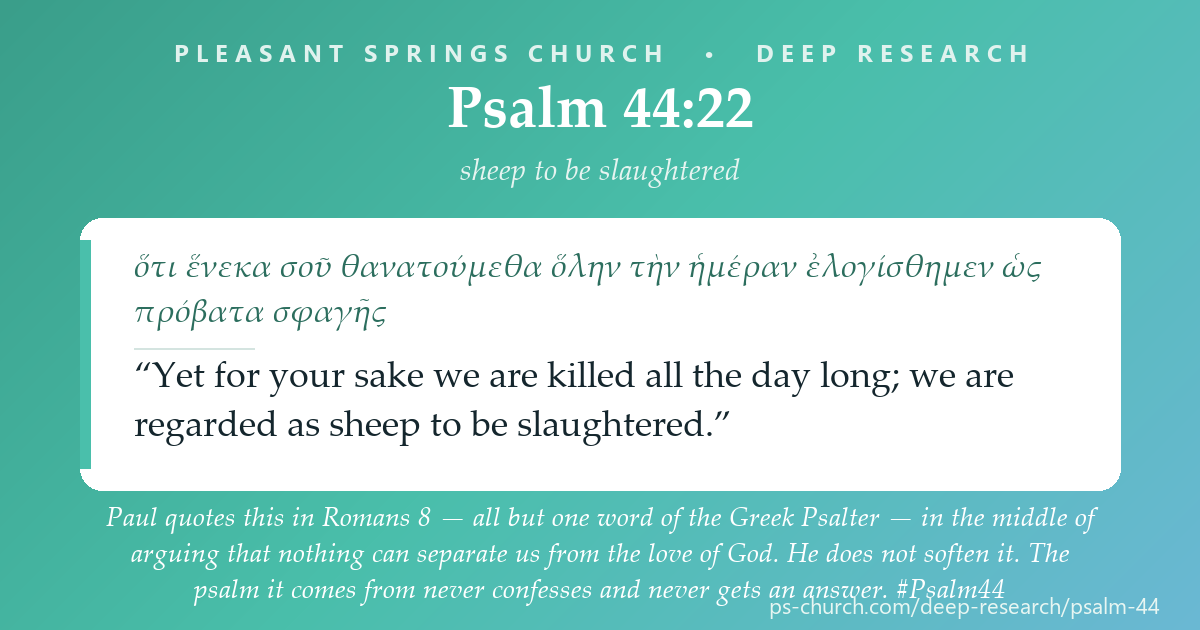
It is often said that Paul reproduces the Greek Psalter word for word. He very nearly does: ὅτι ἕνεκεν σοῦ θανατούμεθα ὅλην τὴν ἡμέραν, ἐλογίσθημεν ὡς πρόβατα σφαγῆς against Rahlfs’ ὅτι ἕνεκα σοῦ θανατούμεθα… — identical except that Rahlfs has ἕνεκα where Paul has ἕνεκεν.
That is a trivial difference of form and it is still a difference, and this page says “all but one word” rather than “word for word”. The substance is untouched: Paul is quoting the Greek, and the line he takes is the one where the psalm says the suffering is for God’s sake.
⚠️ Two more divergences worth having. At verse 26 the Hebrew asks God to redeem for the sake of your steadfast love; Rahlfs reads for the sake of your name, and supplies a vocative κύριε the Hebrew does not have. And the Greek title adds a psalm, where the Hebrew heading has no such word — the seventh title-plus recorded on this shelf.
The Shape of the Passage
SequenceThe claim in verses 17–18 is the hinge, and it is extraordinary. All this has come upon us, though we have not forgotten you, and we have not been false to your covenant. The psalm asserts national innocence and then demands an explanation — which is why it sits uncomfortably beside Psalm 37’s confidence that the righteous are not forsaken, and why the two belong in the same collection.
And the accusation is grammatical, not merely emotional. Through verses 9–16 God is the subject of nearly every verb of harm: you have rejected, you have made, you have sold, you have made us a byword. Five consecutive Hebrew verses open with the same second-person form, two of them with the same word — an anaphora the Greek preserves by repeating its verb too.
A solo study. Psalm 44 sits in the Elohistic Psalter and never uses the divine name YHWH — not once in twenty-six verses. Rahlfs nonetheless has κύριε twice, and only one of the two answers anything in the Hebrew.
Author
He does not confess. We have not forgotten you; we have not been false to your covenant. Almost every other lament in the Psalter concedes something. This one denies the charge and asks for an explanation.
He makes God the subject of the damage. Fourteen verses of you have — rejected, sold, scattered, made a byword. The grammar is the accusation.
And he tells God to wake up. Awake! Why are you sleeping, O Lord? The psalm ends four verses later with no reply.
Audience
People who had lost a war they thought they were owed. You have made us like sheep for slaughter and scattered us among the nations. The psalm assumes a defeat that looked theologically impossible.
People who had been taught the older story. We have heard with our ears; our fathers have told us. The complaint is sharper because the earlier testimony was believed.
And, later, people being killed for their faith. Paul quotes verse 22 in Romans 8 and applies it to Christians under pressure — without softening it.
Orient on communal lament, on the Elohistic Psalter, and on Korah.
Search by topic: communal lament; national defeat; Elohistic Psalter; Sons of Korah; maskil; covenant faithfulness.
Which articles are relevant?
- Anchor Bible Dictionary — “Lament,” “Korah, Sons of,” “Covenant,” “War, Holy.”
- Dictionary of the OT: Wisdom, Poetry & Writings (IVP) — “Lament, Communal,” “Elohistic Psalter,” “Theodicy,” “Suffering.”
- NIDOTTE / TDOT — נָטָה (nāṭāh, to turn aside), חֶסֶד (ḥeseḏ), מַשְׂכִּיל (maśkîl), תַּנִּים (tannîm, jackals).
- On the Greek — the NETS Psalms introduction, and Romans 8:35–39, where Paul quotes verse 22. See the reference page.
Bibliography surfaced:
- John Goldingay, Psalms 42–89 — the commentary for this stretch.
- Robert Alter, The Book of Psalms; Gerald H. Wilson, The Editing of the Hebrew Psalter.
- Beale and Carson, Commentary on the NT Use of the OT — for Romans 8:36.
A lament that refuses to confess, and a quotation that is nearly exact.
The verse 18 divergence is the finding; the Romans 8:36 precision is the correction.
Which parallels shed light on this psalm?
Communal laments normally include a confession, and this one does not. The standard shape — complaint, confession, petition, vow of praise — is visible across the Psalter and in comparable Mesopotamian city-laments. Psalm 44 keeps the complaint and the petition, removes the confession, and drops the closing vow. It is one of very few psalms that ends on a bare imperative.
The psalm sits in the Elohistic Psalter. Across Psalms 42–83 the divine name YHWH is largely replaced by Elohim — and in Psalm 44 it does not appear at all. The Greek, working from a text without it, nonetheless supplies κύριε twice: once rendering the Hebrew’s ʾădōnāy, and once at the very last verse with nothing behind it.
And “place of jackals” is a picture of ruin. Jackals inhabit abandoned cities throughout the prophets — the animal is shorthand for a site where people used to live. Rahlfs drops the animal entirely and reads a place of ill-treatment, keeping the desolation and losing the picture.
- Romans 8:36 → Psalm 44:22. Paul quotes the Greek — all but one word, and that word a mere variant form of the same preposition. See the reference page.
- Psalm 37 → Psalm 44. Psalm 37 says the righteous are never forsaken; Psalm 44 says they have been. See that study, where the same tension is worked from the other side.
- Lamentations 5 → Psalm 44. Another communal lament ending without resolution.
- Isaiah 34:13; Jeremiah 9:11 → Psalm 44:19. Jackals in ruined places.
- Deuteronomy 4:34–38 → Psalm 44:1–3. The inherited testimony — not by their own sword.
- Psalm 78 → Psalm 44:1. What our fathers have told us — the same transmission formula, put to opposite use.
Two things on this page needed checking rather than repeating, and both came back interesting.
• Verse 18: the Hebrew and the Greek disagree about the agent.
Hebrew: wattēṭ ʾăšurênû minnî ʾorḥeḵā — a third-person feminine verb, with our steps as its subject: “nor have our steps departed from your way.” Part of the innocence claim.
Greek: καὶ ἐξέκλινας τὰς τρίβους ἡμῶν ἀπὸ τῆς ὁδοῦ σου — a second-person aorist active, with our paths as direct object: “and you turned our paths aside from your way.”
The Hebrew protests that the people did not stray. The Greek says God moved them. Inside a psalm already accusing God of everything else, that is a further charge dropped into the middle of the defence. Neither reading is called earlier here.
• Romans 8:36: nearly, but not quite, word for word.
It is frequently said that Paul reproduces the Greek Psalter exactly at this verse. The two texts agree in every word but one.
Rahlfs 43:23: ὅτι ἕνεκα σοῦ θανατούμεθα ὅλην τὴν ἡμέραν, ἐλογίσθημεν ὡς πρόβατα σφαγῆς
Romans 8:36: ὅτι ἕνεκεν σοῦ θανατούμεθα ὅλην τὴν ἡμέραν, ἐλογίσθημεν ὡς πρόβατα σφαγῆς
The difference is between two forms of the same preposition and changes nothing at all. But “word for word” is a claim that can be checked, and on this text it is off by one — so this page says all but one word. The substance stands: Paul is quoting the Greek, and he takes the psalm’s hardest line — that the killing is for God’s sake — and applies it to the church without softening it.
A verb that changes who is to blame.
Read verse 18 in both columns and ask who the subject is.
Counted here, not assumed:
- Hebrew and Rahlfs give Psalm 44 twenty-seven verses; English has twenty-six. Offset of one; the title is Hebrew verse 1.
- The divine name YHWH occurs ZERO times in Hebrew Psalm 44. Rahlfs has κύριε twice — once for the Hebrew’s ʾădōnāy, and once at the last verse as a bare plus.
- GREEK TITLE-PLUS: Rahlfs adds ψαλμός, where the Hebrew heading has no corresponding word. The seventh on this shelf.
- At 44:18 the Hebrew verb is third person with our steps as subject; the Greek is second person with our paths as object.
- Romans 8:36 agrees with Rahlfs in every word but one — Paul has ἕνεκεν, Rahlfs ἕνεκα. “Word for word” is off by one; this page says “all but one word.”
- No acrostic and no refrain. The nearest thing is all the day long, three times in both columns. Five consecutive Hebrew verses open with the same second-person form, two with the identical word — an anaphora Rahlfs preserves by repeating his verb.
“Nor have our steps turned aside.” A third-person feminine verb with our steps as subject — the people are the ones who did not stray. Rahlfs reads a second-person active with our paths as object: “you turned our paths aside.” Subject, object and blame all move.
“For your sake we are killed.” The preposition is the psalm’s sharpest word — the dying is not incidental to loyalty but caused by it. Rahlfs has ἕνεκα σοῦ θανατούμεθα, and Paul reproduces the clause at Romans 8:36 with a single variant form of that preposition.
“Steadfast love.” The psalm’s last word in Hebrew, and the ground of its final appeal — redeem us for the sake of your ḥeseḏ. Rahlfs reads for the sake of your name instead, and adds a vocative κύριε with nothing behind it. Two different grounds of appeal: God’s commitment, or God’s reputation.
“Jackals.” The prophets’ standard inhabitant of a ruined city — the animal that moves in when people move out. “You have crushed us in the place of jackals” means you left us where cities go to die. Rahlfs drops the animal and reads a place of ill-treatment, keeping the desolation and losing the picture.
An unexplained heading on thirteen psalms, probably connected with insight or skill. Rahlfs renders it εἰς σύνεσιν, for understanding — and then adds ψαλμός, which answers nothing in the Hebrew. The seventh Greek title-plus recorded on this shelf.
A psalm that will not confess, quoted about martyrdom.
Read Romans 8:35–39 and notice that Paul does not soften the psalm.
Which cross-references matter?
- Romans 8:36 → Psalm 44:22. Quoted from the Greek, and applied to Christians under persecution.
- Psalm 37 → Psalm 44. “I have not seen the righteous forsaken” against “you have rejected us.” See Psalm 37.
- Deuteronomy 4:34–38 → Psalm 44:1–3. The inherited testimony.
- Lamentations 5 → Psalm 44:23–26. Another lament that ends without an answer.
- Isaiah 34:13; Jeremiah 9:11 → Psalm 44:19. Jackals in ruins.
- Psalm 74; Psalm 79 → Psalm 44. The other great national laments — both on this library’s list.
Three open questions.
Goldingay for the Hebrew; Beale and Carson for Romans 8.
Commentaries & studies:
- John Goldingay, Psalms 42–89; Robert Alter, The Book of Psalms.
- Beale and Carson, Commentary on the NT Use of the OT — for Romans 8:36.
- Gerald H. Wilson, The Editing of the Hebrew Psalter — on the Elohistic Psalter.
Three things reported as unsettled:
- Whether 44:18 makes the people or God the agent. The Hebrew says the people did not stray; the Greek says God moved them. Neither can be shown earlier.
- What historical defeat the psalm refers to. Proposals span several centuries, and the psalm names nothing.
- Whether the psalm’s claim of innocence is corporate or representative. It asserts national faithfulness in the plural, which is a stronger claim than any individual lament makes.
A lament with no confession in it.
Name what you learned, why it matters, and one concrete response.
What should we carry away — and do?
- This psalm does not confess, and Scripture keeps it. We have not forgotten you; we have not been false to your covenant. Almost every other lament concedes something. This one denies the charge and demands an explanation — and it is in the book.
- It ends on an imperative with no reply. Rise up; come to our help. No resolution, no vow of praise, no answer. The psalm stops.
- Paul quotes its hardest line and does not soften it. For your sake we are killed all the day long. Romans 8 puts that sentence in the middle of its argument that nothing can separate us from the love of God — not as a contradiction but as the conditions.
- One concrete response. The psalm’s last appeal is to God’s ḥeseḏ — his commitment — where the Greek appeals to his name. When you have no case to make from your own record, those are the two grounds left.
Psalm 44:22 · to share
Hebrew + Greek (Rahlfs) + ESVEvery Deep Research page traces its passage across the whole sweep — the Old Testament, the Second-Temple world between the testaments (historical witnesses, not Scripture), and the New Testament. Follow the thread:
Pleasant Springs Church — Deep Research
Research method after Michael S. Heiser’s Bible Research Method (examine dictionaries → ancient literature → important words → textual connections → academic publications → share), with the Pleasant Springs “Author & Audience” foundation. Scripture set in the Hebrew, the Greek editions named on each page and the ESV (Old Testament), and the Greek New Testament and the ESV (New Testament), per the practice of Pleasant Springs Church. Psalm 44 research grounded in Goldingay (Psalms 42–89), Alter and Wilson, with Beale and Carson for Romans 8:36. Text: Hebrew from the Masoretic text as printed in the editions consulted — Sefaria’s Miqra according to the Masorah; no critical apparatus was consulted for the Hebrew. Greek from Rahlfs’ Greek Psalter (CATSS digitization of Rahlfs 1931), with the file’s morphological codes used to check parsing. The standing caution for this shelf applies: these pages say “Rahlfs’ Greek Psalter reads…” and never call a Greek reading early or late. ⚠️ The verse 18 divergence was verified from the parsing codes: the Greek verb is coded aorist active second singular with our paths accusative, against a Hebrew third-feminine form whose subject is our steps — so the Hebrew denies that the people strayed and the Greek makes God the one who moved them. Neither reading is called earlier. ⚠️ A common overstatement is corrected: Romans 8:36 is often said to reproduce the Greek Psalter word for word, but Rahlfs reads ἕνεκα where Paul reads ἕνεκεν — a trivial variant of the same preposition that changes nothing, and still a difference — so this page says “all but one word.” Counts verified directly: 27 verses in MT and Rahlfs against 26 in English; zero occurrences of the Tetragrammaton in the Hebrew (the Elohistic Psalter), against two κύριε in Rahlfs of which only one answers anything in the Hebrew; a Greek title-plus (ψαλμός) with no Hebrew counterpart, the seventh recorded on this shelf; all the day long three times in both columns; and five consecutive Hebrew verses opening with the same second-person form, two with the identical word, an anaphora Rahlfs preserves. Further verified divergences reported on the page: 44:8 active we have boasted against a Greek future passive; 44:19 place of jackals against place of ill-treatment; 44:26 for the sake of your steadfast love against for the sake of your name. Typology is handled per the house position: what the text says, what the New Testament itself draws, and what we see from this side of the cross — with the seeing left to the reader.
Scripture quotations marked ESV are from the ESV® Bible (The Holy Bible, English Standard Version®), © 2001 by Crossway, a publishing ministry of Good News Publishers. ESV Text Edition: 2016. Used by permission. All rights reserved. The ESV text may not be quoted in any publication made available to the public by a Creative Commons license, and the ESV may not be translated in whole or in part into any other language. www.esv.org
|
Did this study bless you today? 💚 Give to Support PS Church100% of gifts go to the General Fund — thank you. |