Hebrews 1:8–9 quotes two whole verses of Psalm 45 from the Greek Psalter with not one word changed — twenty words, zero differences. That is rarer than most readers assume; nearly every other New Testament citation on this shelf has turned out to differ somewhere. It also sharpens the old question rather than settling it, because "your throne, O God" is ambiguous in Hebrew and equally ambiguous in Greek — the Greek preserved the puzzle rather than deciding it. Then Psalm 46, and the line everyone knows. "Be still, and know that I am God" is not about quietness. The Hebrew verb harpû means slacken, let drop, leave off — and Rahlfs read it the same way, scholasate, "cease from what you are doing." The verse before has God breaking bows, shattering spears and burning chariots. The command is spoken to combatants. One more thing worth knowing: the familiar claim that Psalm 46 has a threefold refrain marked by its three Selahs does not survive checking. See the method →
Psalms 45:1–46:11 (selections)
Hebrew · Greek (Rahlfs’ Psalter) · ESVChecked word by word across both verses, with accents and punctuation normalised: twenty words, zero differences. That is rarer than most readers assume. This library’s reference page and its Psalm 44 study both had to report near-misses — a changed preposition here, a shortened clause there. Psalm 45:6–7 is the clean case.
Which sharpens the old question about verse 6 rather than settling it. The Hebrew kisʾaḵā ʾĕlōhîm can be read “your throne, O God” — addressing the king as God — or “your throne is God’s”. The Greek is ambiguous in exactly the same way, as this library noted on the reference page. Hebrews takes the first. What the Greek supplied was not a decision but a faithful reproduction of the puzzle.
⚠️ And the Greek title reads the Hebrew’s plural as a singular person. MT calls this šîr yəḏîḏōṯ, “a song of loves” — a feminine plural noun, an ordinary way to say a love song. Rahlfs reads ᾠδὴ ὑπὲρ τοῦ ἀγαπητοῦ — an ode concerning the beloved, singular and masculine. A wedding song’s heading becomes a heading about a person.
⚠️ Psalm 46’s most quoted line does not say what English suggests.
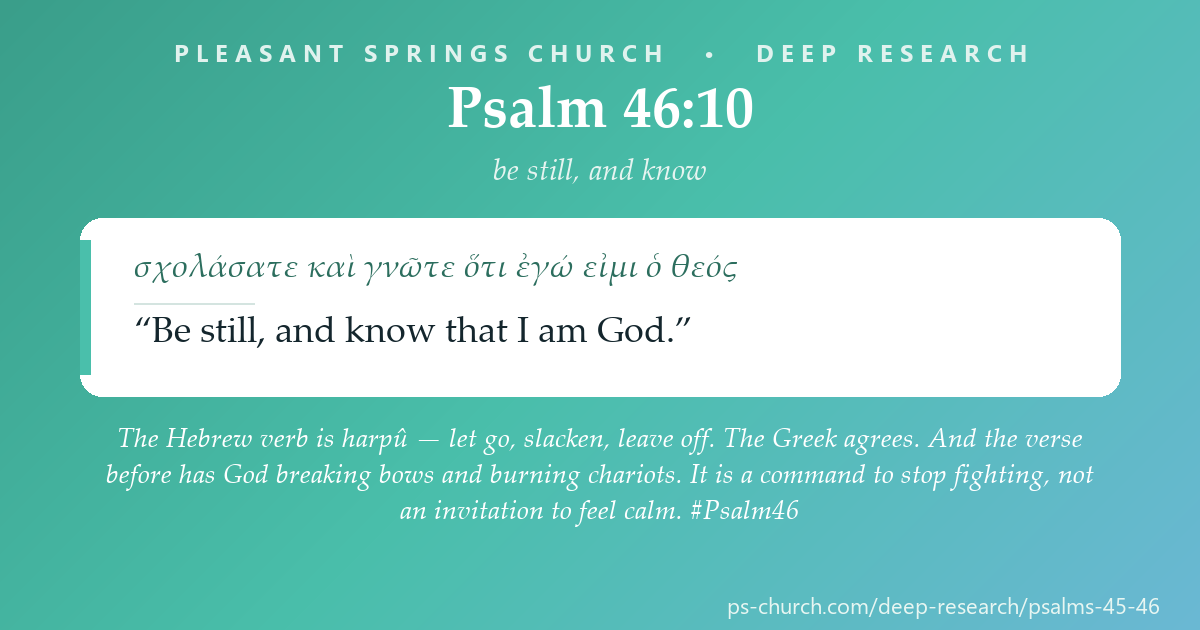
“Be still, and know that I am God” is heard as an invitation to quietness. The Hebrew verb is harpû — a causative imperative from a root meaning to slacken, let drop, leave off. It is closer to “let go” or “stop” than to “be quiet”, and in context it is addressed to nations at war: the preceding verse has God breaking bows and burning chariots.
Rahlfs agrees. He reads σχολάσατε — “be at leisure, cease from your work”, the verb behind our word school, which originally meant leisure. Neither language is asking for silence. Both are telling somebody to stop doing something.
⚠️ One received claim about Psalm 46 does not survive. The psalm is often said to have a threefold refrain marked by its three Selahs. Checked: the refrain does not fall where the Selahs do, and it does not occur three times. The psalm has a repeated line — the Lord of hosts is with us — but the tidy three-strophe scheme is imposed rather than found.
The Shape of the Passage
SequencePsalm 46’s river is worth noticing because Jerusalem does not have one. The city’s water came from a spring through a tunnel; there is no river. The psalm places one there anyway — quiet streams in a city, set against a roaring sea and shaking mountains in the verses before.
And the psalm ends in a battlefield, not a retreat. Bows broken, spears shattered, chariots burning — and into that, let go, and know that I am God. The line is addressed to combatants.
Psalm 45:6 was flagged as ambiguous on this library’s New Testament reference page. That stands — and the Hebrew-to-Greek correspondence is nonetheless exact, which is a different question and is worked here.
Author
He introduces himself, which no other psalmist does. My tongue is like the pen of a ready scribe. The psalm opens by telling you it is a commissioned piece of work.
He addresses a king in language that will not stay inside a wedding. Your throne, O God… God, your God, has anointed you. Two verses, and the referent shifts between them.
And in Psalm 46 he puts a river in a city that has none. Jerusalem was supplied by a spring and a tunnel. The psalm gives it streams anyway, and sets them against a sea that roars.
Audience
Wedding guests, first. Psalm 45 is a court poem for an actual occasion — ivory palaces, myrrh and aloes, the daughter of Tyre with a gift. Whatever else it became, it began there.
People who had seen the ground move. Though the earth gives way and the mountains be moved. Psalm 46 names the worst case in its first three verses and then refuses to be frightened by it.
And armies. The famous line is addressed into a field of broken weapons — not to an anxious individual.
Orient on royal weddings, on Zion theology, and on the river.
Search by topic: royal psalms; marriage and dowry; Zion; the river of God; Gihon spring; Selah; Korahite psalms.
Which articles are relevant?
- Anchor Bible Dictionary — “Marriage,” “Kingship,” “Zion,” “Jerusalem, Water Supply.”
- Dictionary of the OT: Wisdom, Poetry & Writings (IVP) — “Royal Psalms,” “Zion Songs,” “Kingship of God,” “Korah, Sons of.”
- NIDOTTE / TDOT — רָפָה (rāpāh, to slacken / let go), יְדִידוֹת (yəḏîḏōṯ, loves), מַחֲסֶה (maḥăseh, refuge), פֶּלֶג (peleg, channel).
- On the Greek — the NETS Psalms introduction, and Hebrews 1:8–9, which reproduces Rahlfs here without variation.
Bibliography surfaced:
- John Goldingay, Psalms 42–89; Robert Alter, The Book of Psalms.
- Beale and Carson, Commentary on the NT Use of the OT — for Hebrews 1:8–9.
- Gerald H. Wilson, The Editing of the Hebrew Psalter — on the Korahite collection.
A wedding at court, a city with no river, and a verb about letting go.
The Hebrews 1 correspondence is the finding; the harpû correction is the one most readers will want.
Which parallels shed light on these psalms?
Royal wedding poetry is a known genre and Psalm 45 fits it closely. Praise of the king’s beauty and prowess, the arrival of the bride, the mention of foreign gifts, a wish for sons. What is unusual is the address in verse 6 — court poetry across the region could speak of a king in extravagant terms, and this line goes further than most surviving parallels.
Jerusalem has no river, and the psalm knows what it is doing. The city’s water came from the Gihon spring through a rock-cut tunnel — the one thing a besieged city needs and the one geographical feature Jerusalem conspicuously lacks. Psalm 46 places a river whose streams make glad the city of God in the middle of a poem about the sea roaring and mountains falling. The contrast is the point: raging water outside, quiet channels inside.
And harpû is a battlefield word here. The verb means to let the hands drop, to slacken, to leave off — and the previous verse has God destroying weapons. Rahlfs’ σχολάσατε carries the same force: stop what you are doing, from the noun that means leisure and gives English its word school.
- Hebrews 1:8–9 → Psalm 45:6–7. Two full verses, twenty words, no variation from Rahlfs. See the reference page.
- Isaiah 33:21 → Psalm 46:4. There the Lord in majesty will be for us a place of broad rivers and streams. The same imagined waterway for the same waterless city.
- Ezekiel 47:1–12; Revelation 22:1–2 → Psalm 46:4. The river that ends up flowing from the temple, and from the throne. Stated; the seeing is left to the reader.
- 2 Kings 20:20 — Hezekiah’s tunnel. How Jerusalem actually got its water.
- Song of Songs → Psalm 45. The Bible’s other extended love poetry, and on this library’s list for the Wisdom shelf.
Two things about Psalm 46 need correcting, and both are checkable.
• Harpû is not about quietness.
The verb is a causative imperative of a root meaning to sink, slacken, let drop, leave off. It is what you tell someone doing something to stop doing it. Rahlfs read it the same way: σχολάσατε, “be at leisure, cease” — from the noun σχολή, leisure, which is where English gets school.
And the context is not a quiet room. The verse before has God making wars cease, breaking the bow, shattering the spear and burning the chariots. “Let go, and know that I am God” is said to people holding weapons.
“Be still” is a defensible rendering — a slackened hand is a still one — but the English has drifted toward interior calm, and neither the Hebrew nor the Greek is asking for that.
• The “threefold refrain marked by the three Selahs” does not survive.
The psalm is frequently described as three strophes, each closed by the refrain the Lord of hosts is with us and marked by a Selah. Checked against the text: the refrain does not occur three times, and it does not coincide with the Selahs.
The psalm does have a repeated line, and it is genuinely structural. But the tidy three-part scheme is a reconstruction, and some printed Bibles and commentaries supply a third occurrence the Hebrew does not have. This page reports the repetition that is there and declines the scheme that is not.
A verb that means let go, and a throne nobody can parse.
Read Psalm 46:9 before you read 46:10. The context changes the command.
Counted here, not assumed:
- Hebrews 1:8–9 reproduces Rahlfs’ Psalm 44:7–8 across twenty words with zero differences after normalising accents. A clean verbatim case, unlike the near-misses at Psalm 44 and elsewhere.
- Hebrew and Rahlfs give Psalms 45 and 46 eighteen and twelve verses; English gives seventeen and eleven. Offset of one in both.
- Neither psalm has a Greek title-plus — every Greek element answers a Hebrew one. But the Greek re-reads two of them, turning a song of loves into concerning the beloved.
- Psalm 45:6 is ambiguous in Hebrew and equally ambiguous in Greek. The Greek does not resolve it.
- The claim that Psalm 46 has a threefold refrain marked by its three Selahs does not survive checking — the refrain does not occur three times and does not align with the Selahs.
- Both Hebrew harpû and Greek σχολάσατε mean cease activity, not be quiet.
“Let go, slacken, leave off.” A causative imperative from a root meaning to sink or drop — used of hands falling limp and of abandoning a task. In context it addresses people whose weapons have just been destroyed. Rahlfs reads σχολάσατε, be at leisure, cease — from the word that gives English school. Neither language asks for silence.
“A song of loves” — a feminine plural, an ordinary idiom for a love song. Rahlfs reads ᾠδὴ ὑπὲρ τοῦ ἀγαπητοῦ, an ode concerning the beloved — singular and masculine. A genre label becomes a description of a person.
“Your throne, O God” — or “your throne is God’s.” The Hebrew is ambiguous and the Greek reproduces the ambiguity exactly, since Greek can use a nominative with the article as a vocative. Hebrews 1:8 takes it as an address. The Greek did not create that option; it preserved the Hebrew’s.
“Its streams” — the cut channels of an irrigation system, the same word this library met at Psalm 1:3 and Psalm 119:136. Jerusalem had no river; it had a spring and a tunnel. The psalm supplies quiet channels inside the city and sets them against a roaring sea outside.
“Refuge and strength.” A maḥăseh is a shelter you run to — a place of escape, not a fortification you hold. Rahlfs has καταφυγή, a place to flee to, which keeps that exactly. The phrase behind Luther’s hymn is about running somewhere, not standing somewhere.
A throne in Hebrews, and a river that keeps reappearing.
Read Hebrews 1:8–9 beside Psalm 45:6–7 in Greek. Nothing has moved.
Which cross-references matter?
- Hebrews 1:8–9 → Psalm 45:6–7. Verbatim across two verses.
- Isaiah 33:21 → Psalm 46:4. The imagined river.
- Ezekiel 47:1–12; Revelation 22:1–2 → Psalm 46:4. Stated; the seeing is left to the reader.
- Psalm 2 → Psalm 45. The two great royal psalms of Books I–II — see Psalm 2 and Psalms 1–2.
- Psalm 48 → Psalm 46. The other Zion song in this group, and the next study on this shelf.
- Genesis 12:1 → Psalm 45:10. Forget your people and your father’s house — the same demand made of Abraham, here made of a bride.
Three open questions.
Goldingay for the Hebrew; Beale and Carson for Hebrews 1.
Commentaries & studies:
- John Goldingay, Psalms 42–89; Robert Alter, The Book of Psalms.
- Beale and Carson, Commentary on the NT Use of the OT — for Hebrews 1:8–9.
- NETS Psalms, with Rahlfs — for the re-read titles.
Three things reported as unsettled:
- Whether Psalm 45:6 addresses the king as God. Ambiguous in Hebrew and in Greek; Hebrews takes one option and the psalm does not force it.
- What occasion Psalm 45 was written for. A specific royal wedding is assumed by the content, and no king is named.
- How Psalm 46 divides. The three-strophe scheme is not supported by the refrain or the Selahs, and no alternative division is obviously right.
A command to stop, said on a battlefield.
Name what you learned, why it matters, and one concrete response.
What should we carry away — and do?
- “Be still” means let go. The Hebrew verb is about slackening the hands, and the Greek agrees. It is spoken over broken bows and burning chariots, to people who were fighting. The command is to stop, not to feel calm.
- Hebrews quotes two whole verses without changing a word. That is rarer than it sounds — most New Testament citations of the Psalms differ somewhere. This one does not.
- The psalm puts a river in a city that has none. Jerusalem was fed by a spring through a tunnel. Psalm 46 gives it quiet streams anyway, set against a sea that roars.
- One concrete response. The refuge word means a place you run to, not a wall you hold. Stop defending the position and go somewhere.
Psalm 46:10 · to share
Hebrew + Greek (Rahlfs) + ESVEvery Deep Research page traces its passage across the whole sweep — the Old Testament, the Second-Temple world between the testaments (historical witnesses, not Scripture), and the New Testament. Follow the thread:
Pleasant Springs Church — Deep Research
Research method after Michael S. Heiser’s Bible Research Method (examine dictionaries → ancient literature → important words → textual connections → academic publications → share), with the Pleasant Springs “Author & Audience” foundation. Scripture set in the Hebrew, the Greek editions named on each page and the ESV (Old Testament), and the Greek New Testament and the ESV (New Testament), per the practice of Pleasant Springs Church. Psalms 45–46 research grounded in Goldingay (Psalms 42–89), Alter and Wilson, with Beale and Carson for Hebrews 1. Text: Hebrew from the Masoretic text as printed in the editions consulted — Sefaria’s Miqra according to the Masorah; no critical apparatus was consulted for the Hebrew. Greek from Rahlfs’ Greek Psalter (CATSS digitization of Rahlfs 1931). The standing caution for this shelf applies: these pages say “Rahlfs’ Greek Psalter reads…” and never call a Greek reading early or late. ⚠️ The Hebrews 1:8–9 correspondence was checked word by word with accents normalised: twenty words across two verses, zero differences — explicitly contrasted on the page with the near-misses recorded at Psalm 44 (Rom 8:36 differs by one preposition form) and on the reference page. The ambiguity of 45:6 is reported as standing in both languages, consistent with what that reference page already says, with the observation that the Greek reproduces the puzzle rather than resolving it. ⚠️ Two corrections are carried here. (1) Harpû at 46:10 is a causative imperative meaning slacken / let go / leave off, and Rahlfs’ σχολάσατε means cease from activity — neither asks for silence, and the preceding verse supplies a battlefield context. “Be still” is described as defensible but drifted. (2) The widely-repeated claim that Psalm 46 has a threefold refrain marked by its three Selahs does not survive checking — the refrain neither occurs three times nor aligns with the Selahs, and the page reports the repetition that exists while declining the scheme that does not. Verse counts verified in all three columns (Hebrew and Rahlfs 18/12; English 17/11). Neither psalm carries a Greek title-plus, though the Greek re-reads two title elements. Typology is handled per the house position: what the text says, what the New Testament itself draws, and what we see from this side of the cross — with the seeing left to the reader.
Scripture quotations marked ESV are from the ESV® Bible (The Holy Bible, English Standard Version®), © 2001 by Crossway, a publishing ministry of Good News Publishers. ESV Text Edition: 2016. Used by permission. All rights reserved. The ESV text may not be quoted in any publication made available to the public by a Creative Commons license, and the ESV may not be translated in whole or in part into any other language. www.esv.org
|
Did this study bless you today? 💚 Give to Support PS Church100% of gifts go to the General Fund — thank you. |