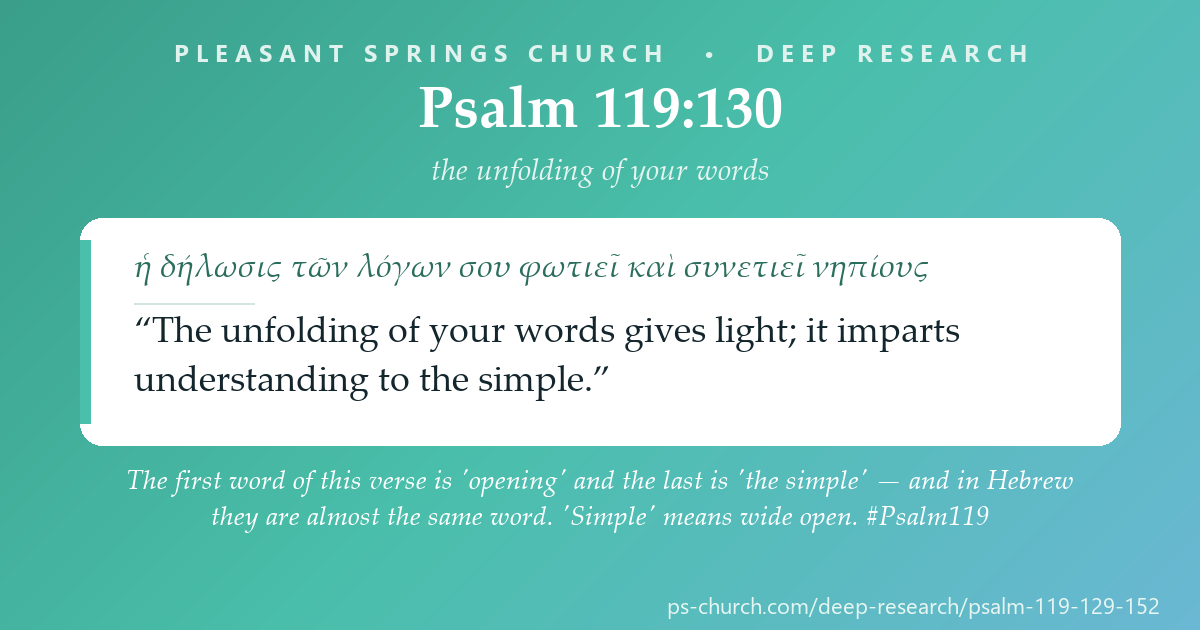
Verse 130 is a small masterpiece that no translation can carry. The stanza's letter is pe, and the verse opens on pētaḥ — an opening, the word for a doorway — and closes on pətāyîm, the simple. Two words, same letter, almost the same sound, at either end of the line — and simple in Hebrew means wide open, someone not yet shut. The opening opens the open. The claim is not that God's words are simple; it is that unfolding them gives light, and that what it takes to receive it is not cleverness but not being closed. This section also carries the psalm's clearest written-versus-read variant. At verse 147 the consonants say your words and the reading tradition says your word — and the Greek sides with what is written. That shows the plural was already old when the Masoretes recorded it. It does not show which is original, because a translator working from unpointed consonants would produce the plural either way — and this page says so rather than pressing the point. Part 5 of 6. See the method →
Psalm 119:129–152 (selections)
Hebrew · Greek (Rahlfs’ Psalter) · ESVSo the claim is not that God’s words are simple. It is that opening them gives light, and that the people it reaches are the ones who are still open. Rahlfs reads ἡ δήλωσις — the disclosure, the making-plain — which keeps the sense and necessarily loses the pun.
⚠️ Verse 147 carries a written-versus-read variant, and it is the clearest one in the psalm. The Masoretic tradition preserves two forms of a word: what stands written in the consonants (the ketiv), and what the reader is instructed to say (the qere). Both are transmitted; neither is a correction.
Here the written form is plural — your words — and the reading tradition says the singular, your word. Printed Hebrew Bibles show both, which is why the codex line above has two forms bracketed.
⚠️ And Rahlfs has the plural: εἰς τοὺς λόγους σου. The Greek agrees with what is written rather than with what is read.
What that is worth, stated carefully. It shows that the plural reading was in circulation early and was not invented by the Masoretes — the two traditions are independent witnesses to it. What it does not show is which reading is original. A translator working from consonants alone would produce the plural whether or not it was intended, so the agreement is weaker evidence than it first appears. The page reports the alignment and declines the inference.
The stanzas either side of it are the psalm at its most personal. A man whose eyes run like irrigation channels because other people are not keeping the law — not because he is suffering. And then, twice, getting up before it is light.
The Shape of the Passage
SequenceAnd the pre-dawn verses tell you what kind of book this is. Not a psalm about study, but about a person who is awake before anyone else and has decided what to do with the hours. Part 2 had him rising at midnight; here he is up before the watches change. The psalm is quietly consistent about this from one end to the other.
Part 5 of 6. The acrostic, the eight terms and the Greek stanza headings are set out in part 1.
Author
He builds a pun into the stanza\u2019s first and last words. P\u0113ta\u1e25 and p\u0259t\u0101y\u00eem — opening and the open. The acrostic gave him the letter and he used it twice in one line.
He cries about other people\u2019s disobedience. Not his own troubles — because people do not keep your law. That is an unusual thing to weep about and he says it plainly.
And he is awake before dawn, again. I rise before dawn… my eyes are awake before the watches. Two verses running, and it matches the midnight verse twelve stanzas earlier.
Audience
The simple. Verse 130 names its intended reader — p\u0259t\u0101y\u00eem, the open, the not-yet-formed. The psalm claims that opening the text is what makes them wise, not that they must be wise first.
People who were small and disregarded. I am small and despised, yet I do not forget your precepts. The same self-description as Psalm 151\u2019s shepherd boy — see that study.
And people who kept watches. The night was divided into watches, and the psalm assumes a reader who knows when they change. This is written for people with a working knowledge of the dark.
Orient on ketiv and qere, on night watches, and on the simple.
Search by topic: ketiv and qere; Masoretes and the Masorah; night watches; the simple (peti) in wisdom literature; irrigation channels.
Which articles are relevant?
- Anchor Bible Dictionary — “Masoretes,” “Text of the OT,” “Watches of the Night,” “Agriculture.”
- Dictionary of the OT: Wisdom, Poetry & Writings (IVP) — “Fool, Simple,” “Psalms: Text and Versions,” “Righteousness.”
- NIDOTTE / TDOT — פֶּתַח (pēṯaḥ, opening), פְּתִי (pəṯî, simple), פֶּלֶג (peleg, channel), נֶשֶׁף (nešep, twilight).
- On the Masorah — any introduction explaining ketiv and qere. It is the apparatus this page turns on.
Bibliography surfaced:
- Kent Aaron Reynolds, Torah as Teacher; Hossfeld and Zenger, Psalms 3 (Hermeneia).
- John Goldingay, Psalms 90–150; Robert Alter, The Book of Psalms — good on the verse 130 wordplay.
- Emanuel Tov, Textual Criticism of the Hebrew Bible — the standard account of ketiv/qere.
What a reading tradition is, and what agreement between traditions proves.
The ketiv/qere apparatus is one of the most useful things a reader can understand about the Hebrew Bible, and verse 147 is a clean example.
Which parallels shed light on these stanzas?
“Simple” is not an insult in Hebrew, or not only one. Pəṯî comes from a root meaning open, spacious, wide — the picture is of a person not yet closed up, and therefore persuadable in either direction. Proverbs uses it of the young man who can still be taught and of the fool who believes anything (Proverbs 14:15). The psalm chooses the hopeful sense.
The night was measured in watches, and the psalm assumes you know that. My eyes are awake before the watches of the night means he is up before the guard changes. Rahlfs’ ἐν ἀωρίᾳ at verse 147 is stronger than “before dawn” — it means at an unseasonable hour.
And the tears use an irrigation word. Palgê mayim are the cut channels that carry water through a field — the same phrase that describes what the blessed man’s tree is planted beside in Psalm 1. The psalm has taken the image of flourishing and turned it into weeping.
- Psalm 1:3 → Psalm 119:136. Channels of water. The same phrase, once as the source of life and once as grief. See the Psalms 1–2 study.
- Proverbs 1:4; 9:4; 14:15 → Psalm 119:130. The simple as the wisdom literature’s intended audience. Proverbs addresses them at its opening; the psalm says what reaches them.
- Jeremiah 9:1 → Psalm 119:136. Oh that my head were waters, and my eyes a fountain of tears. The same grief over other people’s disobedience.
- Luke 19:41 → Psalm 119:136. He wept over the city. Stated as a correspondence in kind; the seeing is left to the reader.
The Masoretic text preserves, in a number of places, two forms of a word at once. The consonants that stand in the line are the ketiv — what is written. The form the reader is directed to pronounce is the qere — what is read. Both are transmitted deliberately. The qere is not a correction and the ketiv is not an error; the tradition is preserving two things rather than choosing between them, which is a conservative habit rather than a careless one.
At Psalm 119:147 the written form is plural — your words — and the read form is singular, your word. Printed Hebrew Bibles display both, which is why the codex above shows two bracketed forms.
⚠️ Rahlfs’ Greek has the plural: εἰς τοὺς λόγους σου. The Greek tradition agrees with what is written, against what the Hebrew reading tradition says aloud.
That is genuinely interesting, and it proves less than it looks.
• What it does show: the plural was current well before the Masoretes, who worked centuries after the Greek translation. They were not inventing a variant; they were recording one side of something already old.
• What it does not show: which reading is original. A translator working from an unpointed consonantal text would produce the plural automatically, whether or not a singular was intended — so the Greek is not really an independent vote. The agreement may be nothing more than two witnesses to the same consonants.
This page reports the alignment and declines the inference — and notes that the sense is barely affected either way, which is true of most ketiv/qere pairs and is part of why the tradition could afford to keep both.
A pun in one verse, and two forms of one word in another.
Read verse 130 aloud in Hebrew if you can. The first and last words rhyme.
“Opening” and “the simple” — the first and last words of the verse, from the same letter and nearly the same sound. The opening of your words… gives understanding to the open. The pun is untranslatable and it is the point of the line: the pəṯî is not stupid but wide open — unformed, still persuadable. Rahlfs has δήλωσις and νηπίους, keeping the sense and losing the sound.
“Channels of water” — cut irrigation ditches, not natural streams. This is the same phrase used in Psalm 1:3 of what the blessed man’s tree is planted beside. Here it describes his eyes. The image of flourishing, turned into weeping — and the grief is over other people’s disobedience, not his own trouble.
“Twilight” — and it can mean either end of the night, dusk or the dark before dawn. The context settles it: the next verse has him awake before the watches change. Rahlfs’ ἐν ἀωρίᾳ is blunter — at an unseasonable hour, which is a slightly comic way to put it and captures the effort involved.
“Righteous” — and the stanza’s letter, so it governs eight verses. The stanza is a sustained statement that God is in the right, made by a man who is small and despised (v.141). Righteousness here is not moral perfection in the abstract but being in the right in a dispute, which is what a court decides.
“I came before, anticipated” — the verb means to get in front of, to forestall. It begins with qop, the stanza’s letter. Rahlfs’ προέφθασα is the exact equivalent, and both mean he got there first: he beat the dawn to it.
Counted here, not assumed:
- 119:147 carries a written-versus-read variant: the consonants give your words (plural), the reading tradition says your word (singular). Both are printed in standard Hebrew Bibles.
- Rahlfs reads the plural — εἰς τοὺς λόγους σου. Verified directly. The Greek agrees with what is written.
- But that agreement is weak evidence for originality, because a translator working from consonants alone would produce the plural either way. Reported, not pressed.
- Verse 130’s first and last words share the stanza letter and nearly the whole consonant group — pēṯaḥ and pəṯāyîm. The acrostic constraint produced a pun.
- Palgê mayim in 119:136 is the same phrase as in Psalm 1:3. Verified across both texts.
- The acrostic remains flawless through this quarter. See part 1.
A prophet's tears, and a phrase from the Psalter's first page.
Read Psalm 1:3 and then Psalm 119:136. Same two words, opposite effect.
Which cross-references matter?
- Psalm 1:3 → Psalm 119:136. Channels of water. The Psalter’s image of a well-watered life, reused for a man in tears. See the Psalms 1–2 study.
- Jeremiah 9:1 → Psalm 119:136. Oh that my eyes were a fountain of tears. The same grief, in a prophet.
- Proverbs 1:4 → Psalm 119:130. Wisdom offered to the simple. Both books name the same audience, and the psalm says what actually reaches them: the opening.
- Ezekiel 9:4 → Psalm 119:136. A mark set on those who sigh and groan over the abominations. Grief over other people’s sin is treated as a distinguishing mark.
- Luke 19:41 → Psalm 119:136. He wept over the city. Stated; the seeing is left to the reader.
Two open questions, both about verse 147.
Tov is the reference for the apparatus; the commentaries for the verse.
Commentaries & studies:
- Emanuel Tov, Textual Criticism of the Hebrew Bible — on ketiv and qere and what agreement with the versions can and cannot establish.
- Hossfeld and Zenger, Psalms 3 (Hermeneia); Goldingay, Psalms 90–150.
- Robert Alter, The Book of Psalms — on the verse 130 wordplay.
- NETS Psalms, with Rahlfs — for the Greek at 147.
Two things reported as unsettled:
- Whether the singular or the plural is original at 119:147. The Greek agrees with the written plural, and that agreement is not strong evidence, since an unpointed text yields the plural automatically. The sense is barely affected either way.
- Why the reading tradition preferred the singular. The qere is deliberate and its reasoning is not recorded. Harmonisation with nearby verses is one suggestion among several.
A door, and a field of tears.
Name what you learned, why it matters, and one concrete response.
What should we carry away — and do?
- The verse does not say God’s words are simple. It says opening them gives light. And the people it reaches are the open — the Hebrew word for simple means wide, not slow. The requirement is not intelligence but not being shut.
- He weeps because other people are not keeping the law. Not because he is being persecuted — he has plenty of other verses for that. Grief over somebody else’s wrong, with nothing in it for you, is a strange and specific thing to feel.
- The Hebrew Bible preserves two readings rather than choosing. What is written and what is read, both transmitted for centuries. That is a tradition confident enough to keep its own loose ends visible — and it is why we can see the variant at all.
- One concrete response. Twice in this section he is up before it is light, and twelve stanzas back he was up at midnight. Pick the hour you actually have and give it away — the psalm never argues for the practice, it just keeps mentioning it.
Psalm 119:130 · to share
Hebrew + Greek (Rahlfs) + ESVEvery Deep Research page traces its passage across the whole sweep — the Old Testament, the Second-Temple world between the testaments (historical witnesses, not Scripture), and the New Testament. Follow the thread:
Pleasant Springs Church — Deep Research
Research method after Michael S. Heiser’s Bible Research Method (examine dictionaries → ancient literature → important words → textual connections → academic publications → share), with the Pleasant Springs “Author & Audience” foundation. Scripture set in the Hebrew, the Greek editions named on each page and the ESV (Old Testament), and the Greek New Testament and the ESV (New Testament), per the practice of Pleasant Springs Church. Psalm 119 research grounded in Reynolds (Torah as Teacher), Hossfeld and Zenger (Psalms 3, Hermeneia), Goldingay, Alter, and Tov (Textual Criticism of the Hebrew Bible) for the ketiv/qere apparatus. Part 5 of a six-part study; the shared apparatus is in part 1. Text: Hebrew from the Masoretic text as printed in the editions consulted — Sefaria’s Miqra according to the Masorah, which prints both ketiv and qere at 119:147; no critical apparatus was consulted for the Hebrew. Greek from Rahlfs’ Greek Psalter (CATSS digitization of Rahlfs 1931). The standing caution for this shelf applies: these pages say “Rahlfs’ Greek Psalter reads…” and never call a Greek reading early or late. ⚠️ The 119:147 variant and the Greek’s alignment with the ketiv were verified directly in both columns. The page is deliberately restrained about what that alignment proves: it states that the plural was current before the Masoretes, and then states plainly that a translator working from unpointed consonants would generate the plural regardless, so the Greek is not an independent vote on originality — the inference is declined rather than made. It is also noted that ketiv and qere are both deliberately transmitted, the qere not being a correction nor the ketiv an error. The 119:130 wordplay is checkable from the consonants (pēṯaḥ / pəṯāyîm), and the sense of pəṯî as open rather than stupid is drawn from the root. The palgê mayim link to Psalm 1:3 was verified across both texts. Typology is handled per the house position: what the text says, what the New Testament itself draws, and what we see from this side of the cross — with the seeing left to the reader.
Scripture quotations marked ESV are from the ESV® Bible (The Holy Bible, English Standard Version®), © 2001 by Crossway, a publishing ministry of Good News Publishers. ESV Text Edition: 2016. Used by permission. All rights reserved. The ESV text may not be quoted in any publication made available to the public by a Creative Commons license, and the ESV may not be translated in whole or in part into any other language. www.esv.org
|
Did this study bless you today? 💚 Give to Support PS Church100% of gifts go to the General Fund — thank you. |