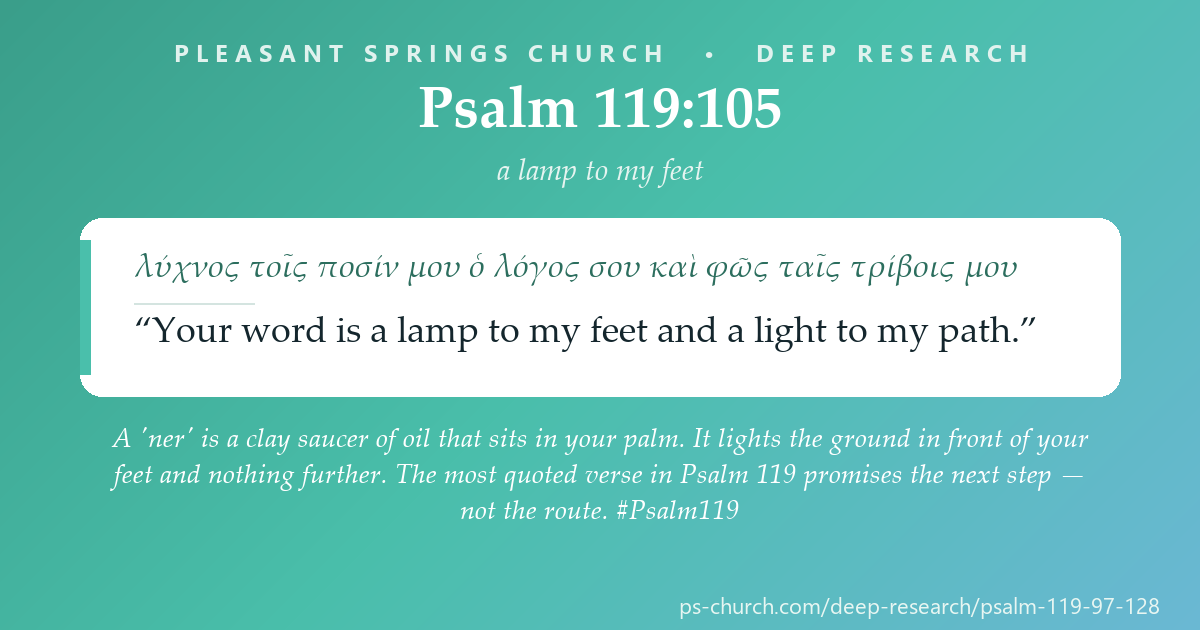
This quarter holds the most quoted verse in the psalm, and it is usually quoted for more than it says. Your word is a lamp to my feet and a light to my path. A ner is a shallow clay saucer of oil with a wick in the lip — it sits in your palm and lights the ground immediately in front of you. Both halves of the line keep the scale small: feet, and a footpath. It is not a promise of seeing where you are going; it is a promise of being able to take the next step — and the seven verses after it are about being hunted, which is when that is the only offer worth having. Twenty verses later comes something stranger: one of only two verses in all 176 that never mentions God's instruction at all. Verse 122 asks instead for a guarantor — be surety for your servant — using a moneylender's verb for pledging yourself against someone else's debt. Proverbs warns four separate times against doing this for anyone. The psalm asks God to do it anyway. Part 4 of 6. See the method →
Psalm 119:97–128 (selections)
Hebrew · Greek (Rahlfs’ Psalter) · ESVA nēr is a small clay oil lamp — a saucer of oil with a wick in the lip, held in one hand. It lights the next step and very little else. The two halves of the verse say the same thing twice: to my feet, and to my path — and nəṯîḇāh is a footpath, not a road. The verse is not a promise of seeing where you are going. It is a promise of being able to take the next step.
⚠️ And twenty verses later comes one of only two verses in the entire psalm that never mentions God’s instruction at all. Verified by consonantal search across all 176 verses (see part 1): only 90 and 122 carry none of the eight terms, and none of the near-synonyms either. Verse 122 is a legal request: be surety for your servant.
The verb is commercial. ʿāraḇ means to stand as guarantor — to put up a pledge so that somebody else’s debt is covered. In a psalm of a hundred and seventy-six verses about God’s word, the one verse that forgets to mention it is asking God to co-sign. Rahlfs reads ἔκδεξαι, which is softer — receive or take up your servant — and loses the financial edge.
⚠️ A smaller thing worth flagging at verse 97. The Hebrew reads Oh how I love your law! with no one addressed. Rahlfs adds κύριε — O Lord. A vocative with no Hebrew counterpart, turning a statement into an address. It is a very small addition and it is an addition, and this page notes it rather than passing over it.
The boldest sentence in the psalm is also here. I have more understanding than all my teachers… I understand more than the aged (vv.99–100). Said by the same man who spends the whole poem asking to be taught.
The Shape of the Passage
SequenceThe lamp verse sits exactly on that hinge. It is the last line of the confident stretch and the first line of the frightened one. And what it promises is modest: enough light for the next step, on a footpath, held in the hand. Read in its place rather than on a greetings card, it is a verse for people who cannot see very far.
The claim to outrank the teachers is worth taking seriously rather than softening. I have more understanding than all my teachers, for your testimonies are my meditation. The reason given is not talent but attention. And it is said by a man who has asked to be taught in almost every stanza so far — which is either a contradiction or the point.
Part 4 of 6. The acrostic, the eight terms and the Greek stanza headings are set out in part 1.
Author
He claims to have outgrown his teachers, and gives a reason that is not flattering to himself. Your testimonies are my meditation — not I am clever. The claim is about time spent, not ability.
He chooses a small light. Of all the images available — sun, torch, beacon — he takes the handheld clay lamp. The verse everyone quotes is the most modest one he could have written.
And he uses a moneylender\u2019s word to God. Be surety for your servant — stand as my guarantor. In the one verse where he never mentions Scripture, he asks for a signature.
Audience
People who could not see far ahead. The lamp verse is followed immediately by I am severely afflicted and I hold my life in my hand. The light is enough for the next step because the next step is the question.
People being leaned on. Let not the insolent oppress me — the verb covers extortion and defrauding. The surety request is what you ask for when someone is using your debts against you.
And the young, again. More understanding than the aged is a young person\u2019s sentence, and the psalm has already asked how can a young man keep his way pure?
Orient on lamps, on surety, and on honey.
Search by topic: lamp; oil lamps in ancient Israel; surety and pledges; debt and creditors; honey; wisdom and age.
Which articles are relevant?
- Anchor Bible Dictionary — “Lamp,” “Loans and Pledges,” “Honey,” “Debt.”
- Dictionary of the OT: Wisdom, Poetry & Writings (IVP) — “Imagery,” “Light,” “Wisdom and Age,” “Psalm 119.”
- NIDOTTE / TDOT — נֵר (nēr, lamp), עָרַב (ʿāraḇ, to go surety), נְתִיבָה (nəṯîḇāh, path), שִׂיחָה (śîḥāh, meditation).
- Archaeology — anything illustrated on Iron Age oil lamps. Seeing the object changes how the verse reads.
Bibliography surfaced:
- Kent Aaron Reynolds, Torah as Teacher — on verses 99–100 and the claim to surpass the teachers.
- Hossfeld and Zenger, Psalms 3 (Hermeneia); Goldingay, Psalms 90–150.
- Robert Alter, The Book of Psalms — on the lamp.
How much light a lamp actually gives, and what it means to stand surety.
Both key verses here turn on knowing what an ordinary object or transaction was.
Which parallels shed light on these stanzas?
The lamp is a specific object and a small one. An Iron Age Israelite lamp is a shallow clay saucer, pinched at one edge to hold a wick, filled with olive oil — it sits in the palm. It gives roughly enough light to see the ground immediately in front of you. That is what the verse is comparing God’s word to, and both halves of the line keep the scale small: feet, and a footpath.
Standing surety was a serious and discouraged act. Proverbs warns against it repeatedly — do not be one of those who give pledges (Proverbs 22:26) — because a guarantor could be seized for another’s debt. Asking God to be your surety is asking him to take on a liability the wisdom literature tells you to avoid.
And honey was the standard measure of sweetness. Sweeter than honey also closes the torah passage of Psalm 19, and the same comparison is used of wisdom in Proverbs. Rahlfs adds a word here — καὶ κηρίον, and the honeycomb — where the Hebrew has honey alone.
- Proverbs 6:1–5; 11:15; 17:18; 22:26 → Psalm 119:122. Repeated warnings against standing surety. The psalm asks God to do the thing Proverbs tells you not to do.
- Psalm 19:10 → Psalm 119:103. Sweeter than honey and drippings of the honeycomb. Psalm 19 has the honeycomb in Hebrew; Psalm 119 does not, and Rahlfs supplies it.
- Proverbs 6:23 → Psalm 119:105. The commandment is a lamp and the teaching a light. Nearly the same sentence, in the same two nouns.
- 2 Samuel 21:17 and 1 Kings 11:36. The lamp of Israel; that David may always have a lamp before me. The word can mean a dynasty’s survival — a small flame that must not go out.
- Job 12:12 → Psalm 119:100. Wisdom is with the aged. The psalm contradicts the proverb, and says why.
Psalm 119 has 176 verses and eight words for God’s instruction. Two verses use none of them. Verified by consonantal search across the whole psalm (see part 1): verse 90, and verse 122.
Verse 90 looks at the earth staying where it was put. Your faithfulness endures to all generations; you have established the earth, and it stands.
Verse 122 asks for a guarantor. ʿărōḇ ʿaḇdəḵā ləṭōḇ — stand surety for your servant for good. The verb belongs to commerce: to pledge yourself against somebody else’s debt, so that if they default you are seized instead.
Two things make that remarkable. First, the wisdom literature is emphatically against the practice — Proverbs returns to it four times to say don’t. The psalm asks God to do it anyway. Second, it is the only place in a hundred and seventy-six verses where the speaker asks for something other than instruction, and it comes out as a request for someone to cover him.
⚠️ Rahlfs does not keep the commercial sense. He has ἔκδεξαι τὸν δοῦλόν σου εἰς ἀγαθόν — receive or take up your servant for good. A warmer verb, and a less legally specific one. The Greek is not wrong so much as differently shaped, and a reader working from it will not see the moneylending.
A hand-lamp, a footpath, and a moneylender's verb.
Look at a photograph of an Iron Age oil lamp before reading verse 105 again.
“Lamp” — and specifically the small clay oil lamp that fits in a hand, not a torch and not a fire. The word is also used of a dynasty’s survival — the lamp of David — where the point is that a small flame is still burning. Rahlfs has λύχνος, the same modest object; the Greek for a torch would be λαμπάς, and he does not use it.
“Path, track” — a footpath worn by walking, not a built road (that is dereḵ or məsillāh). Both halves of the lamp verse keep the scale small: a hand-lamp, and a footpath. Rahlfs’ τρίβοις is the same idea — a beaten track.
“To stand surety, go bail, pledge oneself.” A commercial and legal term — the guarantor becomes liable for another’s debt. Proverbs warns against it four times. This is the verb in the one verse of the psalm that names no word of God, and it is asking God to accept a liability. Rahlfs’ ἔκδεξαι, “receive,” softens it.
“Meditation, musing” — from a root meaning to talk, complain, go over something. Like hāģāh in Psalm 1, it is not silent; the same root gives the word for a complaint poured out. Rahlfs has μελέτη, which means practice or study — the noun behind a musician’s rehearsal.
“The insolent, the presumptuous” — from a root meaning to boil over. They recur throughout the psalm as the speaker’s opponents, and the verb used of them here, ʿāšaq, means to defraud or extort. Rahlfs has συκοφαντησάτωσαν — the verb behind sycophant, which in Greek meant a malicious accuser or extortioner.
Counted here, not assumed:
- Verse 122 is one of only two verses in the psalm with none of the eight terms — the other is 90. Verified by consonantal search across all 176 verses.
- Rahlfs adds κύριε at 119:97, where the Hebrew addresses no one. A vocative with no Hebrew counterpart.
- Rahlfs adds καὶ κηρίον — and honeycomb — at 119:103, where the Hebrew has honey alone. Psalm 19:10 has the honeycomb in Hebrew; this verse does not.
- Both halves of verse 105 use small-scale nouns: a hand-lamp, and a footpath. The parallelism is exact and the scale is deliberate.
- The acrostic remains flawless through this quarter. See part 1.
A proverb that says the same thing, and four that say the opposite.
Read Proverbs 6:23 beside Psalm 119:105, then Proverbs 6:1–5 beside Psalm 119:122.
Which cross-references matter?
- Proverbs 6:23 → Psalm 119:105. The commandment is a lamp and the teaching a light. The same two nouns in the same order.
- Proverbs 6:1–5; 11:15; 17:18; 22:26 → Psalm 119:122. Four warnings against standing surety — and the psalm asks God to do exactly that. The tension is worth sitting with rather than smoothing.
- Psalm 19:10 → Psalm 119:103. Sweeter than honey.
- Job 12:12 and Job 32:6–9 → Psalm 119:100. Wisdom is with the aged, and Elihu’s objection to it. The psalm sides with Elihu, and gives a different reason.
- 2 Peter 1:19 → Psalm 119:105. A lamp shining in a dark place, until the day dawns. The same image, with the same limitation built in — the lamp is what you have until daylight. Stated; the seeing is left to the reader.
- Hebrews 7:22 → Psalm 119:122. Jesus has become the guarantor of a better covenant — and the Greek noun there, ἔγγυος, is the legal term the psalm’s Hebrew verb describes. Stated as a correspondence in vocabulary; the seeing is left to the reader.
Two open questions.
Reynolds on verses 99–100; the commentaries on 122.
Commentaries & studies:
- Kent Aaron Reynolds, Torah as Teacher — on the claim to surpass the teachers.
- Hossfeld and Zenger, Psalms 3 (Hermeneia); Goldingay, Psalms 90–150.
- Robert Alter, The Book of Psalms — on the modesty of the lamp image.
- NETS Psalms, with Rahlfs — for the pluses at 97 and 103.
Two things reported as unsettled:
- Whether verses 99–100 are boast or testimony. More understanding than all my teachers is startling in a poem otherwise full of requests to be taught. Whether it is confidence in the text rather than in himself is arguable both ways, and the psalm does not explain.
- Whether the Greek pluses at 97 and 103 reflect a different Hebrew text or a translator’s expansion. Both are small, natural additions of the kind translators make, and no apparatus for the Greek Psalter permits deciding.
A small light, and a large request.
Name what you learned, why it matters, and one concrete response.
What should we carry away — and do?
- The lamp verse promises less than it is usually made to promise. A hand-held clay lamp, and a footpath. It offers the next step, not the route — and the seven verses after it are about being hunted, which is when that is the only offer worth having.
- The one verse that never mentions Scripture asks God to co-sign. Be surety for your servant. Proverbs says four times not to do this for anyone. The psalm asks God to do it anyway — which is either presumption or a very clear-eyed understanding of the position he is in.
- “More understanding than my teachers” is about hours, not talent. The reason given is your testimonies are my meditation. Attention is the whole claim.
- One concrete response. The lamp lights one step. Stop trying to see the whole path before moving — identify the single next thing you can actually see to do, and do that.
Psalm 119:105 · to share
Hebrew + Greek (Rahlfs) + ESVEvery Deep Research page traces its passage across the whole sweep — the Old Testament, the Second-Temple world between the testaments (historical witnesses, not Scripture), and the New Testament. Follow the thread:
Pleasant Springs Church — Deep Research
Research method after Michael S. Heiser’s Bible Research Method (examine dictionaries → ancient literature → important words → textual connections → academic publications → share), with the Pleasant Springs “Author & Audience” foundation. Scripture set in the Hebrew, the Greek editions named on each page and the ESV (Old Testament), and the Greek New Testament and the ESV (New Testament), per the practice of Pleasant Springs Church. Psalm 119 research grounded in Reynolds (Torah as Teacher), Hossfeld and Zenger (Psalms 3, Hermeneia), Goldingay and Alter. Part 4 of a six-part study; the shared apparatus is in part 1. Text: Hebrew from the Masoretic text as printed in the editions consulted — Sefaria’s Miqra according to the Masorah; no critical apparatus was consulted for the Hebrew. Greek from Rahlfs’ Greek Psalter (CATSS digitization of Rahlfs 1931). The standing caution for this shelf applies: these pages say “Rahlfs’ Greek Psalter reads…” and never call a Greek reading early or late. ⚠️ The claim that verse 122 is one of only two verses in the psalm carrying none of the eight terms was established by consonantal search across all 176 verses (see part 1), which also allows for the plene/defective spelling of piqqûḏîm that defeats a naive search. Two Greek pluses were verified directly and are reported as pluses: κύριε at 119:97, where the Hebrew addresses no one, and καὶ κηρίον at 119:103, where the Hebrew has honey without the honeycomb — noting that Psalm 19:10 does have the honeycomb in Hebrew. Whether these reflect a different Hebrew text or translator’s expansion is explicitly left open, since no apparatus for the Greek Psalter permits deciding. Rahlfs’ softening of ʿāraḇ to ἔκδεξαι is reported so readers know the commercial sense is not visible in the Greek. The lamp is described from the archaeology of Iron Age oil lamps, and the small scale of both nouns in 119:105 (nēr, nəṯîḇāh) is checkable from the text. Typology is handled per the house position: what the text says, what the New Testament itself draws, and what we see from this side of the cross — with the seeing left to the reader.
Scripture quotations marked ESV are from the ESV® Bible (The Holy Bible, English Standard Version®), © 2001 by Crossway, a publishing ministry of Good News Publishers. ESV Text Edition: 2016. Used by permission. All rights reserved. The ESV text may not be quoted in any publication made available to the public by a Creative Commons license, and the ESV may not be translated in whole or in part into any other language. www.esv.org
|
Did this study bless you today? 💚 Give to Support PS Church100% of gifts go to the General Fund — thank you. |