This is the quarter where Psalm 119 says the hardest thing in it, and says it twice: before I was afflicted I went astray, and it is good for me that I was afflicted. And then, eleven verses later, the same man is asking how long? — which is the honest order, and the reason the statements have to be read together. At verse 71 the Greek says something the Hebrew leaves unsaid. The Hebrew verb is passive and names nobody: I was afflicted. Rahlfs reads it active and second-person — because you humbled me. Nothing suspicious is happening; an unvocalised text is open either way, and a translator must choose. But the two sentences do different work, and it is worth knowing which one you are quoting. Verse 83 has an odder split still: the psalmist is a wineskin in the smoke in Hebrew and in the frost in Greek — the same ruin by opposite weathers. Against all of it stands verse 89, the sentence the whole psalm leans on. Part 3 of 6. See the method →
Psalm 119:65–96 (selections)
Hebrew · Greek (Rahlfs’ Psalter) · ESV⚠️ At verse 71 the Greek says something the Hebrew leaves unsaid. The Hebrew verb is passive — ʿunnêṯî, I was afflicted. It does not name who did it. Rahlfs reads ἐταπείνωσάς με — second person, active: because you humbled me.
The Hebrew leaves the agent open and the Greek closes it. That is a real difference and it is a small one grammatically: an unvocalised Hebrew text can be read either way, and a translator has to choose a person for the verb whether or not the source specifies one. But the theological weight differs — the Hebrew allows a reader to say affliction came, while the Greek makes the psalmist say you did this, and it was good for me. This page reports both and adopts neither.
⚠️ And verse 83 has one of the psalm’s odder divergences. The Hebrew compares the speaker to a wineskin in the smoke — a leather bottle hung above a fire, shrivelled and blackened and no longer holding anything. Rahlfs reads ἐν πάχνῃ, in the frost. Both are pictures of a skin ruined by exposure, and they are pictures of opposite weathers. The consonants behind the Hebrew word admit more than one reading, and the page does not adjudicate.
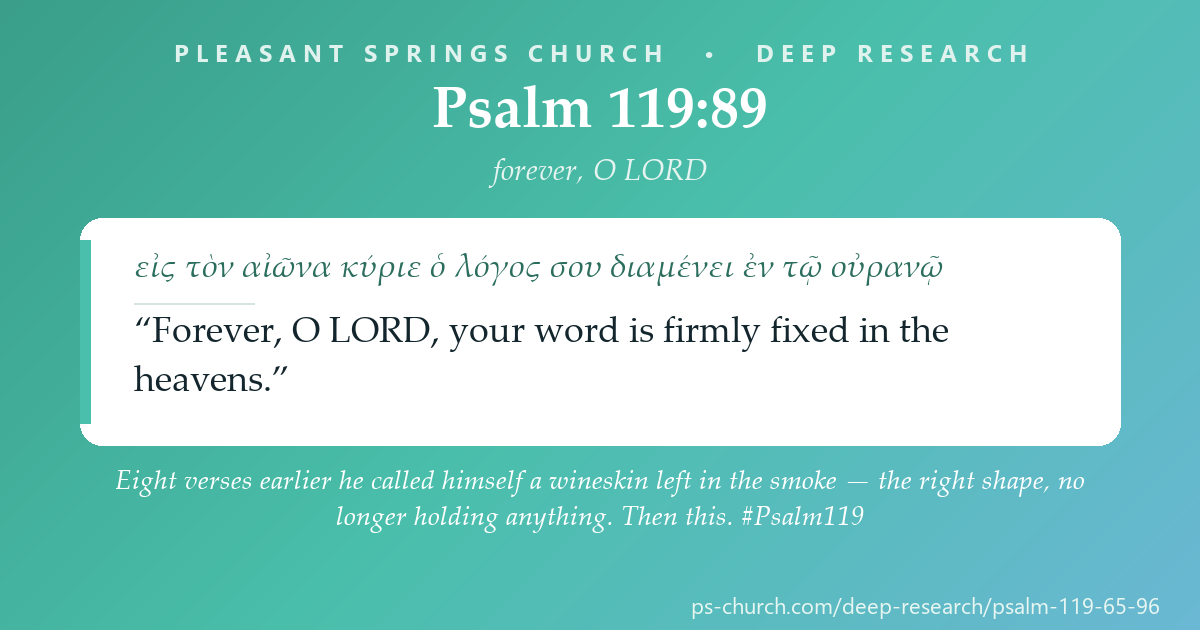
Against all of that stands verse 89, which is the sentence the whole psalm leans on: forever, O Lord, your word is fixed in the heavens. The verb pictures something set upright and standing — and Rahlfs’ διαμένει means it remains through. The man who is like a shrivelled wineskin is talking about something that does not shrivel.
The Shape of the Passage
SequenceThe teth stanza is also the clearest demonstration of how the acrostic drives the content. Ṭōḇ means good and begins with teth — so the letter that governs the stanza supplies its theme, and the stanza becomes a meditation on goodness because of the alphabet. Form producing substance, in public.
And verse 90 is worth pausing on. Your faithfulness endures to all generations; you have established the earth, and it stands. In a psalm of 176 verses about God’s word, this is one of only two verses that never mentions it — and it is about the ground staying where it was put. The psalm looks away from the text for exactly one line, and what it looks at is the earth holding.
Part 3 of 6. The acrostic, the eight terms and the Greek stanza headings are set out in part 1; the translation findings are in part 2.
Author
He says affliction did him good, and then asks how long it will last. Both, in the same twenty-four verses. He does not treat the first statement as cancelling the second. That is a more honest arrangement than either statement alone.
He lets the alphabet choose his subject. The teth stanza is about goodness because good begins with teth. The constraint is visibly generating the content, and he does not hide it.
And he describes himself as a ruined object. Not sad, not tired — a wineskin left out, shrivelled and useless. The most vivid line in the psalm is a piece of self-description with no dignity in it.
Audience
People in the middle of something. How long must your servant endure? is not asked by someone at the end of a trial. The psalm is written from inside.
People being watched. Those who fear you shall see me and rejoice — and let the insolent be put to shame. The speaker knows his case is a test case for others.
And people who needed something that does not move. The answer to the psalm\u2019s bleakest stanza is not comfort but permanence: your word is fixed in the heavens. Fixed, not sympathetic.
Orient on affliction and discipline, and on Hebrew verb voice.
Search by topic: affliction; discipline (musar); suffering in the Psalms; wineskins; Hebrew passive stems; divine agency.
Which articles are relevant?
- Anchor Bible Dictionary — “Suffering,” “Discipline,” “Wineskin,” “Poor and Poverty.”
- Dictionary of the OT: Wisdom, Poetry & Writings (IVP) — “Suffering,” “Lament,” “Retribution,” “Psalm 119.”
- NIDOTTE / TDOT — עָנָה (ʿānāh, to afflict / humble), טוֹב (ṭōḇ, good), נָצַב (nāṣaḇ, to stand firm), נֹאד (nōʾd, skin bottle).
- On the Greek — anything on how the Greek Psalter handles Hebrew passives. Verse 71 is the case in point.
Bibliography surfaced:
- Kent Aaron Reynolds, Torah as Teacher; Hossfeld and Zenger, Psalms 3 (Hermeneia).
- John Goldingay, Psalms 90–150 — careful on verse 71.
- Robert Alter, The Book of Psalms — on the wineskin image.
A ruined wineskin, and a verb with no subject.
Verse 71 is a grammar question with theological consequences. It is worth going slowly.
Which parallels shed light on these stanzas?
The wineskin image is concrete and unflattering. A nōʾd is a whole animal skin sewn up as a bottle. Hung near a fire it dries, hardens, cracks and stops holding liquid — it keeps the shape of a container without being one. That is the comparison: still recognisably himself, no longer able to hold anything.
The disagreement about smoke or frost is old and unresolved. Hebrew qîṭōr is smoke or vapour; Rahlfs read something that gave him frost. Both describe a skin destroyed by exposure — one by heat, one by cold — and the picture survives either way, which may be why the difference persisted.
And “good for me that I was afflicted” belongs to a wider conversation. The idea that hardship instructs runs through Proverbs, Job and Deuteronomy. What is distinctive here is the purpose clause: not so that I would be better but so that I might learn your statutes. The affliction is described as a curriculum.
- Proverbs 3:11–12 → Psalm 119:71. Do not despise the Lord’s discipline. The same claim, made about a father.
- Deuteronomy 8:2–3 → Psalm 119:67, 71. He humbled you… that he might make you know. The same verb as Rahlfs uses at 119:71, and there the agent is explicit in Hebrew too. Which is part of why the Greek’s reading is a natural one.
- Job 5:17–18. Blessed is the one whom God reproves. Spoken by Eliphaz, whom the book does not vindicate — a reminder that this idea can be said truly and used cruelly.
- Matthew 9:17 → Psalm 119:83. Old wineskins that cannot hold new wine. The same object and the same failure mode, put to a different purpose.
The Hebrew reads ṭōḇ-lî ḵî ʿunnêṯî — it is good for me that I was afflicted. The verb is passive. No agent is named. A reader can supply one, and the text does not require it.
Rahlfs reads ἀγαθόν μοι ὅτι ἐταπείνωσάς με — it is good for me that you humbled me. Second person singular, active, addressed to God.
How that happens is not mysterious. The consonantal Hebrew is open to more than one vocalisation, and a Greek translator must choose a person and voice for every verb whether or not the source specifies them. Nothing here suggests tampering.
But the two readings do different work, and a reader should know which one they have. The Hebrew permits a lament in which affliction simply arrived and turned out to be instructive. The Greek makes the psalmist address the one who did it and thank him for it. The second is a harder sentence to say, and much of the Christian tradition has read the verse in the Greek's direction.
This page reports both and adopts neither — and notes that verse 67, three lines earlier, is passive in both languages. Whatever is going on at 71 is local to that verse.
A passive verb, a ruined bottle, and one verse that never mentions the law.
Read verse 67 and verse 71 together. One is passive in both languages; the other is not.
“I was afflicted, humbled.” Passive, and with no agent named. The root covers being brought low by force, by poverty, or by God. The related noun is the word for the poor that runs through the Psalter. Rahlfs turns the verb active and second person — ἐταπείνωσάς με, you humbled me — supplying what the Hebrew withholds.
“Good.” It begins with teth, so it governs the stanza — and appears in six of its eight verses. You have dealt well… you are good and do good… it is good for me… better to me than thousands of gold and silver. This is the clearest place in the psalm where the alphabet chooses the theme.
“A skin bottle in the smoke.” The most physical self-description in the psalm — a leather container dried out past usefulness, still bottle-shaped and no longer a bottle. Rahlfs reads ἐν πάχνῃ, in frost, which is the same ruin by the opposite weather. The page reports the divergence without resolving it.
“Standing firm, set upright.” Used of a pillar, of a person stationed at a post, of the waters of the Jordan standing in a heap (Joshua 3:13). The word is about something put in place and staying there. Rahlfs has διαμένει, it remains right through — which keeps the endurance and loses the uprightness.
“Faithfulness, reliability” — from the root behind amen. Verse 90 is one of only two verses in the entire psalm containing none of the eight terms for God’s instruction (the other is 122). The psalm looks away from the text for one line, and what it says is that the earth was established and stands.
Counted here, not assumed:
- At 119:71 the Hebrew verb is passive with no agent; Rahlfs reads a second-person active. Verified directly. At 119:67, three verses earlier, both languages are passive — so the difference is local, not systematic.
- At 119:83 Hebrew has smoke and Rahlfs has frost. Both are pictures of a skin ruined by exposure.
- Verse 90 contains none of the eight terms for God’s instruction. It is one of only two such verses in 176 — the other is 122 — and it is about the earth standing where it was put.
- Six of the eight verses in the teth stanza turn on the word good, which is the letter’s own word. The alphabet is visibly generating the theme.
- The acrostic remains flawless through this quarter, as through all 176 verses. See part 1.
A wilderness that taught by hunger, and a word that does not move.
Read Deuteronomy 8:2–3 beside Psalm 119:67 and 71.
Which cross-references matter?
- Deuteronomy 8:2–3 → Psalm 119:67, 71. He humbled you and let you hunger… that he might make you know. The same verb, and there the agent is explicit in the Hebrew too — which makes the Greek’s reading at 119:71 a natural one rather than an invention.
- Proverbs 3:11–12 → Psalm 119:71. Discipline as fatherly. Quoted at Hebrews 12:5–6.
- Job 5:17 — a caution. The same doctrine, spoken by a friend the book does not vindicate. True things can be said at the wrong moment.
- Psalm 119:89 → Isaiah 40:8; 1 Peter 1:24–25. The word of our God will stand forever. Peter quotes Isaiah in Greek to make the same point the psalm makes.
- Matthew 9:17 → Psalm 119:83. The wineskin that has lost its use.
- Psalm 119:90 → Psalm 104:5. He set the earth on its foundations, so that it should never be moved. The one verse here that does not mention the law says what Psalm 104 says.
Two open questions, both textual.
Goldingay is the most careful English commentator on verse 71.
Commentaries & studies:
- John Goldingay, Psalms 90–150 — on the passive at verse 71.
- Hossfeld and Zenger, Psalms 3 (Hermeneia); Reynolds, Torah as Teacher.
- Robert Alter, The Book of Psalms — on the wineskin.
- NETS Psalms, with Rahlfs — for the Greek at 71 and 83.
Two things reported as unsettled:
- Whether 119:71 names God as the agent. The Hebrew does not; Rahlfs does. The consonantal text permits both, and the difference is theologically substantial even though grammatically small. Not adjudicated here.
- Whether 119:83 is smoke or frost. Hebrew and Greek disagree, and both yield a coherent picture of the same ruin. Reported, not resolved.
Two sentences that sit badly together, on purpose.
Name what you learned, why it matters, and one concrete response.
What should we carry away — and do?
- “It was good for me” and “how long?” are in the same twenty-four verses. The psalm does not treat the first as settling the second. It says affliction taught him, and then goes on asking when it will stop. Both are allowed.
- The Hebrew does not say who afflicted him. The Greek does. Worth knowing which one you are quoting — the Hebrew leaves room for a reader not yet able to say you did this, and the Greek puts the words in their mouth.
- His self-description has no dignity in it. A wineskin left out — still the right shape, no longer holding anything. The psalm lets him say that about himself without correcting him.
- One concrete response. Verse 89 is the counterweight to the whole quarter: forever, O Lord, your word is fixed in the heavens. When you cannot say anything true about your own state, say something true about God’s.
Psalm 119:89 · to share
Hebrew + Greek (Rahlfs) + ESVEvery Deep Research page traces its passage across the whole sweep — the Old Testament, the Second-Temple world between the testaments (historical witnesses, not Scripture), and the New Testament. Follow the thread:
Pleasant Springs Church — Deep Research
Research method after Michael S. Heiser’s Bible Research Method (examine dictionaries → ancient literature → important words → textual connections → academic publications → share), with the Pleasant Springs “Author & Audience” foundation. Scripture set in the Hebrew, the Greek editions named on each page and the ESV (Old Testament), and the Greek New Testament and the ESV (New Testament), per the practice of Pleasant Springs Church. Psalm 119 research grounded in Reynolds (Torah as Teacher), Hossfeld and Zenger (Psalms 3, Hermeneia), Goldingay and Alter. Part 3 of a six-part study; the shared apparatus is in part 1 and the translation findings in part 2. Text: Hebrew from the Masoretic text as printed in the editions consulted — Sefaria’s Miqra according to the Masorah; no critical apparatus was consulted for the Hebrew. Greek from Rahlfs’ Greek Psalter (CATSS digitization of Rahlfs 1931). The standing caution for this shelf applies: these pages say “Rahlfs’ Greek Psalter reads…” and never call a Greek reading early or late. ⚠️ The verse 71 divergence was verified directly in both columns — Hebrew ʿunnêṯî, passive with no agent, against Rahlfs’ ἐταπείνωσάς με, second-person active. The page explains the mechanism (an unvocalised source; a translator must choose person and voice) so the difference is not mistaken for tampering, states that the two readings do different theological work, and adopts neither. It also notes the control: 119:67, three verses earlier, is passive in both languages, so the divergence is local rather than a systematic tendency. The 119:83 smoke/frost divergence is reported and left unresolved. Verse 90 is identified as one of only two verses in the psalm carrying none of the eight terms (the other being 122) — a count established in part 1 by consonantal search across all 176 verses. The observation that the teth stanza's theme is generated by its letter is checkable from the text. Typology is handled per the house position: what the text says, what the New Testament itself draws, and what we see from this side of the cross — with the seeing left to the reader.
Scripture quotations marked ESV are from the ESV® Bible (The Holy Bible, English Standard Version®), © 2001 by Crossway, a publishing ministry of Good News Publishers. ESV Text Edition: 2016. Used by permission. All rights reserved. The ESV text may not be quoted in any publication made available to the public by a Creative Commons license, and the ESV may not be translated in whole or in part into any other language. www.esv.org
|
Did this study bless you today? 💚 Give to Support PS Church100% of gifts go to the General Fund — thank you. |