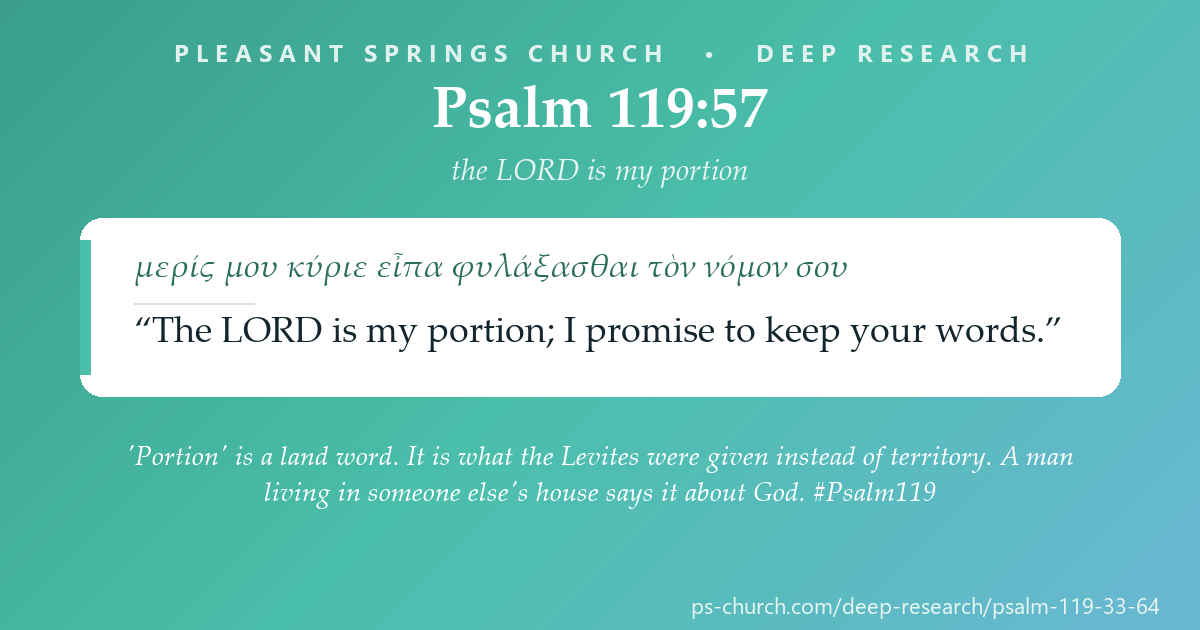
Psalm 119 works eight different Hebrew words for what God has said, and part 1 of this study found them distributed with remarkable evenness — no single term allowed to dominate. This section asks what happens to that scheme in translation, and counts the answer. Four of the eight come through cleanly: torah is always nomos, and three others have equally consistent Greek counterparts. The rest double up. One Greek word, entolē, carries two different Hebrew terms; the logos family carries two more. And at verse 57 it goes further still — the Hebrew says I promise to keep your words, and the Greek reads your law: the psalm's most general term arriving as its most specific. None of this makes the Greek careless — Greek simply does not have eight words in this field. But it means the psalm's second great structural device is largely invisible outside Hebrew. These four stanzas are also where the psalm turns personal: a request to have his eyes moved, a wide place to walk in, and a man with no land of his own saying the LORD is my portion. Part 2 of 6. See the method →
Psalm 119:33–64 (selections)
Hebrew · Greek (Rahlfs’ Psalter) · ESV⚠️ The answer, counted rather than assumed: four distinctions survive intact and the rest do not. Checked across all 176 verses in both columns.
• Kept. Tōrāh is νόμος (law) — consistently. Ḥuqqîm is δικαιώματα. Mišpāṭîm is κρίματα. ʿĒḏûṯ is a μαρτύριον word. Four of the eight come through more or less one-to-one.
• Collapsed. ἐντολή, commandment, does duty for two different Hebrew words — miṣwōṯ and piqqûḏîm. You can watch it happen in the codex above: verse 45 has Hebrew precepts and Greek ἐντολάς, which is the same Greek word the translator uses elsewhere for commandments. Two of the eight arrive in Greek as one. The word-terms behave similarly: dāḇār and ʾimrāh are both carried by the λόγος family.
⚠️ And once it goes further than that. Look at verse 57. The Hebrew says I promise to keep your words — dəḇāreḵā. Rahlfs reads τὸν νόμον σου — your law. That is not a near-synonym; it is the psalm’s most specific term arriving where the Hebrew had its most general one.
None of this means the Greek is careless. Greek simply does not have eight words in this field, and a translator working line by line under an eight-fold Hebrew scheme has to double up somewhere. What it means is that a reader working only from a translation cannot see the pattern Part 1 described — and that is worth knowing before drawing conclusions from an English word count.
⚠️ Verse 37 is also one of the four verses in the whole psalm with none of the eight terms in it. It has way instead — and the Greek agrees, reading ὁδῷ. Some manuscripts and versions read your word here rather than your ways; Rahlfs supports the reading printed above.
The Shape of the Passage
Sequence“The Lord is my portion” is the sharpest thing in it. Ḥēleq is the word for an allotment of land — and it is the word used of the Levites, who were given no territory because the Lord is their inheritance. The speaker is claiming the condition of the landless tribe as his own, three verses after describing himself as living in a house that is not his.
And the midnight verse tells you the shape of the practice. Not a devotional half hour but getting up in the dark. The psalm has already said he thinks about this at night (v.55); here he gets out of bed.
Part 2 of 6. The acrostic, the eight terms and the Greek stanza headings are set out in part 1 and not repeated here.
Author
He turns a hard letter into an argument. The waw stanza had to open eight consecutive verses with Hebrew\u2019s word for and. Instead of padding, he writes a chain of consequences — and then I shall… and then I will… The constraint produced the stanza\u2019s shape.
He asks to have his eyes moved. Turn my eyes from looking at worthless things is not a resolution to look away; it is a request that somebody else do the turning.
And he is awake at midnight. Twice in this quarter he mentions the night. The psalm is not describing a reading habit but a way of getting through the dark.
Audience
People being mocked. The insolent utterly deride me — and the response is not argument but song: your statutes have been my songs.
People with nothing of their own. The house of my sojourning, and the LORD is my portion. Both phrases belong to people without property.
And people who might have to speak up. I will also speak of your testimonies before kings and shall not be put to shame. Somebody expected this psalm to be needed in a room where it was costly.
Orient on the vocabulary of instruction, and on translation technique.
Search by topic: law and commandment terminology; Septuagint translation technique; Levites and inheritance; night vigil; the eight synonyms.
Which articles are relevant?
- Anchor Bible Dictionary — “Law (OT),” “Levites,” “Septuagint,” “Translation.”
- Dictionary of the OT: Wisdom, Poetry & Writings (IVP) — “Psalm 119,” “Torah Psalms,” “Psalms: Text and Versions.”
- NIDOTTE / TDOT — חֵלֶק (ḥēleq, portion), פִּקּוּדִים (piqqûḏîm), מִצְוָה (miṣwāh), רְחָבָה (rəḥāḇāh, broad place).
- On the Greek — anything on Septuagint translation technique, which is the real subject of this page: what happens when a source language has more distinctions than the target.
Bibliography surfaced:
- Kent Aaron Reynolds, Torah as Teacher — on the eight terms and whether they are distinct.
- Hossfeld and Zenger, Psalms 3 (Hermeneia); Goldingay, Psalms 90–150.
- NETS Psalms — and its introduction on the Greek Psalter’s technique.
What a translator does when the target language has fewer words.
This page is largely about translation. The counts are the argument.
Which parallels shed light on these stanzas?
“The Lord is my portion” is Levite language. When the land was divided, the tribe of Levi received none — the Lord is their inheritance (Deuteronomy 18:2). The psalm takes the arrangement that defined a landless tribe and makes it a personal claim. Rahlfs uses μερίς, the ordinary word for a share or portion.
The “wide place” is a standard Hebrew image and a physical one. Distress is narrowness; rescue is room. The same root lies behind the name of the place where God brought the psalmist “into a broad place” in Psalm 18:19. Rahlfs’ πλατυσμῷ keeps the spatial sense exactly — the word means a widening.
And the night vigil was a recognised practice. At midnight I rise to praise you; I remember your name in the night. Getting up in the dark to pray is attested across the Psalter and would become the backbone of monastic hours much later.
- Deuteronomy 18:1–2 → Psalm 119:57. The Lord is their inheritance. The psalmist claims the Levites’ settlement as his own.
- Psalm 18:19 and Psalm 31:8 → Psalm 119:45. He brought me out into a broad place. The same spatial metaphor for deliverance.
- Psalm 63:6 and Psalm 77:6 → Psalm 119:55, 62. Night-time remembering and rising. A recognised pattern, not an eccentricity.
- Acts 16:25 → Psalm 119:62. About midnight Paul and Silas were praying and singing hymns. Stated as a striking correspondence; nothing built on it.
Hebrew has eight terms here. Greek does not have eight words for this. A translator working line by line has to make choices, and the choices are traceable.
Counted across all 176 verses in both columns:
• Four distinctions come through cleanly. Tōrāh → νόμος. Ḥuqqîm → δικαιώματα. Mišpāṭîm → κρίματα. ʿĒḏûṯ → a μαρτύριον word. In each case one Hebrew term, one Greek counterpart.
• The rest double up. ἐντολή carries both miṣwōṯ and piqqûḏîm — two of the eight arriving as one. The λόγος family carries both dāḇār and ʾimrāh.
• And at least once it goes further. At verse 57 the Hebrew has dəḇāreḵā, your words; Rahlfs has τὸν νόμον σου, your law. The most general Hebrew term rendered by the most specific Greek one.
The point is not that the Greek is wrong. It is that the eight-fold pattern which is the psalm’s second great structural device is largely invisible in translation — in Greek, and for the same reason in English. Anyone counting “law” in an English Bible is counting the translator’s vocabulary, not the poet’s.
A landless tribe's word, and a term that hides from searches.
Read verse 57 in Hebrew and Greek. The Hebrew says words; the Greek says law.
“Portion, allotted share” — specifically a share of land. It is the word behind the Levites’ peculiar settlement: no territory, because the Lord is their inheritance. The psalmist, who has just called himself a sojourner in someone else’s house, claims it for himself. Rahlfs has μερίς.
“A broad place.” Hebrew consistently pictures trouble as narrowness and rescue as room — the word for distress, ṣar, means tight. So “I shall walk in a wide place” is not a landscape but a description of being able to breathe. Rahlfs’ πλατυσμῷ means literally a widening, keeping the physical image.
“Precepts” — from a root meaning to attend to, muster, appoint; the sense is of things entrusted to someone’s charge. It occurs 21 times in the psalm and nowhere else in the Hebrew Bible outside the Psalms. The word is spelled two different ways within the psalm — with and without the internal waw — which is why a naive search misses about a third of them. Rahlfs mostly renders it ἐντολή, the same word he uses for commandments.
“Worthlessness, emptiness, falsehood.” The same word as in the commandment about taking God’s name in vain. It is not a word for wickedness but for nothingness — things with no substance in them. Rahlfs has ματαιότητα, vanity, the word Ecclesiastes made famous.
“The middle of the night” — literally the dividing of the night. Rahlfs’ μεσονύκτιον is the same word Luke uses when Paul and Silas sing in prison (Acts 16:25). The psalm is not describing insomnia; the verb is “I rise,” which is deliberate.
Counted here, not assumed:
- Four of the eight Hebrew terms have a consistent Greek counterpart — tōrāh/νόμος, ḥuqqîm/δικαιώματα, mišpāṭîm/κρίματα, ʿēḏûṯ/μαρτύριον.
- ἐντολή renders two different Hebrew terms — miṣwōṯ and piqqûḏîm. Two of the eight arrive in Greek as one.
- At 119:57 Hebrew your words is rendered your law. Verified directly.
- Piqqûḏîm is spelled two ways within the psalm — plene and defective. A search on one spelling finds only part of them; the count of 21 is on consonants, allowing for both.
- 119:37 is one of only four verses in the psalm with none of the eight terms. It has way instead, and Rahlfs agrees.
A tribe with no land, and a hymn at midnight.
Read Deuteronomy 18:2 and then Psalm 119:57.
Which cross-references matter?
- Deuteronomy 18:1–2; Numbers 18:20 → Psalm 119:57. I am your portion and your inheritance. Said to Aaron about the priesthood; claimed here by an individual.
- Lamentations 3:24 → Psalm 119:57. The Lord is my portion, says my soul. The same confession, in a book of ruins.
- Psalm 18:19 → Psalm 119:45. He brought me out into a broad place.
- Acts 16:25 → Psalm 119:62. About midnight, prayer and hymns in a prison. The same Greek word for the hour. Stated; the seeing is left to the reader.
- Exodus 20:7 → Psalm 119:37. Šāwʾ, vanity — the word from the third commandment, used here of what the eyes are drawn to.
Translation technique, and two open questions.
The literature on Septuagint technique matters more here than the commentaries.
Commentaries & studies:
- Kent Aaron Reynolds, Torah as Teacher — on whether the eight terms are genuinely distinct.
- Hossfeld and Zenger, Psalms 3 (Hermeneia); Goldingay, Psalms 90–150.
- NETS Psalms and its introduction — on how the Greek Psalter handles Hebrew lexical distinctions generally.
Two things reported as unsettled:
- Whether the Greek’s doubling-up is a decision or a limitation. A translator with fewer available words may be forced into it, or may have judged the Hebrew terms interchangeable. The result looks the same either way.
- Whether 119:37 originally read your ways or your word. Rahlfs supports ways; some witnesses read word. If word were original, one of the psalm’s four term-less verses would disappear.
What survives translation, and what does not.
Name what you learned, why it matters, and one concrete response.
What should we carry away — and do?
- Some patterns are only visible in the original. The psalm’s eight-fold vocabulary largely does not survive into Greek, or into English. That is not a scandal; it is what translation costs — and it is a reason to be careful about arguments built on counting English words.
- “The Lord is my portion” is a landless person’s sentence. It belongs to the tribe that got no ground. Said by someone living in a house that is not his, it is not a pious flourish but an accounting.
- He asks to have his eyes turned, not to try harder. Turn my eyes from looking at worthless things. The verb is an imperative aimed at God.
- One concrete response. Verse 60: I hasten and do not delay to keep your commandments. Name the one thing you already know to do and have been deferring, and do it today.
Psalm 119:57 · to share
Hebrew + Greek (Rahlfs) + ESVEvery Deep Research page traces its passage across the whole sweep — the Old Testament, the Second-Temple world between the testaments (historical witnesses, not Scripture), and the New Testament. Follow the thread:
Pleasant Springs Church — Deep Research
Research method after Michael S. Heiser’s Bible Research Method (examine dictionaries → ancient literature → important words → textual connections → academic publications → share), with the Pleasant Springs “Author & Audience” foundation. Scripture set in the Hebrew, the Greek editions named on each page and the ESV (Old Testament), and the Greek New Testament and the ESV (New Testament), per the practice of Pleasant Springs Church. Psalm 119 research grounded in Reynolds (Torah as Teacher), Hossfeld and Zenger (Psalms 3, Hermeneia), Goldingay and Alter. Part 2 of a six-part study; the shared apparatus is set out in part 1. Text: Hebrew from the Masoretic text as printed in the editions consulted — Sefaria’s Miqra according to the Masorah; no critical apparatus was consulted for the Hebrew. Greek from Rahlfs’ Greek Psalter (CATSS digitization of Rahlfs 1931). The standing caution for this shelf applies: these pages say “Rahlfs’ Greek Psalter reads…” and never call a Greek reading early or late. ⚠️ The translation finding was computed across all 176 verses in both columns, matching Hebrew terms (on consonantal text, so that plene and defective spellings both register) against the Greek vocabulary of the same verse. Four Hebrew terms have consistent Greek counterparts — tōrāh/νόμος (25), ḥuqqîm/δικαιώματα (22), mišpāṭîm/κρίματα (20), ʿēḏûṯ/μαρτύριον (18) — while ἐντολή carries both miṣwōṯ (22) and piqqûḏîm (16) and the λόγος family carries both dāḇār and ʾimrāh. The page is careful to present this as a limitation of the target language rather than a fault in the translation, and the possibility that the translator judged the terms interchangeable is left open. 119:57 (your words → your law) was verified directly. 119:37 is flagged both as one of the psalm’s four term-less verses and as carrying a variant (your ways / your word), with Rahlfs’ support for the printed reading noted and the question left open. Typology is handled per the house position: what the text says, what the New Testament itself draws, and what we see from this side of the cross — with the seeing left to the reader.
Scripture quotations marked ESV are from the ESV® Bible (The Holy Bible, English Standard Version®), © 2001 by Crossway, a publishing ministry of Good News Publishers. ESV Text Edition: 2016. Used by permission. All rights reserved. The ESV text may not be quoted in any publication made available to the public by a Creative Commons license, and the ESV may not be translated in whole or in part into any other language. www.esv.org
|
Did this study bless you today? 💚 Give to Support PS Church100% of gifts go to the General Fund — thank you. |