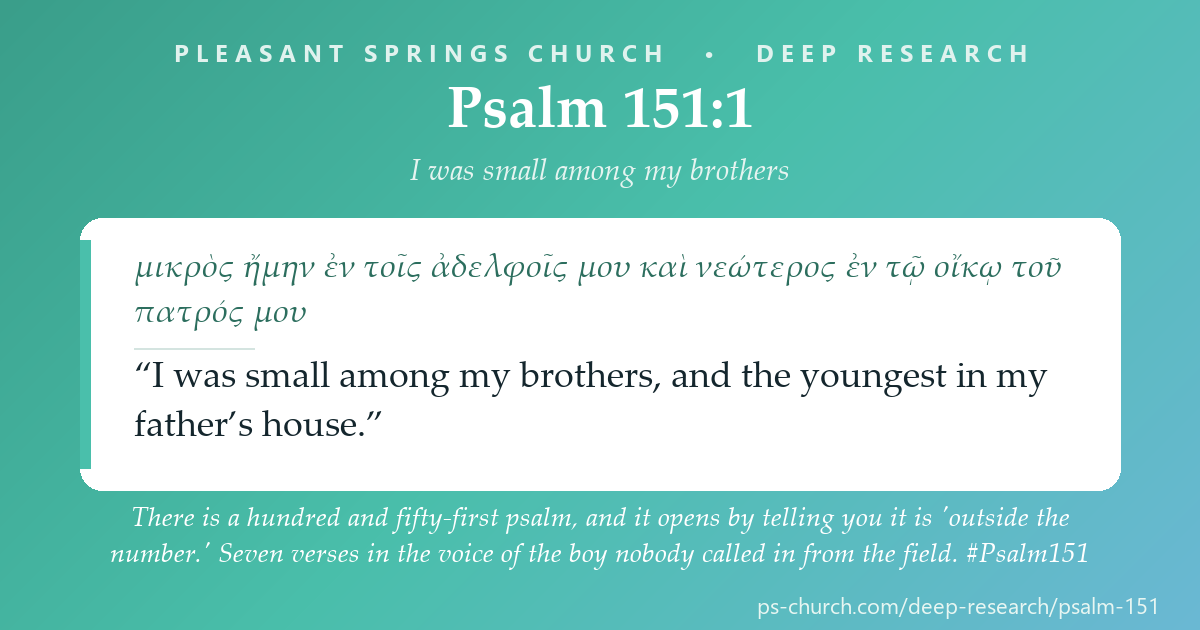
There is a hundred and fifty-first psalm. It stands after Psalm 150 in the Greek Psalter, it is seven verses long, and it opens by saying of itself that it is outside the number. That is not a later editor's note — it is how the text arrives. A poem that begins by telling you it is not one of the hundred and fifty. What follows is David's voice on the two events that made him: he was the smallest in the house and kept the sheep; he built his own instrument; a messenger came and took him from the flock and anointed him; and he went out against a giant and killed him with the giant's own sword. It is often said that the Hebrew original was found at Qumran. Something related was found, and it is not simply this psalm in Hebrew. The differences run both ways: the duel — the most famous part — has no surviving Hebrew behind it at all, and the Hebrew carries lines the Greek never had. This page is filed with the Apocrypha, because that is what the psalm says about itself. See the method →
Psalm 151:1–7 (selections)
Greek (Rahlfs’ Psalter) · English · with the Hebrew evidence statedSeven verses, in David’s voice, on the two events that made him. He was the youngest and the least likely; he kept sheep and made his own instrument; a messenger came and took him from the flock and anointed him; and he went out against a giant and killed him with the giant’s own sword.
The heading also claims something the psalm cannot deliver. ἰδιόγραφος means written in his own hand — an autograph claim, attached to a poem surviving in Greek. The page reports the claim and does not endorse it.
⚠️ A Hebrew psalm covering some of this ground was found at Qumran — and it is not simply this psalm in Hebrew. The great Psalms scroll from Cave 11 carries, in its final surviving column, material that scholars label 151A and 151B; 151B is very fragmentary. The relationship to the Greek is genuinely disputed, and the differences run in both directions:
• The Greek has material the Hebrew does not. There is no extant Hebrew counterpart to the duel of verses 6–7 — the confrontation, the curse by the Philistine’s idols, the drawn sword, the beheading. The most famous part of this psalm is the part with no surviving Hebrew behind it.
• And the Hebrew has material the Greek does not. 151A runs longer in places and carries lines with no Greek counterpart at all — including a striking passage in which the mountains and the hills and the trees and the flocks are said to be unable to bear witness to God, so the shepherd will.
So this is not a translation with variants. The two are related and they are not the same poem. One influential proposal is that the Greek compresses and conflates the Hebrew; that reading has been contested by other specialists in the same scroll, and this page reports it as one proposal among several rather than as the finding.
The Shape of the Passage
SequenceAnd it is told in the first person, which is what makes it unusual. 1 Samuel 16–17 narrates these events from outside. Here David says I was small, I made, I went out — and the one thing he does not claim to have done himself is the anointing. That is done to him, by a messenger, while he is still holding the sheep.
The last line is not about David at all. He does not say I won; he says he took away reproach from the sons of Israel. The victory is described as somebody else’s shame being removed.
⚠️ A word on where this page sits. Psalm 151 is not part of the 150 and does not claim to be. It is canonical in the Orthodox churches, printed among the Apocrypha in others, and absent from the Hebrew Bible. This library treats it as a witness worth reading closely and files it accordingly — the Psalms shelf still counts to 150.
Author
The heading claims David wrote it out himself — ἰδιόγραφος, in his own hand. That is a strong claim attached to a text preserved in Greek, and the same heading in the same breath says the psalm stands outside the collection. Whoever framed it wanted both the authority and the honesty.
He is interested in the parts of the story nobody watched. Making an instrument, tuning it, keeping sheep, being overlooked at home. 1 Samuel tells you David was a musician; this tells you he built the thing.
And he is a careful reader of 1 Samuel 16. My brothers were handsome and tall, and the LORD took no pleasure in them is that chapter\u2019s argument in one line — and the psalm puts it in the mouth of the boy who was passed over.
Audience
People who read Psalms in Greek. This psalm stands at the end of the Greek Psalter, after Psalm 150, with a heading explaining its status. Anyone reading that Psalter met it, and met it already labelled.
People who liked David stories. The Second Temple period produced a great deal of material filling in the gaps in famous lives. This psalm is doing that — supplying the interior of an episode the Bible tells from outside.
And people who needed the small to matter. The reversal is the entire content: youngest son, unimpressive, unwatched, chosen. It is a psalm for anyone who has been the one not called in from the field.
Orient on the supernumerary psalms, the canon question, and the Qumran scroll.
Search by topic: Psalm 151; apocryphal psalms; Syriac Psalms 151–155; 11QPsª; canon of the Old Testament; Septuagint; Orthodox canon.
Which articles are relevant?
- Anchor Bible Dictionary — “Psalm 151,” “Apocryphal Psalms,” “Canon, Old Testament,” “Dead Sea Scrolls.”
- Dictionary of the OT: Wisdom, Poetry & Writings (IVP) — “Psalms: Text and Versions,” “Apocryphal Psalms,” “Qumran and the Psalms.”
- On the Greek — the NETS Psalms volume, which includes Psalm 151 and its heading.
- On the scroll — the editions and discussion of 11QPsª, where 151A and 151B stand in the last surviving column.
Bibliography surfaced:
- James A. Sanders, The Psalms Scroll of Qumrân Cave 11 — the original publication, and the source of the most-cited proposal about the relationship.
- Peter W. Flint, The Dead Sea Psalms Scrolls and the Book of Psalms — and the responses of Skehan and Strugnell, which is where the disagreement lives.
- NETS Psalms, with Rahlfs — for the Greek text and the heading.
A psalm about a fight, a scroll from a cave, and a disagreement worth understanding.
The evidential question is the heart of this page. It rewards being read slowly.
Which parallels shed light on this psalm?
Filling in the interior of biblical episodes was a recognised activity. The Second Temple period produced retellings, expansions and first-person supplements across the whole range of biblical narrative. Psalm 151 belongs to that world — it adds nothing to the plot of 1 Samuel and supplies a voice for it.
And it is not alone. The Syriac tradition preserves a set of additional psalms numbered 151 to 155, and some of that material also turns up at Qumran. “The Psalter” was a less fixed object at the edges than the number 150 suggests, and this psalm sits exactly at that edge — while being unusually candid about doing so.
The duel language is technical. The heading’s verb, ἐμονομάχησεν, is the Greek word for single combat — the formal practice of settling a battle by champions. 1 Samuel 17 describes exactly that arrangement, and the Greek heading names it with the technical term.
- 1 Samuel 16:1–13 → Psalm 151:1–5. The anointing; the brothers passed over; man looks on the outward appearance. The psalm is that chapter told from inside.
- 1 Samuel 17:40–51 → Psalm 151:6–7. The Philistine curses by his gods; David kills him and cuts off his head with the Philistine’s own sword. The psalm keeps that detail, which is the sharpest thing in the narrative.
- The Syriac Psalms 151–155 (witnesses, not Scripture) — a wider body of additional psalms, partly paralleled at Qumran.
- 11QPsª, final column (Qumran material — a witness, not Scripture) — where the Hebrew psalms labelled 151A and 151B stand. 151B survives in a very fragmentary state.
It is often said that the Hebrew original of Psalm 151 was found at Qumran. That is a compression of something more interesting.
What was found: in the last surviving column of the great Psalms scroll from Cave 11, Hebrew psalm material that scholars designate 151A and 151B. 151B is very fragmentary — only a small amount of text survives.
What overlaps: the shepherd boy, the youngest of the brothers, the making of instruments, the anointing, the brothers who looked more suitable. These are genuinely common ground, and the correspondence is close enough that a relationship is not in doubt.
What does not overlap — and this runs both ways.
• The Greek has more at the end. The duel of verses 6–7 has no extant Hebrew counterpart — not the confrontation, not the cursing by idols, not the sword, not the beheading. The most memorable part of the Greek psalm is the part with no surviving Hebrew.
• The Hebrew has more in the middle. 151A carries lines the Greek does not, notably a passage where the natural world is said to be unable to declare God’s glory adequately — so the shepherd undertakes to. That idea is absent from the Greek entirely.
The disputed part. The scroll’s original editor proposed that the Greek represents a compressed conflation of the Hebrew material. Other specialists on the same scroll have contested that account, and no reconstruction has become the settled view. This page reports the proposal as a proposal.
The safe statement, and the one used throughout this page: a Hebrew psalm covering some of this ground was found at Qumran; it is not simply this psalm in Hebrew; and the direction of the relationship is not established.
A heading that says two opposite things, and a last word about somebody else.
Read the heading twice. It claims David’s own handwriting and denies canonical standing, in one sentence.
“Outside the number.” The psalm’s own description of its status, printed at its head in the Greek Psalter. It is not a later editor’s note bolted on; it is how the text arrives. A text that begins by telling you it is not one of the hundred and fifty is doing something almost no other ancient religious text does — and it is the reason this study is filed under the Apocrypha rather than with the Psalms.
“Written in his own hand” — an autograph claim. Set beside outside the number, the heading is making a maximal claim about authorship and a minimal one about status in the same sentence. The page reports the claim; a poem surviving in Greek cannot substantiate it.
“He fought in single combat” — from monos and machē, the technical term for a duel between champions. 1 Samuel 17 describes precisely that arrangement: two armies drawn up, and the matter settled by one man against one man. The Greek heading names the institution.
“I was small.” The first two words of the psalm proper, and the psalm’s entire argument in miniature. The word covers both young and little — and it is set against verse 5’s μεγάλοι, tall, of the brothers, and against the giant. Three sizes, and the smallest wins.
“Reproach, disgrace.” The last word of the psalm is not about David’s victory but about Israel’s shame being lifted. He does not say he won; he says he removed a reproach from the sons of Israel. The same word runs through the Greek of 1 Samuel 17, where the giant’s daily challenge is precisely a reproach.
Counted here, not assumed:
- The psalm has 7 verses in Rahlfs’ Greek Psalter. Verified directly.
- The heading contains the phrase outside the number. It is part of the text as transmitted, not an editorial addition.
- The duel — verses 6–7 — has no extant Hebrew counterpart. This is the single most important thing to know before repeating that “the Hebrew was found at Qumran.”
- And the Hebrew 151A carries material with no Greek counterpart, including the passage on the inadequacy of creation’s witness. The differences run in both directions.
- 151B is very fragmentary. Conclusions drawn from it should be held loosely.
- Psalm 151 is not among the 150 and this library does not count it there. The Psalms shelf counts to 150; this page is filed under the Apocrypha and Deuterocanon.
Two chapters of 1 Samuel, told from inside.
Read 1 Samuel 16:7 and then Psalm 151:5. The psalm is quoting the chapter’s thesis back in the first person.
Which cross-references matter?
- 1 Samuel 16:7 → Psalm 151:5. The Lord sees not as man sees — and the psalm has David say my brothers were handsome and tall, and the Lord took no pleasure in them. The narrator’s point, put in the boy’s mouth.
- 1 Samuel 16:11 → Psalm 151:1, 4. There remains yet the youngest, and behold, he is keeping the sheep. Both the smallness and the sheep come straight from that verse.
- 1 Samuel 17:51 → Psalm 151:7. David kills the giant with his own sword and cuts off his head. The psalm preserves the detail exactly.
- 1 Samuel 17:26 → Psalm 151:7. Who is this that he should defy the armies of the living God? The reproach David says he removed is the reproach that chapter keeps naming.
- Psalm 78:70–71 and Psalm 89:19–20. He chose David his servant and took him from the sheepfolds. The canonical Psalter says the same thing in the third person; Psalm 151 says it in the first.
- Not quoted in the New Testament. Stated plainly: no New Testament writer cites Psalm 151. Its interest is historical and literary, and nothing doctrinal depends on it.
Where the disagreement is, and what it would take to settle it.
Sanders published the scroll; Skehan, Strugnell and Flint responded. That exchange is the state of the question.
Commentaries & studies:
- James A. Sanders, The Psalms Scroll of Qumrân Cave 11 — the editio princeps, and the origin of the compressed-conflation proposal.
- Patrick Skehan and John Strugnell — the principal responses. Read these alongside Sanders rather than after him; the disagreement is the substance.
- Peter W. Flint, The Dead Sea Psalms Scrolls and the Book of Psalms — for the scroll in the wider context of the Psalter’s transmission.
- NETS Psalms — for the Greek and a translation of the heading.
Three things reported as unsettled:
- The relationship between the Greek psalm and the Qumran Hebrew. The compressed-conflation account is one proposal, contested by other specialists on the same scroll. No reconstruction is established.
- Whether a Hebrew duel section ever existed. None survives. Its absence may reflect the state of the manuscript or the state of the text, and the two cannot be distinguished.
- Whether 11QPsª is a scriptural Psalter or a liturgical collection. Disputed, and it bears directly on what the scroll’s contents prove about the shape of the Psalter.
A psalm that tells you it does not belong.
Name what you learned, why it matters, and one concrete response.
What should we carry away — and do?
- A text that labels its own status is worth respecting. Psalm 151 opens by saying it is outside the number. It is not pretending, and it was never smuggled in — readers of the Greek Psalter met it already labelled. Knowing what a document claims for itself is the first step in reading it fairly.
- “The Hebrew original was found at Qumran” is too quick. Something related was found, and it differs in both directions — the Greek has a duel the Hebrew does not, and the Hebrew has lines the Greek does not. Precision costs one extra sentence and is worth it.
- The psalm's interest is in what nobody saw. Making an instrument, tuning it, minding sheep, being the one not called in. The anointing happens to him while he is still holding the flock — and the one thing he never claims to have done for himself is the thing that changed everything.
- One concrete response. The last line is not I won but I took away reproach from the sons of Israel. Ask what your work removes from other people, rather than what it adds to you.
Psalm 151:1 · to share
Greek (Rahlfs) + EnglishEvery Deep Research page traces its passage across the whole sweep — the Old Testament, the Second-Temple world between the testaments (historical witnesses, not Scripture), and the New Testament. Follow the thread:
Pleasant Springs Church — Deep Research
Research method after Michael S. Heiser’s Bible Research Method (examine dictionaries → ancient literature → important words → textual connections → academic publications → share), with the Pleasant Springs “Author & Audience” foundation. Scripture set in the Hebrew, the Greek editions named on each page and the ESV (Old Testament), and the Greek New Testament and the ESV (New Testament), per the practice of Pleasant Springs Church. Psalm 151 research grounded in Sanders (The Psalms Scroll of Qumrân Cave 11), the responses of Skehan and Strugnell, and Flint (The Dead Sea Psalms Scrolls and the Book of Psalms). ⚠️ Status: Psalm 151 is not part of the 150, is canonical in the Orthodox churches, is printed among the Apocrypha elsewhere, and is absent from the Hebrew Bible. This study is filed under Apocrypha / Deuterocanon; the library’s Psalms shelf still counts to 150. Text: Greek from Rahlfs’ Greek Psalter (CATSS digitization of Rahlfs 1931); the seven-verse extent was verified directly. The standing caution for the Psalms shelf applies: these pages say “Rahlfs’ Greek Psalter reads…” and never call a Greek reading early or late. ⚠️ The Qumran evidence is stated precisely rather than in the usual shorthand. The page does not say the Hebrew original was found at Qumran, and does not say the Hebrew preserves the same material. What it says is that a Hebrew psalm covering some of this ground stands in the final surviving column of 11QPsª, labelled 151A and 151B, with 151B very fragmentary; that the duel of Greek vv. 6–7 has no extant Hebrew counterpart; and that 151A carries material with no Greek counterpart, including the passage on creation’s inadequate witness. The differences run in both directions, and the page says so. Sanders’ compressed-conflation proposal is reported as one proposal, explicitly contested by Skehan, Strugnell and others, and is not adopted; whether 11QPsª is a scriptural Psalter or a liturgical collection is likewise flagged as disputed, since it bears on what the scroll proves. The heading’s idiographos autograph claim is reported, not endorsed. It is stated plainly that no New Testament writer cites this psalm. Typology is handled per the house position: what the text says, what the New Testament itself draws, and what we see from this side of the cross — with the seeing left to the reader.
Scripture quotations marked ESV are from the ESV® Bible (The Holy Bible, English Standard Version®), © 2001 by Crossway, a publishing ministry of Good News Publishers. ESV Text Edition: 2016. Used by permission. All rights reserved. The ESV text may not be quoted in any publication made available to the public by a Creative Commons license, and the ESV may not be translated in whole or in part into any other language. www.esv.org
|
Did this study bless you today? 💚 Give to Support PS Church100% of gifts go to the General Fund — thank you. |