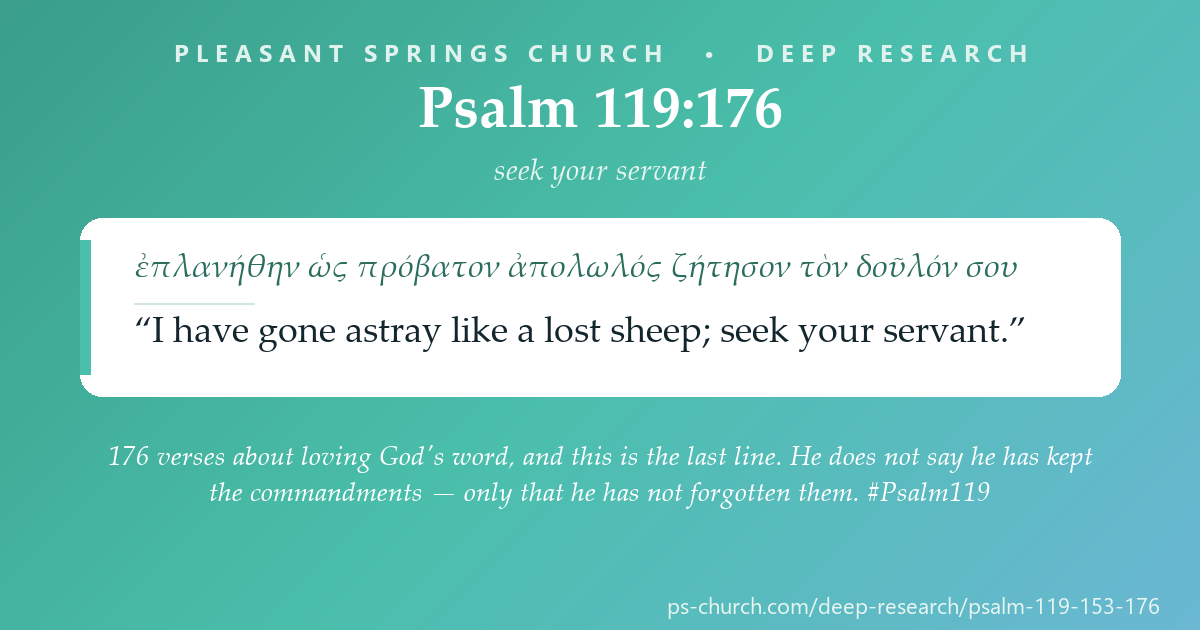
A hundred and seventy-five verses about loving God's word — twenty-two stanzas, the alphabet worked through without a single slip — and then the last line: I have gone astray like a lost sheep. Seek your servant. It is not a conclusion. The psalm does not end by arriving. And the ending was chosen: the letter taw required a taw word, and Hebrew offered praise, law, and blameless — the very word the psalm opened with. He took I have wandered instead. The request that follows is not what the preceding verses would predict: not teach me, which he has asked perhaps thirty times, but come and look for me — the one thing he cannot do himself. And the half-line that closes the longest chapter in the Bible is precisely calibrated: for I do not forget your commandments. He does not claim to have kept them. Only that he still knows where they are. Part 6 of 6. See the method →
Psalm 119:153–176 (selections)
Hebrew · Greek (Rahlfs’ Psalter) · ESVIt is the last line of the longest chapter in the Bible, and it is not a conclusion. The psalm does not end by arriving. After twenty-two perfect stanzas — the alphabet worked through without a single slip — the speaker’s final self-description is an animal that has wandered off and cannot find its own way back. And the request is not show me the way but come and look for me.
The half-line that follows is the psalm in miniature: for I do not forget your commandments. He has not abandoned anything. He knows exactly where the path is. He simply is not on it, and cannot get back unaided.
⚠️ Verse 160 is harder than English suggests. The Hebrew opens with rōʾš — the ordinary word for head. It can mean the sum, the total (as in the head of a column of figures) or the beginning, the first thing. English versions mostly choose sum; Rahlfs chose ἀρχή, beginning.
The two give quite different sentences. “The sum of your word is truth” says take it all together and it is true. “The beginning of your words is truth” says it was true from the first. Both are available from the same consonants, and this page reports both rather than choosing.
⚠️ And verse 165 supplies a word with a long afterlife. The Hebrew miḵšōl is a stumbling-block — a thing in the path that trips you. Rahlfs renders it σκάνδαλον, which is the word the New Testament will use of the cross itself, and which comes into English as scandal. The psalm’s promise is that those who love the law have nothing in their way. Eleven verses later the same speaker says he has wandered off it.
The Shape of the Passage
SequenceRead against the rest of the psalm, the last verse re-frames everything before it. This is not a poem by a man who has mastered the text. It is a poem by a man who has spent a hundred and seventy-six verses holding on to something while being unable to keep himself. The claim in the second half of the verse is the only thing he asserts about himself at the close: I do not forget your commandments. Not “I have kept them.”
And the two halves of verse 165 and verse 176 sit against each other deliberately. Nothing makes them stumble (165); I have gone astray (176). The psalm ends eleven verses after its most confident promise by admitting the promise has not been his experience — and it does not resolve the tension. It asks to be found.
Part 6 of 6, and the end of the psalm. The acrostic, the eight terms and the Greek stanza headings are set out in part 1.
Author
He had a choice of last words and chose “I have wandered.” The letter taw constrains the verse, not its content. He could have ended on t\u0259hill\u0101h, praise, or t\u014dr\u0101h itself. He ended on a lost animal.
He claims very little for himself at the close. Not I have kept your commandments but I do not forget them. After a hundred and seventy-six verses, that is the whole of his self-assessment.
And he counts. Seven times a day I praise you. Somebody who builds a poem out of twenty-two stanzas of eight is exactly the sort of person to have a number for how often he prays.
Audience
People who had not arrived either. The psalm ends without resolution — no triumph, no summary, no closing doxology. Anybody who has read all the way through is left holding a request to be looked for.
People being pursued. Princes persecute me without cause, and many are my persecutors. The last stanzas are still under pressure.
And people who would build hours around it. Seven times a day became a foundation text for the daily offices centuries later. The psalm supplied the number.
Orient on lost sheep, on stumbling-blocks, and on the daily offices.
Search by topic: shepherd and sheep imagery; lost sheep; stumbling block (skandalon); prayer hours; truth (emet).
Which articles are relevant?
- Anchor Bible Dictionary — “Shepherd,” “Sheep,” “Stumbling Block,” “Prayer,” “Truth.”
- Dictionary of the OT: Wisdom, Poetry & Writings (IVP) — “Imagery: Animals,” “Psalm 119,” “Worship.”
- NIDOTTE / TDOT — תָּעָה (tāʿāh, to wander), מִכְשׁוֹל (miḵšōl, stumbling block), רֹאשׁ (rōʾš, head / sum), אֱמֶת (ʾĕmeṯ, truth).
- On the Greek — anything on σκάνδαλον and its New Testament career. This psalm is one of the places the Greek Psalter supplies the word.
Bibliography surfaced:
- Kent Aaron Reynolds, Torah as Teacher — and specifically on how the psalm ends.
- Hossfeld and Zenger, Psalms 3 (Hermeneia); Goldingay, Psalms 90–150.
- Robert Alter, The Book of Psalms — on the final verse.
A lost animal, a word with a future, and a number that became an institution.
The ending is the subject here. It rewards being read against the whole psalm.
Which parallels shed light on these stanzas?
A lost sheep is a specific kind of helpless. Sheep do not find their way home; they graze in a straight line with their heads down until they are somewhere else, and then they stop. The metaphor is not about rebellion but about incapacity — which is why the request is seek your servant rather than forgive your servant.
“Seven times a day” became an institution. The verse was read as a prescription and used to justify the pattern of daily prayer hours that shaped monastic life from the sixth century onward. Whether the psalm meant a literal count or simply often — seven being the number of completeness — is not decidable, and the reception happened either way.
And σκάνδαλον has a career ahead of it. In Greek it is the trigger-stick of a trap, then anything that trips you. The New Testament will apply it to the cross — a stumbling block to Jews (1 Corinthians 1:23) — and English will take it as scandal. Here it is simply what the person who loves the law does not have in front of them.
- Isaiah 53:6 → Psalm 119:176. All we like sheep have gone astray. The same verb and the same image, in the plural.
- Ezekiel 34:11–16 → Psalm 119:176. I myself will search for my sheep and seek them out. The psalm asks for exactly what Ezekiel promises, using the same verb for seeking.
- Luke 15:3–7 → Psalm 119:176. The shepherd who leaves ninety-nine to go after one. Stated as a correspondence; the seeing is left to the reader.
- 1 Corinthians 1:23; Romans 9:33 → Psalm 119:165. σκάνδαλον — the word the Greek Psalter uses here, put to a very different use.
- Psalm 23 and Psalm 100:3. We are his people, and the sheep of his pasture. The Psalter’s standard use of the image is corporate; here it is one animal.
Psalm 119 is often described as a celebration of God’s law by someone who delights in it. That description survives the first stanza and not the last.
The evidence is in the ending, and the ending was chosen. The letter taw constrained the poet to a taw word, and Hebrew offered him good ones — təhillāh (praise), tōrāh itself, tāmîm (blameless), the very word the psalm opened with in verse 1. He chose tāʿîtî: I have wandered off.
And the request that follows is not what a hundred and seventy-five verses would predict. Not “teach me,” which he has asked perhaps thirty times. Not “give me understanding.” Seek your servant — come and find me. The one thing he asks for at the end is the one thing he cannot do himself.
The half-verse that closes the psalm is precisely calibrated. For I do not forget your commandments. He does not claim to have kept them. He claims only that he still knows where they are. That is the psalm’s final and entire self-assessment after 176 verses — and it is why the poem is more useful to most readers than a triumphant ending would have been.
The alphabet finished. The man did not.
The last word of the longest chapter, and the word it did not use.
Ask what other taw words were available for verse 176. The choice is the finding.
“I have wandered, gone astray.” The first word of the psalm’s last verse, and it begins with taw, the alphabet’s final letter. The constraint required a taw word; it did not require this one — praise, law and blameless were all available. The same verb is used at Isaiah 53:6. Rahlfs has ἐπλανήθην, from which planet comes: a wanderer.
“Seek! Search for!” — an imperative addressed to God. In a psalm where the speaker asks perhaps thirty times to be taught, the final request is to be looked for. It is the verb Ezekiel uses when God says he will search out his scattered sheep himself. Rahlfs has ζήτησον.
“Head” — and therefore either the sum, the total or the beginning, the first. English versions mostly take sum; Rahlfs took ἀρχή, beginning. “Taken altogether, your word is true” and “your word was true from the start” are different claims, and the Hebrew supports both. The page reports both.
“Stumbling-block” — something left in a path that trips the walker; Leviticus 19:14 forbids putting one before the blind. Rahlfs renders it σκάνδαλον, originally the trigger of a trap. That Greek word will be used of the cross itself, and reaches English as scandal. Here it is simply what the law-lover does not trip over — eleven verses before the speaker says he has wandered off.
“Seven times a day.” Seven is the number of completeness in Hebrew, so the phrase may mean a full number of times rather than a literal seven. It was read literally in later centuries and helped shape the daily prayer offices. Which the psalm did not intend and does not exclude.
Counted here, not assumed:
- The acrostic is complete and flawless to the last verse. 22 stanzas, 8 verses each, zero exceptions across all 176 — verified letter by letter. See part 1.
- The final verse begins with taw, as the scheme requires — and the poet had təhillāh, tōrāh and tāmîm available. He chose I have wandered.
- 119:160 turns on a genuinely ambiguous word. Rōʾš can be sum or beginning; Rahlfs reads ἀρχή, beginning, where most English versions read sum.
- Rahlfs renders miḵšōl at 119:165 with σκάνδαλον — the word the New Testament will apply to the cross.
- The last verse claims only that he has not forgotten. Not that he has kept. Checkable in any translation.
A shepherd who promises to do exactly what the psalm asks.
Read Ezekiel 34:11–16 and then Psalm 119:176. The psalm asks; Ezekiel answers.
Which cross-references matter?
- Ezekiel 34:11–16 → Psalm 119:176. I myself will search for my sheep and will seek them out… I will seek the lost. The psalm’s last request and the prophet’s promise use the same verb.
- Isaiah 53:6 → Psalm 119:176. All we like sheep have gone astray — the same verb, said of everyone rather than one man.
- Luke 15:3–7 and John 10:11 → Psalm 119:176. The shepherd who goes after the one, and the one who lays down his life for the sheep. Stated; the seeing is left to the reader.
- 1 Corinthians 1:23 → Psalm 119:165. σκάνδαλον — the psalm says the law-lover has none; Paul says the cross is one. The same Greek word doing opposite work, which is worth noticing rather than harmonising.
- Leviticus 19:14 → Psalm 119:165. You shall not put a stumbling block before the blind. The concrete law behind the metaphor.
- 1 Peter 2:25 → Psalm 119:176. You were straying like sheep, but have now returned to the Shepherd. Stated; the seeing is left to the reader.
Two open questions, and the whole psalm in view.
The commentaries divide on how to read the ending.
Commentaries & studies:
- Kent Aaron Reynolds, Torah as Teacher — on the ending and what it does to the psalm.
- Hossfeld and Zenger, Psalms 3 (Hermeneia); Goldingay, Psalms 90–150.
- Robert Alter, The Book of Psalms; NETS Psalms with Rahlfs, for 119:160 and 165.
Two things reported as unsettled:
- Whether 119:160 means sum or beginning. The Hebrew word carries both; Rahlfs took beginning, most English versions take sum. The resulting claims differ, and the text does not choose.
- Whether “seven times a day” is a count or a completeness idiom. Seven functions as a number of fullness throughout the Hebrew Bible, and the phrase was later read literally with lasting institutional consequences. Not decidable from the verse.
The alphabet finished. The man did not.
Name what you learned, why it matters, and one concrete response.
What should we carry away — and do?
- The longest chapter in the Bible ends by asking to be found. Not with a summary, not with praise, not with a resolution — with I have gone astray like a lost sheep. Seek your servant. The form completed perfectly; the person did not.
- He chose that ending. The letter required a taw word and Hebrew offered him praise, law, and blameless — the very word the psalm opened with. He took “I have wandered” instead.
- His final claim about himself is deliberately small. Not I have kept your commandments but I do not forget them. He still knows where the path is. He just is not on it.
- One concrete response. A sheep does not find its own way back; that is the whole point of the image. Stop asking only for instruction and ask to be come after — which is what this psalm, having asked to be taught for a hundred and seventy-five verses, does with its last breath.
Psalm 119:176 · to share
Hebrew + Greek (Rahlfs) + ESVEvery Deep Research page traces its passage across the whole sweep — the Old Testament, the Second-Temple world between the testaments (historical witnesses, not Scripture), and the New Testament. Follow the thread:
Pleasant Springs Church — Deep Research
Research method after Michael S. Heiser’s Bible Research Method (examine dictionaries → ancient literature → important words → textual connections → academic publications → share), with the Pleasant Springs “Author & Audience” foundation. Scripture set in the Hebrew, the Greek editions named on each page and the ESV (Old Testament), and the Greek New Testament and the ESV (New Testament), per the practice of Pleasant Springs Church. Psalm 119 research grounded in Reynolds (Torah as Teacher), Hossfeld and Zenger (Psalms 3, Hermeneia), Goldingay and Alter. Part 6 of a six-part study, completing the psalm; the shared apparatus is in part 1. Text: Hebrew from the Masoretic text as printed in the editions consulted — Sefaria’s Miqra according to the Masorah; no critical apparatus was consulted for the Hebrew. Greek from Rahlfs’ Greek Psalter (CATSS digitization of Rahlfs 1931). The standing caution for this shelf applies: these pages say “Rahlfs’ Greek Psalter reads…” and never call a Greek reading early or late. ⚠️ The 119:160 ambiguity is reported rather than resolved: rōʾš supports both sum and beginning, Rahlfs reads ἀρχή where most English versions read sum, and the two yield materially different claims. The observation that the final verse's word was chosen rather than forced is checkable: taw constrains the initial letter only, and təhillāh, tōrāh and tāmîm were all available — the last being the psalm's own opening word at 119:1. The page is careful that 119:176 claims non-forgetting, not obedience, and reads the ending against 119:165 without harmonising the tension. Rahlfs’ use of σκάνδαλον at 119:165 is noted alongside the New Testament’s very different application of the same word, with the divergence flagged rather than smoothed. Whether “seven times a day” is literal or a completeness idiom is named as undecidable, with the later institutional reception noted as reception. Typology is handled per the house position: what the text says, what the New Testament itself draws, and what we see from this side of the cross — with the seeing left to the reader.
Scripture quotations marked ESV are from the ESV® Bible (The Holy Bible, English Standard Version®), © 2001 by Crossway, a publishing ministry of Good News Publishers. ESV Text Edition: 2016. Used by permission. All rights reserved. The ESV text may not be quoted in any publication made available to the public by a Creative Commons license, and the ESV may not be translated in whole or in part into any other language. www.esv.org
|
Did this study bless you today? 💚 Give to Support PS Church100% of gifts go to the General Fund — thank you. |