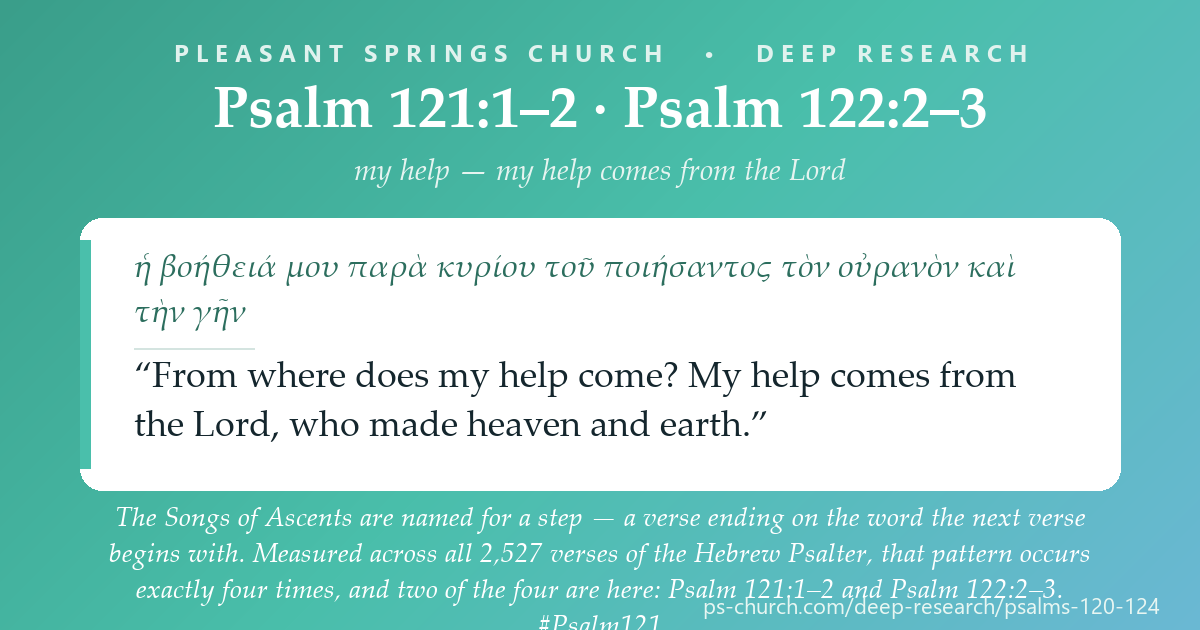
The Songs of Ascents are named for a step — a verse ending on the word the next verse begins with. Measured across all 2,527 verses of the Hebrew Psalter, that pattern occurs exactly four times: Psalm 41:2–3, Psalm 45:4–5, Psalm 121:1–2 and Psalm 122:2–3. Half of them are in the fifteen Songs of Ascents, and both of those are on this page — across the other ten Ascents there are none. Along the way: the one heading of the fifteen spelled with a different letter — a lamed where the other fourteen have a he, which Rahlfs does not register at all; the Hebrew word that occurs three times in the Bible and all three in Psalm 124; and the three words that close both Psalm 121:2 and Psalm 124:8, identical to the last accent. See the method →
Psalms 120–124 (selections)
Hebrew · Greek (Rahlfs’ Psalter) · ESVThe pattern people mean is a verse ending on a word and the next verse beginning on that same word. Tested strictly — last word-form of one verse identical to the first word-form of the next, inside the same psalm — across all 2,527 verses of the Hebrew Psalter, it happens four times:
• Psalm 41:2–3 · on the divine name
• Psalm 45:4–5 · on and your majesty
• Psalm 121:1–2 · on my help
• Psalm 122:2–3 · on Jerusalem
Half of the Psalter’s four are in the fifteen Songs of Ascents — and both of those are in the first five. Across the other ten Ascents there are none.
⚠️ What that does and does not show. Fifteen psalms out of 150 holding two of four is a real concentration, and it is also a very small number to build on: two events cannot carry a statistical claim, and this page does not make one. What it reports is the census. The collection is named for a feature that the collection contains twice, and the rest of the Psalter contains twice more. Whether the name was ever about that feature is a question about how the collection got its title, and this library holds nothing that answers it.
⚠️ And one of the fifteen headings is spelled differently.
Fourteen of the Songs of Ascents are headed שִׁ֗יר הַֽמַּ֫עֲל֥וֹת. Psalm 121 alone is headed שִׁ֗יר לַֽמַּ֫עֲל֥וֹת. The difference is a letter, not an accent — a lamed where the other fourteen have a he.
Rahlfs does not register it. All fifteen Greek headings read ᾠδὴ τῶν ἀναβαθμῶν, at Rahlfs 119:1 through 133:1, with no variation at all. Scoped to the texts held here, and stated as spelling rather than as meaning: this page does not translate the difference or say what it was for.
The Shape of the Passage
Sequence — the Ascents open, and they are very shortThe fifteen Songs of Ascents average 54 words apiece. The other 135 psalms average 139. Ten of the twenty shortest psalms in the Bible are Songs of Ascents — from a group that is one psalm in ten.
The five on this page run 51, 56, 62, 42 and 57 words. Psalm 123, at four verses, is the sixth shortest psalm in the book.
⚠️ A structural claim this page does not make. These five psalms are often set out as a journey — distance, ascent, arrival. That is a reading of their content, and content readings are not what this shelf draws structures from. Nothing in the vocabulary of the five supports a progression that a reshuffle of them would not also produce, so no arc is drawn here. What is drawn is the census above and the two verse-endings the psalms actually share.
Every psalm in this unit carries the same heading, and the Hebrew runs it into the first line of the poem. So there is no free-standing superscription verse to absorb, and the Hebrew, Greek and English verse numbers agree throughout: 7, 8, 9, 4 and 8. The Greek numbers are one behind — Rahlfs 119 to 123.
Author
Two of the five name David; the Greek of those two does not. Psalms 122 and 124 are headed לְדָ֫וִ֥ד in the Hebrew. Rahlfs 121:1 and 123:1 carry no Davidic element at all. The Greek of this block is capable of carrying an ascription — Psalm 127’s Solomon is there at Rahlfs 126:1. This page reports the difference and asserts no direction.
And one heading is spelled with a different letter. Fourteen of the fifteen read one way; Psalm 121 reads another. A lamed against a he — a consonant, not a vowel point or an accent.
They are the shortest sustained run of psalms in the book. Fifty-one, fifty-six, sixty-two, forty-two and fifty-seven words.
And they name God almost entirely one way. Across these five psalms the divine name stands alone everywhere except at 123:2, where it is joined by our God.
Audience
Someone a long way off. Woe to me, that I sojourn in Meshech, that I dwell among the tents of Kedar. The collection opens with a complaint about being elsewhere.
Someone looking up at hills. I lift up my eyes to the hills. From where does my help come?
Someone who has arrived. Our feet have been standing within your gates, O Jerusalem. Two psalms later the destination is under their feet.
And a congregation saying the same thing twice. Who made heaven and earth — the closing words of Psalm 121:2 and of Psalm 124:8, identical to the last accent.
Orient on the Ascents, on step parallelism, and on Meshech and Kedar.
Search by topic: Songs of Ascents; pilgrimage psalms; anadiplosis and step parallelism; Meshech; Kedar.
Which articles are relevant?
- Anchor Bible Dictionary — “Ascents, Songs of,” “Pilgrimage,” “Kedar,” “Meshech.”
- Dictionary of the OT: Wisdom, Poetry & Writings (IVP) — “Songs of Ascents,” “Parallelism,” “Zion.”
- NIDOTTE / TDOT — הַֽמַּ֫עֲל֥וֹת (hammaʿălōṅ, the ascents), עֶזְרִֽי (ʿezrî, my help).
- On the Greek — the NETS Psalms introduction, with the fifteen Greek headings read together to see that they do not vary.
- On step parallelism — any treatment that gives the actual loci rather than asserting the pattern is characteristic.
Bibliography surfaced:
- John Goldingay, Psalms 90–150; Robert Alter, The Book of Psalms.
- Frank-Lothar Hossfeld and Erich Zenger, Psalms 3 (Hermeneia).
- Wilfred G. E. Watson, Classical Hebrew Poetry — for anadiplosis as a device.
A word used three times in the Bible, two verses that end alike, and the claim the name rests on.
Every count below is of exact consonantal forms across the thirty-nine book Hebrew corpus this library holds.
Which parallels shed light on these psalms?
Psalm 124 uses a word three times, and those are its only three occurrences in the Bible. The Hebrew adverb at 124:3, 124:4 and 124:5 — a lengthened form of the ordinary word for then — stands nowhere else in the thirty-nine books. Three verses in a row, and then never again. The count is the finding; the fact that the three are consecutive is not. Tested against 20,000 reshuffles of the psalm’s own verses, three marked verses landing adjacent returns p = 0.11 — ordinary. The page prints the corpus count and not the arrangement.
And two verses on this page end with the same three words. Psalm 121:2 and Psalm 124:8 both close who made heaven and earth, byte-identical including every accent. Those three words close verses in four psalms of the book — 115, 121, 124 and 134 — and three of the four are Songs of Ascents.
- Psalm 121:2 ↔ Psalm 124:8. The same closing three words, identical to the accent.
- Psalms 113, 121, 125, 131. The other shared verse-ending on this page — from this time forth and forevermore — closes verses in these four.
- Psalm 41:2–3 · Psalm 45:4–5. The Psalter’s other two steps, both outside the collection.
- Genesis 10:2 · Isaiah 21:16 → Psalm 120:5. Meshech and Kedar, and Rahlfs 119:5 carries only one of the two names.
“They are called Songs of Ascents because of their step-like structure.” Measured strictly, the step occurs twice in the fifteen — and twice more outside them. Two instances cannot carry the name, and this page reports the census rather than the explanation.
“They were sung on the fifteen steps of the temple.” That is a claim about a building and a liturgy. This library holds no source that bears on either, and the page says so rather than repeating it.
“They are a pilgrim’s progress from exile to Zion.” It is a reading of the content, and a natural one. It is not a measurement, and nothing in the vocabulary of these five psalms distinguishes their order from a reshuffled one.
A heading with the wrong letter, a step, and a word used three times.
Every count below was run on this library’s own texts and is stated with its scope, so a reader can repeat it and get the same number or show that it is wrong.
“For the ascents.” Psalm 121 alone of the fifteen is headed this way. The other fourteen read הַֽמַּ֫עֲל֥וֹת — the same word with a he where this one has a lamed. Rahlfs reads τῶν ἀναβαθμῶν at all fifteen and shows no difference at all.
“My help.” The last word of verse 1 and the first word of verse 2. One of only four places in the Hebrew Psalter where a verse ends on the word the next verse begins with. Rahlfs carries the repetition too — ἡ βοήθειά μου closes 120:1 and opens 120:2.
“Then.” Three occurrences in the whole Hebrew Bible, and all three are in this psalm. A lengthened form of the ordinary word for then, which is common. Rahlfs answers all three with ἄρα. A form count. The word is an uninflectable adverb, so form and lemma coincide here — which is worth saying, because this library holds no Hebrew lemmatiser and most of its counts cannot claim that.
“Who made heaven and earth.” These three words close verses in four psalms, and two of the four are on this page. Psalm 121:2 and Psalm 124:8 carry them byte-identically, accents included.
“Kedar.” Rahlfs 119:5 carries this name — Κηδαρ — and where the Hebrew has Meshech it reads ἡ παροικία μου ἐμακρύνθη, my sojourning has been prolonged. One of the two place-names survives into the Greek and the other does not appear as a name.
The rule. Clean each verse, tokenise on whitespace and maqqef, keep tokens carrying a Hebrew letter, reduce each to its consonants. A step is: the last such form of verse n is identical to the first such form of verse n+1, inside the same psalm.
The result over all 2,527 verses. Four. Psalm 41:2–3 on the divine name; Psalm 45:4–5 on and your majesty; Psalm 121:1–2 on my help; Psalm 122:2–3 on Jerusalem.
Inside the fifteen Songs of Ascents: two, and both in the first five psalms. Psalms 123 through 134 contain none.
What the page does not do with it. It runs no significance test. Two events in fifteen psalms is not a sample you can test, and a p-value attached to it would be borrowed authority. The census is the finding: the pattern the collection is named for is rarer in the Psalter than most readers expect, and the collection holds half of it.
Almost nothing — and the two verses that reach anything reach the same phrase.
The New Testament sweep is exhaustive: every verse of the five Greek psalms against all 7,927 verses of the SBL edition, under one normalisation applied to both sides.
Where does the New Testament take up these psalms?
Barely at all, and the two verses that reach anything reach the same four words. Across the thirty-six verses of this unit, exactly two share a five-word run with any New Testament verse, and both runs are τὸν οὐρανὸν καὶ τὴν γῆν — heaven and earth. They are Psalm 121:2 and Psalm 124:8, which are the two verses that end alike in Hebrew.
How to read that number. Across the whole Greek Psalter, 68.0% of verses reach a three-word New Testament run, 16.1% reach four or more and 5.1% reach five or more. So a three-word run is the Psalter’s normal background, not evidence of contact. In this unit 58% reach three and 5.6% reach five — slightly below the book’s own baseline. Which is why this page reports measured runs against that distribution instead of calling cross-references successes or failures. A verse sharing two or three words with a New Testament verse is doing what most of the Psalter does.
- Psalm 121:2 · Psalm 124:8 → Luke 16:17 · Acts 4:24 · Acts 14:15 · Revelation 14:7. 5 words — a creation formula, not a citation of either psalm.
- Psalm 121 → Revelation 7:16 · John 10:28–29. Shared idea; no run above the Psalter’s background.
- Psalm 122 → anywhere in the New Testament. Nothing above background.
- Psalm 120 · Psalm 123 → anywhere. Nothing above background.
What is settled, what is contested, and what this page refuses to decide.
What is the state of the discussion?
Settled: that fifteen consecutive psalms carry this heading and that the Greek renders it uniformly.
Settled: that Psalm 121’s heading is spelled with a different letter. What the difference meant is not settled, and this page does not guess.
Contested for a very long time, and left contested: what ascents refers to. Pilgrimage, return from exile, temple steps and a poetic device have all been proposed. The only one of the four this library can measure is the poetic device, and measured, it occurs twice in the collection. That is evidence about one hypothesis, not a verdict on the others. Two of them are claims about history and one is a claim about a building, and nothing on disk bears on any of them.
One thing this page could not check at all: the English verse numbering. It is inferred from the Hebrew heading structure rather than read off a printed English text, because the English text this library holds stops before this stretch. The inference is safe — there is no free-standing superscription verse to absorb — but it is an inference and the page says so.
- Hossfeld and Zenger, Psalms 3 (Hermeneia) — on the collection.
- Goldingay, Psalms 90–150 — on the heading and its readings.
- The NETS Psalms volume — for the uniform Greek heading.
Where this lands.
What is worth carrying out of Psalms 120–124?
The collection is named for something it does twice. The step is real, it is here, and there are four of them in the whole book. A name can outlive the thing it was given for, and the text does not explain itself.
Two psalms end the same way. Who made heaven and earth — the last words of Psalm 121:2 and of Psalm 124:8, and the only phrase in these five psalms the New Testament ever reaches.
One concrete response. Read Psalm 121 and Psalm 124 back to back and stop on the last words of each. They are the same four English words and the same three Hebrew ones, and between them sit the two shortest psalms of the five.
Every Deep Research page traces its passage across the whole sweep — the Old Testament, the Second-Temple world between the testaments (historical witnesses, not Scripture), and the New Testament. Follow the thread:
Pleasant Springs Church — Deep Research
Research method after Michael S. Heiser’s Bible Research Method (examine dictionaries → ancient literature → important words → textual connections → academic publications → share), with the Pleasant Springs “Author & Audience” foundation. Scripture set in the Hebrew, the Greek editions named on each page and the ESV (Old Testament), and the Greek New Testament and the ESV (New Testament), per the practice of Pleasant Springs Church. Psalms 120–124 research grounded in Goldingay (Psalms 90–150), Hossfeld and Zenger (Psalms 3), Watson and Alter. Text: Hebrew from the Masoretic text as printed in the editions consulted — Sefaria’s Miqra according to the Masorah; no critical apparatus was consulted for the Hebrew. Greek from Rahlfs’ Greek Psalter (CATSS digitization); Greek New Testament from the SBL edition. The standing caution for this shelf applies: these pages say “Rahlfs’ Greek Psalter reads…” and never call a Greek reading early or late. ⚠️ The step census, stated so it can be repeated. Definition: the last consonantal word-form of verse n is identical to the first consonantal word-form of verse n+1, within the same psalm. Consonantal form = keep only U+05D0–U+05EA after the cleaner and the whitespace+maqqef tokenisation. Run over all 2,527 verses the result is four: Ps 41:2–3, Ps 45:4–5, Ps 121:1–2, Ps 122:2–3. Two fall inside the fifteen Songs of Ascents and both are in this unit; Psalms 123–134 contain none. No significance test is run and none applies — two events is a census result, not a sample. ⚠️ The heading. A consonantal scan of all 2,527 verses for מעלות / המעלות / למעלות returns 15 hits, every one in verse 1 of MT 120–134. Fourteen read המעלות; MT 121:1 alone reads למעלות. All fifteen Greek headings read ᾠδὴ τῶν ἀναβαθμῶν at Rahlfs 119:1 through 133:1, with no variation. ⚠️ New Testament runs are reported against the Psalter’s own baseline. Measured over all 2,534 Greek Psalter verses under one normalisation applied to both sides — movable nu resolved first, then accents stripped, final sigma folded, apostrophes stripped, elision resolved — 68.0% of verses reach a 3-word NT run, 16.1% reach 4+, 5.1% reach 5+, 1.8% reach 7+, maximum 20. A 3-word run is therefore the Psalter norm, not evidence of contact, and this page reports measured runs against that distribution rather than calling links successes or failures. In this unit, 36 verses: 58.3% reach 3+, 5.6% reach 5+, none reaches 6. ⚠️ The baseline was re-measured on 30 August 2026, and it moved. CATSS and MorphGNT spell one Greek word two ways depending on the next word’s first letter — the negative (οὐ / οὐκ / οὐχ), the preposition (ἐκ / ἐξ) and the movable nu (ἐστι / ἐστιν). MorphGNT folds each pair in the column measured here; CATSS does not, so until this was corrected every run compared across the two editions stopped dead at the first such word. The comparison now applies MorphGNT’s own equivalence table — 106 pairs, 1,326 tokens — to both sides. Before the correction this page printed 67.8% reaching 3+ and 16.0% reaching 4+; the re-measurement gives 68.0% and 16.1%. The fold could only ever break a shared run, never invent one, so every figure it touched was too low and none was overstated. 144 of the 2,534 Psalter rows moved. No verse of Psalms 120–124 was among them, so every unit figure on this page is unchanged: 36 verses, two of them reaching five, and both reaching τὸν οὐρανὸν καὶ τὴν γῆν in a tie band of 4. ⚠️ Hebrew counts are FORM counts. This library holds no Hebrew lemmatiser — the morphology files on disk are Greek — so no root or lemma claim is made. Word counts split on whitespace and maqqef and require a Hebrew letter; that rule reproduces a Psalter total of exactly 19,586 words and 2,527 verses. Ps 120 = 51 words / 7 verses; 121 = 56 / 8; 122 = 62 / 9; 123 = 42 / 4; 124 = 57 / 8. ⚠️ What could not be checked. The English verse numbering for this stretch is inferred from the Hebrew heading structure, not read off a printed English text — the English text held here stops before Psalm 120. The inference is that Hebrew, Greek and English agree, because in all five psalms the heading shares verse 1 with the first poetic line and there is no free-standing superscription verse to absorb. Also not consulted: no Qumran manuscript of these psalms, no Cairo Geniza fragment, no Syriac, no Vulgate or Gallican Psalter, no Aquila, Symmachus or Theodotion, and no source of any kind bearing on temple architecture or festival liturgy — which is why this page declines the fifteen-steps explanation rather than repeating it. Typology is handled per the house position: what the text says, what the New Testament itself draws, and what we see from this side of the cross — with the seeing left to the reader.
Scripture quotations marked ESV are from the ESV® Bible (The Holy Bible, English Standard Version®), © 2001 by Crossway, a publishing ministry of Good News Publishers. ESV Text Edition: 2016. Used by permission. All rights reserved. The ESV text may not be quoted in any publication made available to the public by a Creative Commons license, and the ESV may not be translated in whole or in part into any other language. www.esv.org
|
Did this study bless you today? 💚 Give to Support PS Church100% of gifts go to the General Fund — thank you. |