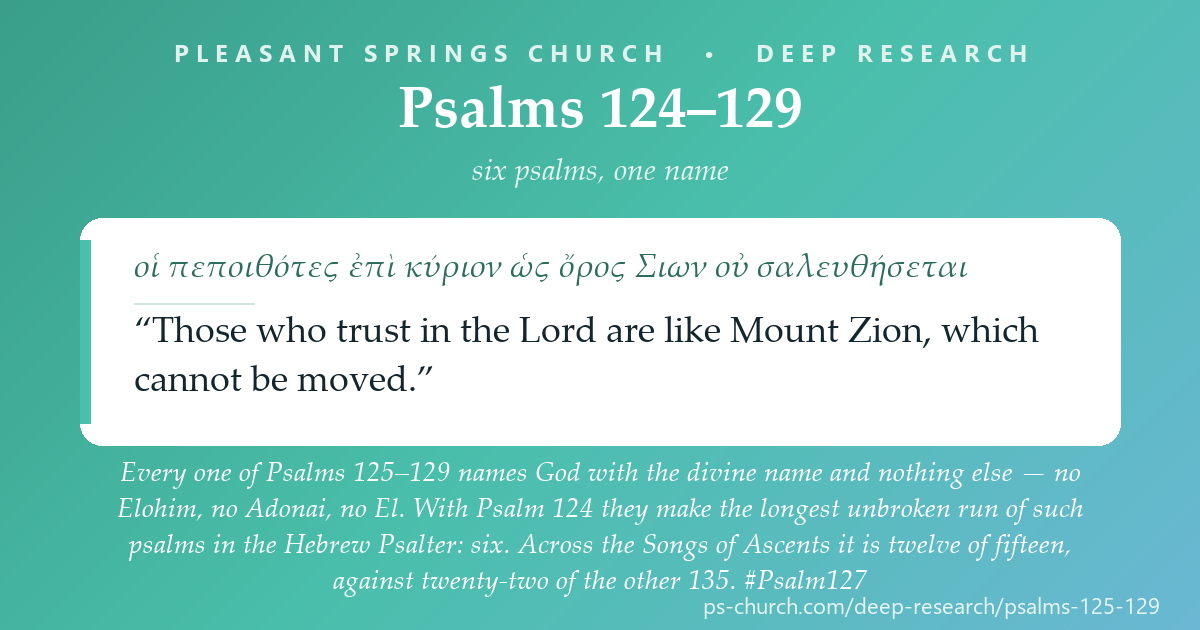
Every psalm on this page names God with the divine name and nothing else — no Elohim in any form, no Adonai, no El, no Shaddai. Together with Psalm 124 they make the longest unbroken run of such psalms in the Hebrew Psalter: six. Across the whole collection it is twelve of the fifteen Songs of Ascents, against twenty-two of the other 135 psalms — eighty per cent against sixteen. The three that break it are Psalms 122 and 123, which each use our God once, and Psalm 130, which uses Adonai three times. Along the way: the three words that close both Psalm 125 and Psalm 128 and no other verse in the book; why Rahlfs reads like those comforted where the Hebrew reads like dreamers; and the two screening rules without which this whole census comes out wrong — both of which this page got wrong first. See the method →
Psalms 125–129 (selections)
Hebrew · Greek (Rahlfs’ Psalter) · ESVA psalm counts here if it names God at all and never uses anything but the divine name or its short form: no Elohim in any form, no Adonai, no El, no Elyon, no Shaddai.
Psalms 124, 125, 126, 127, 128 and 129 all qualify. That is the longest unbroken run of such psalms anywhere in the Hebrew Psalter — six — and five of the six are on this page.
⚠️ Across the collection it is twelve of fifteen. Of the Songs of Ascents, twelve name God only this way. The three that do not are Psalm 122 and Psalm 123, each of which uses our God once, and Psalm 130, which uses Adonai three times.
So the fifteen fall into two unbroken blocks — 124 to 129 and 131 to 134 — broken only at 122, 123 and 130.
⚠️ And against the rest of the book that is a real difference. Twelve of the fifteen Ascents, against twenty-two of the other 135 psalms. Eighty per cent against sixteen.
⚠️ The counting rule, because this figure moves with it. Every published total for a census like this depends on decisions nobody states, and this one is no exception. The rule used here: a token is the divine name if its consonants are those four letters with up to two of the ordinary prefix letters in front; the short form counts only when it is the bare two-letter word carrying its own dot, which keeps the very common verb to be out; Shaddai counts only as the bare word with a shin, which keeps the word for field out; and El counts only when pointed as the noun, which keeps the negative and the preposition out. Two of those screens matter enormously: without the first, a psalm can be credited with the short divine name on the strength of the verb was; without the second, Psalm 132 is disqualified by the phrase in the fields of. This page hit both of those errors before it caught them. Under this rule the Psalter-wide total is thirty-four psalms. A different but equally defensible rule — not counting suffixed Elohim forms as divine names — gives a larger total and a seven-psalm run. The two figures this page prints are stable under both: twelve of fifteen, and a longest run of six at Psalms 124 to 129.
The Shape of the Passage
Sequence — the middle of the AscentsThe two closing lines are worth seeing on their own. Psalm 125:5 and Psalm 128:6 both end peace be upon Israel, byte-identical including every accent — and those are the only two verses in the whole Psalter that end that way. Three psalms apart, at the close of each.
A reader may want that to mark a frame around Psalms 125 to 128. It might. But a two-member repetition inside a collection of fifteen very short psalms is not something a reshuffle test can distinguish from chance, so this page reports where the two verses are and stops there. The shelf’s rule is that a structure gets drawn when a measurement carries it, and this one does not have enough to measure.
All five carry the Songs of Ascents heading, and one carries a name. Psalm 127 is headed לִשְׁלֹ֫מֹ֥ה, and Rahlfs 126:1 carries it as τῷ Σαλωμων. The Greek numbers are one behind — Rahlfs 124 to 128.
Author
Anonymous, except for one. Psalm 127 is the only Song of Ascents headed with Solomon’s name, and both texts carry it. Which is worth noting because two Ascents headed with David’s name — Psalms 122 and 124 — have no Davidic element in the Greek at all. The Greek of this block can carry an ascription; here it does.
They name God one way. Across these five psalms, every reference is the divine name. No Elohim, no Adonai, no El, no Shaddai, no Elyon.
They are short, like the rest of the collection. Forty-nine, fifty, sixty, forty-seven and fifty-four words. The whole unit is 260 Hebrew words — less than twice the length of the single psalm that follows the collection’s end.
And two of them end identically. Peace be upon Israel — the last words of Psalm 125 and of Psalm 128, and of no other verse in the book.
Audience
People who can see hills from where they are standing. As the mountains surround Jerusalem, so the Lord surrounds his people.
People who remember something being given back. When the Lord restored the fortunes of Zion, we were like those who dream.
Builders, watchmen and parents. Unless the Lord builds the house… unless the Lord watches over the city… children are a heritage from the Lord. Psalm 127 addresses three kinds of work and calls two of them vain.
And somebody who has been hurt for a long time. Greatly have they afflicted me from my youth — let Israel now say. The last psalm of the run opens by telling the congregation what to say.
Orient on the divine names, on Solomon’s psalm, and on the harvest image.
Search by topic: names of God in the Psalter; Elohistic Psalter; Songs of Ascents; Solomon in the Psalms; sowing and reaping imagery.
Which articles are relevant?
- Anchor Bible Dictionary — “God, Names of,” “Yahweh,” “Solomon,” “Ascents, Songs of.”
- Dictionary of the OT: Wisdom, Poetry & Writings (IVP) — “God, Names of,” “Elohistic Psalter,” “Songs of Ascents.”
- NIDOTTE / TDOT — שֵׁנָֽא (šēnāʾ, sleep), כְּחֹלְמִֽים (kəḥōləmîm, like dreamers).
- On the Greek — the NETS Psalms introduction, with Rahlfs 125:1 read beside the Hebrew before any commentary on Psalm 126.
- On the divine names — any treatment that publishes its counting rule rather than just its totals.
Bibliography surfaced:
- John Goldingay, Psalms 90–150; Robert Alter, The Book of Psalms.
- Frank-Lothar Hossfeld and Erich Zenger, Psalms 3 (Hermeneia).
- Gerald H. Wilson, The Editing of the Hebrew Psalter — for the collection as a collection.
Two verses that end alike, a word that looks like a place-name, and three claims about the collection.
Every count below is of exact consonantal forms across the thirty-nine book Hebrew corpus this library holds, with the screening rule stated wherever it changes the answer.
Which parallels shed light on these psalms?
Two psalms of this unit end with the same three words, and no other verse in the book does. Psalm 125:5 and Psalm 128:6 both close peace be upon Israel, identical in consonants, vowels and accents. Those are the only two occurrences of that verse-ending in the 2,527 verses of the Psalter.
And one word here looks exactly like a place-name five psalms earlier. Psalm 126:6 has a word for the bag or the drawing-out of seed whose consonants are identical to Meshech at Psalm 120:5. Four verses of the Psalter carry those consonants — 36:11, 109:12, 120:5 and 126:6 — and they are not all the same word. Rahlfs reads neither of the two in this collection as a name.
- Psalm 125:5 ↔ Psalm 128:6. Byte-identical closing line, and the only two in the book.
- Psalm 121:8 · Psalm 113:2 · Psalm 131:3 → Psalm 125:2. The other shared verse-ending in the collection — from this time forth and forevermore — closes verses in these four psalms; see Psalms 120–124.
- Psalm 120:5 → Psalm 126:6. The same three consonants, and not the same word.
- 1 Kings 3 → Psalm 127. The only Ascent headed with Solomon’s name, in both texts.
“The Songs of Ascents avoid the name Elohim.” Twelve of the fifteen do, against twenty-two of the other 135 psalms. Eighty per cent against sixteen — a real difference, and the page gives its counting rule so the figure can be checked. The three exceptions are Psalms 122, 123 and 130.
“Psalm 127:2 says God gives sleep to his beloved.” The Hebrew of that half-line is two words and has carried more than one reading for a very long time. Rahlfs reads it as sleep given, and the ESV prints the same. This page prints both texts and does not adjudicate a Hebrew ambiguity that neither of them resolves.
“Psalm 126 is about returning exiles.” The Hebrew phrase is capable of that and of more than that, and Rahlfs reads it with a word for captivity. What is measurable is the divergence at the end of the same verse: where the Hebrew says the people were like dreamers, Rahlfs 125:1 says like those who have been comforted.
A shared ending, a disputed noun, and the name these psalms use exclusively.
Every count below was run on this library’s own texts and is stated with its scope and its screening rule, so a reader can repeat it and get the same number or show that it is wrong.
“Peace be upon Israel.” These three words close exactly two verses in the whole Psalter, and both are in this unit. Psalm 125:5 and Psalm 128:6, three psalms apart, byte-identical including every accent.
“Like dreamers.” Where the Hebrew has this word, Rahlfs 125:1 has ὡς παρακεκλημένοι, like those who have been comforted. The two readings are not near neighbours, and this page reports both and adjudicates neither.
“A drawing out, a bag of seed.” The same three consonants as the place-name at Psalm 120:5. Four verses of the Psalter carry them — 36:11, 109:12, 120:5 and 126:6. A form count. With no Hebrew lemmatiser on disk this page cannot say how many lexemes those four represent, only that they are not all one word — which is exactly the kind of thing a consonantal search will hide from you.
“Of Solomon.” The only one of the fifteen Ascents headed with his name. Rahlfs 126:1 carries it as τῷ Σαλωμων. Two other Ascents are headed with David’s name in Hebrew and carry no Davidic element in the Greek at all.
“In the name of the Lord.” The last words of the last psalm in the six-psalm run. Psalm 129:8 names God twice — and both times with the name that is the only one these six psalms use.
The rule. A token is the divine name if its consonants are the four letters, with up to two ordinary prefix letters allowed. The short form counts only as the bare two-letter word carrying its own dot. Shaddai counts only as the bare word written with a shin. El counts only when pointed as the noun. Elohim counts in all its suffixed forms, as do Adonai and Elyon.
Why those screens exist. Without the dot rule, the extremely common verb to be reads as the short divine name. Without the shin rule, the phrase in the fields of at Psalm 132:6 reads as Shaddai and disqualifies that psalm. Both of those errors were made in preparing this page and caught by re-derivation. Neither is visible in a total; both change one.
The result. Twelve of the fifteen Songs of Ascents qualify, against twenty-two of the other 135 psalms. The longest unbroken run in the book is Psalms 124 to 129 — six — and there is a second run of four at Psalms 131 to 134.
What moves and what does not. The Psalter-wide total under this rule is thirty-four. A different but defensible rule gives a different total and a seven-psalm run. The two figures on this page — twelve of fifteen, and a longest run of six — hold under both. No significance test is run: this is a census of the whole book.
A unit the New Testament does not reach.
The New Testament sweep is exhaustive: every verse of the five Greek psalms against all 7,927 verses of the SBL edition, under one normalisation applied to both sides.
Where does the New Testament take up these psalms?
Nowhere above the Psalter’s own background. Across the whole Greek Psalter, 67.8% of verses share a three-word run with some New Testament verse, 16.0% reach four or more and 5.1% reach five or more. A three-word run is what the Psalter does; it is not evidence of contact. Nothing in these five psalms rises meaningfully above it.
Which is worth saying plainly, because these are famous psalms. Those who sow in tears, unless the Lord builds the house, children are a heritage — all of it is quoted constantly and none of it is quoted in the New Testament. That is a statement about shared wording and nothing else. A psalm can shape how the New Testament thinks without sharing a run of words with it, and no measurement on this page can see that.
- Psalm 128:6 · Psalm 125:5 → Galatians 6:16. The blessing on Israel. Measured, the run does not clear the Psalter’s background.
- Psalm 126:5–6 → John 4:36 · Galatians 6:7–9. Shared agricultural image; no run above background.
- Psalm 127:1 → anywhere in the New Testament. Nothing above background.
- Psalm 129 → anywhere. Nothing above background.
What is settled, what is contested, and what this page refuses to decide.
What is the state of the discussion?
Settled: that these five psalms use the divine name and nothing else. Anyone can check it in a few minutes.
Settled, and worth stating carefully: that the Psalter-wide total for a census like this depends on the counting rule. This page publishes its rule and its total, and says which figures survive a change of rule and which do not.
Contested, and left contested: Psalm 127:2’s last two words. The Hebrew has carried more than one reading for as long as it has been read, and neither the Greek nor the English settles it.
Contested, and left contested: what Psalm 126:1 describes. Where the Hebrew says like dreamers, Rahlfs says like those comforted. This library holds no critical apparatus for either text and no manuscript of any kind, so it reports the two readings and calls neither early or late.
- Hossfeld and Zenger, Psalms 3 (Hermeneia) — on the collection.
- Goldingay, Psalms 90–150 — on Psalm 127:2 and its readings.
- The NETS Psalms volume — for Rahlfs 125:1 read as translation.
Where this lands.
What is worth carrying out of Psalms 125–129?
Six psalms in a row call God by one name. No Elohim, no Adonai, no El — the longest such run in the book, and five of the six are here. Whether that is design or accident is not something a count can tell you, and the count is still worth having.
Two of them end the same way. Peace be upon Israel — the last words of Psalm 125 and of Psalm 128, and of nothing else in the Psalter.
One concrete response. Read all five straight through — it takes about three minutes — and notice that God is called the same thing every single time. Then read Psalm 130, which is next, and count how quickly that stops.
Every Deep Research page traces its passage across the whole sweep — the Old Testament, the Second-Temple world between the testaments (historical witnesses, not Scripture), and the New Testament. Follow the thread:
Pleasant Springs Church — Deep Research
Research method after Michael S. Heiser’s Bible Research Method (examine dictionaries → ancient literature → important words → textual connections → academic publications → share), with the Pleasant Springs “Author & Audience” foundation. Scripture set in the Hebrew, the Greek editions named on each page and the ESV (Old Testament), and the Greek New Testament and the ESV (New Testament), per the practice of Pleasant Springs Church. Psalms 125–129 research grounded in Goldingay (Psalms 90–150), Hossfeld and Zenger (Psalms 3), Wilson and Alter. Text: Hebrew from the Masoretic text as printed in the editions consulted — Sefaria’s Miqra according to the Masorah; no critical apparatus was consulted for the Hebrew. Greek from Rahlfs’ Greek Psalter (CATSS digitization); Greek New Testament from the SBL edition. The standing caution for this shelf applies: these pages say “Rahlfs’ Greek Psalter reads…” and never call a Greek reading early or late. ⚠️ The divine-name census, stated so it can be repeated — and the two screens that decide it. A psalm qualifies if it names God at least once and never with anything but the Tetragrammaton or its short form. Tetragrammaton = consonantal יהוה with 0–2 leading letters from ו ב ל כ מ ש ה. Short form = the bare two-letter word carrying mappiq (U+05BC) — without that screen the verb הָיָה and its inflections match and the census is badly wrong. Shaddai = the bare word carrying shin (U+05C1) — without that screen בִּשְׂדֵי at Psalm 132:6 matches and disqualifies Psalm 132, which is how the Ascents figure comes out as eleven instead of twelve. Both errors were made in preparing this page and caught by re-derivation. El counts only when pointed with tsere; Elohim counts in all suffixed forms, as do Adonai and Elyon. Under this rule the Psalter-wide total is 34 psalms; the Ascents contribute 12 and the other 135 psalms contribute 22; the longest unbroken run is Pss 124–129 (six) and there is a second run of four at Pss 131–134. A defensible alternative rule — not counting suffixed Elohim forms as divine names — yields a larger total and a seven-psalm run, so the page prints only the two figures that hold under both. No significance test applies: this is a census of all 150 psalms. ⚠️ New Testament runs are reported against the Psalter’s own baseline — 67.8% of the 2,534 Greek Psalter verses reach a 3-word run, 16.0% reach 4+, 5.1% reach 5+, maximum 20 — measured under one normalisation applied to both sides, with the movable nu resolved first and elision resolved. A 3-word run is the Psalter norm, not evidence of contact. ⚠️ Hebrew counts are FORM counts. No Hebrew lemmatiser is on disk, so no root or lemma claim is made anywhere on this page — which is why the note on Psalm 126:6 says the four occurrences of those consonants are not all one word without saying how many words they are. Word counts split on whitespace and maqqef and require a Hebrew letter; that rule reproduces a Psalter total of exactly 19,586 words and 2,527 verses. Ps 125 = 49 words / 5 verses; 126 = 50 / 6; 127 = 60 / 5; 128 = 47 / 6; 129 = 54 / 8. ⚠️ What could not be checked. The English verse numbering for this stretch is inferred from the Hebrew heading structure rather than read off a printed English text, because the English text held here stops before Psalm 120. In all five psalms the heading shares verse 1 with the first poetic line, so no renumbering is possible and Hebrew, Greek and English agree. Also not consulted: no Qumran manuscript of these psalms, no Cairo Geniza fragment, no Syriac, no Vulgate or Gallican Psalter, no Aquila, Symmachus or Theodotion. Typology is handled per the house position: what the text says, what the New Testament itself draws, and what we see from this side of the cross — with the seeing left to the reader.
Scripture quotations marked ESV are from the ESV® Bible (The Holy Bible, English Standard Version®), © 2001 by Crossway, a publishing ministry of Good News Publishers. ESV Text Edition: 2016. Used by permission. All rights reserved. The ESV text may not be quoted in any publication made available to the public by a Creative Commons license, and the ESV may not be translated in whole or in part into any other language. www.esv.org
|
Did this study bless you today? 💚 Give to Support PS Church100% of gifts go to the General Fund — thank you. |