The Songs of Ascents end on their deepest contact with the New Testament. Across all twenty-eight verses of Psalms 130 to 134, exactly one reaches a five-word run with any New Testament verse — and it reaches seven. It is Psalm 134:3, the last verse of the last psalm of the collection, and the seven words are shared with Acts 4:24. That string occurs once in the whole Greek Psalter and once across all 17,385 verses of the Greek Old Testament on disk. And it is not the phrase you would expect: Psalms 121:2 and 124:8 end with the same three Hebrew words, byte-identical — but Rahlfs renders those two with a different participle, so Acts matches them at five and this one at seven. Along the way: the psalm that is twice the length of any other Ascent and whose real twin is 2 Chronicles 6 rather than 2 Samuel 7, and the three consonants Rahlfs reads two different ways inside a single verse. See the method →
Psalms 130–134 (selections)
Hebrew · Greek (Rahlfs’ Psalter) · ESVEvery verse of the fifteen was swept against all 7,927 verses of the Greek New Testament. Across Psalms 130 to 134, exactly one verse reaches a run of five words or more — and it reaches seven.
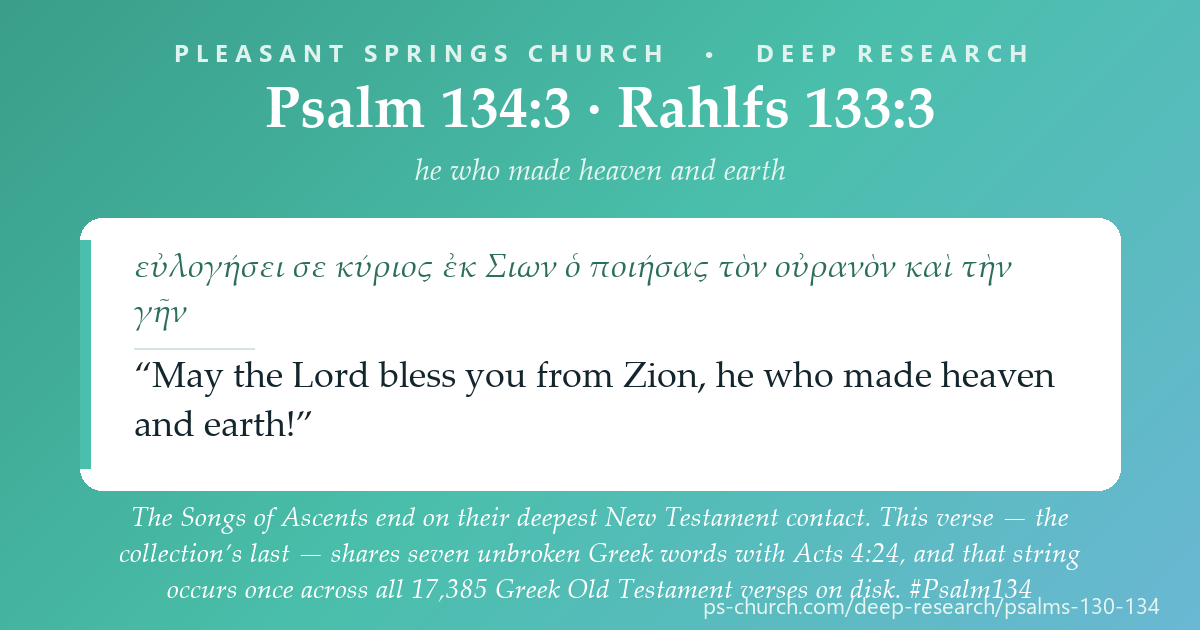
Psalm 134:3, the last verse of the last psalm of the collection, reads in Greek:
εὐλογήσει σε κύριος ἐκ Σιων ὁ ποιήσας τὸν οὐρανὸν καὶ τὴν γῆν
Acts 4:24 reads:
…δέσποτα σὺ ὁ ποιήσας τὸν οὐρανὸν καὶ τὴν γῆν καὶ τὴν θάλασσαν…
Seven words unbroken — and that seven-word string occurs exactly once in the whole Greek Psalter and once across all 17,385 verses of the Greek Old Testament this library holds.
⚠️ And it is not the phrase you would expect. Two earlier Ascents end on the same three Hebrew words — Psalm 121:2 and Psalm 124:8, both who made heaven and earth, byte-identical with this one in Hebrew. In Greek they are not the same.
Psalms 121:2 and 124:8 read τοῦ ποιήσαντος. Psalm 134:3 reads ὁ ποιήσας. Acts 4:24 has ὁ ποιήσας — so it matches the last psalm at seven words and the two earlier ones at five.
Three Hebrew verses that are identical end up at two different depths in Greek, and the difference is one participle. That is a fact about how the three verses read in the Greek text held here, and about what Acts 4:24 shares with each. It is not a claim that Acts is quoting Psalm 134 rather than the others, and this page does not make one: a creation formula this common cannot be traced to a single verse by run length alone. What can be said is that the run is longest here, that the string is unique in the Greek Old Testament on disk, and that the collection happens to end on it.
The Shape of the Passage
Sequence — the Ascents close, and one of them is nothing like the restThe fifteen Songs of Ascents average fifty-four words. Fourteen of them run between twenty-five and sixty-two. Psalm 132 runs to 131. Ranked by length against all 150 psalms, the other fourteen Ascents sit between second shortest and twenty-ninth; Psalm 132 sits at ninety-seventh.
It is more than twice the length of its longest neighbour, and five times the length of the psalm that follows the one after it.
⚠️ And it is the only one with a measurable twin outside the Psalter. Psalm 132:10 and 2 Chronicles 6:42 share four unbroken Hebrew words — do not turn away the face of your anointed. Nothing else in Psalm 132 shares more than that with anything outside itself.
The comparison usually offered is with 2 Samuel 7, and measured it is weaker: against every verse of that chapter the longest run Psalm 132 reaches is two words. The two texts share a subject — a promise to David about a house — and almost no wording. This page reports both numbers and asserts no direction between Psalm 132 and Chronicles either: four shared words cannot establish which text stood first.
Two of these five carry David’s name, and both texts agree. Psalms 131 and 133 are headed לְדָ֫וִ֥ד, and Rahlfs 130:1 and 132:1 carry τῷ Δαυιδ. Which is worth noting, because the two Davidic Ascents on the first page of this collection have no Davidic element in the Greek at all.
Author
David in two of the five, in both languages. Psalms 131 and 133. Psalm 132 is about David and does not claim him as its author.
Psalm 130 names God three ways in eight verses. The divine name, the short form, and Adonai — and it is one of only a handful of psalms in the book that use all three. That is what keeps Psalm 130 out of the twelve Ascents that name God only one way; see Psalms 125–129.
Two of these psalms are among the shortest in the Bible. Psalm 131 at thirty-three words and Psalm 134 at twenty-five. Only Psalm 117 is shorter than 134.
And one is nothing like the others. Psalm 132 is eighteen verses and 131 words, in a collection whose median psalm is fifty-one.
Audience
Somebody at the bottom. Out of the depths I cry to you, O Lord. The collection’s last five psalms open from as low as it gets.
Somebody who has stopped striving. Like a weaned child with its mother; like a weaned child is my soul within me.
A king, a city and an ark. Arise, O Lord, and go to your resting place… the Lord has chosen Zion. Psalm 132 is the only Ascent that rehearses a promise at length.
And finally people working a night shift. All you servants of the Lord, who stand by night in the house of the Lord. The collection ends by addressing the people who are awake when nobody is watching, and then blesses them.
Orient on the close of the collection, on Psalm 132 and the ark, and on Acts 4.
Search by topic: Songs of Ascents; the ark narratives; Zion election; Acts 4 and the believers' prayer; creation formulae.
Which articles are relevant?
- Anchor Bible Dictionary — “Ascents, Songs of,” “Ark of the Covenant,” “Zion,” “Creation.”
- Dictionary of the OT: Wisdom, Poetry & Writings (IVP) — “Songs of Ascents,” “Zion,” “Royal Psalms.”
- NIDOTTE / TDOT — כְּ֭גָמֻל (gāmŭl, weaned / recompense), וַאֲר֥וֹן (waʾărōn, and the ark).
- On the Greek — the NETS Psalms introduction, with Rahlfs 129:5 and 130:2 read beside the Hebrew before any commentary.
- On Acts 4:24 — any treatment that prints the Greek of Rahlfs 133:3 beside it rather than an English psalm beside an English Acts.
Bibliography surfaced:
- John Goldingay, Psalms 90–150; Robert Alter, The Book of Psalms.
- Frank-Lothar Hossfeld and Erich Zenger, Psalms 3 (Hermeneia).
- Gerald H. Wilson, The Editing of the Hebrew Psalter — for Psalm 132 inside the collection.
A psalm with a twin in Chronicles, and three claims measured.
Every run below is a longest unbroken sequence of consonantal word-forms, measured against the thirty-nine book Hebrew corpus this library holds.
Which parallels shed light on these psalms?
Psalm 132 has one measurable partner outside the Psalter, and it is not the one usually named.
Psalm 132:10 and 2 Chronicles 6:42 share four unbroken Hebrew words: do not turn away the face of your anointed. And the flattened psalm shares a second four-word run with 2 Chronicles 6:41 that crosses the psalm’s own verse boundary — you and the ark of your might, your priests — because what stands in the psalm as the end of verse 8 and the start of verse 9 stands in Chronicles inside a single verse.
Against 2 Samuel 7, the chapter this psalm is usually paired with, the longest run is two words. The two texts share a subject — a promise to David about a house — and almost no wording. Four shared words is a real result and a small one. It cannot establish which text stood first, and this page asserts nothing about direction between the psalm and Chronicles.
- 2 Chronicles 6:41–42 → Psalm 132:8–10. Two four-word runs. The longest contact Psalm 132 makes with anything outside itself.
- 2 Samuel 7 → Psalm 132. 2 words. Shared subject, not shared wording.
- Psalm 121:2 · Psalm 124:8 → Psalm 134:3. The same three Hebrew words close all three; see Psalms 120–124.
- Psalms 113:2 · 121:8 · 125:2 → Psalm 131:3. The fourth and last verse to close from this time forth and forevermore.
“Psalm 132 is the Psalter’s version of 2 Samuel 7.” Measured, it is closer to 2 Chronicles 6 — four words against two. Both numbers are small, and the page prints both rather than choosing a favourite.
“Psalm 133 is about oil running down Aaron’s beard.” It is — and the Hebrew says beard twice in one verse, which most English versions keep. Rahlfs 132:2 keeps it too, and names Aaron. What differs is the last phrase: where the Hebrew has the collar or opening of his robes, Rahlfs has τὴν ᾤαν τοῦ ἐνδύματος αὐτοῦ, the hem of his garment.
“Psalm 131 is a picture of a contented child.” In the Hebrew, yes — the same word twice. In Rahlfs 130:2 the two are not the same word at all, and the verse opens by saying the speaker exalted his soul where the Hebrew says he quieted it.
One participle, one spelling read two ways, and the ark.
Every count below was run on this library’s own texts and is stated with its scope, so a reader can repeat it and get the same number or show that it is wrong.
“He who made.” The participle that carries the seven-word run. Psalms 121:2 and 124:8 end with the same three Hebrew words as Psalm 134:3, but Rahlfs renders those two with τοῦ ποιήσαντος and this one with ὁ ποιήσας. Acts 4:24 has the second form, so it matches this verse at seven words and the other two at five.
“Weaned child.” The same three consonants stand twice in this one verse, pointed differently. Rahlfs 130:2 reads the first as ἀπογεγαλακτισμένον, weaned, and the second as ἀνταπόδοσις, recompense — two unrelated Greek words for one Hebrew spelling.
“Lord.” Psalm 130 uses this alongside the divine name and its short form. Three different designations in eight verses — which is why Psalm 130 is one of the three Songs of Ascents that do not name God one way only.
“And the ark.” The only Song of Ascents that mentions it. Rahlfs 131:8 has ἡ κιβωτὸς τοῦ ἁγιάσματός σου — where the Hebrew says the ark of your might, the Greek says the ark of your sanctuary.
“In the nights.” Where the Hebrew ends the verse on this word, Rahlfs 133:1 ends ἐν αὐλαῖς οἴκου θεοῦ ἡμῶν, in the courts of the house of our God. The two texts close the same verse on different things.
The sweep. Every verse of Rahlfs 129 to 133 — our Psalms 130 to 134 — against all 7,927 verses of the SBL edition, longest unbroken token run, one normalisation applied to both sides: movable nu resolved first, then accents stripped, final sigma folded, apostrophes stripped, elision resolved.
The result. Exactly one verse in the five psalms reaches five or more, and it reaches seven: Rahlfs 133:3 against Acts 4:24. The next best runs against that same psalm verse are five — Revelation 14:7, Luke 16:17 and Acts 14:15.
The uniqueness check. The seven-word string was searched across the whole Greek Psalter — one hit, this verse — and then across all 17,385 verses in the twenty-five CATSS Greek Old Testament files on disk, with Beta Code mapped to the same alphabet. One hit, the same verse.
What the page does not claim. Not that Acts is quoting this psalm rather than the two earlier ones. A creation formula this common cannot be traced to a single verse by run length, and the honest statement is that the run is longest here, the string is unique in the Greek Old Testament on disk, and the collection ends on it.
One deep contact, and the psalms around it that reach nothing.
Runs are reported against the Psalter’s own baseline: 68.0% of the 2,534 Greek Psalter verses reach a three-word New Testament run, 16.1% reach four or more, 5.1% reach five or more.
Where does the New Testament take up these psalms?
Once, and at the very end. Of the twenty-eight verses in Psalms 130 to 134, exactly one clears five words — and it clears seven. It is the last verse of the last psalm of the Songs of Ascents.
Everything else sits at or below the Psalter’s background. Psalm 130 — out of the depths, if you should mark iniquities — is quoted constantly and reaches nothing measurable. Psalm 133 likewise. A three-word run is what two thirds of the Greek Psalter does. Reporting one as contact would be reporting the background.
- Psalm 134:3 → Acts 4:24. 7 words. Unique across the Greek Old Testament on disk.
- Psalm 134:3 → Revelation 14:7 · Luke 16:17 · Acts 14:15. 5 words each.
- Psalm 130:8 → Matthew 1:21 · Titus 2:14. Shared idea — redemption from iniquities — and no run above background.
- Psalm 132:11 → Acts 2:30. Acts refers to the oath to David; measured, the run does not clear the background.
- Psalm 132:17 → Luke 1:69. The horn for David. Shared image, no measurable run.
- Psalm 133 → Acts 4:32 · Ephesians 4:3. Shared theme of unity; nothing above background.
What is settled, what is contested, and what this page refuses to decide.
What is the state of the discussion?
Settled: that Psalm 132 is the odd psalm of the collection by every measure of size. Eighteen verses where the median Ascent has six.
Settled: that Acts 4:24 and Psalm 134:3 share seven Greek words, and that the string is unique in the Greek Old Testament held here.
Contested, and left contested: whether Acts 4:24 is quoting a psalm at all, or using a formula. The formula appears in Acts 14:15 and Revelation 14:7 as well, and this page does not adjudicate.
Contested, and left contested: what Psalm 131:2 says. The same Hebrew spelling stands twice; the Greek reads it two different ways; and the first half of the verse is read in opposite directions by the two texts. This library holds no critical apparatus and no manuscript, so it prints both readings and calls neither early or late.
- Hossfeld and Zenger, Psalms 3 (Hermeneia) — on Psalm 132 in the collection.
- Goldingay, Psalms 90–150 — on Psalm 131:2 and its readings.
- The NETS Psalms volume — for Rahlfs 129:5 and 130:2 read as translation.
Where this lands.
What is worth carrying out of Psalms 130–134?
The collection ends on a blessing, and that is where the New Testament touches it deepest. Seven words, unbroken, in the prayer of a frightened church in Acts 4. Fifteen psalms of going up, and the last thing said is may the Lord bless you from Zion.
The shortest psalm in the group says the least and repeats itself. Like a weaned child with its mother; like a weaned child is my soul within me. Thirty-three words.
One concrete response. Read Psalm 134 — it takes fifteen seconds — and notice that it is addressed to people working at night. Then read Acts 4:24 and see where they got the words.
Every Deep Research page traces its passage across the whole sweep — the Old Testament, the Second-Temple world between the testaments (historical witnesses, not Scripture), and the New Testament. Follow the thread:
Pleasant Springs Church — Deep Research
Research method after Michael S. Heiser’s Bible Research Method (examine dictionaries → ancient literature → important words → textual connections → academic publications → share), with the Pleasant Springs “Author & Audience” foundation. Scripture set in the Hebrew, the Greek editions named on each page and the ESV (Old Testament), and the Greek New Testament and the ESV (New Testament), per the practice of Pleasant Springs Church. Psalms 130–134 research grounded in Goldingay (Psalms 90–150), Hossfeld and Zenger (Psalms 3), Wilson and Alter. Text: Hebrew from the Masoretic text as printed in the editions consulted — Sefaria’s Miqra according to the Masorah; no critical apparatus was consulted for the Hebrew. Greek from Rahlfs’ Greek Psalter (CATSS digitization); Greek New Testament from the SBL edition. The standing caution for this shelf applies: these pages say “Rahlfs’ Greek Psalter reads…” and never call a Greek reading early or late. ⚠️ The Acts 4:24 measurement, stated so it can be repeated. All 28 verses of Rahlfs 129–133 against all 7,927 SBLGNT verses, longest unbroken token run, one normalisation applied to both sides — movable nu resolved first, then accents stripped by Unicode decomposition, final sigma folded, apostrophes stripped, elision resolved. Exactly one verse clears 5: Rahlfs 133:3 vs Acts 4:24 at 7. The shared string is ὁ ποιήσας τὸν οὐρανὸν καὶ τὴν γῆν. Searched as a 7-gram it returns 1 hit in the 2,534-verse Greek Psalter and 1 hit across the 17,385 verses in the 25 CATSS Greek Old Testament files, Beta Code mapped to the same normalised alphabet — the same verse both times. Rahlfs 120:2 and 123:8, whose Hebrew endings are byte-identical with 133:3, read τοῦ ποιήσαντος and reach 5 against Acts 4:24. The page does not claim Acts is quoting this psalm rather than those; the formula also stands at Acts 14:15 and Revelation 14:7, and run length cannot settle it. ⚠️ The Psalm 132 comparison. Longest unbroken run of consonantal word-forms, Psalm 132 against every verse of the 39-book corpus: 4, at 2 Chronicles 6:42 (אַל תָּ֝שֵׁ֗ב פְּנֵ֣י מְשִׁיחֶֽךָ) and again at 2 Chronicles 6:41 across the psalm’s own 8/9 verse boundary. Against every verse of 2 Samuel 7 the longest run is 2. Four shared words cannot establish direction and the page asserts none. ⚠️ New Testament runs are reported against the Psalter’s own baseline — 68.0% of the 2,534 Greek Psalter verses reach a 3-word run, 16.1% reach 4+, 5.1% reach 5+, maximum 20. A 3-word run is the Psalter norm, not evidence of contact. ⚠️ The baseline was re-measured on 30 August 2026, and it moved. CATSS and MorphGNT spell one Greek word two ways depending on the next word’s first letter — the negative (οὐ / οὐκ / οὐχ), the preposition (ἐκ / ἐξ) and the movable nu (ἐστι / ἐστιν). MorphGNT folds each pair in the column measured here; CATSS does not, so until this was corrected every run compared across the two editions stopped dead at the first such word. The comparison now applies MorphGNT’s own equivalence table — 106 pairs, 1,326 tokens — to both sides. Before the correction this page printed 67.8% reaching 3+ and 16.0% reaching 4+; the re-measurement gives 68.0% and 16.1%. The fold could only ever break a shared run, never invent one, so every figure it touched was too low and none was overstated. 144 of the 2,534 Psalter rows moved. No verse of Psalms 130–134 was among them, so every unit figure on this page is unchanged, the seven-word run at Rahlfs 133:3 against Acts 4:24 included — it stands at 7 in a tie band of 1, with Revelation 14:7, Luke 16:17 and Acts 14:15 next at 5. ⚠️ Hebrew counts are FORM counts. No Hebrew lemmatiser is on disk, so no root or lemma claim is made — which is why the note on Psalm 131:2 says the same three consonants stand twice with different pointing, without asserting how many words that is. Word counts split on whitespace and maqqef and require a Hebrew letter; that rule reproduces a Psalter total of exactly 19,586 words and 2,527 verses. Ps 130 = 54 words / 8 verses; 131 = 33 / 3; 132 = 131 / 18; 133 = 40 / 3; 134 = 25 / 3. ⚠️ What could not be checked. The English verse numbering for this stretch is inferred from the Hebrew heading structure rather than read off a printed English text, because the English text held here stops before Psalm 120. Also not consulted: no Qumran manuscript of these psalms, no Cairo Geniza fragment, no Syriac, no Vulgate or Gallican Psalter, no Aquila, Symmachus or Theodotion, and no source bearing on festival liturgy or temple practice. Typology is handled per the house position: what the text says, what the New Testament itself draws, and what we see from this side of the cross — with the seeing left to the reader.
Scripture quotations marked ESV are from the ESV® Bible (The Holy Bible, English Standard Version®), © 2001 by Crossway, a publishing ministry of Good News Publishers. ESV Text Edition: 2016. Used by permission. All rights reserved. The ESV text may not be quoted in any publication made available to the public by a Creative Commons license, and the ESV may not be translated in whole or in part into any other language. www.esv.org
|
Did this study bless you today? 💚 Give to Support PS Church100% of gifts go to the General Fund — thank you. |