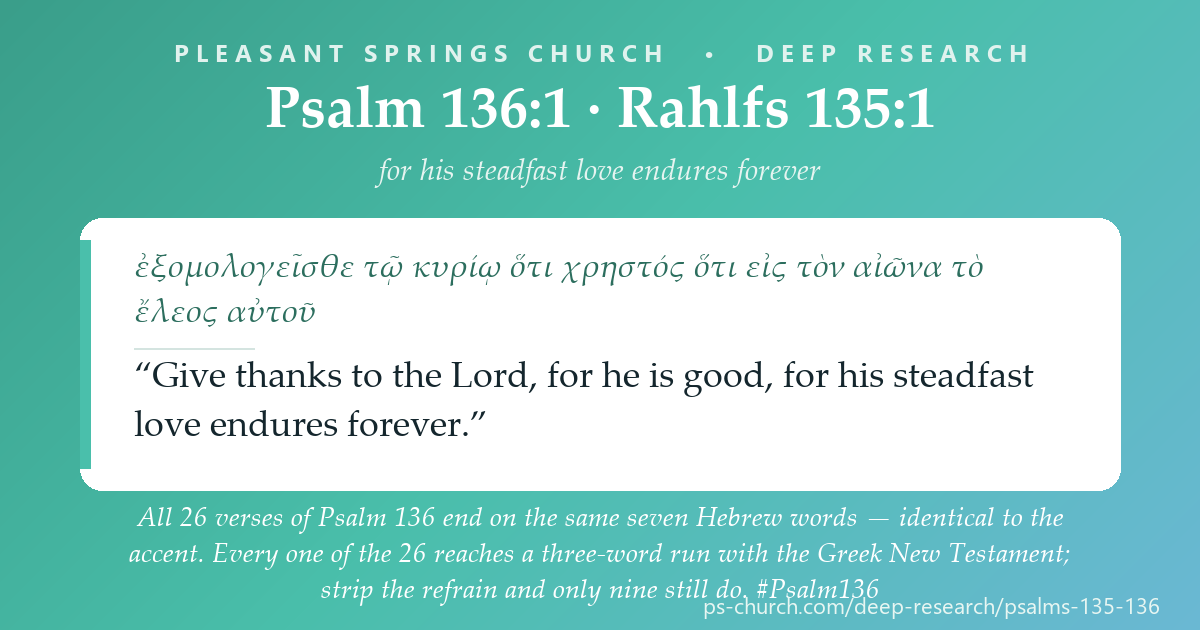
Psalm 136 ends all twenty-six of its verses with the same seven Hebrew words, identical down to the accents. That one repeated line is why every verse of the psalm touches the Greek New Testament — and why almost none of them touches it deeply. Swept against all 7,927 verses of the Greek New Testament, every one of Psalm 136's twenty-six verses reaches a three-word run. No other psalm longer than nine verses in the whole Psalter does that. Take the refrain away and only nine of the twenty-six still get there. The refrain carries the other seventeen across by itself. And it holds them there: one verse in twenty-six reaches four words, none reaches five, against a Psalter baseline where 16.0% of verses reach four and 5.1% reach five. The line that guarantees the contact is the same line that caps it.
Psalms 135–136 (selections)
Hebrew · Greek (Rahlfs’ Psalter) · ESVNot approximately. The last three tokens of all twenty-six verses are one string:
כִּ֖י לְעוֹלָ֣ם חַסְדּֽוֹ׃
Hashed, the twenty-six copies collapse to a single value — the vowels and the accents match too, not just the letters. In Rahlfs’ Greek the corresponding line is ὅτι εἰς τὸν αἰῶνα τὸ ἔλεος αὐτοῦ.
That repeated line is the reason every verse of this psalm touches the New Testament — and the reason almost none of them touches it deeply.
The Shape of the Passage
Sequence — two praise psalms, and only one of them repeats itselfNeither psalm carries a name in either text. Psalm 135 opens הַ֥לְלוּ־יָ֨הּ and Rahlfs 134:1 opens αλληλουια; Psalm 136 opens straight into הוֹד֣וּ לַיהֹוָ֣ה, and Rahlfs 135:1 carries αλληλουια before it. So the one heading-word these two psalms have in the Greek is a word the Hebrew places inside the poem in one case and not at all in the other. That is a difference in where a word sits, not a claim about which text is older — and this page makes no such claim.
Author
Anonymous in both texts. No לְדָוִד, no τῷ Δαυιδ, no Asaph, no Korah, no direction to a choirmaster. Psalm 136 carries no superscription in the Hebrew at all — verse 1 begins straight on the imperative, הוֹד֣וּ לַיהֹוָ֣ה.
What can be said is what the psalms do rather than who wrote them. Both are liturgical in shape: Psalm 135 addresses groups by name — house of Israel, house of Aaron, house of Levi, you who fear the Lord — and Psalm 136 is built for a second voice, since a fixed line returns at the end of every verse.
Audience
People standing in the house of the Lord. Psalm 135:2 names the place: בְּבֵ֣ית יְהֹוָ֑ה, in the house of the Lord, in the courts of the house of our God.
Psalm 136 is called the Great Hallel in Jewish tradition. That name is reported here as tradition, not as something measured from the text. No source on festival liturgy or synagogue practice was consulted for this page, and the page makes no claim about when or how either psalm was used.
Orient on the Hallel psalms, on the idol-parody form, and on refrain structure.
Search by topic: Hallel and Great Hallel; hallelujah psalms; idol polemic; antiphonal and responsorial psalmody; the historical recital.
Which articles are relevant?
- Anchor Bible Dictionary — “Hallel,” “Hallelujah,” “Idol, Idolatry,” “Praise.”
- Dictionary of the OT: Wisdom, Poetry & Writings (IVP) — “Hymns,” “Liturgy,” “Refrain,” “Hesed.”
- NIDOTTE — הלל, ידה, חֶסֶד, עֶצֶב.
What the reference works agree on, and where this page stops following them
The agreement is on form. These are hymns of praise: a call to praise, a body of reasons introduced by for, and a closing call. Psalm 136 is the clearest responsorial text in the Psalter, and the standard works describe it as built for two voices.
Where this page stops. The dictionaries also date these psalms, assign them to a post-exilic setting, and describe Psalm 136 as a reworking of Psalm 135. None of that is measurable from the files on disk, so none of it is asserted here. What is measurable is what the two psalms share word for word, and how the shared material actually behaves — which is the subject of stages 3 and 4.
The idol parody, and where else it stands in the Psalter.
Psalm 115 and Psalm 135 say the same thing about idols. They do not say it the same way.
The overlap is real and it is partial, and the partial part is the interesting part. Psalm 115:4–8 and Psalm 135:15–18 both run the idol parody. Compared as full strings — consonants, vowels and accents — here is what actually matches:
| Psalm 115 | Psalm 135 | Relationship |
|---|---|---|
| 115:4 | 135:15 | Different. עֲֽ֭צַבֵּיהֶם against עֲצַבֵּ֣י הַ֭גּוֹיִם — the rest of the verse is the same. |
| 115:5 | 135:16 | Byte-identical. Every codepoint. |
| 115:6 | 135:17 | Different. Ears that do not יִשְׁמָ֑עוּ against ears that do not יַאֲזִ֑ינוּ, and a different second half entirely. |
| 115:7 | — | No counterpart. The hands, feet and throat verse stands only in Psalm 115. |
| 115:8 | 135:18 | Byte-identical. Every codepoint. |
So of the five verses, two come back unchanged, two come back changed, and one does not come back. That is a description of what is on the page. It is not a claim about which psalm was written first, or which one is drawing on the other — the measurement cannot settle that, and this page does not try to.
⚠️ How “byte-identical” was tested. Both verses were run through the same cleaner: ketiv spans dropped and qere kept, implicit maqaf spans unwrapped, brackets and paseq removed, whitespace collapsed. The resulting strings were compared with ==. Vowel points and cantillation accents are inside the comparison, not stripped out of it — which is why two of the five pairs fail it.
The refrain, counted.
The refrain is one string, twenty-six times
Every verse of Psalm 136 ends כִּ֖י לְעוֹלָ֣ם חַסְדּֽוֹ׃ — for his steadfast love endures forever. The last three tokens of each of the twenty-six verses were taken and hashed. The twenty-six hashes collapse to one value. The repetition is exact at the level of the accent, not just the consonant.
Which means the arithmetic of the psalm is unusual. Psalm 136 has 166 words across 26 verses. Seventy-eight of those 166 words — three per verse, twenty-six times — are the refrain. Just under half the psalm is one repeated line. Psalm 135, next door, has 167 words across 21 verses and no refrain at all.
In Rahlfs’ Greek Psalter the corresponding line is ὅτι εἰς τὸν αἰῶνα τὸ ἔλεος αὐτοῦ — seven Greek words where the Hebrew has three.
One place where the two texts count differently
Hebrew 136:26 closes the psalm with one turn of the refrain. Rahlfs 135:26 has two.
Where the Hebrew reads ה֭וֹדוּ לְאֵ֣ל הַשָּׁמָ֑יִם כִּ֖י לְעוֹלָ֣ם חַסְדּֽוֹ׃, Rahlfs’ Greek runs ἐξομολογεῖσθε τῷ θεῷ τοῦ οὐρανοῦ ὅτι εἰς τὸν αἰῶνα τὸ ἔλεος αὐτοῦ and then continues ἐξομολογεῖσθε τῷ κυρίῳ τῶν κυρίων ὅτι εἰς τὸν αἰῶνα τὸ ἔλεος αὐτοῦ inside the same verse.
Both texts have twenty-six verses. The Greek has twenty-seven turns of the refrain in them. Stated as a difference between two texts on disk, in that direction and no other: this page does not say that either text added or lost a line.
What the refrain does to the psalm's contact with the New Testament.
Every verse of Psalm 136 reaches the New Testament. No other long psalm does.
Each of the 2,534 verses of Rahlfs’ Greek Psalter was swept against all 7,927 verses of the Greek New Testament, taking the longest unbroken run of matching word-forms under one normalisation applied to both sides.
Across the whole Psalter, 67.8% of verses reach a three-word run. It is the ordinary case, not a signal — which is why this shelf reports runs against that baseline rather than on their own.
Rahlfs 135 — Hebrew Psalm 136 — reaches three in every one of its twenty-six verses. Eight psalms in the Psalter have that property. Here they are, with their lengths:
| Rahlfs psalm | Verses |
|---|---|
| 135 = Hebrew 136 | 26 |
| 53 = Hebrew 54 | 9 |
| 52 = Hebrew 53 | 7 |
| 10 = Hebrew 11 | 7 |
| 42 = Hebrew 43 | 5 |
| 133 = Hebrew 134 | 3 |
| 130 = Hebrew 131 | 3 |
| 116 = Hebrew 117 | 2 |
The second-longest is nine verses. Psalm 136 is twenty-six. The other seven are short enough that a clean sweep is unremarkable; at twenty-six verses it is not.
Take the refrain away and seventeen of the twenty-six fall below the line
The refrain was stripped from the end of each verse — every trailing occurrence of the seven Greek words — and the remaining head of each verse was measured on its own.
| Whole verse | Refrain removed | |
|---|---|---|
| Verses reaching a 3-word run | 26 of 26 | 9 of 26 |
| Verses falling to 2 or fewer | 0 | 17 |
| Verses falling to 1 | 0 | 4 — vv 4, 17, 18, 25 |
Seventeen of the twenty-six verses reach the Psalter’s baseline only because of the repeated line. The refrain reaches three by itself: εἰς τὸν αἰῶνα stands in 27 New Testament verses and τὸ ἔλεος αὐτοῦ in 2.
The nine that stand on their own are vv 6, 11, 13, 15, 16, 21, 23, 24 and 26. Those are the verses whose own words — not the refrain’s — reach three.
And the same line holds the psalm down
Of the twenty-six verses, exactly one reaches four words, and none reaches five.
| Psalm 136 | Psalter baseline | |
|---|---|---|
| Verses reaching 3+ | 100% (26 of 26) | 67.8% |
| Verses reaching 4+ | 3.8% (1 of 26) | 16.0% |
| Verses reaching 5+ | 0% (0 of 26) | 5.1% |
The psalm sits far above the baseline at three and below it at four and five. The refrain guarantees the floor for every verse and reaches no further than the floor, and the verse-heads it is attached to are mostly short.
The one verse that clears four is the last one. Rahlfs 135:26 shares τῷ θεῷ τοῦ οὐρανοῦ — four words — with Revelation 11:13. That run comes from the head of the verse, the part that answers to the Hebrew’s לְאֵ֣ל הַשָּׁמָ֑יִם, not from the extra refrain turn the Greek carries there.
Four shared words is above the Psalter median and well short of anything that could establish a quotation. Revelation 11:13 is not marked as a citation, the phrase God of heaven is common in the Greek Old Testament, and this page claims contact of a measured length and nothing beyond it.
Where the literature and the measurement meet, and where they do not.
What the commentaries say, and what the files can check
The standard treatments read Psalms 135 and 136 as a pair — two praise psalms that recite the same history in the same order, one without a refrain and one with. That much the text supports directly: Psalm 135:8–12 and Psalm 136:10–22 run Egypt, the firstborn, the sea, the kings, Sihon, Og and the land as a heritage in the same sequence.
The literature also routinely describes Psalm 136 as an expansion of Psalm 135, and both as anthologies of earlier material. Nothing on disk can test a direction of composition, so this page does not repeat those claims as findings. It reports what is shared and leaves the direction open.
Psalm 135 behaves like an ordinary psalm. Its neighbour does not.
Psalm 135’s twenty-one verses run 3, 2, 3, 2, 4, 4, 3, 2, 4, 2, 3, 3, 3, 5, 3, 2, 4, 3, 2, 3, 3. Six verses at two, thirteen at three or four, one at five. That is what the Psalter normally looks like. Psalm 136 is flat: twenty-five threes and a single four. The two psalms are almost the same length — 167 words against 166 — and the difference in profile is the refrain.
The one verse in either psalm that reaches five, and why it proves nothing about the psalm
Psalm 135:14 shares five words with Hebrews 10:30 — κρινεῖ κύριος τὸν λαὸν αὐτοῦ, the Lord will judge his people.
But that run is not the psalm’s alone. Psalm 135:14 and the opening of Deuteronomy 32:36 are the same wording in both languages:
| Deuteronomy 32:36 | Psalm 135:14 | |
|---|---|---|
| Hebrew | כִּֽי־יָדִ֤ין יְהֹוָה֙ עַמּ֔וֹ וְעַל־עֲבָדָ֖יו יִתְנֶחָ֑ם …and the verse continues | כִּֽי־יָדִ֣ין יְהֹוָ֣ה עַמּ֑וֹ וְעַל־עֲ֝בָדָ֗יו יִתְנֶחָֽם׃ — and stops |
| Consonants | All seven words identical. The vowels and accents differ; the consonantal text does not. | |
| Greek | Rahlfs 134:14 is the first twelve words of Greek Deuteronomy 32:36, verbatim. Then Deuteronomy carries on and the psalm ends. | |
So the five-word run is shared with a verse of Deuteronomy just as much as with the psalm, and run length cannot settle which one Hebrews 10:30 is drawing on. This page reports the measurement and asserts nothing about the source.
What to do with a psalm that says the same thing twenty-six times.
The repetition is the point, and it is measurable
It is easy to read Psalm 136 as a psalm with a chorus stuck on the end of each line. The measurement says something more specific: for most of the psalm, the repeated line is the part that carries. Seventeen of twenty-six verses reach the Psalter’s ordinary depth of contact with the New Testament only because the refrain is there.
And it never carries far. The psalm that touches the New Testament in every single verse is also a psalm that almost never touches it deeply. A line repeated twenty-six times guarantees a floor and builds no ceiling above it.
Which is a reasonable description of what a congregational refrain is for. It is not there to say something new. It is there so that everyone can say it.
Every Deep Research page traces its passage across the whole sweep — the Old Testament, the Second-Temple world between the testaments (historical witnesses, not Scripture), and the New Testament. Follow the thread:
Pleasant Springs Church — Deep Research
Research method after Michael S. Heiser’s Bible Research Method (examine dictionaries → ancient literature → important words → textual connections → academic publications → share), with the Pleasant Springs “Author & Audience” foundation. Scripture set in the Hebrew, the Greek editions named on each page and the ESV (Old Testament), and the Greek New Testament and the ESV (New Testament), per the practice of Pleasant Springs Church. Psalms 135–136 research grounded in Goldingay (Psalms 90–150), Hossfeld and Zenger (Psalms 3), Wilson and Alter. Text: Hebrew from the Masoretic text as printed in the editions consulted — Sefaria’s Miqra according to the Masorah; no critical apparatus was consulted for the Hebrew. Greek from Rahlfs’ Greek Psalter (CATSS digitization); Greek New Testament from the SBL edition. The standing caution for this shelf applies: these pages say “Rahlfs’ Greek Psalter reads…” and never call a Greek reading early or late. ⚠️ The refrain measurement, stated so it can be repeated. All 26 verses of Rahlfs 135 against all 7,927 SBLGNT verses, longest unbroken token run, one normalisation applied to both sides — movable nu resolved first, then accents stripped by Unicode decomposition, lowercased, final sigma folded, apostrophes stripped, elision resolved from a fixed table. Whole verses: 26 of 26 reach 3, one reaches 4 (v 26, τῷ θεῷ τοῦ οὐρανοῦ, Revelation 11:13), none reaches 5. The refrain was then stripped by deleting every trailing run of the seven tokens ὅτι εἰς τὸν αἰῶνα τὸ ἔλεος αὐτοῦ in normalised form, and the remaining head measured: 9 of 26 reach 3, 17 fall to 2 or fewer, 4 fall to 1. The run search tries every length from 1 upward and stops at the first miss, so a verse with no 3-gram match is still reported at its true 1 or 2 rather than at 0. ⚠️ The Hebrews 10:30 measurement. Psalm 135:14 is the only verse in either psalm reaching 5. The shared string is κρινεῖ κύριος τὸν λαὸν αὐτοῦ. The same wording stands at Deuteronomy 32:36: the seven Hebrew words of Psalm 135:14 are consonantally identical to that verse’s opening seven, and Rahlfs 134:14 is the first twelve words of Greek Deuteronomy 32:36 in the CATSS text, Beta Code mapped to the same normalised alphabet. The page does not claim Hebrews is drawing on the psalm rather than on Deuteronomy; run length cannot settle it. ⚠️ The eight-psalm table was derived the same way — all 2,534 Greek Psalter verses measured, then grouped by psalm; exactly eight psalms have every verse at 3 or more, and only one of the eight is longer than nine verses. ⚠️ New Testament runs are reported against the Psalter’s own baseline — 67.8% of the 2,534 Greek Psalter verses reach a 3-word run, 16.0% reach 4+, 5.1% reach 5+, maximum 20. A 3-word run is the Psalter norm, not evidence of contact. ⚠️ The Psalm 115 comparison is a full-string test. Both verses cleaned identically and compared with ==, accents included. 115:5 = 135:16 and 115:8 = 135:18 pass; 115:4 vs 135:15 and 115:6 vs 135:17 fail; 115:7 has no counterpart. Shared wording cannot establish which psalm drew on the other and the page asserts nothing about direction. ⚠️ Hebrew counts are FORM counts. No Hebrew lemmatiser is on disk, so no root or lemma claim is made. Word counts follow the shelf rule: split on whitespace and maqqef, count a token only if it carries a Hebrew letter, count a ketiv/qere pair once. Under that rule the 39-book corpus totals exactly 19,586 words and 2,527 verses for the Psalter. Ps 135 = 167 words / 21 verses; Ps 136 = 166 / 26. ⚠️ What could not be checked. No Qumran manuscript of either psalm, no Cairo Geniza fragment, no Syriac, no Vulgate or Gallican Psalter, no Aquila, Symmachus or Theodotion, and no source bearing on festival liturgy, Passover practice or synagogue use — which is why the “Great Hallel” label is reported above as tradition rather than as a finding. Typology is handled per the house position: what the text says, what the New Testament itself draws, and what we see from this side of the cross — with the seeing left to the reader.
Scripture quotations marked ESV are from the ESV® Bible (The Holy Bible, English Standard Version®), © 2001 by Crossway, a publishing ministry of Good News Publishers. ESV Text Edition: 2016. Used by permission. All rights reserved. The ESV text may not be quoted in any publication made available to the public by a Creative Commons license, and the ESV may not be translated in whole or in part into any other language. www.esv.org
|
Did this study bless you today? 💚 Give to Support PS Church100% of gifts go to the General Fund — thank you. |