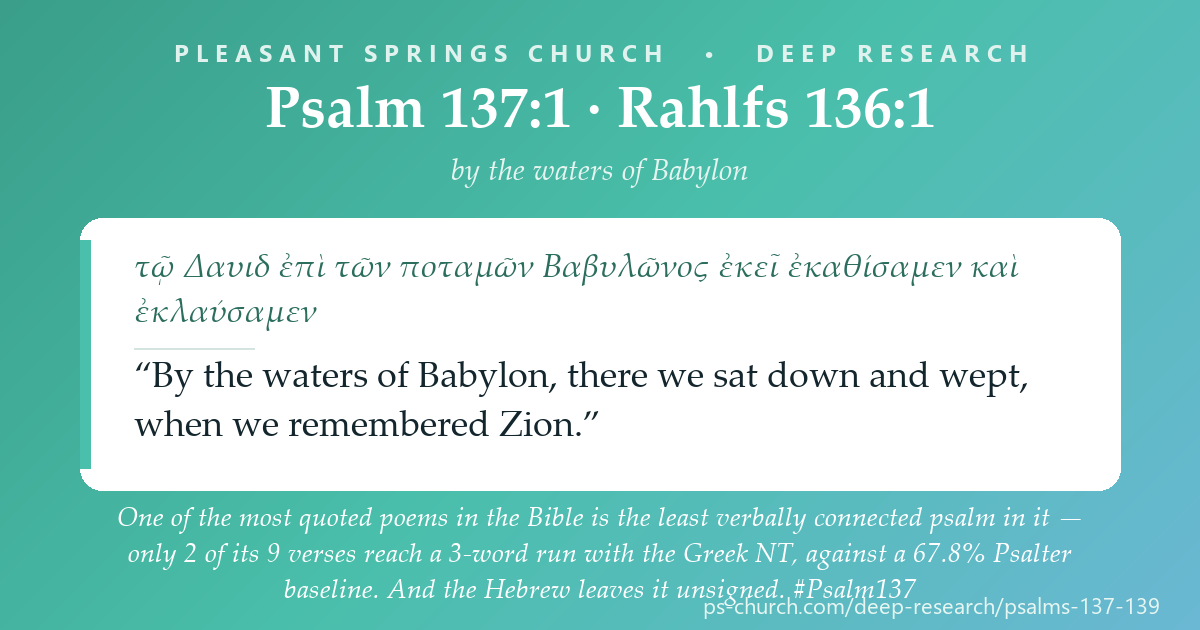
Psalm 137 is one of the most quoted poems in the Bible. It is also the least verbally connected psalm in the book. Measured against the other thirty-eight books of the Hebrew Bible, the longest unbroken run of word-forms anywhere in its nine verses is two words. Measured against all 7,927 verses of the Greek New Testament, only two of its nine verses reach a three-word run — 22.2%, against a Psalter baseline of 68.0%. That is the lowest figure of any psalm of eight verses or more, and no psalm is tied with it; the next lowest is 37.5%. And the one psalm of these three that the Hebrew leaves without a heading is the one Rahlfs' Greek Psalter opens with David's name. Psalms 138 and 139 are signed in both texts and behave normally. Psalm 137 is signed in one, and behaves like nothing else in the Psalter.
Psalms 137–139 (selections)
Hebrew · Greek (Rahlfs’ Psalter) · ESVTwo independent measurements, both run against everything on disk:
— Against the other thirty-eight books of the Hebrew Bible, the longest unbroken run of consonantal word-forms anywhere in Psalm 137 is two words.
— Against all 7,927 verses of the Greek New Testament, only two of its nine verses reach a three-word run. That is 22.2%, against a Psalter baseline of 68.0% — and it is the lowest figure of any psalm of eight verses or more, with no psalm tied to it.
The psalm everyone can quote is the one that shares least of its wording with anything else.
The Shape of the Passage
Sequence — one psalm without a name, two withTwo of these three psalms carry David’s name in both texts. The third carries it in one. Psalm 138 is headed לְדָוִ֨ד and Rahlfs 137:1 has τῷ Δαυιδ; Psalm 139 is headed לַ֭מְנַצֵּחַ לְדָוִ֣ד מִזְמ֑וֹר and Rahlfs 138:1 has εἰς τὸ τέλος ψαλμὸς τῷ Δαυιδ. Psalm 137 has no superscription in the Hebrew — the poem begins on עַ֥ל־נַהֲר֨וֹת בָּבֶ֗ל — and Rahlfs 136:1 begins τῷ Δαυιδ.
Author
The disagreement falls on the one psalm that is plainly about the exile. Psalm 137 names Babylon, names Zion, and speaks in the first person plural of captors and a foreign land. It is the one psalm of the three the Hebrew leaves unsigned, and the one Rahlfs’ Greek heads with David’s name.
What this page does not say. It does not say the Greek added a heading, or that the Hebrew lost one. It reports what each text on disk carries at that point, and stops. No critical apparatus was consulted for either text, and no manuscript evidence bearing on the superscription was available here.
Audience
Psalm 137 addresses several parties in nine verses. Captors, in reported speech; Jerusalem, in the second person singular feminine; the Lord, in the imperative; and finally the daughter of Babylon.
Psalms 138 and 139 address God throughout. Psalm 138 turns outward once, at verse 4 — all the kings of the earth shall give you thanks — which is also the verse in that psalm with the longest New Testament run.
Orient on the exile psalms, on superscriptions, and on imprecation.
Search by topic: Psalm 137 and the exile; psalm superscriptions and their transmission; imprecatory psalms; Babylon in the prophets; Psalm 139 and divine knowledge.
Which articles are relevant?
- Anchor Bible Dictionary — “Exile,” “Babylon,” “Psalms, Book of,” “Superscriptions, Psalm.”
- Dictionary of the OT: Wisdom, Poetry & Writings (IVP) — “Imprecation,” “Lament,” “Titles of Psalms,” “Zion.”
- NIDOTTE — חקר, ידע, שכח, זכר.
The one point where the reference works and the files disagree in emphasis
The standard treatments describe Psalm 137 as saturated with the language of the prophets — Babylon, Zion, the daughter of Babylon, the Edomites at the fall of Jerusalem — and cross-reference Jeremiah, Isaiah, Lamentations and Obadiah freely.
That is a claim about theme, and it is fair. It is not a claim about wording, and at the level of wording the psalm is remarkably isolated. Its deepest verbal overlap with any verse in the other thirty-eight books is two consonantal words: בבל שם, which also stand together at Micah 4:10. Shared subject matter and shared wording are different measurements, and this page only makes the second one.
The heading that stands in one text and not the other.
Three psalms, three headings — and one of them appears only in the Greek
| Hebrew | Rahlfs’ Greek | |
|---|---|---|
| Psalm 137 = Rahlfs 136 | No superscription. Verse 1 begins עַ֥ל־נַהֲר֨וֹת בָּבֶ֗ל. | τῷ Δαυιδ and nothing else, then straight into the river. |
| Psalm 138 = Rahlfs 137 | לְדָוִ֨ד | τῷ Δαυιδ |
| Psalm 139 = Rahlfs 138 | לַ֭מְנַצֵּחַ לְדָוִ֣ד מִזְמ֑וֹר | εἰς τὸ τέλος ψαλμὸς τῷ Δαυιδ |
On two of the three the texts line up element for element. Psalm 139’s three Hebrew elements — to the choirmaster, of David, a psalm — answer to the Greek’s three. On the third there is nothing in the Hebrew to line up with.
Which text is doing what here cannot be settled from the files on disk, and this page does not try. Rahlfs’ edition is a modern reconstruction of the Greek wording; no Hebrew or Greek critical apparatus was consulted, and no manuscript of either text was examined.
A note on the psalm's last verse
Psalm 137 ends on a line about infants and a rock. The house position on hard texts is to print them and to say what can be measured about them, not to soften them and not to explain them away.
What can be measured: the verse’s longest run with any New Testament verse is two words, which is below the Psalter’s ordinary floor. That is a fact about wording. It is not evidence that the New Testament avoids the verse, and this page does not present it as such — the same measurement returns two for most of the psalm, including the lines everybody loves.
The verb that opens and closes Psalm 139.
Psalm 139 begins and ends on the same three consonants
Verse 1: יְהֹוָ֥ה חֲ֝קַרְתַּ֗נִי וַתֵּדָֽע׃ — O Lord, you have searched me and known me.
Verse 23: חׇקְרֵ֣נִי אֵ֭ל וְדַ֣ע לְבָבִ֑י — Search me, O God, and know my heart.
Two different forms of the same three consonants חקר, at the first verse and the second-to-last — and the verb ידע, to know, stands beside it both times. What changes is the mood: the psalm opens by saying it has been done and closes by asking for it.
This is a form observation, not a lemma count. No Hebrew lemmatiser is on disk, so the claim is about the consonantal skeletons that appear in these two verses and about nothing wider.
One place the two texts part company
Psalm 138:8. Where the Hebrew has יְהֹוָה֮ יִגְמֹ֢ר בַּ֫עֲדִ֥י — the Lord will complete on my behalf — Rahlfs’ Greek has κύριος ἀνταποδώσει ὑπὲρ ἐμοῦ, the Lord will repay on my behalf.
Recorded as a difference between two texts, in that form and no other. This shelf does not say which reading is earlier and does not describe either text as having changed the other.
Two measurements, and what they do and do not show.
Against the rest of the Hebrew Bible
Every verse of every psalm was compared with every verse of the other thirty-eight books, taking the longest unbroken run of consonantal word-forms.
Psalm 137’s deepest contact anywhere in that corpus is two words — בבל שם, Babylon… there, which also stand together at Micah 4:10. Psalm 139 is also at two (אתה ידעת, with Genesis 30:26). Psalm 138 reaches three (אל היכל קדשך, with Jonah 2:5).
Two words is a common floor, not a distinction. Across the 150 psalms the deepest-contact figure is 2 for 38 psalms, 3 for 76, 4 for 16, 5 for 7 and 6 or more for 13. Psalm 137 sits at the bottom of that distribution with thirty-seven other psalms, and this page does not claim the two-word figure is unique to it.
Against the Greek New Testament — where Psalm 137 is genuinely alone
Each verse of Rahlfs’ Greek Psalter was swept against all 7,927 verses of the Greek New Testament. Across the whole Psalter, 68.0% of verses reach a three-word run — the ordinary case.
Rahlfs 136, the Greek Psalm 137, reaches three in two of its nine verses.
| Verse | Longest run | Where |
|---|---|---|
| 1 | 2 | — |
| 2 | 3 | ἐν μέσῳ αὐτῆς — Luke 21:21 |
| 3 | 2 | — |
| 4 | 2 | — |
| 5 | 2 | — |
| 6 | 3 | ἡ γλῶσσά μου — Acts 2:26 |
| 7 | 2 | — |
| 8 | 2 | — |
| 9 | 2 | — |
Two of nine is 22.2%. Restricted to psalms of eight verses or more, that is the lowest figure in the Psalter, and nothing is tied with it. The next lowest is Rahlfs 81 at 37.5%; then Rahlfs 59 at 42.9%. No verse of Psalm 137 reaches four, against a baseline where 16.1% of Psalter verses do.
The eight-verse floor is stated because short psalms make the fraction unstable — a three-verse psalm can read 33.3% off a single verse. The figure is reported inside that restriction, and the restriction is part of the claim.
What the other two psalms do
Psalm 138 (Rahlfs 137): 3, 3, 3, 4, 3, 2, 3, 4 — seven of eight verses reach three, two reach four. The fours are οἱ βασιλεῖς τῆς γῆς at v 4, which stands in four New Testament verses, and ἔργα τῶν χειρῶν σου at v 8, with Hebrews 1:10.
Psalm 139 (Rahlfs 138): sixteen of twenty-four verses reach three, one reaches four — τὰ ἔργα σου καί at v 14, with Revelation 2:2.
Both are ordinary. Psalm 137 is not. The three psalms sit next to each other and only one of them is an outlier, which is worth saying because it means the result is not an artefact of where the passage was cut.
What the measurement can carry, and what it cannot.
Why a low run-length figure is not a claim about influence
A short longest-run figure means the psalm shares little wording with the corpus searched. It does not mean the psalm was unknown, unused or unquoted. Psalm 137 is nine verses long and its vocabulary is concrete and local — rivers, willows, lyres, a rock. Short psalms with distinctive vocabulary will score low on any run-length measure, and that is a property of the measure as much as of the psalm.
What the figure does support is narrower and still worth having: if you are looking for verbal contact between this psalm and the New Testament, there is very little of it to find, and what there is — ἐν μέσῳ αὐτῆς, ἡ γλῶσσά μου — is ordinary Greek that appears in many places.
What was checked and came back negative
No verse of Psalms 137, 138 or 139 reaches a five-word run with any New Testament verse. Scoped to the files on disk — Rahlfs’ Greek Psalter as digitised by CATSS against the 7,927 verses of the SBL Greek New Testament — and to the spelling as counted under the normalisation set out in the method note. Maximum across all forty-one verses of the three psalms is four, reached three times.
A psalm that borrows nothing and is borrowed from by no one.
Being quoted often and quoting rarely are different things
Psalm 137 is in the hymnbooks, the protest songs and the anthologies. By the measure this shelf uses, it is the psalm that shares least of its wording with anything else in the Bible. Those two facts sit together comfortably once you separate what a text is made of from what people do with it.
It is a poem about not being able to sing in a foreign language, and it turns out to be written in wording that almost nothing else in the Bible repeats. That is an observation about a word count, not a theological claim, and the page leaves it there.
Every Deep Research page traces its passage across the whole sweep — the Old Testament, the Second-Temple world between the testaments (historical witnesses, not Scripture), and the New Testament. Follow the thread:
Pleasant Springs Church — Deep Research
Research method after Michael S. Heiser’s Bible Research Method (examine dictionaries → ancient literature → important words → textual connections → academic publications → share), with the Pleasant Springs “Author & Audience” foundation. Scripture set in the Hebrew, the Greek editions named on each page and the ESV (Old Testament), and the Greek New Testament and the ESV (New Testament), per the practice of Pleasant Springs Church. Psalms 137–139 research grounded in Goldingay (Psalms 90–150), Hossfeld and Zenger (Psalms 3), Wilson and Alter. Text: Hebrew from the Masoretic text as printed in the editions consulted — Sefaria’s Miqra according to the Masorah; no critical apparatus was consulted for the Hebrew. Greek from Rahlfs’ Greek Psalter (CATSS digitization); Greek New Testament from the SBL edition. The standing caution for this shelf applies: these pages say “Rahlfs’ Greek Psalter reads…” and never call a Greek reading early or late. ⚠️ The 22.2% figure, stated so it can be repeated. All 2,534 verses of Rahlfs’ Greek Psalter against all 7,927 SBLGNT verses, longest unbroken token run, one normalisation applied to both sides — movable nu resolved first, then accents stripped by Unicode decomposition, lowercased, final sigma folded, apostrophes stripped, elision resolved from a fixed table. Verses were then grouped by psalm and scored on the fraction reaching 3. Restricted to psalms of 8 or more verses, Rahlfs 136 is lowest at 2/9 = 22.2%; the set of psalms tied at that fraction has one member, itself; no psalm in the restriction scores lower. Next lowest are Rahlfs 81 at 37.5% and Rahlfs 59 at 42.9%. The 8-verse restriction is part of the claim — without it, short psalms dominate the bottom of the table for arithmetic reasons. ⚠️ The run search tries every length from 1 upward and stops at the first miss, so a verse with no 3-gram match is reported at its true 1 or 2 rather than at 0. ⚠️ The Hebrew-Bible measurement. Longest unbroken run of consonantal word-forms, each psalm against all 20,677 verses of the other 38 books. Ps 137 = 2 (בבל שם, Micah 4:10); Ps 138 = 3 (אל היכל קדשך, Jonah 2:5); Ps 139 = 2 (אתה ידעת, Genesis 30:26). Two is the floor for 38 of the 150 psalms and is not distinctive on its own — the distinction in this study is the New Testament figure, not this one. Shared wording cannot establish direction and the page asserts none. ⚠️ New Testament runs are reported against the Psalter’s own baseline — 68.0% of the 2,534 Greek Psalter verses reach a 3-word run, 16.1% reach 4+, 5.1% reach 5+, maximum 20. A 3-word run is the Psalter norm, not evidence of contact. ⚠️ The baseline was re-measured on 30 August 2026, and it moved. CATSS and MorphGNT spell one Greek word two ways depending on the next word’s first letter — the negative (οὐ / οὐκ / οὐχ), the preposition (ἐκ / ἐξ) and the movable nu (ἐστι / ἐστιν). MorphGNT folds each pair in the column measured here; CATSS does not, so until this was corrected every run compared across the two editions stopped dead at the first such word. The comparison now applies MorphGNT’s own equivalence table — 106 pairs, 1,326 tokens — to both sides. Before the correction this page printed 67.8% reaching 3+ and 16.0% reaching 4+; the re-measurement gives 68.0% and 16.1%. The fold could only ever break a shared run, never invent one, so every figure it touched was too low and none was overstated. 144 of the 2,534 Psalter rows moved. One verse of this study moved: Rahlfs 138:4 — Hebrew Psalm 139:4 — from 2 to 3, in a tie band of 7 (ὅτι οὐκ ἔστιν, which the old comparison could not see, because CATSS spells it οὐκ and MorphGNT files it under οὐ). That is what makes Psalm 139 read sixteen of twenty-four verses at three — the figure this page prints. The pre-correction sweep returned fifteen: the page was right where the tooling was wrong, and the history is printed here rather than the number quietly restated. Psalm 137’s nine rows and Psalm 138’s eight did not move at all, so 22.2% stands, and re-running the whole restriction after the correction still leaves Rahlfs 136 lowest of any psalm of eight verses or more with nothing tied to it, the next lowest being Rahlfs 81 at 37.5%. ⚠️ Hebrew counts are FORM counts. No Hebrew lemmatiser is on disk, so no root or lemma claim is made — the חקר observation in stage 3 is about the consonantal skeletons in Psalm 139:1 and 139:23 and nothing wider. Word counts follow the shelf rule: split on whitespace and maqqef, count a token only if it carries a Hebrew letter, count a ketiv/qere pair once. Under that rule the Psalter totals exactly 19,586 words and 2,527 verses. Ps 137 = 84 words / 9 verses; Ps 138 = 76 / 8; Ps 139 = 177 / 24. ⚠️ What could not be checked. No Qumran manuscript of these psalms, no Cairo Geniza fragment, no Syriac, no Vulgate or Gallican Psalter, no Aquila, Symmachus or Theodotion, and no manuscript evidence of any kind bearing on the Psalm 137 superscription — which is why stage 2 reports what each text carries and declines to say how the difference arose. Typology is handled per the house position: what the text says, what the New Testament itself draws, and what we see from this side of the cross — with the seeing left to the reader.
Scripture quotations marked ESV are from the ESV® Bible (The Holy Bible, English Standard Version®), © 2001 by Crossway, a publishing ministry of Good News Publishers. ESV Text Edition: 2016. Used by permission. All rights reserved. The ESV text may not be quoted in any publication made available to the public by a Creative Commons license, and the ESV may not be translated in whole or in part into any other language. www.esv.org
|
Did this study bless you today? 💚 Give to Support PS Church100% of gifts go to the General Fund — thank you. |