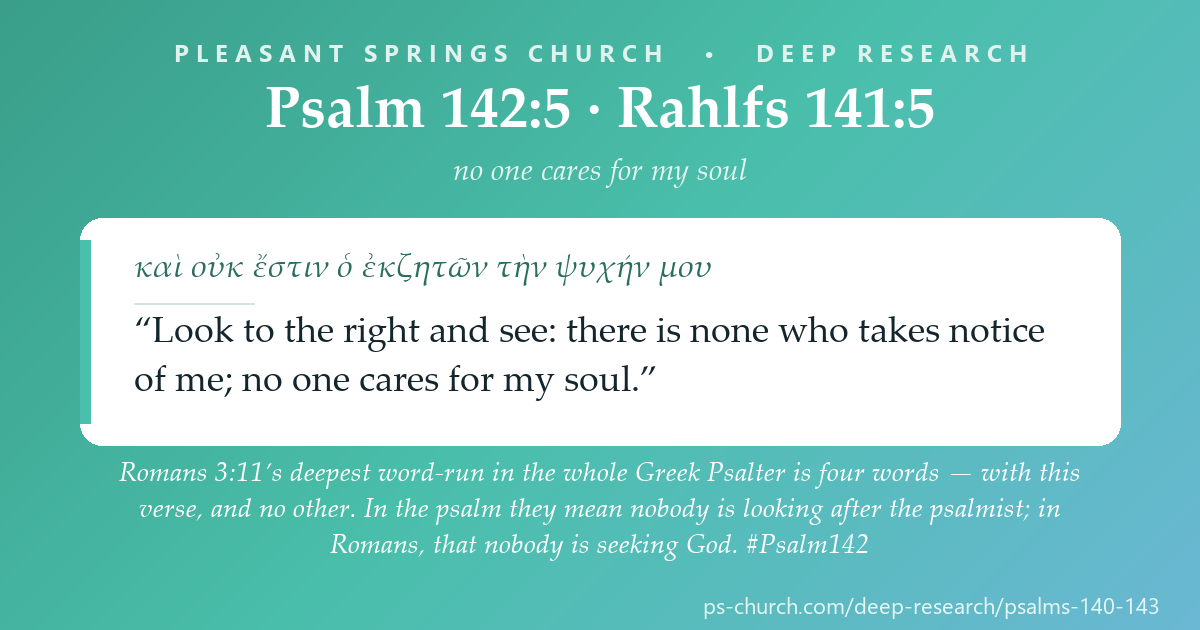
Romans 3:10–18 strings together more psalm material than any other paragraph in the New Testament. Swept against all 2,534 verses of the Greek Psalter, seven of its nine verses have their deepest word-run with one single verse — Rahlfs 13:3 — at 5, 6, 7, 7, 8, 12 and 15 words. Two verses do not, and both of them point into this study. Romans 3:11's deepest contact in the entire Psalter is four words with Psalm 142:5, and no other verse in the book reaches four with it — but in the psalm those four words say that nobody is looking after the psalmist, and in Romans they say that nobody is seeking God. Then, two verses further on, Psalm 143:2 — the verse Romans 3:20 is universally said to be reworking — shares exactly two words with it. One quotation found precisely, one pointed somewhere its wording does not mean, one missed altogether. All three land in these four psalms, which makes them a good place to say plainly what this shelf's main measurement can and cannot do.
Psalms 140–143 (selections)
Hebrew · Greek (Rahlfs’ Psalter) · ESVEach of the nine verses was swept against all 2,534 verses of Rahlfs’ Greek Psalter, taking the longest unbroken run.
— Seven of the nine have their deepest run with one single verse: Rahlfs 13:3, at 5, 6, 7, 7, 8, 12 and 15 words.
— Romans 3:11 does not. Its deepest run in the entire Psalter is four words, with Rahlfs 141:5 — Psalm 142:5 — and it is the only verse in the book that reaches four with it.
— Romans 3:10 does not either. It reaches three, in a wide tie.
The measure finds one quotation exactly, points a second somewhere its own wording does not mean, and — two verses later, at Romans 3:20 — misses a third entirely.
The Shape of the Passage
Sequence — four Davidic prayers, and where Romans touches themAll four psalms carry David’s name, in both texts, and three of the four headings match element for element. Psalm 140: לַמְנַצֵּ֗חַ מִזְמ֥וֹר לְדָוִֽד׃ and εἰς τὸ τέλος ψαλμὸς τῷ Δαυιδ. Psalm 141: מִזְמ֗וֹר לְדָ֫וִ֥ד and ψαλμὸς τῷ Δαυιδ. Psalm 142: מַשְׂכִּ֥יל לְדָוִ֑ד בִּֽהְיוֹת֖וֹ בַמְּעָרָ֣ה תְפִלָּֽה׃ and συνέσεως τῷ Δαυιδ ἐν τῷ εἶναι αὐτὸν ἐν τῷ σπηλαίῳ προσευχή. Psalm 143 is the exception: where the Hebrew heading is two words, Rahlfs 142:1 carries five more — ὅτε αὐτὸν ὁ υἱὸς καταδιώκει.
Author
David in all four, and two of the headings place him in a situation. Psalm 142 puts him in a cave, in both texts. Psalm 143 puts him under pursuit by his son — in the Greek only.
This shelf reports what each text carries and does not say how a difference arose. No critical apparatus was consulted for either text, and no manuscript evidence bearing on these superscriptions was available here. Rahlfs’ edition is a modern reconstruction of the Greek wording.
Audience
All four are addressed to God, in the first person singular, throughout. There is no congregation being instructed here and no group being called to praise — which is a plain contrast with Psalms 135 and 136 a few pages earlier.
A note on verse numbers. In Psalms 140 and 142 the Hebrew counts the superscription as verse 1, so English verse numbers run one behind the Hebrew: Hebrew 140:4 is ESV 140:3, and Hebrew 142:5 is ESV 142:4. In Psalms 141 and 143 the superscription shares verse 1 with the first line of the poem and the numbering agrees. Rahlfs follows the Hebrew in all four, which is why this page can label a line three ways at once.
Orient on the Davidic laments, on Romans 3, and on how quotation is identified.
Search by topic: individual lament; Romans 3:10-18 and the catena; Old Testament in the New; testimonia; Psalm 141 and incense; the cave narratives.
Which articles are relevant?
- Anchor Bible Dictionary — “Quotations in the NT,” “Romans, Epistle to the,” “Testimonia,” “Lament.”
- Dictionary of the OT: Wisdom, Poetry & Writings (IVP) — “Lament,” “Enemies,” “Prayer,” “Psalms in the NT.”
- NIDOTTE — צדק, דרש, נצר, קטרת.
How the reference works identify a quotation, and how this page measures one
They are not the same operation, and the difference is the subject of this page.
Commentaries identify quotations by introductory formula, by argument, by context, by the history of interpretation, and by wording. This shelf measures one of those five: the longest unbroken run of matching word-forms. It is fast, reproducible and blind — and being blind is exactly what makes it worth publishing alongside the commentaries rather than instead of them.
Romans 3 is the clearest place in the Bible to show what that blindness costs and what it buys.
The long verse that seven of the nine point at.
Rahlfs 13:3 and the Hebrew of Psalm 14:3
Where the Hebrew of Psalm 14:3 has ten words, Rahlfs’ Greek Psalter has sixty at 13:3.
Hebrew: הַכֹּ֥ל סָר֮ יַחְדָּ֢ו נֶ֫אֱלָ֥חוּ אֵ֤ין עֹֽשֵׂה־ט֑וֹב אֵ֝֗ין גַּם־אֶחָֽד׃
Rahlfs 13:3 begins with the counterpart of those ten and continues through the open grave, the deceiving tongues, the venom of asps, the mouth full of cursing, the swift feet, the ruin and misery, the way of peace, and the fear of God before the eyes.
That is why seven of the nine verses of Romans 3:10–18 measure their deepest Psalter run against this one verse. Stated as a difference between two texts on disk, in that direction and no other. This page does not say that the Greek added the material or that the Hebrew lost it, does not call either reading early or late, and does not say whether Paul is reading a text like this one.
Where Psalm 140 comes into it
One clause inside that long verse also stands, by itself, in Psalm 140.
ἰὸς ἀσπίδων ὑπὸ τὰ χείλη αὐτῶν — the venom of asps is under their lips — occurs in exactly two of the 2,534 verses of the Greek Psalter: Rahlfs 13:3 and Rahlfs 139:4, which is Psalm 140:4.
In the Hebrew there is no question where it sits: Psalm 14:3 does not contain it and Psalm 140:4 does. Romans 3:13 carries all six words.
Four words that mean two different things.
οὐκ ἔστιν ὁ ἐκζητῶν
Psalm 142:5 (Rahlfs 141:5; ESV 142:4) ends: καὶ οὐκ ἔστιν ὁ ἐκζητῶν τὴν ψυχήν μου — and there is no one seeking out my soul. The Hebrew behind it is אֵ֖ין דּוֹרֵ֣שׁ לְנַפְשִֽׁי׃, and the ESV renders it no one cares for my soul.
Romans 3:11 reads: οὐκ ἔστιν ὁ συνίων, οὐκ ἔστιν ὁ ἐκζητῶν τὸν θεόν — there is none who understands; there is none who seeks God.
The four shared words are οὐκ ἔστιν ὁ ἐκζητῶν. In the psalm the missing seeker is a friend who would look after the psalmist. In Romans the missing seeker is a human being who would look for God. Same four words, opposite direction of the searching, and only the fifth word tells you which.
This is not offered as evidence that Romans is drawing on Psalm 142, and the page does not claim it is. It is offered as the clearest available demonstration that a longest-run figure measures wording and nothing else.
Two places where the Greek reads more than the Hebrew
Psalm 141:3. Where the Hebrew has נִ֝צְּרָ֗ה עַל־דַּ֥ל שְׂפָתָֽי׃ — a watch over the door of the lips — Rahlfs 140:3 has θύραν περιοχῆς περὶ τὰ χείλη μου, a door of enclosure around the lips.
Psalm 143:10. The Hebrew’s two words רוּחֲךָ֥ טוֹבָ֑ה stand in Rahlfs 142:10 as four: τὸ πνεῦμά σου τὸ ἀγαθόν, the article carried twice.
Both recorded as differences between two texts and nothing more.
The whole catena, measured.
Romans 3:10–18 against the Greek Psalter, verse by verse
Each verse swept against all 2,534 verses of Rahlfs’ Greek Psalter; longest unbroken run of word-forms; one normalisation applied to both sides.
| Romans | Longest run | Where |
|---|---|---|
| 3:10 | 3 | a wide tie — Rahlfs 6:6, 70:11, 72:4 and others |
| 3:11 | 4 | Rahlfs 141:5 alone = Psalm 142:5 |
| 3:12 | 12 | Rahlfs 13:3 |
| 3:13 | 15 | Rahlfs 13:3 (and six of those words also at Rahlfs 139:4 = Psalm 140:4) |
| 3:14 | 7 | Rahlfs 13:3 |
| 3:15 | 6 | Rahlfs 13:3 |
| 3:16 | 7 | Rahlfs 13:3 |
| 3:17 | 5 | Rahlfs 13:3 |
| 3:18 | 8 | Rahlfs 13:3 |
Seven of nine land on one verse. One lands on Psalm 142:5 and nowhere else. One does not land anywhere in particular.
And the quotation the measure does not see at all
Romans 3:20 — οὐ δικαιωθήσεται πᾶσα σὰρξ ἐνώπιον αὐτοῦ — is read by essentially every commentary as a rework of Psalm 143:2, οὐ δικαιωθήσεται ἐνώπιόν σου πᾶς ζῶν.
Their longest unbroken shared run is two words: οὐ δικαιωθήσεται. After that the psalm has ἐνώπιόν σου and Romans has πᾶσα σάρξ; the psalm has πᾶς ζῶν and Romans has ἐνώπιον αὐτοῦ. The same three elements, reordered and one of them swapped — which breaks every run longer than two.
A reader working only from run lengths would never find this quotation. Rahlfs 142:2 reaches two with a very large number of New Testament verses, and this page prints no ranking among them, because at a run of two the tie band runs to the hundreds.
What the four psalms look like on the ordinary measure
| Psalm | Verses reaching 3+ | Maximum |
|---|---|---|
| 140 = Rahlfs 139 | 8 of 14 | 6 (v 4, Romans 3:13) |
| 141 = Rahlfs 140 | 8 of 10 | 3 |
| 142 = Rahlfs 141 | 4 of 8 | 5 (v 1) |
| 143 = Rahlfs 142 | 10 of 12 | 4 |
Against a Psalter baseline of 67.8% reaching three. Psalm 141 is the flat one: eight of its ten verses reach three and none goes beyond it, and the two that fall short are the last two.
Stating the limits of the shelf's main tool.
What a longest-run figure is good for
It is good at finding sustained verbatim overlap, and it is honest about it. Romans 3:13’s fifteen-word run with Rahlfs 13:3 is not a judgement call; you can reproduce it in a few lines of code and check it by eye.
It is bad at three things, all of them on display here.
— It cannot see a quotation that has been reordered or had a word swapped: Romans 3:20 and Psalm 143:2.
— It cannot tell a quotation from a coincidence of common words: Romans 3:11 and Psalm 142:5 share four words that mean different things.
— It cannot establish direction. A shared run tells you two texts have wording in common and nothing about who had it first.
What was checked and came back negative
No verse of Psalms 141, 142 or 143 reaches a seven-word run with any New Testament verse; the maxima are 3, 5 and 4. Psalm 140 reaches 6, once, at verse 4.
And no Psalter verse other than Rahlfs 141:5 reaches four words with Romans 3:11. Scoped to the files on disk and to the spelling as counted — Rahlfs’ Greek Psalter as digitised by CATSS against the 7,927 verses of the SBL Greek New Testament, under the normalisation set out in the method note.
Why a measurement worth publishing is one you can also see the edge of.
The number is not the finding; the number plus its rule is
Every page on this shelf reports run lengths. This one exists to show, in a single paragraph of Romans, all three things that can happen when you do. The measure finds the great catena exactly. It points at Psalm 142:5 for reasons that turn out to be about Greek vocabulary rather than about Paul. And it walks straight past Psalm 143:2.
That is not an argument against measuring. It is an argument for publishing the rule next to the result — which is why the method note under every one of these pages is as long as it is, and why the negatives are scoped to the files on disk and to the spelling as counted.
A reader who knows exactly what a number was allowed to see can decide for themselves what it is worth. A reader who is only shown the number cannot.
Every Deep Research page traces its passage across the whole sweep — the Old Testament, the Second-Temple world between the testaments (historical witnesses, not Scripture), and the New Testament. Follow the thread:
Pleasant Springs Church — Deep Research
Research method after Michael S. Heiser’s Bible Research Method (examine dictionaries → ancient literature → important words → textual connections → academic publications → share), with the Pleasant Springs “Author & Audience” foundation. Scripture set in the Hebrew, the Greek editions named on each page and the ESV (Old Testament), and the Greek New Testament and the ESV (New Testament), per the practice of Pleasant Springs Church. Psalms 140–143 research grounded in Goldingay (Psalms 90–150), Hossfeld and Zenger (Psalms 3), Wilson and Alter. Text: Hebrew from the Masoretic text as printed in the editions consulted — Sefaria’s Miqra according to the Masorah; no critical apparatus was consulted for the Hebrew. Greek from Rahlfs’ Greek Psalter (CATSS digitization); Greek New Testament from the SBL edition. The standing caution for this shelf applies: these pages say “Rahlfs’ Greek Psalter reads…” and never call a Greek reading early or late. ⚠️ The Romans 3 table, stated so it can be repeated. Each of Romans 3:10–18 against all 2,534 verses of Rahlfs’ Greek Psalter, longest unbroken token run, one normalisation applied to both sides — movable nu resolved first, then accents stripped by Unicode decomposition, lowercased, final sigma folded, apostrophes stripped, elision resolved from a fixed table. Maxima: 3, 4, 12, 15, 7, 6, 7, 5, 8. Ties are reported, not hidden — Romans 3:10 reaches 3 against a wide band and no ranking is printed inside it; Romans 3:11 reaches 4 against exactly one verse, Rahlfs 141:5, and 3 against Rahlfs 13:2 and 52:3, the two verses it is usually assigned to. The six-word string ἰὸς ἀσπίδων ὑπὸ τὰ χείλη αὐτῶν was searched as a 6-gram across the whole Greek Psalter and returns exactly two verses, Rahlfs 13:3 and Rahlfs 139:4. ⚠️ The Romans 3:20 comparison is a negative result and is reported as one. Rahlfs 142:2 against Romans 3:20 is a run of 2 (οὐ δικαιωθήσεται); against Galatians 2:16 it is also 2. Rahlfs 142:2’s deepest run against the whole New Testament is 2, shared with well over a hundred verses, so no rank or nearest-match is printed for it. A run of 2 is not evidence that Paul is not using the verse — the page’s point is the opposite. ⚠️ New Testament runs are reported against the Psalter’s own baseline — 67.8% of the 2,534 Greek Psalter verses reach a 3-word run, 16.0% reach 4+, 5.1% reach 5+, maximum 20. A 3-word run is the Psalter norm, not evidence of contact. ⚠️ Verse numbering. Hebrew numbering is used for the psalms throughout, with Rahlfs and ESV numbers given alongside. In Psalms 140 and 142 the Hebrew counts the superscription as verse 1 and the ESV does not, so ESV numbers run one behind; in Psalms 141 and 143 they agree. Rahlfs follows the Hebrew in all four. ⚠️ Hebrew counts are FORM counts. No Hebrew lemmatiser is on disk, so no root or lemma claim is made. Word counts follow the shelf rule: split on whitespace and maqqef, count a token only if it carries a Hebrew letter, count a ketiv/qere pair once. Under that rule the Psalter totals exactly 19,586 words and 2,527 verses. Ps 140 = 116 words / 14 verses; 141 = 95 / 10; 142 = 75 / 8; 143 = 117 / 12. ⚠️ What could not be checked. No Qumran manuscript of these psalms, no Cairo Geniza fragment, no Syriac, no Vulgate or Gallican Psalter, no Aquila, Symmachus or Theodotion, and no manuscript evidence bearing on the length of Rahlfs 13:3 or on the Psalm 143 superscription — which is why stage 2 reports what each text carries and declines to say how the difference arose. Typology is handled per the house position: what the text says, what the New Testament itself draws, and what we see from this side of the cross — with the seeing left to the reader.
Scripture quotations marked ESV are from the ESV® Bible (The Holy Bible, English Standard Version®), © 2001 by Crossway, a publishing ministry of Good News Publishers. ESV Text Edition: 2016. Used by permission. All rights reserved. The ESV text may not be quoted in any publication made available to the public by a Creative Commons license, and the ESV may not be translated in whole or in part into any other language. www.esv.org
|
Did this study bless you today? 💚 Give to Support PS Church100% of gifts go to the General Fund — thank you. |