Why do the nations rage…?” The kings of the earth conspire “against the Lord and against his Anointed” — but heaven is unshaken. God enthrones his King on Zion and declares, “You are my Son; today I have begotten you.” The New Testament reads this royal psalm of Jesus — his resurrection (Acts 13:33), his reign, and his return with a rod of iron. And it ends not with a threat but a welcome: “Blessed are all who take refuge in him.” This study works Psalm 2 from the raging nations to the crowned and returning Son. See the method →
Psalm 2 (selections)
Hebrew · LXX · ESVThe Shape of the Passage
Parallel panelsPsalm 2 is a royal psalm the New Testament reads of Jesus (Acts 13:33 quotes it as “the second Psalm”). With Psalm 1 it forms the gateway to the Psalter: the blessed man, and the enthroned Son.
Author
A royal / coronation psalm, ascribed by the New Testament to David (Acts 4:25). It moves through four voices — the raging nations (vv.1–3), the Lord who laughs and installs his king (vv.4–6), the king who recites God’s decree (vv.7–9), and the psalmist’s warning to the kings of the earth (vv.10–12). In its first setting it celebrates the enthronement of a Davidic king in Zion, using the ancient court idiom of the king as God’s “son.” But its language strains past any mere man: nations for an inheritance, an everlasting rule, refuge found in the Son.
From coronation to Christ. Already before the New Testament, Jewish readers heard Psalm 2 as messianic and eschatological (4QFlorilegium; Psalms of Solomon 17). The New Testament makes the identification explicit: the anointed King is Jesus, installed as the messianic Son at his resurrection (Acts 13:33), reigning over the nations, and coming to judge (Rev 19).
Audience
Israel at worship, and every generation tempted to fear the “raging” of the nations. The psalm answers that fear with a vision of heaven’s calm: the Lord is not threatened by the plots of kings; he has already set his King on the holy hill. The last word is not warning but blessing: “Blessed are all who take refuge in him.”
How they heard it. Psalm 2 became one of the most-used messianic texts in the Second-Temple world and the early church. Its “you are my Son” sounds again at Jesus’ baptism and transfiguration (Matt 3:17; 17:5), its “today I have begotten you” interprets his resurrection (Acts 13:33), and its “rod of iron” describes his reign and return (Rev 12:5; 19:15).
Orient on the royal psalm, the Anointed, sonship, and Zion.
Search by topic: royal psalm, Messiah / Anointed, divine sonship, Zion, kingship.
Which articles are relevant?
- Anchor Bible Dictionary — “Psalms,” “Messiah,” “Anointing,” “King, Kingship.”
- Dictionary of the OT: Wisdom, Poetry & Writings — “Royal Psalms,” “Messianic Psalms,” “Zion,” “Sonship.”
- NIDOTTE / TDOT — מָשִׁיחַ (māšîaḥ, anointed), בֵּן (bēn, son), חֹק (ḥōq, decree), נַחֲלָה (naḥălâ, heritage).
Bibliography surfaced:
- Peter Craigie (WBC), Derek Kidner (TOTC), Hossfeld & Zenger (Hermeneia), John Goldingay on the Psalms.
- Studies of Psalm 2 as royal-messianic and its heavy use in the NT (Acts 4; 13; Hebrews 1; Revelation).
- Beale & Carson, Commentary on the NT Use of the OT (Acts; Hebrews; Revelation).
The king as God’s son, the rod of iron, and the raging nations.
Read the coronation idiom against its background, weigh the two text-notes, then follow the psalm into the New Testament.
Which parallels shed light on religion and worldview?
The king as ‘son.’ Across the ancient Near East, kings were addressed as sons of the national god (Egypt’s Pharaoh as “son of Ra,” and similar royal ideology at Ugarit). Israel used the idiom — but bent it toward covenant: the Davidic king is God’s son by promise (2 Sam 7:14), and the words point beyond every coronation to a Son who is Son by nature (Heb 1). The shared court-language is background, not the source of the meaning.
The rod, and the ‘Son.’ Two readings meet the eye. At 2:9 the Masoretic תְּרֹעֵם is “break them” (parallel to “dash… like a potter’s vessel”), while the Septuagint read the consonants as ποιμανεῖς, “you shall shepherd / rule them” — and it is the LXX that the New Testament echoes (Rev 2:27; 12:5; 19:15). The images are compatible: a rule that shatters rebellion. At 2:12, “Kiss the Son” uses the Aramaic bar for “son,” unusual in a Hebrew psalm; the LXX read no “son” here at all. Held honestly, neither text-note weakens the psalm: its Son-Messiah is anchored in 2:7 (“you are my Son”) and 2:2 (the Lord and his Anointed).
- 2 Samuel 7:12–16 — the Davidic covenant, “I will be to him a father, and he shall be to me a son”: the promise behind Psalm 2’s sonship (see the Davidic covenant).
- 4QFlorilegium (4Q174) 1 i 18–19 (Dead Sea Scrolls — a witness, not Scripture) — quotes Psalm 2:1–2 of the last-days assault on God’s people, linking Ps 2 with 2 Sam 7: a pre-Christian messianic reading.
- Psalms of Solomon 17:23–24 (Pseudepigrapha — a witness, not Scripture) — the coming son of David shatters the arrogant “like a potter’s vessel” and “with a rod of iron”: Ps 2:9 already read of the Messiah.
- ANE royal-sonship ideology (Egyptian / Ugaritic) — the king as the god’s son: the coronation idiom Israel adopts and the Son fulfills.
The New Testament reads Psalm 2 as fulfilled in Jesus, and it is careful about how. Paul, preaching at Antioch, applies “you are my Son, today I have begotten you” to the resurrection: “this he has fulfilled… by raising Jesus… as also it is written in the second Psalm” (Acts 13:33). So “today I have begotten you” is not the beginning of the Son’s existence (he is the eternal Son, John 1:1; Heb 1:3) and not adoptionism; it is his public installation and vindication as the messianic King — coronation language, the day the eternal Son is enthroned in power (Rom 1:4). Hebrews pairs the same verse with the Davidic covenant to prove the Son’s supremacy over angels (Heb 1:5) and his appointment as high priest (Heb 5:5, joined at once to Ps 110:4; see Psalm 110). And Revelation takes 2:8–9 to the end: the Messiah — and, with him, his overcomers — will “rule the nations with a rod of iron” (Rev 2:27; 12:5; 19:15). The raging of the nations meets its answer in the crowned and returning Son.
The vocabulary of the Anointed, the Son, and the iron scepter.
Watch the “Anointed,” the “Son” and “begotten today,” and the rod of iron.
“Anointed one” — the Lord’s installed king (LXX χριστός, hence “Christ”). The hinge of the psalm: the nations rage against God’s Messiah.
“You are my Son” — the covenant sonship of the king (2 Sam 7:14), fulfilled in the eternal Son. The words heard at the baptism and transfiguration (Matt 3:17; 17:5).
“Today I have begotten you” — royal-installation language; the New Testament ties “today” to the resurrection/enthronement (Acts 13:33), not to the origin of the Son.
“A rod of iron” — the king’s scepter of rule and judgment; taken up of Christ’s reign in Revelation (2:27; 12:5; 19:15), following the LXX “rule/shepherd.”
How the New Testament reuses Psalm 2:
- Acts 4:25–26 — the church quotes Psalm 2:1–2 of the coalition (Herod, Pilate, Gentiles, Israel) that raged against Jesus, God’s Anointed.
- Acts 13:33; Hebrews 1:5; 5:5 — “you are my Son, today I have begotten you”: the resurrection-enthronement, the Son’s supremacy, his priesthood.
- Matthew 3:17; 17:5 (Mark 1:11; 9:7; Luke 3:22; 9:35) — the heavenly voice, “this is my beloved Son”: Psalm 2:7 fused with Isaiah 42:1.
- Revelation 2:26–27; 12:5; 19:15 — “rule the nations with a rod of iron” (Ps 2:8–9): the reign and return of the Anointed.
From the enthroned king to the returning Son.
Trace the anointed Son from the Davidic covenant through the Gospels to the throne of Revelation.
Which cross-references matter?
- 2 Samuel 7:12–16; Psalm 89:26–27 — the Davidic son and firstborn: the covenant that Psalm 2 sings (see 2 Samuel 7).
- Psalm 110:1–2 — the enthroned Lord ruling from Zion “in the midst of your enemies”: Psalm 2’s companion (see Psalm 110).
- Daniel 7:13–14 — the Son of Man given the nations and an everlasting kingdom (see Daniel 7).
- Acts 4:25–28; 13:33; Hebrews 1:5; 5:5 — the psalm applied to Jesus’ rejection, resurrection, and priesthood.
- Revelation 11:15–18; 12:5; 19:15 — the nations’ rage answered; the Anointed reigns and returns.
Psalm 2 is one of the load-bearing pillars of New Testament Christology. Its opening rage-of-the-nations is prayed by the church over the cross (Acts 4:25–28): the plotting of Herod and Pilate is Psalm 2 coming true, yet only to accomplish what God’s hand had planned. Its central decree — “you are my Son, today I have begotten you” — becomes the charter of Jesus’ resurrection-enthronement (Acts 13:33) and, with 2 Samuel 7:14, the proof of his unique Sonship (Heb 1:5). And its royal grant — the nations for an inheritance, ruled with a rod of iron — is stretched to the second coming, where the returning Christ, and his people with him, receive the kingdom the nations tried to seize (Rev 2:26–27; 19:15). Read canonically, Psalm 2 answers the world’s defiance with a single fact: God has already set his King on Zion, and his name is Jesus.
The scholarship on Psalm 2.
The commentators on the Psalms; the studies of Psalm 2’s messianic use; Beale & Carson on the NT.
Commentaries & studies:
- Peter C. Craigie (WBC, Psalms 1–50), Derek Kidner (TOTC), Frank-Lothar Hossfeld & Erich Zenger (Hermeneia).
- John Goldingay (Psalms 1–41); Bruce Waltke & James Houston, The Psalms as Christian Worship.
- G. K. Beale & D. A. Carson, eds., Commentary on the New Testament Use of the Old Testament.
Interpretation notes worth keeping:
- “Begotten today” = installation, not origin. The New Testament ties “today” to the resurrection-enthronement (Acts 13:33); it is coronation language, not adoptionism, and does not touch the Son’s eternal being.
- 2:9 text-note. MT “break” (teroʿem) and LXX/NT “rule/shepherd” (ποιμανεῖς) rest on the same consonants; disclose both, and note the New Testament follows the Greek.
- 2:12 crux. “Kiss the Son” (Aramaic bar) is contested and the LXX read it otherwise; the psalm’s Son-Christology stands on 2:7 and 2:2, not on this single word.
From the raging nations to your own refuge.
Name what you learned, why it matters, and one concrete response.
What should we carry away — and do?
- Heaven is not anxious. While the nations rage, God has already enthroned his King. The headlines do not rule history; the risen Son does.
- Jesus is the begotten Son and King. His resurrection was his coronation. To follow him is to serve the one whose reign the world’s powers cannot overturn.
- Refuge, not rebellion. The psalm ends not with a threat but an invitation: “Blessed are all who take refuge in him.” The wisest response to the crowned Son is to run to him.
Step in response: where the “raging” of the world — its powers, fears, or hostility — presses on you, preach Psalm 2 to yourself: the King is on the throne. Then do what the psalm counsels: “take refuge in him” — bring one specific fear to the enthroned Son and rest under his reign this week.
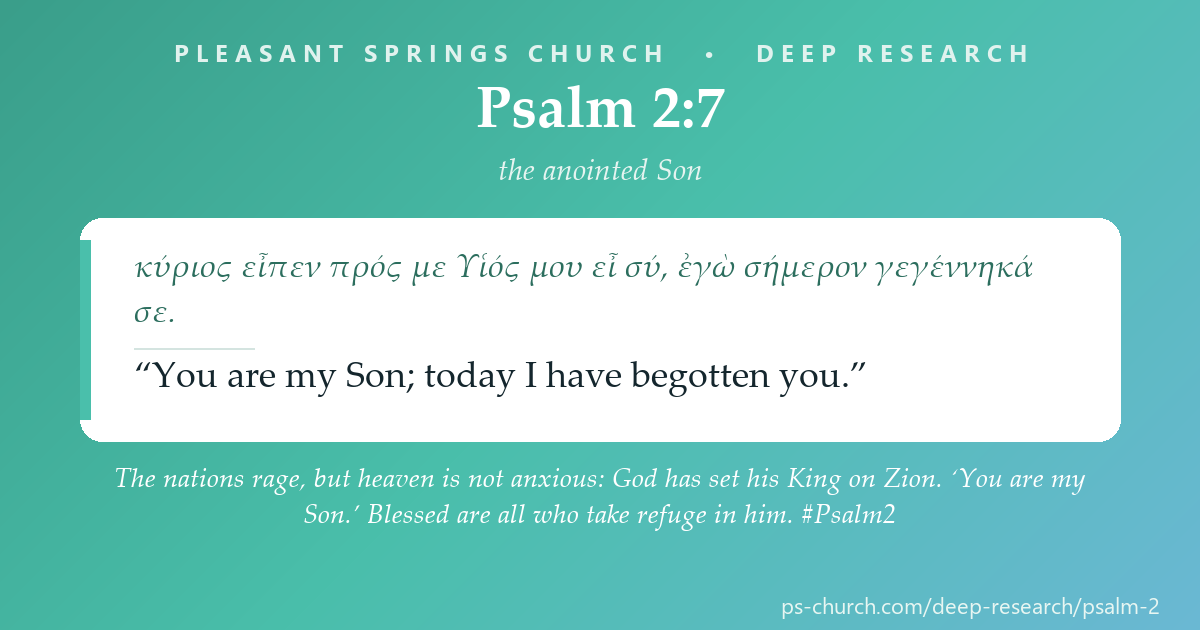
Psalm 2:7 · to share
LXX + ESVEvery Deep Research page traces its passage across the whole sweep — the Old Testament, the Second-Temple world between the testaments (historical witnesses, not Scripture), and the New Testament. Follow the thread:
Pleasant Springs Church — Deep Research
Research method after Michael S. Heiser’s Bible Research Method (examine dictionaries → ancient literature → important words → textual connections → academic publications → share), with the Pleasant Springs “Author & Audience” foundation. Scripture set in the Hebrew, the Greek editions named on each page and the ESV (Old Testament), and the Greek New Testament and the ESV (New Testament), per the practice of Pleasant Springs Church. Psalm 2 research grounded in Craigie, Kidner, Hossfeld & Zenger, Goldingay, and Waltke & Houston, with Beale & Carson on the New Testament use; ANE royal-sonship background; Second-Temple material per 4QFlorilegium and the Psalms of Solomon (read as witnesses, not Scripture).
Scripture quotations marked ESV are from the ESV® Bible (The Holy Bible, English Standard Version®), © 2001 by Crossway, a publishing ministry of Good News Publishers. ESV Text Edition: 2016. Used by permission. All rights reserved. The ESV text may not be quoted in any publication made available to the public by a Creative Commons license, and the ESV may not be translated in whole or in part into any other language. www.esv.org
|
Did this study bless you today? 💚 Give to Support PS Church100% of gifts go to the General Fund — thank you. |