Somebody finally prays. The Psalter opens with two psalms that describe and instruct — the blessed man, the raging nations — and neither of them addresses God at all. Psalm 3 is the first psalm in the book spoken to him: O LORD, how many are my foes! It is also the first with a title, and the title puts it at the worst week of David's life — running from Absalom, his own son. And its central claim is extraordinary for a man being hunted: I lay down and slept; I woke again. In 2 Samuel 17, Ahithophel had advised attacking David that night, while he was weary. The psalm reports sleeping through it. This is also where the verse numbers start disagreeing, so this page explains that once: in Hebrew the title is verse 1, and Rahlfs' Greek follows the Hebrew — 9, 9 and 13 verses against English's 8, 8 and 12. It affects 62 of the 150 psalms, and it compounds with the other offset. Psalms 1–2 escaped both because they had no titles. From here on, you watch. See the method →
Psalms 3:1–5:12 (selections)
Hebrew · Greek (Rahlfs’ Psalter) · ESVIt is also the first psalm with a title, and the first with a story attached. When he fled from Absalom his son — the worst week of David’s life, when his own son drove him out of Jerusalem. Thirteen psalms carry this kind of historical note, and this is the first.
⚠️ And this is where the verse numbers start disagreeing — so this page explains it where it first bites.
In Hebrew the title is verse 1. So Hebrew Psalm 3 has nine verses and English Psalm 3 has eight, and every verse number after the title is one higher in Hebrew than in your English Bible. Rahlfs’ Greek does the same as the Hebrew: nine, nine and thirteen for these three psalms, against English’s eight, eight and twelve. Verified in all three columns.
This affects 62 of the 150 psalms — 58 by one verse and four by two. It is a completely separate problem from the Greek/Hebrew psalm-number offset, which starts at Psalms 9–10 and compounds with this one. Psalms 1–2 escaped both because they have no titles. From Psalm 3 on, you have to watch.
⚠️ Psalm 4:4 is quoted word for word in the New Testament — from the Greek. Paul writes be angry and do not sin (Ephesians 4:26), which is ὀργίζεσθε καὶ μὴ ἁμαρτάνετε exactly as Rahlfs has it. But the Hebrew verb rāģaz means tremble, quake, be agitated — it is used of the earth shaking. Anger is one thing it can cover; fear is another, and probably the primary one here. The Greek narrowed it, and Paul built on the narrowing.
The same verse diverges again at its end: Hebrew and be silent; Rahlfs κατανύγητε, be stung, be pierced. Two quite different instructions for what to do on your bed at night.
The Shape of the Passage
SequenceAnd sleep is the thread. I lay down and slept; I woke again (3:5); ponder on your beds (4:4); in peace I will both lie down and sleep (4:8); in the morning you hear my voice (5:3). Four references to bed in three psalms — from a man whose son is trying to kill him. The Psalter’s first prayers are substantially about being able to sleep.
The title of Psalm 3 tells you why that matters. 2 Samuel 15–17 describes the flight from Absalom, and the danger in it was precisely nocturnal — Ahithophel’s advice was to attack David tonight, while he was weary. The psalm reports sleeping through it.
These follow directly on Psalms 1–2, which are untitled and address nobody. Psalm 3 is where the Psalter starts doing what it is for.
Author
The title puts him at the worst moment of his life. When he fled from Absalom his son — not from Saul, not from Philistines, but from his own child. Whoever attached that note chose the least flattering possible setting for the book\u2019s first prayer.
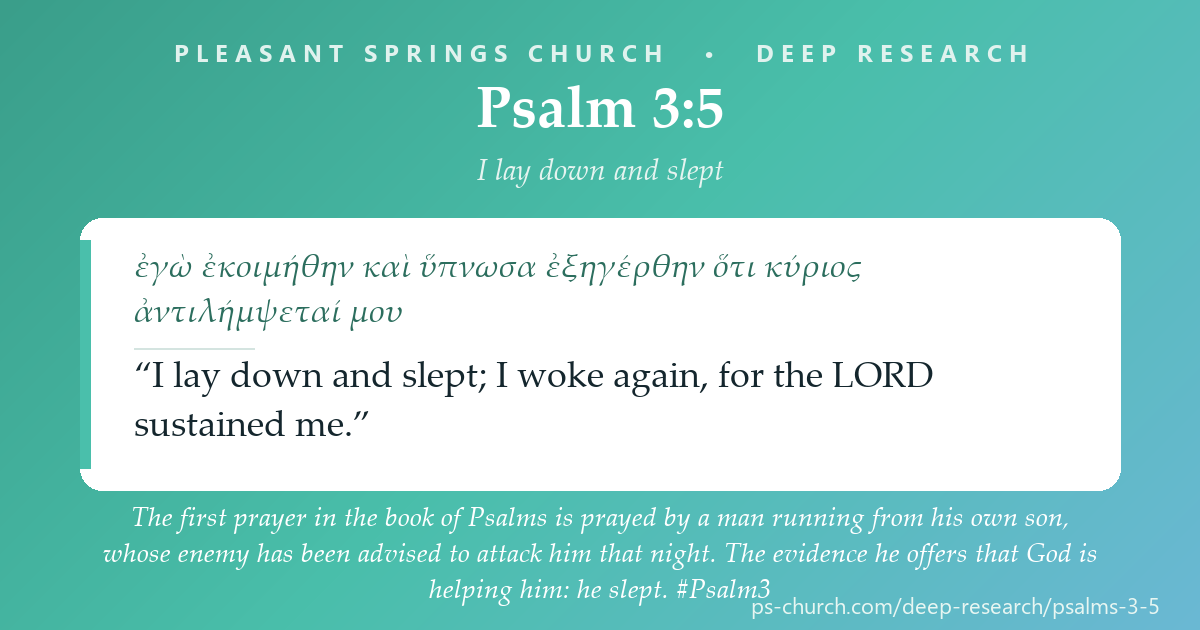
He reports sleeping. Not courage, not a plan — I lay down and slept; I woke again. In a psalm about being surrounded, the evidence of God\u2019s help is a night\u2019s rest.
And he argues with people, not just about them. Psalm 4 addresses the opposition directly — O men, how long shall my honour be turned into shame? The first prayers in the book have other people in the room.
Audience
People who had been told God would not help them. Many are saying of my soul, there is no salvation for him in God. That is the specific accusation Psalm 3 answers — not that God does not exist, but that he has finished with you.
People lying awake. Four references to beds in three psalms. Psalm 4 is a set of instructions for the middle of the night, and both traditions agree that is when it is for — they differ on what to do.
And people who prayed at fixed hours. In the morning… in the morning, said twice in one verse. Psalms 4 and 5 became the evening and morning psalms of Christian daily prayer, which is a use the texts invite.
Orient on psalm titles, on Absalom, and on the verse numbering.
Search by topic: psalm superscriptions; historical titles; Absalom’s revolt; selah; morning and evening prayer; verse division.
Which articles are relevant?
- Anchor Bible Dictionary — “Psalm Titles,” “Absalom,” “Selah,” “Chapter and Verse Divisions.”
- Dictionary of the OT: Wisdom, Poetry & Writings (IVP) — “Psalms: Titles,” “Lament,” “David,” “Enemies.”
- NIDOTTE / TDOT — רָגַז (rāģaz, to tremble / be agitated), מָגֵן (māģēn, shield), יְשׁוּעָה (yəšûʿāh, salvation), סֶלָה (selah).
- On the Greek — the NETS Psalms introduction, and note that Rahlfs numbers verses as the Hebrew does, counting the title.
Bibliography surfaced:
- John Goldingay, Psalms 1–41 — the standard English commentary for this stretch. Note again that there is no Hermeneia volume for Psalms 1–50.
- Robert Alter, The Book of Psalms; Gerald H. Wilson, The Editing of the Hebrew Psalter.
- Beale and Carson, Commentary on the NT Use of the OT — for Ephesians 4:26.
A night attack, a numbering convention, and a verb that means shaking.
The numbering is explained here once, where it first applies. Later pages refer back.
Which parallels shed light on these psalms?
The title points to a specific night. In 2 Samuel 17, Ahithophel advises Absalom to pursue David tonight, while he is weary and discouraged — a night raid on an exhausted man. The advice was overruled, and David survived the night. Psalm 3’s central claim is that he slept through it. Whether the title records history or supplies a setting for reading is argued, and this page does not decide.
The verb in Psalm 4:4 is about shaking, not temper. Rāģaz describes the earth quaking, a nation trembling, limbs shuddering. Rahlfs chose ὀργίζεσθε, be angry — one available sense, and the one Paul takes up. The Hebrew line is probably closer to “tremble, and do not sin” — advice to frightened people rather than to angry ones.
And these became the church’s bedtime and daybreak psalms. Psalm 4:8 — in peace I will both lie down and sleep — has been said at night prayer for many centuries, and Psalm 5 at morning prayer. The texts ask for it: both name their hour.
- 2 Samuel 15–17 → Psalm 3 title. The flight from Absalom, and Ahithophel’s advice to attack that night. The psalm’s claim to have slept is pointed.
- Ephesians 4:26 → Psalm 4:4. Be angry and do not sin — quoted verbatim from the Greek. Paul then adds his own clause about the sun going down, which is not in the psalm.
- Psalm 4:6 → Numbers 6:24–26. Lift up the light of your face upon us — the Aaronic blessing, turned into a request.
- Psalm 5:9 → Romans 3:13. Their throat is an open grave. Paul quotes it in his chain of indictments — from the Greek, and using the Greek numbering.
- Psalm 3:5 and Psalm 4:8. Two psalms in a row about lying down. The Psalter’s first prayers are largely about sleep.
Psalms 1 and 2 have no titles, so their verse numbers are identical in Hebrew, Greek and English (see the Psalms 1–2 study). From Psalm 3 onward that stops being true.
In the Hebrew Bible, a psalm’s title is counted as verse 1. A Psalm of David, when he fled from Absalom his son is Hebrew 3:1. English Bibles print the title above the psalm and start counting at the first line of poetry. So everything after the title sits one number higher in Hebrew.
Verified in all three columns for these three psalms: Hebrew has 9, 9 and 13 verses; Rahlfs’ Greek has 9, 9 and 13; English has 8, 8 and 12. The Greek follows the Hebrew convention, not the English one.
The scale of it: 62 of the 150 psalms are affected — 58 offset by one verse and four by two (the four having two-line titles). That is a little under half the book.
⚠️ And it is a completely separate problem from the other numbering trap. This one is about verse numbers and comes from the title convention. The other is about psalm numbers, comes from the Greek joining Hebrew Psalms 9 and 10, and runs from Psalm 10 to Psalm 147 (see Psalms 9–10). The two compound. A patristic citation of “Psalm 50:3” needs both corrections applied to land on our Psalm 51:1.
This page uses English numbering throughout and gives the Hebrew number alongside, which is the convention for the whole shelf.
A verb that means shaking, and a word nobody can translate.
Read Psalm 4:4 in Hebrew and Greek side by side. It diverges twice in one verse.
“To tremble, quake, be agitated.” Used of the earth shaking, of nations in terror, of a body shuddering. Anger is one thing it can cover, and probably not the main sense here — the verse is addressed to people who have just been told to consider things on their beds at night. Rahlfs chose ὀργίζεσθε, be angry, and Ephesians 4:26 quotes that. The narrowing happened in translation, and Paul built on the Greek.
“And be silent, be still.” The same verse’s second divergence. Rahlfs reads κατανύγητε — be pierced, be stunned, a word used of being cut to the heart. The Hebrew tells you to be quiet; the Greek tells you to be shaken. Both instructions, on the same bed, in the same verse.
“A shield around me” — and the preposition matters. Not a shield carried in front, which is what a shield is, but one that surrounds. Rahlfs has ἀντιλήμπτωρ elsewhere in these psalms — a helper or supporter — a legal and social word rather than a military one.
“I lay down and slept.” Rahlfs renders it ἐκοιμήθην — and that Greek verb is the one the New Testament regularly uses as a euphemism for dying (fallen asleep). Early Christian readers took this verse as speaking of death and resurrection. The Hebrew is about a night’s sleep, and the Greek verb ordinarily means that too — the page notes the reading history and does not assert it as the sense.
Nobody knows what selah means. It occurs 71 times in the Psalter and three times in Habakkuk, always at a line-end. Proposals: a musical interlude, a pause, a change of voice, a lifting. Rahlfs does not translate but substitutes διάψαλμα — which looks like “through the playing” and may itself be a guess. Two traditions, neither of them able to tell us.
Counted here, not assumed:
- Hebrew and Rahlfs both give Psalms 3, 4 and 5 nine, nine and thirteen verses; English gives eight, eight and twelve. Verified in all three columns. The Greek follows the Hebrew title convention.
- The verse offset affects 62 of the 150 psalms — 58 by one and four by two. It is separate from, and compounds with, the psalm-number offset that begins at Psalms 9–10.
- Psalm 3 is the first psalm in the book addressed to God. Psalms 1 and 2 speak about him and to the reader; neither prays.
- Psalm 4:4 diverges from the Hebrew twice in one verse — tremble → be angry, and be silent → be pierced. Ephesians 4:26 quotes the first of these verbatim from the Greek.
- Four references to lying down or beds across the three psalms (3:5; 4:4; 4:8; and the morning of 5:3). Checkable in any translation.
A night raid that never came, and a line Paul borrowed.
Read 2 Samuel 17:1–14 and then Psalm 3:5.
Which cross-references matter?
- 2 Samuel 15–17 → Psalm 3 title. Ahithophel advises a night attack on a weary David; the advice is overruled. The psalm reports sleeping.
- Ephesians 4:26 → Psalm 4:4. Be angry and do not sin — the Greek quoted exactly. See the library’s reference page on New Testament quotation for how often this happens.
- Romans 3:13 → Psalm 5:9. Their throat is an open grave. Part of Paul’s chain in Romans 3, quoted from the Greek.
- Numbers 6:24–26 → Psalm 4:6. Lift up the light of your face upon us. The priestly blessing turned into a petition — asked for rather than pronounced.
- Psalm 3:8 — salvation belongs to the Lord. The answer to the accusation in verse 2, that there is no salvation for him in God. The psalm ends by giving the word back.
- Psalm 3:5 and Mark 4:38. A man asleep while others panic about the danger. Stated as a correspondence in kind; the seeing is left to the reader.
Three open questions.
Goldingay for the text; Beale and Carson for Ephesians 4:26.
Commentaries & studies:
- John Goldingay, Psalms 1–41 — the main commentary for this stretch.
- Robert Alter, The Book of Psalms; Gerald H. Wilson, The Editing of the Hebrew Psalter — on the titles as editorial work.
- Beale and Carson, Commentary on the NT Use of the OT — on Ephesians 4:26.
- NETS Psalms, with Rahlfs.
Three things reported as unsettled:
- Whether the historical titles record tradition or supply a reading setting. Thirteen psalms carry them; none is confirmed by the narrative books. Argued both ways, and this page does not decide.
- Whether Psalm 4:4 means tremble or be angry. The Hebrew verb primarily means shaking; Rahlfs chose anger; Paul quotes Rahlfs. The Hebrew sense and the apostolic use are not the same, and the page reports both.
- What selah means. Unknown in Hebrew, and the Greek substitute may itself be a guess.
The book of prayers takes two psalms to start praying.
Name what you learned, why it matters, and one concrete response.
What should we carry away — and do?
- Nobody prays until Psalm 3. The Psalter opens by telling you to read, and only then does anyone speak to God. And when they do, it is from the worst week of their life — running from their own son.
- The evidence offered for God’s help is a night’s sleep. Not rescue, not victory — I lay down and slept; I woke again. Said by a man whose enemy was advised to attack him that very night.
- Paul quotes a Greek narrowing. Be angry and do not sin is Rahlfs’ verb; the Hebrew says tremble. Both are worth having — but they are advice to different people, and it is worth knowing which one the psalm is giving.
- One concrete response. Psalm 4 tells you what to do when you cannot sleep: ponder in your own hearts on your beds, and then either be silent or be pierced, depending on which column you read. Try the Hebrew one. Stop talking.
Psalm 3:5 · to share
Hebrew + Greek (Rahlfs) + ESVEvery Deep Research page traces its passage across the whole sweep — the Old Testament, the Second-Temple world between the testaments (historical witnesses, not Scripture), and the New Testament. Follow the thread:
Pleasant Springs Church — Deep Research
Research method after Michael S. Heiser’s Bible Research Method (examine dictionaries → ancient literature → important words → textual connections → academic publications → share), with the Pleasant Springs “Author & Audience” foundation. Scripture set in the Hebrew, the Greek editions named on each page and the ESV (Old Testament), and the Greek New Testament and the ESV (New Testament), per the practice of Pleasant Springs Church. Psalms 3–5 research grounded in Goldingay (Psalms 1–41), Alter and Wilson, with Beale and Carson for Ephesians 4:26. Note again that there is no Hermeneia volume for Psalms 1–50. Text: Hebrew from the Masoretic text as printed in the editions consulted — Sefaria’s Miqra according to the Masorah; no critical apparatus was consulted for the Hebrew. Greek from Rahlfs’ Greek Psalter (CATSS digitization of Rahlfs 1931). The standing caution for this shelf applies: these pages say “Rahlfs’ Greek Psalter reads…” and never call a Greek reading early or late. ⚠️ The verse-number offset is explained on this page because this is where it first applies, and it was verified in all three columns: Hebrew 9/9/13, Rahlfs 9/9/13, English 8/8/12 — so the Greek follows the Hebrew title-as-verse-1 convention and the divergence is against English. The scale (62 of 150 psalms; 58 at one verse, four at two) is stated, together with the fact that this is a separate problem from the psalm-number offset beginning at Psalms 9–10, and that the two compound. ⚠️ Psalm 4:4 is reported as diverging twice in one verse: Hebrew rāģaz (tremble, quake — used of the earth shaking) against Rahlfs’ ὀργίζεσθε (be angry), and Hebrew be silent against κατανύγητε (be pierced). Ephesians 4:26 quotes the Greek verbatim, and the page states plainly that the narrowing happened in translation and that Paul built on it — without calling either reading wrong. The ἐκοιμήθην reading-history at 3:5 is noted as reception and explicitly not asserted as the verse’s sense. Whether the historical titles record tradition or supply a reading setting is named as argued and left open; selah is reported as unknown in both languages. Typology is handled per the house position: what the text says, what the New Testament itself draws, and what we see from this side of the cross — with the seeing left to the reader.
Scripture quotations marked ESV are from the ESV® Bible (The Holy Bible, English Standard Version®), © 2001 by Crossway, a publishing ministry of Good News Publishers. ESV Text Edition: 2016. Used by permission. All rights reserved. The ESV text may not be quoted in any publication made available to the public by a Creative Commons license, and the ESV may not be translated in whole or in part into any other language. www.esv.org
|
Did this study bless you today? 💚 Give to Support PS Church100% of gifts go to the General Fund — thank you. |