Two psalms in a row are headed by words nobody can translate — and the Greek handles them in two completely different ways, which is worth watching, because it shows a translator's choices in the open. Psalm 6 is "upon the sheminith" — the eighth. An eight-stringed instrument? An octave? A mode? Rahlfs renders it word for word, concerning the eighth — perfectly faithful and no help at all. Psalm 7 is a shiggaion, a word that occurs nowhere else in the Psalter and once more, in the plural, in Habakkuk. Rahlfs simply leaves it out. One unknown passed on to the reader, one quietly removed. Then Psalm 8 diverges in the body of the text: the Hebrew says God founded strength out of the mouths of infants, and the Greek says praise. When children were shouting in the temple and the chief priests objected, Jesus asked "have you never read?" and quoted the Greek — because praise answers the objection and strength would not. See the method →
Psalms 6:1–8:9 (selections)
Hebrew · Greek (Rahlfs’ Psalter) · ESV• Psalm 6 is ʿal-haššəmînîṯ — upon the eighth. Nobody knows what that means. An eight-stringed instrument? An octave lower? An eighth melody or mode? Rahlfs translates it literally — ὑπὲρ τῆς ὀγδόης, concerning the eighth — which is faithful and just as opaque. He passed the problem on rather than solving it.
• Psalm 7 is a šiggāyōn — and that word occurs only here in the Psalter, with a plural form once in Habakkuk 3:1. Proposals: a lament, a wild or wandering song, an ecstatic piece. Rahlfs simply leaves it out. His title reads ψαλμὸς τῷ Δαυιδ — a psalm of David — with no equivalent for the word at all.
Two unknowns, back to back. One rendered word for word and left obscure; one quietly dropped. Neither approach is wrong, and seeing both in adjacent psalms tells you more about how the Greek Psalter was made than a page of theory would.
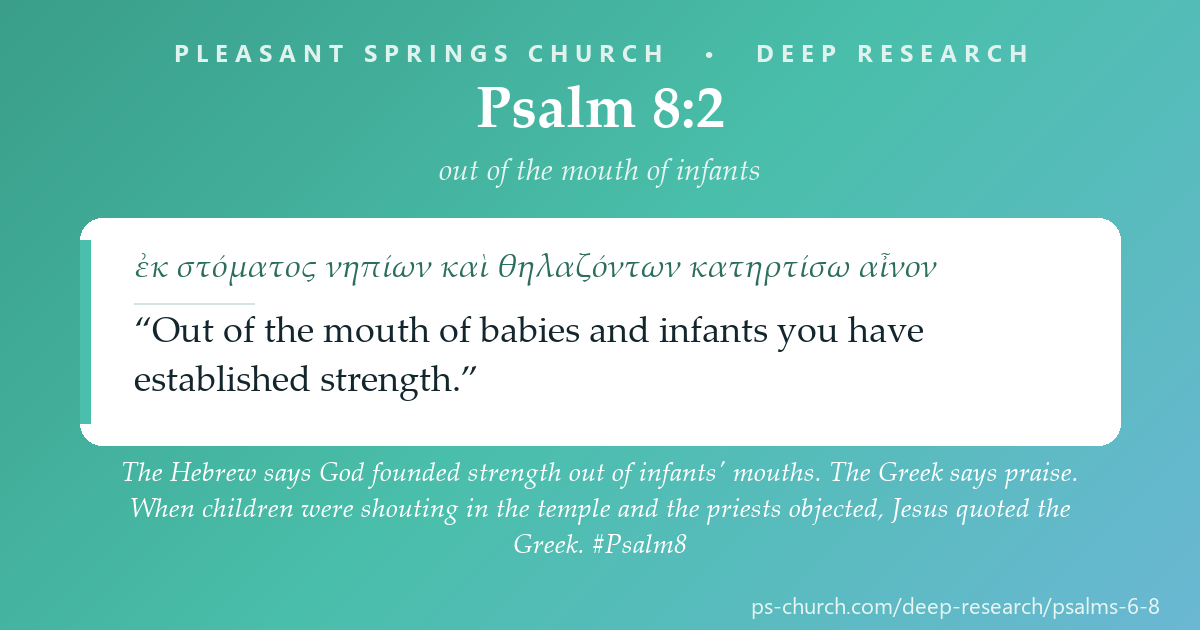
⚠️ Psalm 8:2 diverges, and Jesus quotes the Greek. The Hebrew says God has founded ʿōz — strength — out of the mouths of infants. Rahlfs reads αἶνον, praise.
In Matthew 21:16, with children shouting in the temple and the chief priests indignant, Jesus asks “have you never read…?” and quotes it as praise. The Hebrew’s strength would not have answered the objection; the Greek’s praise answers it exactly.
Both readings are defensible — ʿōz can carry the sense of a stronghold or bulwark, and praise is the psalm’s subject — and they are different words. See the library’s reference page for how often this pattern recurs, and for one famous case where the usual account of it is wrong.
The verse numbers here are offset by one throughout, because all three psalms have titles and Hebrew counts a title as verse 1 — explained in full on the Psalms 3–5 page.
The Shape of the Passage
SequencePsalm 6’s argument deserves attention because it is not the one we would make. In death there is no remembrance of you; in Sheol who will give you praise? The reason offered for being spared is that God will lose a worshipper. The Old Testament is largely reticent about what lies past death, and this psalm reasons from that reticence rather than around it.
And Psalm 8 is the first psalm in the book with a frame. O Lord, our Lord, how majestic is your name in all the earth opens it and closes it, word for word. Between those two identical lines sit the stars, an infant’s mouth, and a question about what a person is worth. The frame is the answer: the subject is God’s name, not humanity’s status.
These follow Psalms 3–5, where the verse numbering convention is explained. Psalm 8:5 is treated on the New Testament reference page and is not re-argued here.
Author
He bargains with God about his own usefulness. In death there is no remembrance of you. The argument for being kept alive is that a corpse cannot praise — which is either very bold or very desperate, and the psalm does not soften it.
He offers to be condemned. Psalm 7 lists what he would deserve if the accusation against him were true, in detail. Nobody who was guilty would write verse 4.
And then he stops arguing. Psalm 8 has no enemy, no petition, no complaint. After two psalms of trouble he looks at the sky and asks a question about scale — and the psalm is framed so that the answer is about God\u2019s name, not his own.
Audience
People who were ill or exhausted. My bones are troubled… I am weary with my moaning… my eye wastes away. Psalm 6 is physical throughout, and it was read for centuries by people who were dying.
People accused of something. Psalm 7 is a formal protest of innocence — concerning the words of Cush, whoever he was. Somebody had said something, and this is the answer.
And people who needed the question asked out loud. What is man that you are mindful of him? It is the question anyone asks under a clear night sky, and the Psalter puts it in the eighth position.
Orient on the penitential psalms, on Sheol, and on musical terms.
Search by topic: penitential psalms; Sheol and the dead; psalm titles and musical terms; sheminith; shiggaion; oath of innocence; imago Dei.
Which articles are relevant?
- Anchor Bible Dictionary — “Psalm Titles,” “Music and Musical Instruments,” “Dead, Abode of the,” “Oath.”
- Dictionary of the OT: Wisdom, Poetry & Writings (IVP) — “Lament,” “Penitential Psalms,” “Creation Theology,” “Enemies.”
- NIDOTTE / TDOT — שְׁאוֹל (šəʾōl), עֹז (ʿōz, strength), אֱנוֹשׁ (ʾĕnōš, mortal), שִׁגָּיוֹן (šiggāyōn).
- On the Greek — the NETS Psalms introduction, especially on how the translator handled untranslatable technical terms in the titles. Psalms 6 and 7 are the cleanest pair of examples in the book.
Bibliography surfaced:
- John Goldingay, Psalms 1–41 — the main commentary for this stretch.
- Robert Alter, The Book of Psalms; Gerald H. Wilson, The Editing of the Hebrew Psalter.
- Beale and Carson, Commentary on the NT Use of the OT — for Matthew 21:16.
A translator's two strategies, an oath of innocence, and the silence of the dead.
Psalms 6 and 7 are worth reading side by side for the titles alone.
Which parallels shed light on these psalms?
Psalm 7 is built on a legal form. An accused person who could not be convicted by evidence could swear an oath calling down the penalty on himself if guilty — and 1 Kings 8:31–32 describes exactly that procedure at the temple. Psalm 7:3–5 is that oath: if I have done this… let the enemy trample my life to the ground. The psalm is a legal document turned into a prayer.
Psalm 6’s argument depends on how the Old Testament speaks about death. Sheol is the place the dead go, and the Old Testament is largely reticent about it — the dead are described as silent, cut off, no longer praising. So “in death there is no remembrance of you” is not a denial of an afterlife so much as an argument from what has been revealed — and it is the same argument Hezekiah makes in Isaiah 38.
And Psalm 8 sets a human being against a night sky on purpose. The comparison is with the moon and the stars, which you have set in place — and the word for humanity in verse 4 is ʾĕnōš, the frailest of the Hebrew words for a person, associated with weakness and mortality.
- 1 Kings 8:31–32 → Psalm 7:3–5. The self-imprecatory oath at the temple. Psalm 7 is that procedure in poetry.
- Isaiah 38:18–19 → Psalm 6:5. Hezekiah, sick to death: Sheol does not thank you. The same argument, by a king who was granted the extension.
- Genesis 1:26–28 → Psalm 8:5–8. Dominion over the works of God’s hands. Psalm 8 is Genesis 1 set to music, in the same order.
- Matthew 21:15–16 → Psalm 8:2. Children shouting in the temple; the chief priests object; Jesus quotes this verse. He quotes the Greek, which reads praise.
- Matthew 7:23 and Luke 13:27 → Psalm 6:8. Depart from me, you workers of lawlessness. Not an exact quotation — the verb differs — but the phrase “you who work lawlessness” matches Rahlfs word for word. Reported as an allusion, not a citation.
Every translator meets words they cannot render, and their choices are usually invisible. Here they are not.
• Psalm 6’s title has ʿal-haššəmînîṯ — literally upon the eighth. The best guesses are an eight-stringed instrument, a lower octave, or an eighth mode or melody; none can be confirmed. Rahlfs renders it word for word: ὑπὲρ τῆς ὀγδόης, concerning the eighth. Perfectly faithful, and no help at all. He handed the difficulty to the reader.
• Psalm 7’s title has šiggāyōn — a word that occurs nowhere else in the Psalter, with a plural form once in Habakkuk 3:1 and nowhere else in the Bible. Proposals connect it with a root meaning to stray or reel — a wandering song, an erratic or passionate piece — or with an Akkadian term for a lament. Rahlfs does not render it. He writes ψαλμὸς τῷ Δαυιδ, a psalm of David, and moves on.
Two consecutive psalms; two unknowns; one transliterated into sense and one silently removed. That is a translator making judgement calls, and it is worth seeing plainly. It also shows why this shelf reports what a named edition prints rather than appealing to “the Greek” as an oracle — the Greek is a set of decisions, some of them made in the dark.
Two unknowns, and a word Jesus quoted in Greek.
Compare the two titles. One is rendered literally; the other is not rendered at all.
Counted here, not assumed:
- Rahlfs renders ʿal-haššəmînîṯ literally and omits šiggāyōn entirely. Verified directly in both titles.
- Šiggāyōn occurs once in the Psalter, with a plural form at Habakkuk 3:1. That is the whole biblical evidence for the word.
- At 8:2 the Hebrew has ʿōz (strength) and Rahlfs has αἶνον (praise). Matthew 21:16 quotes the Greek.
- Hebrew and Rahlfs give Psalms 6, 7 and 8 eleven, eighteen and ten verses; English gives ten, seventeen and nine. The title-as-verse-1 offset applies to all three — see Psalms 3–5.
- Psalm 8 opens and closes with the same line, word for word. The first framed psalm in the book.
- Matthew 7:23 is an allusion, not a quotation, of Psalm 6:8. The verb differs; the phrase you who work lawlessness matches Rahlfs exactly.
A word that appears once in the Psalter and once more, in the plural, in Habakkuk 3:1. That is the entire biblical evidence. Proposals link it to a root meaning to stray, reel — a wandering or impassioned song — or to an Akkadian term for lament. Rahlfs offers no rendering at all, dropping it from the title. English versions transliterate rather than pretend.
“Upon the eighth.” Also unknown — an eight-stringed instrument, an octave, an eighth mode. It appears in the titles of Psalms 6 and 12 and in 1 Chronicles 15:21. Rahlfs translates it literally, ὑπὲρ τῆς ὀγδόης, preserving the obscurity exactly. Compare the previous entry: two unknowns, two different strategies, in adjacent psalms.
“Strength, might” — and it can carry the sense of a stronghold or bulwark. Rahlfs reads αἶνον, praise, which is not the ordinary equivalent. Jesus quotes the Greek at Matthew 21:16, where children are shouting in the temple — and praise answers the chief priests’ objection in a way that strength would not.
“Man” — and it is the frailest of the Hebrew words for a human being, carrying overtones of weakness and mortality (the parallel line uses ben-ʾāḏām, son of Adam, i.e. of the ground). The question is not “what is a person?” in the abstract but “what is this frail mortal, that you should pay attention?”
“Sheol” — the realm of the dead, and the Old Testament says remarkably little about it. The dead there are described as silent and cut off from praise, which is the premise of Psalm 6’s argument. Rahlfs uses ᾅδης, Hades — a Greek word carrying its own mythology, and the choice shapes how later readers heard the verse.
An oath at the temple, and children shouting in it.
Read 1 Kings 8:31–32 and then Psalm 7:3–5.
Which cross-references matter?
- 1 Kings 8:31–32 → Psalm 7:3–5. The self-imprecatory oath — if I have done this, let the penalty fall.
- Isaiah 38:18–19 → Psalm 6:5. Hezekiah makes the identical argument from his sickbed. He was given fifteen more years.
- Genesis 1:26–28 → Psalm 8:5–8. Dominion, in the same order: beasts, birds, fish.
- Matthew 21:15–16 → Psalm 8:2. Jesus quotes this verse as praise, which is the Greek reading. See the reference page.
- Hebrews 2:6–9 → Psalm 8:4–6. Worked in detail on the New Testament page and not repeated here.
- 1 Corinthians 15:27 and Ephesians 1:22 → Psalm 8:6. All things under his feet. Paul uses the line twice. Stated; the seeing is left to the reader.
Three open questions, two of them about single words.
Goldingay for the text; Beale and Carson for Matthew 21:16.
Commentaries & studies:
- John Goldingay, Psalms 1–41; Robert Alter, The Book of Psalms.
- Gerald H. Wilson, The Editing of the Hebrew Psalter — on the titles as editorial layer.
- Beale and Carson, Commentary on the NT Use of the OT — on Matthew 21:16.
- NETS Psalms, with Rahlfs — for the titles and for 8:2.
Three things reported as unsettled:
- What šiggāyōn means. One occurrence, plus a plural in Habakkuk. Rahlfs gives no help — he omits it.
- What ʿal-haššəmînîṯ means. Rahlfs translates it literally and preserves the obscurity. Instrument, octave and mode are all proposed.
- Whether 8:2 should read strength or praise. The Hebrew has ʿōz; Rahlfs has praise; Matthew quotes Rahlfs. Both are defensible and they are different words — reported, not resolved.
Words the translators could not carry.
Name what you learned, why it matters, and one concrete response.
What should we carry away — and do?
- The Greek Psalter is a set of decisions, not an oracle. Two unknown words in consecutive titles — one rendered literally and left obscure, one quietly dropped. Seeing a translator work in the dark is a useful corrective to treating any version as self-evidently transparent.
- Psalm 6 argues from what it does not know. In death there is no remembrance of you. The Old Testament says very little about what lies past death, and this psalm reasons from that reticence rather than filling it in. Hezekiah made the same argument and was given fifteen years.
- Psalm 7 offers to be sentenced. If I have done this… let the enemy overtake me. That is not rhetoric — it is a legal form, and nobody guilty would use it.
- One concrete response. Psalm 8 opens and closes with the same sentence, and the question about human worth sits between them. When you next find yourself asking what you amount to, notice what the psalm frames the question with — not an answer about you.
Psalm 8:2 · to share
Hebrew + Greek (Rahlfs) + ESVEvery Deep Research page traces its passage across the whole sweep — the Old Testament, the Second-Temple world between the testaments (historical witnesses, not Scripture), and the New Testament. Follow the thread:
Pleasant Springs Church — Deep Research
Research method after Michael S. Heiser’s Bible Research Method (examine dictionaries → ancient literature → important words → textual connections → academic publications → share), with the Pleasant Springs “Author & Audience” foundation. Scripture set in the Hebrew, the Greek editions named on each page and the ESV (Old Testament), and the Greek New Testament and the ESV (New Testament), per the practice of Pleasant Springs Church. Psalms 6–8 research grounded in Goldingay (Psalms 1–41), Alter and Wilson, with Beale and Carson for Matthew 21:16. There is no Hermeneia volume for Psalms 1–50. Text: Hebrew from the Masoretic text as printed in the editions consulted — Sefaria’s Miqra according to the Masorah; no critical apparatus was consulted for the Hebrew. Greek from Rahlfs’ Greek Psalter (CATSS digitization of Rahlfs 1931). The standing caution for this shelf applies: these pages say “Rahlfs’ Greek Psalter reads…” and never call a Greek reading early or late. ⚠️ The two title strategies were verified directly: Rahlfs renders ʿal-haššəmînîṯ word for word as ὑπὲρ τῆς ὀγδόης, and gives no equivalent whatever for šiggāyōn — his Psalm 7 title reads simply a psalm of David. Both words are reported as unknown, with the standing proposals listed and none adopted. The 8:2 divergence was verified in both columns (ʿōz against αἶνον), and both readings are presented as defensible — ʿōz can carry the sense of a stronghold, and praise is the psalm’s subject — while stating plainly that they are different words and that Matthew 21:16 follows the Greek. ⚠️ Matthew 7:23 is reported as an allusion to Psalm 6:8, not a quotation: the verb differs (ἀποχωρεῖτε against Rahlfs’ ἀπόστητε) while the phrase you who work lawlessness matches exactly. Verse counts were checked in all three columns (Hebrew and Rahlfs 11/18/10; English 10/17/9), with the title-as-verse-1 convention explained on Psalms 3–5 rather than repeated. Psalm 8:5 and Hebrews 2 are deliberately not re-argued here, belonging to the reference page. Typology is handled per the house position: what the text says, what the New Testament itself draws, and what we see from this side of the cross — with the seeing left to the reader.
Scripture quotations marked ESV are from the ESV® Bible (The Holy Bible, English Standard Version®), © 2001 by Crossway, a publishing ministry of Good News Publishers. ESV Text Edition: 2016. Used by permission. All rights reserved. The ESV text may not be quoted in any publication made available to the public by a Creative Commons license, and the ESV may not be translated in whole or in part into any other language. www.esv.org
|
Did this study bless you today? 💚 Give to Support PS Church100% of gifts go to the General Fund — thank you. |