The New Testament quotes the Psalms in Greek, and uses the Greek numbers — which is why a Church Father citing "Psalm 50" on repentance means the psalm you know as 51. The Greek Psalter runs one behind ours from Psalm 10 to Psalm 147, because it joins Hebrew Psalms 9 and 10 into one. More interesting is what happens to the words. Peter's whole Pentecost argument turns on the Greek reading decay where the Hebrew has pit; Hebrews needs the Greek's angels where the Hebrew has elohim. But the case everyone cites is usually told backwards. The story goes that Psalm 40:6 says ears you have dug for me in Hebrew, that the Septuagint changed it to a body you have prepared for me, and that Hebrews 10:5 quotes the Septuagint. Rahlfs' Greek Psalter reads ōtia — ears. The critical edition of the Greek agrees with the Hebrew. So the divergence is not between Hebrew and Greek; it is between the Greek Psalter and Hebrews — and where Hebrews got body is a genuinely open question. This is why every page on this shelf names its edition. See the method →
Four Psalms as the New Testament quotes them
Hebrew · Greek (Rahlfs’ Psalter) · English⚠️ The numbering, once, clearly. Because the Greek tradition joins Hebrew Psalms 9 and 10 into one, the Greek Psalter runs one number behind ours from Psalm 10 to Psalm 147. Our Psalm 51 is its Psalm 50; our Psalm 23 is its 22. The gap closes again at the end. So when a Church Father cites “Psalm 50” on repentance, he means the psalm you know as 51 — he is not misquoting, he is using a different table of contents. This library’s Psalms 9–10 study covers where the offset starts and Psalms 114–117 covers where it survives a merge and a split.
More interesting is what happens to the words. Three of the four cases above are places where the Greek differs from the Hebrew and a New Testament argument leans on the Greek.
• Psalm 8:5. The Hebrew says humanity was made a little lower than ʾĕlōhîm — God, or possibly divine beings. The Greek reads ἀγγέλους, angels, and Hebrews 2:7 follows it — then builds an argument on Jesus being made lower than angels for a little while.
• Psalm 16:10. The Hebrew has šaḥaṯ, the pit — a grave. The Greek reads διαφθοράν, decay, and Peter’s whole argument at Pentecost turns on it: David died and was buried and his tomb is with us to this day — so the one who did not see decay is somebody else (Acts 2:29–31).
• Psalm 45:6 is the control case, and it is the one usually got wrong. The Hebrew kisʾaḵā ʾĕlōhîm can mean your throne, O God or your throne is God’s. The Greek is ambiguous in exactly the same way. Hebrews 1:8 takes it as an address — but the Greek did not hand him that reading; it preserved the same puzzle the Hebrew has.
⚠️ And now the case everyone cites, which does not work the way it is usually told.
The standard account: Psalm 40:6 in Hebrew says ears you have dug for me; the Septuagint says a body you have prepared for me; Hebrews 10:5 quotes the Septuagint and builds the incarnation on it.
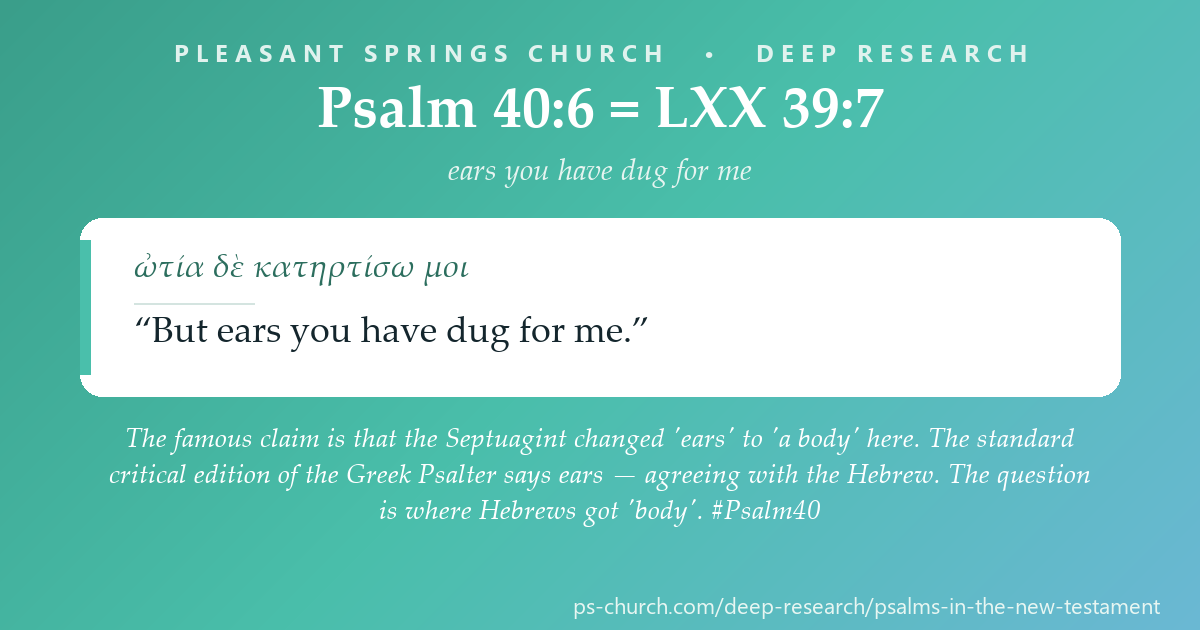
⚠️ Rahlfs’ Greek Psalter reads ὠτία δὲ κατηρτίσω μοι — but ears you have prepared for me. Verified directly, in the critical edition, against the Hebrew: they agree. The Greek says ears.
So the divergence is not between Hebrew and Greek. It is between the Greek Psalter and Hebrews. Some manuscripts of the Greek Psalms do read σῶμα, body — and whether that reading is older than Hebrews, or entered Greek Psalters from Hebrews, is disputed and not decidable here. What can be said is that the neat story — “the Septuagint says body” — is not what the standard critical edition prints.
This is exactly why every page on this shelf says “Rahlfs’ Greek Psalter reads…” and never “the Septuagint says.” There is no single Septuagint to say anything.
The Shape of the Passage
ReferenceWhat this shelf can and cannot do is worth stating here once. In this library’s Job studies, the ancient Greek could be separated from Origen’s later supplement, because the critical editions mark the additions with asterisks. No such apparatus exists for the Psalms. The Greek Psalter agrees with the Hebrew at verse level almost exactly, so there was nothing for an asterisk to do — and the Psalter’s real difficulty is the opposite one: roughly 1,300 manuscripts, revised repeatedly for liturgical use.
So these pages report what a named edition prints, and refuse to call any Greek reading early or late. Which is not caution for its own sake — it is the difference between the Hebrews 10:5 story as usually told and the Hebrews 10:5 story as it actually stands.
This is a reference page for the whole Psalms shelf, not a study of one passage. It explains the numbering once, and works four quotation cases in both columns.
The apostles as readers
They quote from memory and from scrolls, in Greek. Their audiences read Greek; the Greek Psalter was what was available. Nothing about that is remarkable — it is what any writer does.
And they argue from wording. Peter\u2019s Pentecost sermon turns on a single noun — decay — and on the observable fact of David\u2019s tomb. The argument is only as strong as the word he is quoting, which is why it matters that the Greek reads decay where the Hebrew reads pit.
But they are not mechanical. Hebrews 10:5 has a body where the standard Greek Psalter has ears. Something is happening there that “he quoted the Septuagint” does not explain.
Readers now
People confused by the numbers. If you have ever found a Father quoting “Psalm 50” and meaning Psalm 51, this page is the answer — and the answer is a merge back at Psalm 9.
People who have heard the Hebrews 10:5 argument. It is taught widely and told slightly wrong. The correction does not weaken anything; it relocates the question.
And people deciding how much weight a Greek reading can bear. The honest answer varies case by case, and this page works four cases so the method is visible rather than asserted.
Orient on the Septuagint, on citation technique, and on the numbering.
Search by topic: Septuagint; Old Testament in the New Testament; citation technique; textual criticism; Psalm numbering; Vulgate.
Which articles are relevant?
- Anchor Bible Dictionary — “Septuagint,” “Quotations in the NT,” “Versions, Ancient,” “Text of the NT.”
- Dictionary of the OT: Wisdom, Poetry & Writings (IVP) — “Psalms: Text and Versions,” “Psalms in the New Testament.”
- NIDOTTE / TDOT — אֱלֹהִים (ʾĕlōhîm), שַׁחַת (šaḥaṯ, pit), אֹזֶן (ʾōzen, ear), כָּרָה (kārāh, to dig).
- On the Greek — the NETS introduction to Psalms, which is candid that Rahlfs 1931 is a working edition rather than a full critical one and that the Göttingen Psalter is in progress to replace it.
Bibliography surfaced:
- G. K. Beale and D. A. Carson, eds., Commentary on the New Testament Use of the Old Testament — the standard reference, case by case.
- Karen H. Jobes and Moisés Silva, Invitation to the Septuagint — the best entry point, and clear about why “the Septuagint” is a misleading singular.
- Emanuel Tov, Textual Criticism of the Hebrew Bible — on versional evidence and what it can establish.
Why there is no such thing as the Septuagint.
The four cases in the codex are worked here. The fourth is the one worth the most attention.
What is actually going on when the New Testament quotes a psalm?
“The Septuagint” names a library, not a book. The Greek Old Testament was translated over generations by different hands, revised repeatedly, and survives in manuscripts that disagree. For the Psalms the scale of that is roughly 1,300 manuscripts, many shaped by centuries of liturgical use. Asking “what does the Septuagint say?” is like asking what the English Bible says.
Which is why this shelf names its edition. Every page says Rahlfs’ Greek Psalter reads… Rahlfs 1931 is the standard working text and its own English translator concedes it is not a full critical edition. Naming it is not pedantry; it is the only way to make a claim that someone else can check.
And it is why this shelf will never call a Greek reading early or late. In Job, this library could: the critical editions mark Origen’s third-century supplements with asterisks. For the Psalms there is no such apparatus, because the Greek and Hebrew agree at verse level almost exactly and there was no gap for anyone to fill.
- Acts 2:25–31 → Psalm 16:8–11. Peter’s argument depends on decay, and he makes the dependence explicit: David… died and was buried, and his tomb is with us to this day. The Hebrew’s pit would not point the same way.
- Hebrews 2:6–9 → Psalm 8:4–6. The argument needs angels, and the Greek supplies it where the Hebrew has ʾĕlōhîm. Not a mistranslation — the Hebrew word does cover divine beings.
- Hebrews 1:8 → Psalm 45:6. Here the Greek gives no help: it is ambiguous in the same way the Hebrew is. The reading is Hebrews’ own.
- Hebrews 10:5–10 → Psalm 40:6. Rahlfs reads ears, with the Hebrew. The body reading is in some Greek manuscripts; its relationship to Hebrews is disputed.
- The Latin Vulgate followed the Greek numbering, which is why older Catholic Bibles and liturgical books number the Psalms differently from most Protestant ones. Not a disagreement about the text — a disagreement about where Psalm 9 ends.
The version most readers have heard: Psalm 40:6 says in Hebrew “ears you have dug for me,” the Septuagint changed it to “a body you have prepared for me,” and Hebrews quotes the Septuagint to speak about the incarnation.
⚠️ What Rahlfs’ Greek Psalter actually prints at 39:7 (= our 40:6): ὠτία δὲ κατηρτίσω μοι — but ears you have prepared for me.
Verified directly against the Hebrew אׇזְנַיִם כָּרִיתָ לִּי. The two agree. The standard critical edition of the Greek Psalter says ears, exactly as the Hebrew does.
So the divergence is not Hebrew-versus-Greek. It is the Greek Psalter versus Hebrews. Hebrews 10:5 reads σῶμα δὲ κατηρτίσω μοι — a body. And some manuscripts of the Greek Psalms do carry σῶμα.
Which leaves a genuinely open question, and two live possibilities:
• the body reading existed in some Greek Psalters before Hebrews, and the author used one of them; or
• the reading entered Greek Psalters from Hebrews, as Christian copyists harmonised the psalm to the epistle — a well-attested phenomenon.
This page does not decide, and no apparatus for the Greek Psalter permits deciding. What it does insist on is that the tidy version is not accurate, and that “ears you have dug” is itself a striking phrase — the verb kārāh means to dig, and the image is of ears hollowed out so that obedience becomes possible. The Hebrew is not the dull option.
Four words that decide four arguments.
Compare the Hebrew and Greek columns in the codex above before reading the notes.
“God” — grammatically plural, and able to mean God, gods, or divine beings generally. Rahlfs reads ἀγγέλους, angels, which is a legitimate narrowing rather than an error. Hebrews 2:7 needs the narrowing for its argument — that Jesus was made lower than angels for a little while, which the Greek’s βραχύ τι also permits.
“Pit, grave” — from a root meaning to sink down, though a similar root means to corrupt. Rahlfs reads διαφθοράν, decay. Peter’s Pentecost argument depends entirely on that word: David’s tomb is still here, so David saw decay, so the psalm is about someone else.
“Ears you have dug for me.” The verb is to dig, excavate — used of digging a well or a grave. The image is of ears hollowed out so that hearing, and therefore obedience, becomes possible. Rahlfs’ Greek agrees: ὠτία, ears. It is Hebrews 10:5 that has σῶμα, and the relationship between the two is disputed.
The Greek Psalter’s rendering of selah — and nobody knows what either word means. The Greek looks like a musical term (“through the playing”), which may be a guess. It is a useful reminder that translators facing an unknown word produce something, and the something can look more confident than it is.
“Your throne, O God” — or “your throne is God.” Greek can use the nominative with the article as a vocative, so the phrase is ambiguous exactly as the Hebrew is. Hebrews 1:8 reads it as an address to the Son. The important point for this page: the Greek did not create that option — it preserved the Hebrew’s.
Verified here, not assumed:
- Rahlfs’ Psalm 39:7 (= our 40:6) reads ὠτία, ears — agreeing with the Hebrew, not with Hebrews 10:5. Checked directly in both columns.
- Rahlfs’ Psalm 8:6 reads παρ᾽ ἀγγέλους where the Hebrew has ʾĕlōhîm. A real divergence, and a defensible rendering.
- Rahlfs’ Psalm 15:10 reads διαφθοράν where the Hebrew has šaḥaṯ. Acts 2 depends on it.
- Rahlfs’ Psalm 44:7 preserves the same ambiguity as the Hebrew. The Greek is not the source of Hebrews 1:8’s reading.
- The Greek numbering runs one behind from Psalm 10 to Psalm 147. See Psalms 9–10 for where it starts and Psalms 114–117 for the merge and split that cancel out.
Where to go next in this library.
Each of the four heavily-quoted psalms has, or will have, its own study.
Which studies follow this one?
- Psalm 110 — the most quoted psalm in the New Testament: the right hand, and the priest after the order of Melchizedek.
- Psalm 2 — the decree and the sonship, quoted at Acts 4, Acts 13 and Hebrews 1 and 5. See also Psalms 1–2, which reads it with Psalm 1.
- Psalm 22 — the cry from the cross.
- Psalms 9–10 — where the numbering offset begins, and why.
- Psalms 114–117 — a merge and a split that cancel, and Psalm 117 quoted at Romans 15:11.
- Psalm 119 — where the Greek Psalter does something it does nowhere else in the book.
The state of the Hebrews 10:5 question.
Beale and Carson work every case; Jobes and Silva explain the framework.
Commentaries & studies:
- Beale and Carson, Commentary on the NT Use of the OT — case by case, with the textual evidence.
- Jobes and Silva, Invitation to the Septuagint — on why the singular “the Septuagint” misleads.
- NETS Psalms, with Rahlfs — and its own admission about the edition’s limits.
- Emanuel Tov, Textual Criticism of the Hebrew Bible.
Three things reported as unsettled:
- Where Hebrews 10:5 got σῶμα. Either it stood in a Greek Psalter the author used, or it entered Greek Psalters from Hebrews. Both are live; harmonisation of Old Testament manuscripts toward New Testament quotations is well attested. Not decidable from the evidence available.
- Whether Psalm 45:6 addresses the king as God. Ambiguous in Hebrew and equally ambiguous in Greek. Hebrews takes one option; the psalm does not force it.
- How much weight any single Greek reading can carry. With roughly 1,300 manuscripts and no full critical edition yet published, the honest answer varies case by case — which is the argument for naming the edition every time.
Precision as a form of respect.
Name what you learned, why it matters, and one concrete response.
What should we carry away — and do?
- There is no such thing as “the Septuagint” for the Psalms. Roughly 1,300 manuscripts, revised for centuries. Naming an edition is what makes a claim checkable — which is why every page here says Rahlfs’ Greek Psalter reads…
- The Hebrews 10:5 story is usually told backwards. Rahlfs’ Greek says ears, agreeing with the Hebrew. The interesting question is not what the Greek did to the Hebrew but where Hebrews got body — and that is genuinely open.
- And “ears you have dug” is not the boring option. The verb means to excavate. Ears hollowed out so that hearing becomes possible — which is a startling picture of what it takes to obey.
- One concrete response. Next time you meet an argument that turns on “the original says X,” ask which original, and which edition. Not to be difficult — the answer is often more interesting than the claim.
Psalm 40:6 · to share
Hebrew + Greek (Rahlfs) + EnglishEvery Deep Research page traces its passage across the whole sweep — the Old Testament, the Second-Temple world between the testaments (historical witnesses, not Scripture), and the New Testament. Follow the thread:
Pleasant Springs Church — Deep Research
Research method after Michael S. Heiser’s Bible Research Method (examine dictionaries → ancient literature → important words → textual connections → academic publications → share), with the Pleasant Springs “Author & Audience” foundation. Scripture set in the Hebrew, the Greek editions named on each page and the ESV (Old Testament), and the Greek New Testament and the ESV (New Testament), per the practice of Pleasant Springs Church. Reference page for the Psalms shelf, grounded in Beale and Carson (Commentary on the NT Use of the OT), Jobes and Silva (Invitation to the Septuagint) and Tov. Text: Hebrew from the Masoretic text as printed in the editions consulted — Sefaria’s Miqra according to the Masorah; no critical apparatus was consulted for the Hebrew. Greek from Rahlfs’ Greek Psalter (CATSS digitization of Rahlfs 1931). ⚠️ All four quotation cases were checked directly in both columns rather than taken from secondary sources, and one of them corrects a very widely repeated claim. Rahlfs’ Ps 39:7 (= our 40:6) reads ὠτία, ears, agreeing with Hebrew ʾoznayim kārîtā lî — so the standard telling (“the Septuagint changed ears to a body”) does not describe what the standard critical edition prints. The page relocates the question to where Hebrews 10:5 got σῶμα, presents both live possibilities — a Greek Psalter that already read body, or later harmonisation of Greek Psalters toward Hebrews — and declines to decide, since no apparatus for the Greek Psalter permits it. The other three cases are reported with equal care: Ps 8:6 (ʾĕlōhîm → ἀγγέλους) and Ps 15:10 (šaḥaṯ → διαφθοράν) are genuine divergences on which NT arguments lean, and both Greek renderings are noted as defensible rather than erroneous; Ps 44:7 is flagged as a case where the Greek gives no help at all, preserving the Hebrew’s ambiguity, so Hebrews 1:8’s reading is its own. The numbering offset (one behind, Psalm 10 to 147) is explained once with cross-references to Psalms 9–10 and Psalms 114–117. The standing caution for this shelf is argued here rather than merely asserted: the Job asterisk method is unavailable for the Psalms, the manuscript tradition is large and liturgically revised, and Rahlfs 1931 is a working edition — therefore these pages name their edition and never call a Greek reading early or late. Typology is handled per the house position: what the text says, what the New Testament itself draws, and what we see from this side of the cross — with the seeing left to the reader.
Scripture quotations marked ESV are from the ESV® Bible (The Holy Bible, English Standard Version®), © 2001 by Crossway, a publishing ministry of Good News Publishers. ESV Text Edition: 2016. Used by permission. All rights reserved. The ESV text may not be quoted in any publication made available to the public by a Creative Commons license, and the ESV may not be translated in whole or in part into any other language. www.esv.org
|
Did this study bless you today? 💚 Give to Support PS Church100% of gifts go to the General Fund — thank you. |