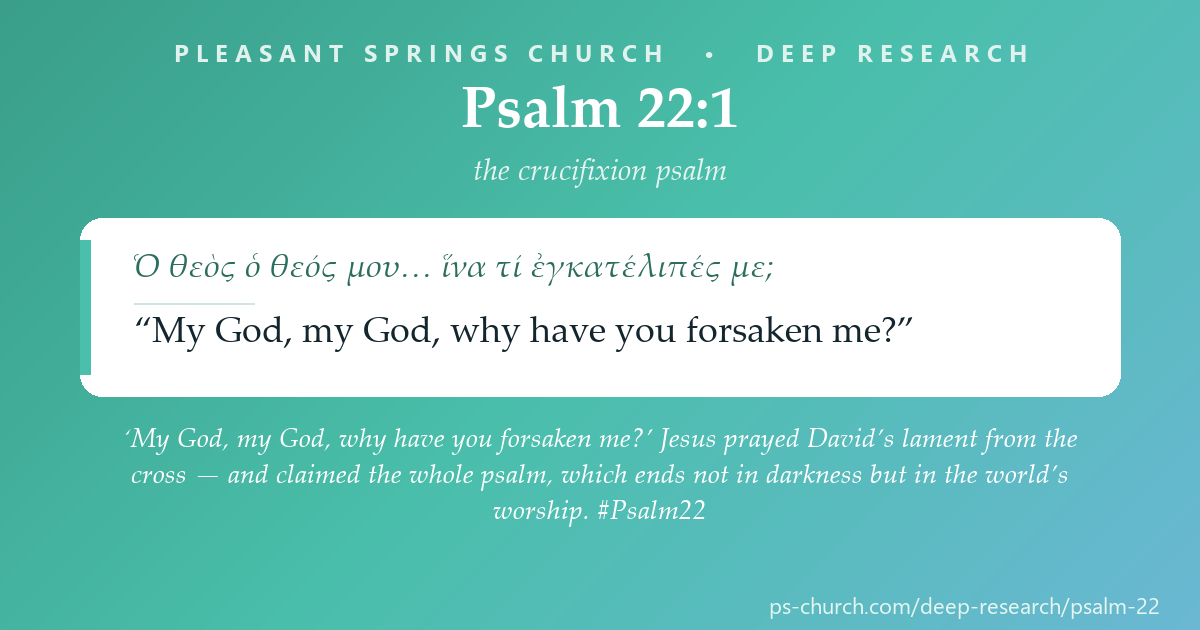
“My God, my God, why have you forsaken me?” David’s ancient lament became the cry of Jesus from the cross — and its details read like an eyewitness of Calvary: pierced hands and feet, garments gambled away, mockers wagging their heads. Yet Psalm 22 does not stay in the dark. It turns from dereliction to deliverance, until “all the ends of the earth” turn to the Lord. This study works the crucifixion psalm from the cry of forsakenness to the world’s worship. See the method →
Psalm 22 (selections)
Hebrew · LXX · ESVThe Shape of the Passage
Parallel panelsPsalm 22 is a lament of David (superscription) — a real cry of anguish that the New Testament reads as prophetic of the Messiah’s suffering. Compare the method template on Psalm 1.
Author
David gives voice to overwhelming suffering — encircled by enemies, mocked, wasted in body, at the edge of death. Like many laments, the psalm moves in two movements: a long cry of distress (vv. 1–21) and then a burst of praise for deliverance (vv. 22–31). The anguish is genuine and personal; David is not merely predicting the future but pouring out a present agony.
Prophecy through a life. Yet the details outrun David’s own experience — pierced hands and feet, garments gambled away, a rescue that spreads to “all the ends of the earth.” The New Testament sees here a pattern God built into David’s life and words that finds its full meaning in David’s greater Son. Jesus, quoting v.1 from the cross, claims the whole psalm as his.
Audience
Israel at worship — a people who prayed the Psalms as their own, learning to bring their darkest hours to God without pretense. Psalm 22 gave sufferers permission to cry “why?” and still to hope, holding lament and faith together in one breath.
How they heard it. Laments like this taught Israel that God is present even in apparent absence, and that the road through suffering can end in praise and public testimony. When the Gospels place v.1 on Jesus’ lips and v.18 at the foot of the cross, they invite the reader to hear the whole psalm as the story of the crucified and vindicated Christ — whose deliverance opens worship to the whole world.
Orient on lament, the Psalms, and messianic prophecy.
Search by topic: lament, Psalms, David, Messiah, crucifixion, suffering.
Which articles are relevant?
- Anchor Bible Dictionary — “Psalms, Book of,” “Lament,” “David,” “Messiah.”
- Dictionary of the OT: Wisdom, Poetry & Writings — “Lament,” “Psalms,” “Messianic Psalms,” “Suffering.”
- NIDOTTE / TDOT — עָזַב (ʿāzaḇ, forsake), שׁוּב (šûḇ, turn/return), יְשׁוּעָה (yəšûʿâ, salvation), גּוֹרָל (gôrāl, lot).
Bibliography surfaced:
- Peter Craigie (WBC), Derek Kidner (TOTC), John Goldingay on the Psalms.
- Studies of Psalm 22 in the Passion narratives; the text-critical question at 22:16 (“pierced”).
- Beale & Carson, Commentary on the NT Use of the OT (the Gospels; Hebrews 2).
The shape of lament, the “pierced” text, and the cry from the cross.
Read the lament form, weigh the text at 22:16, then follow the psalm into the Passion.
Which parallels shed light on religion and worldview?
The lament that turns. Ancient Israel’s laments (and their ANE neighbors’ complaints) typically move from anguish toward trust; Psalm 22 follows that path but stretches it to its limit — from “why have you forsaken me?” to a worldwide congregation praising God. The form itself teaches that honest grief and unbroken faith can share the same prayer.
‘Pierced’ or ‘like a lion’? Verse 16 is a famous text-critical question. The traditional Masoretic reading is כָּאֲרִי (kaʾări, “like a lion… my hands and feet”); but some (medieval) Hebrew manuscripts, and — more weightily — the ancient versions and a Dead Sea Psalms scroll read a verb — the LXX ὤρυξαν (“they dug/bored through”) — behind the ESV’s “they have pierced my hands and feet.” The reading is debated, but the versions and the earliest manuscript evidence support “pierced,” and it is not the ground of the messianic reading, only one of its many details.
- ANE and biblical laments — the complaint-to-trust movement Psalm 22 follows and surpasses: honest anguish that ends in praise.
- The Nahal Hever Psalms scroll (5/6 HevPs) and ancient versions (LXX, Syriac) — manuscript witnesses reading a verb (“pierced/dug”) at 22:16 rather than the Masoretic “like a lion.”
- Psalm 31:5 — “into your hand I commit my spirit,” another Davidic lament on Jesus’ lips at the cross (Luke 23:46): the psalms of lament as the language of his passion.
- Hebrews 2:12 — quotes Psalm 22:22 (“I will tell of your name to my brothers”) of Christ among his people: the psalm’s praise-half fulfilled too.
On the cross, in the ninth-hour darkness, Jesus cried out the first line of this psalm: “My God, my God, why have you forsaken me?” (Matt 27:46; Mark 15:34). By taking Psalm 22 on his lips he claimed the whole of it — and the Gospel writers show its details unfolding around him: the mockers who say “He trusts in God; let God deliver him” (Matt 27:43; Ps 22:8), the pierced hands and feet, the soldiers who, fulfilling this psalm, divided his garments and cast lots for his clothing (John 19:23–24 cites Ps 22:18: “They divided my garments among them, and for my clothing they cast lots”). The cry is real: on the cross the sinless Son bore our sin and its judicial God-forsakenness, so that we might never be forsaken (Heb 13:5). Yet Psalm 22 does not end in the dark. Its second half erupts in praise and deliverance, reaching out until “all the ends of the earth… turn to the Lord” (22:27) — and its final words, “he has done it” (22:31), stand not far from another cry of the same cross: “It is finished” (John 19:30). The forsaken One is vindicated, and his suffering becomes the world’s worship.
The vocabulary of forsakenness, piercing, and the turning world.
Watch the cry “forsaken,” the debated “pierced,” the cast lots, and the world that “turns” to God.
“You have forsaken me” — Jesus’ cry from the cross (Aramaic sabachthani, Matt 27:46); the Son bearing, in our place, the God-forsakenness sin deserves.
“They pierced” (verb, with the versions and a DSS scroll) or “like a lion” (Masoretic). The ESV follows “pierced” — the reading behind the LXX ὤρυξαν.
“Lot” — “for my clothing they cast lots”; quoted verbatim of the soldiers at the cross (John 19:24 < LXX Ps 21:19).
“They shall turn” — the psalm’s outward turn: from one sufferer to “all the ends of the earth” turning to the Lord in worship.
How the New Testament reuses Psalm 22:
- Matthew 27:46; Mark 15:34 — Jesus cries Psalm 22:1 from the cross: “My God, my God, why have you forsaken me?”
- John 19:23–24; Matthew 27:35 — the soldiers divide his garments and cast lots (Ps 22:18); John cites it “to fulfill the Scripture.”
- Matthew 27:39, 43 — the mockers’ “He trusts in God; let God deliver him” echoes Psalm 22:7–8.
- Hebrews 2:12 — “I will tell of your name to my brothers” (Ps 22:22): the risen Christ leading his people’s praise.
From David’s lament to the cross and the world’s worship.
Trace the lament’s details into the Passion and its praise into the mission to the nations.
Which cross-references matter?
- Psalm 22:1, 7–8, 16, 18 — forsakenness, mockery, pierced hands and feet, garments cast for: the Passion’s script.
- Psalm 31:5; 69 — kindred Davidic laments on Jesus’ lips and in the Passion narratives.
- Isaiah 52:13–53:12 — the Suffering Servant alongside the suffering Psalmist (see Isaiah 53): two portraits of the same cross.
- Matthew 27; Mark 15; John 19; Hebrews 2:12 — the psalm quoted and enacted in the crucifixion and resurrection.
- Psalm 22:27–31 — “all the ends of the earth… turn to the Lord”: the deliverance that becomes a worldwide worship.
The Gospel writers do not merely dot their crucifixion accounts with Psalm 22; they read the whole psalm as fulfilled in Jesus. Mark and Matthew place its opening line on his lips (Mark 15:34) — the interpretive key that invites the reader to hear every other detail (mockery, pierced hands and feet, gambled garments) as this psalm coming true. John explicitly cites 22:18 as Scripture “fulfilled” (John 19:24). And Hebrews takes the psalm’s turn to praise — “I will tell of your name to my brothers” (22:22) — and puts it in the mouth of the risen Christ, gathering a family to worship (Heb 2:12). Read whole, Psalm 22 is the arc of the cross and the empty tomb: a real cry of God-forsakenness borne for us, answered by a vindication so wide it draws the nations. The lament that begins “why have you forsaken me?” ends with the whole earth remembering and turning to God.
The scholarship on Psalm 22.
The commentators on the Psalms; the text-critical work on 22:16; Beale & Carson on the Passion’s use of the psalm.
Commentaries & studies:
- Peter C. Craigie (WBC), Derek Kidner (TOTC), John Goldingay (Psalms) on the Psalms.
- Text-critical studies of Psalm 22:16 (“pierced” / “like a lion”) and the Nahal Hever scroll.
- G. K. Beale & D. A. Carson, eds., Commentary on the New Testament Use of the Old Testament.
Interpretation notes worth keeping:
- Real lament, real prophecy. Psalm 22 is David’s genuine anguish and a God-shaped foreshadowing of the Messiah’s suffering; the New Testament reads it as fulfilled, not merely illustrated, in Christ.
- The “pierced” text (22:16) is debated, but the ancient versions and a Dead Sea Psalms scroll support the verb behind “pierced”; the messianic reading rests on the whole psalm, not this one word.
- The forsakenness is not the end. The cry of dereliction (borne for us) gives way to vindication and worldwide praise (22:22–31); the psalm’s shape is cross and resurrection.
From the cry of dereliction to the world’s worship.
Name what you learned, why it matters, and one concrete response.
What should we carry away — and do?
- He was forsaken so you never will be. On the cross the Son bore the God-forsakenness sin deserves, and the psalm’s cry became his — so that God could promise you, “I will never leave you nor forsake you.”
- Lament is a faithful prayer. Psalm 22 gives you words for the worst hour: you may cry “why?” honestly and still hope. Faith and grief can share one breath.
- The dark is not the last word. The psalm turns to praise and reaches the ends of the earth. Your suffering, joined to Christ’s, is on a road that ends in vindication and worship.
Step in response: if you are in a dark hour, pray Psalm 22 slowly — the whole of it, cry and all, through to its praise — and let the One who prayed it before you carry you from “why?” toward worship. Then tell someone “of his name,” as the psalm’s deliverance always overflows to others.
Psalm 22:1 · to share
LXX + ESVEvery Deep Research page traces its passage across the whole sweep — the Old Testament, the Second-Temple world between the testaments (historical witnesses, not Scripture), and the New Testament. Follow the thread:
Pleasant Springs Church — Deep Research
Research method after Michael S. Heiser’s Bible Research Method (examine dictionaries → ancient literature → important words → textual connections → academic publications → share), with the Pleasant Springs “Author & Audience” foundation. Scripture set in the Hebrew, the Greek editions named on each page and the ESV (Old Testament), and the Greek New Testament and the ESV (New Testament), per the practice of Pleasant Springs Church. Psalm 22 research grounded in Craigie, Kidner, and Goldingay, with Beale & Carson on the New Testament use; the text-critical work on 22:16; Second-Temple material per the Nahal Hever Psalms scroll and the ancient versions (read as textual witnesses).
Scripture quotations marked ESV are from the ESV® Bible (The Holy Bible, English Standard Version®), © 2001 by Crossway, a publishing ministry of Good News Publishers. ESV Text Edition: 2016. Used by permission. All rights reserved. The ESV text may not be quoted in any publication made available to the public by a Creative Commons license, and the ESV may not be translated in whole or in part into any other language. www.esv.org
|
Did this study bless you today? 💚 Give to Support PS Church100% of gifts go to the General Fund — thank you. |