Psalm 19 says two things that cannot both be true and puts them one after the other. The heavens declare the glory of God; day to day pours out speech — and then, immediately, there is no speech, nor are there words. Something is being communicated by a medium with no vocabulary. Then the next verse diverges, and the divergence carries an argument in Romans. The Hebrew reads their line goes out through all the earth — qaw is a surveyor's measuring cord. The Greek reads their sound. Paul quotes the Greek word for word at Romans 10:18 to answer the objection have they not heard? — and that argument needs a sound, not a survey line. The second half of the psalm then lists six things: law, testimony, precepts, commandment, the fear of the LORD, rules — each with an adjective and an effect, in three perfectly regular verses. Five are things God has given. The fifth is a human posture. It sits in the pattern as though it belonged. See the method →
Psalms 19:1–21:13 (selections)
Hebrew · Greek (Rahlfs’ Psalter) · ESV⚠️ And then the next verse diverges, and the divergence carries a New Testament argument.
The Hebrew reads qawwām — their line, a measuring cord or a boundary marker. Rahlfs reads ὁ φθόγγος αὐτῶν — their sound.
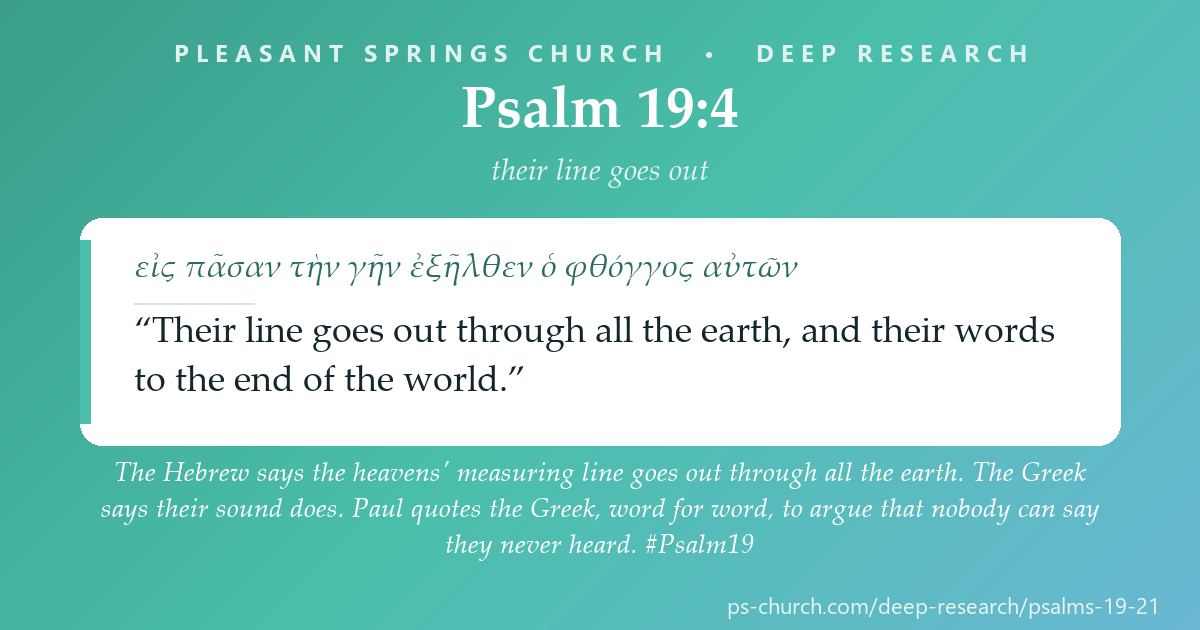
Paul quotes the Greek, word for word, at Romans 10:18 — εἰς πᾶσαν τὴν γῆν ἐξῆλθεν ὁ φθόγγος αὐτῶν — arguing that Israel cannot claim not to have heard. The Hebrew’s measuring line would not carry that argument. The Greek’s sound carries it exactly.
And the Greek reading is not obviously wrong. The preceding verse is about voices being heard, so sound suits the context; some suppose a text reading qōlām, their voice — one letter’s difference. Others keep the Hebrew: the heavens’ survey line is stretched across the whole earth, which fits a psalm about the sun’s circuit. Both are defensible; this page reports both.
⚠️ The second half of Psalm 19 lists six things and one of them does not belong. Law, testimony, precepts, commandment, the fear of the Lord, rules — each with an adjective and a described effect, in three perfectly regular verses. Five are things God has given. The fifth is a human posture.
“The fear of the Lord is clean, enduring forever” sits in a slot the other five fill with a word for divine communication. Whether the psalm is deliberately including the response among the gifts, or whether an original term has been replaced, is argued — and the page reports the oddity rather than smoothing it.
The Shape of the Passage
SequenceBut the two halves are doing the same thing, which is why they belong together. The heavens communicate without words; the law communicates with them. And the psalm ends by asking that the words of my mouth be acceptable — a third kind of speech, from the smallest of the three speakers. Sky, scroll, mouth.
Psalms 20 and 21 are a matched pair, and the tenses are the clue. Psalm 20 is all petition — may he answer, may he send, may he grant. Psalm 21 is all completion — you have given, you have set, you have made. Read in order, they are before and after. Whether they were composed as a pair or placed together by an editor cannot be shown from the text.
Psalm 19:7–11 is the seed of Psalm 119 — six of the same terms in five verses, which Psalm 119 extends to a hundred and seventy-six. Read this passage first and that psalm becomes much easier.
Author
He contradicts himself on purpose. Day to day pours out speech, and then there is no speech. Two verses apart. The point is that something is being communicated by a medium with no vocabulary.
He builds the tightest pattern in the Psalter and then breaks it. Six terms, six adjectives, six effects — and the fifth item is not a thing God gave but a way people stand. Whether that is the point or a textual accident is argued.
And he ends on his own mouth. After the stars and the law: let the words of my mouth… be acceptable. The psalm gets steadily smaller and finishes with a request to be allowed to speak.
Audience
People who looked at the sky. Psalm 19 assumes an audience for whom the sun\u2019s daily circuit was the most reliable thing they knew. The bridegroom and the runner are images of gladness and strength, not of grandeur.
People sending an army out. Psalm 20 is a public blessing with a congregation in it — may we shout for joy over your salvation. The chariots-and-horses line is said by people who did not have many of either.
And people who needed the response to be recorded. Psalm 21 is Psalm 20 answered. Placing them adjacent is itself a claim.
Orient on general revelation, on royal psalms, and on the six terms.
Search by topic: general revelation; creation and revelation; sun imagery; royal psalms; torah psalms; the fear of the LORD; chariots and horses.
Which articles are relevant?
- Anchor Bible Dictionary — “Revelation,” “Sun,” “Kingship,” “War, Holy,” “Law (OT).”
- Dictionary of the OT: Wisdom, Poetry & Writings (IVP) — “Torah Psalms,” “Royal Psalms,” “Creation Theology,” “Fear of the Lord.”
- NIDOTTE / TDOT — קַו (qaw, line / cord), יִרְאָה (yirʾāh, fear), נִסְתָּרוֹת (nistārōṯ, hidden things), זָכַר (zāḵar, to remember / invoke).
- On the Greek — the NETS Psalms introduction, and anything on Romans 10:18 and its source. This is one of the clearest cases where a New Testament argument runs on a Greek reading.
Bibliography surfaced:
- John Goldingay, Psalms 1–41; Robert Alter, The Book of Psalms — good on the two halves of Psalm 19.
- Beale and Carson, Commentary on the NT Use of the OT — for Romans 10:18.
- Kent Aaron Reynolds, Torah as Teacher — for the relationship between Psalm 19 and Psalm 119.
A sun that is not a god, and a line that became a voice.
The Romans 10:18 case belongs beside the others on the reference page.
Which parallels shed light on these psalms?
Psalm 19’s sun is conspicuously demoted. Across the ancient Near East the sun was a god — Shamash in Mesopotamia, and the judge of the world. Here the sun is a bridegroom and an athlete, and God pitches a tent for it. It is a creature with lodgings. What the sun does in the surrounding cultures — see everything, judge everything — is in this psalm transferred to the second half: it is the law that enlightens the eyes.
Psalm 20’s chariots-and-horses line is a political statement. Israel was not a chariot power; Deuteronomy 17:16 forbids the king to multiply horses, and the prophets repeatedly attack alliances built on Egyptian cavalry. Saying some trust in chariots is naming the neighbours’ advantage and declining to want it. Rahlfs reads the verb differently — μεγαλυνθησόμεθα, we shall be magnified, where the Hebrew has we invoke or we make mention.
And the Greek Psalter has a habit worth knowing about here. Psalm 19:14 calls God my rock; Rahlfs renders it βοηθέ μου, my helper. Across the Greek Psalter the Hebrew rock-titles for God commonly stand as something other than a stone-word — a pattern rather than a one-off, and worth remembering whenever a rock-image seems to vanish in Greek.
- Romans 10:18 → Psalm 19:4. Paul quotes the Greek verbatim — their sound has gone out into all the earth — to argue that no one can plead ignorance. See the reference page.
- Deuteronomy 17:16; Isaiah 31:1 → Psalm 20:7. Against horses and chariots.
- Psalm 19:7–11 → Psalm 119. Six of the same terms, extended across 176 verses — see that study.
- Psalm 19:10 → Psalm 119:103. Sweeter than honey. Note that Psalm 19 has the honeycomb in Hebrew and Psalm 119 does not — where Rahlfs supplies it.
- Genesis 1:14–18. Sun and moon as lamps hung by someone else, the same demotion Psalm 19 performs.
- Psalm 21:3 → 2 Samuel 12:30. A crown of fine gold set on the king’s head.
Psalm 19:4 in Hebrew reads bəḵol-hāʾāreṣ yāṣāʾ qawwām — through all the earth their line has gone out. Qaw is a measuring cord, a builder’s or surveyor’s line.
Rahlfs reads ὁ φθόγγος αὐτῶν — their sound. A different noun entirely.
⚠️ And Paul quotes the Greek exactly. Romans 10:18: εἰς πᾶσαν τὴν γῆν ἐξῆλθεν ὁ φθόγγος αὐτῶν καὶ εἰς τὰ πέρατα τῆς οἰκουμένης τὰ ῥήματα αὐτῶν. Word for word. And his argument depends on it: he is answering the objection have they not heard? — and the answer needs a sound, not a surveyor’s line.
How the difference arises, fairly stated.
• One suggestion is a text reading qōlām, their voice — a single letter’s difference from qawwām.
• Another is that the translator read the same consonants in the light of the previous verse, which is entirely about voices being heard.
• And the Hebrew as it stands makes good sense on its own — a survey line stretched across the whole earth is a natural image in a psalm that goes on to describe the sun’s circuit from one end of the heavens to the other.
What this page will and will not say. It will say that the Hebrew and the Greek differ here, that Paul used the Greek, and that his argument would not run the same way from the Hebrew. It will not say that the Greek is a mistake, or that it is a correction, or that either reading is demonstrably earlier — because no apparatus for the Greek Psalter permits that, as the reference page sets out at length.
A line or a voice, and one item that does not fit its list.
Read 19:7–9 and mark the six terms. The fifth is not like the others.
Counted here, not assumed:
- Hebrew and Rahlfs give Psalms 19, 20 and 21 fifteen, ten and fourteen verses; English gives fourteen, nine and thirteen. All three are offset by one — see Psalms 3–5.
- At 19:4 Hebrew has their line and Rahlfs has their sound. Romans 10:18 quotes the Greek verbatim.
- Psalm 19:7–9 lists six terms in three verses, each with an adjective and an effect. Five are divine communications; the fifth item is the fear of the Lord, a human posture.
- Psalm 19:10 has the honeycomb in Hebrew. Psalm 119:103 does not, and Rahlfs supplies it there — the reverse situation. See Psalm 119 part 4.
- At 19:14 Hebrew my rock becomes Greek my helper, consistent with a wider pattern in the Greek Psalter, where stone-words seldom stand for God.
- The Hebrew of 20:7 has no verb for trust. English supplies one; Rahlfs supplies a different one.
“Line, measuring cord” — a surveyor’s or builder’s line (Isaiah 34:11; Zechariah 1:16). Rahlfs reads φθόγγος, sound — possibly from a text with qōlām, their voice, one letter away. Both make sense: a line stretched over the earth, or a sound going out over it. Paul quotes the Greek at Romans 10:18, and his argument requires the sound.
“The fear of the Lord” — and this is the odd item in the list. The other five — law, testimony, precepts, commandment, rules — are things God has given. This one is how a person stands. It occupies the same slot, with the same adjective-plus-effect pattern (clean, enduring forever), as if it belonged. Whether that is the psalm’s point or a replaced term is argued, and the page reports it as an oddity.
“Hidden things” and “presumptuous ones.” Two categories of fault: the ones you cannot see in yourself, and the ones you commit knowingly. The psalm asks to be acquitted of the first and kept from the second. The second word may be personal — arrogant people — rather than abstract, and Hebrew allows either. It is the same word that names the psalmist’s opponents throughout Psalm 119.
“My rock.” Rahlfs renders it βοηθέ μου, my helper — and this is not a one-off. The Greek Psalter regularly declines to render God’s rock-titles with a stone word, preferring helper, protector or support. Worth remembering whenever a rock image seems to disappear in Greek — it is a translation habit, not an accident.
“We invoke, we make mention.” The Hebrew sentence has no verb for trust — it is elliptical: these in chariots, and these in horses, but we — in the name of the Lord our God we invoke. English versions supply trust to make it read. Rahlfs supplies something different: μεγαλυνθησόμεθα, we shall be magnified. Two traditions filling the same gap two ways.
A sun with a tent, and an argument about hearing.
Read Romans 10:14–18 and then Psalm 19:1–4.
Which cross-references matter?
- Romans 10:18 → Psalm 19:4. Paul quotes the Greek to answer have they not heard? See the reference page.
- Psalm 19:7–11 → Psalm 119. The six terms, extended to a whole psalm.
- Genesis 1:14–18 → Psalm 19:4–6. The sun as a made thing, given a place rather than occupying one.
- Deuteronomy 17:16 and Isaiah 31:1 → Psalm 20:7. Against horses and chariots.
- Psalm 8 → Psalm 19:1. The heavens declare… and when I look at your heavens… Two psalms that start by looking up and end somewhere very different — see Psalms 6–8.
- Psalm 19:14 → Psalm 119:108. Accept the freewill offerings of my mouth. The same request.
Three open questions.
Goldingay and Alter on the unity of Psalm 19; Beale and Carson on Romans 10:18.
Commentaries & studies:
- John Goldingay, Psalms 1–41; Robert Alter, The Book of Psalms.
- Beale and Carson, Commentary on the NT Use of the OT — on Romans 10:18.
- Kent Aaron Reynolds, Torah as Teacher — on Psalm 19 as the seed of Psalm 119.
- NETS Psalms, with Rahlfs — for 19:4 and 19:14.
Three things reported as unsettled:
- Whether 19:4 is line or sound. The Hebrew makes sense; the Greek makes sense; Paul used the Greek. Neither can be shown earlier.
- Whether Psalm 19 is one psalm or two joined. The two halves differ in divine name, vocabulary and metre, and they are doing the same thing. Argued both ways.
- Why the fear of the Lord stands in a list of divine gifts. Deliberate inclusion of the response, or a replaced term? The page reports the oddity and does not resolve it.
Three kinds of speech, getting smaller.
Name what you learned, why it matters, and one concrete response.
What should we carry away — and do?
- The psalm says the heavens speak and then says they have no words. Both, two verses apart, deliberately. Something is being communicated by a medium with no vocabulary — which is a careful claim, not a vague one.
- The list of six has one item that is not a gift. The fear of the Lord sits among law, testimony, precepts, commandment and rules, with the same pattern, as though a human posture belonged among things God handed over.
- Paul's argument runs on the Greek. Their sound has gone out into all the earth — and the Hebrew has their line. Worth knowing which text an argument is standing on, especially a famous one.
- One concrete response. Psalm 19 moves from the sky to the scroll to the words of my mouth — each speaker smaller than the last, and the last one asking permission. Pray verse 14 before you speak, not after.
Psalm 19:4 · to share
Hebrew + Greek (Rahlfs) + ESVEvery Deep Research page traces its passage across the whole sweep — the Old Testament, the Second-Temple world between the testaments (historical witnesses, not Scripture), and the New Testament. Follow the thread:
Pleasant Springs Church — Deep Research
Research method after Michael S. Heiser’s Bible Research Method (examine dictionaries → ancient literature → important words → textual connections → academic publications → share), with the Pleasant Springs “Author & Audience” foundation. Scripture set in the Hebrew, the Greek editions named on each page and the ESV (Old Testament), and the Greek New Testament and the ESV (New Testament), per the practice of Pleasant Springs Church. Psalms 19–21 research grounded in Goldingay (Psalms 1–41), Alter and Reynolds, with Beale and Carson for Romans 10:18. Text: Hebrew from the Masoretic text as printed in the editions consulted — Sefaria’s Miqra according to the Masorah; no critical apparatus was consulted for the Hebrew. Greek from Rahlfs’ Greek Psalter (CATSS digitization of Rahlfs 1931). The standing caution for this shelf applies: these pages say “Rahlfs’ Greek Psalter reads…” and never call a Greek reading early or late. ⚠️ The 19:4 divergence was verified directly in both columns — Hebrew qawwām (their line) against Rahlfs’ ὁ φθόγγος αὐτῶν (their sound) — and matched against Romans 10:18, which reproduces the Greek word for word. Both readings are presented as defensible: the proposed qōlām (their voice) is a one-letter difference and the preceding verse concerns voices, while the Hebrew as it stands suits a psalm about the sun’s circuit. Neither is called earlier, and the page states explicitly that Paul’s argument would not run the same way from the Hebrew. The six-term list at 19:7–9 was checked term by term, and the oddity is reported rather than smoothed: yirʾaṯ YHWH occupies a slot the other five fill with words for divine communication, and whether that is deliberate or a replaced term is left open. The 19:14 rock → helper rendering is identified as an instance of a wider habit in the Greek Psalter, not an isolated choice. Verse counts were checked in all three columns (Hebrew and Rahlfs 15/10/14; English 14/9/13). The honeycomb at 19:10 is noted as present in Hebrew here and absent at 119:103, where Rahlfs supplies it — the reverse of the situation on this page. Typology is handled per the house position: what the text says, what the New Testament itself draws, and what we see from this side of the cross — with the seeing left to the reader.
Scripture quotations marked ESV are from the ESV® Bible (The Holy Bible, English Standard Version®), © 2001 by Crossway, a publishing ministry of Good News Publishers. ESV Text Edition: 2016. Used by permission. All rights reserved. The ESV text may not be quoted in any publication made available to the public by a Creative Commons license, and the ESV may not be translated in whole or in part into any other language. www.esv.org
|
Did this study bless you today? 💚 Give to Support PS Church100% of gifts go to the General Fund — thank you. |