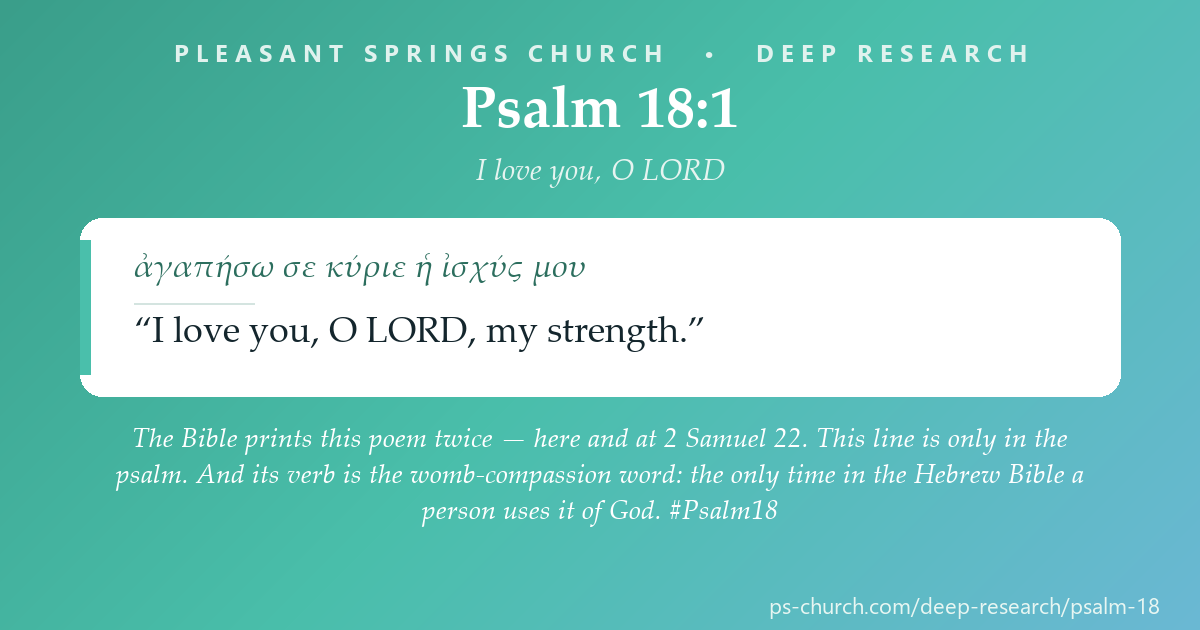
The Bible prints this poem twice. It is Psalm 18, and it is also 2 Samuel 22, where it stands as David's song near the end of his life — both fifty-one verses in Hebrew. And they are not the same text. Counted here on a proper alignment — Psalm 18:4–51 against 2 Samuel 22:4–51, forty-eight verses, compared letter by letter — only two are identical. Forty-six differ. Ninety-six per cent. Most of the variation is small: a preposition, a spelling, a singular for a plural. Some of it is not: the psalm has the cords of death where 2 Samuel has the breakers of death — a snare against a wave — and the Greek read the same consonants a third way and got birth-pangs. And the psalm opens with a line 2 Samuel does not have at all: I love you, O LORD, my strength — whose verb comes from the root for a mother's compassion, and which is the only place in the Hebrew Bible where a person uses that word of God. The version that went into the hymnbook begins by saying something the version in the history book does not. See the method →
Psalm 18:1–50 (selections)
Hebrew · Greek (Rahlfs’ Psalter) · ESV⚠️ And they are not the same text. They are two texts of the same poem, and the difference is far larger than most readers are told.
Counted here, on a proper alignment — Psalm 18:4–51 against 2 Samuel 22:4–51, forty-eight verses, compared letter by letter with the vowel points set aside:
• Identical: 2.
• Differing: 46.
• That is ninety-six per cent.
Almost every verse of this poem differs between its two biblical copies in at least one letter. Most of the differences are small — a preposition, a spelling, a singular for a plural, a divine name — and a few change the picture. At verse 4 the psalm has the cords of death and 2 Samuel has the breakers of death; one is a hunter’s snare, the other is surf. Rahlfs read the consonants a third way and got ὠδῖνες — birth-pangs.
⚠️ And the Psalter version opens with a line 2 Samuel does not have. ʾErḥāməḵā YHWH ḥizqî — “I love you, O Lord, my strength.” Verified by searching the whole of 2 Samuel 22 for the verb: it is not there.
The verb is worth pausing on. It is from the root behind raḥămîm, womb-compassion — and this is the only place in the Hebrew Bible where a person uses it of God rather than the other way round. The version of the poem that went into the hymnbook begins by saying something the version in the history book does not.
What all this is evidence of. Not carelessness. A poem that circulated for generations in worship and in the historical narrative will develop two forms, and the tradition kept both rather than harmonising them. The same instinct preserved Psalm 14 and Psalm 53 side by side. A tradition confident enough to print its own variants is telling you something about how it was handled.
The Shape of the Passage
SequenceThe claim in verses 20–24 is the hardest thing in the psalm and should not be softened. The Lord dealt with me according to my righteousness… I was blameless before him. This is the same David the narrative books do not flatter. Whether the psalm is claiming innocence in a specific dispute rather than a general moral verdict is argued, and the psalm does not say.
And verse 25–26 is one of the strangest statements about God in the Bible. With the merciful you show yourself merciful; with the blameless you show yourself blameless; with the pure you show yourself pure; and with the crooked you make yourself seem tortuous. God is described as appearing to people in the shape of their own conduct.
A solo study. Psalm 18 is one of the longest psalms in the book and the only one printed twice in the Bible. Its opening lines are borrowed at the head of Psalm 144.
Author
He begins by saying he loves God, using a word nobody else uses that way. The verb is from the root for womb-compassion, and this is the only place in the Hebrew Bible where a human being applies it to God. And it is exactly the line the other copy of the poem does not have.
He describes a cosmic storm and then says what it was for. Sixteen verses of earthquake and thunder, resolving into he drew me out of many waters. The disproportion is the point.
And he claims to have been blameless. According to my righteousness. Nothing in the psalm qualifies it, and the narrative books do not support it as a general verdict. The page reports the difficulty rather than smoothing it.
Audience
People who sang it, and people who read it as history. The two settings produced two texts — the hymnbook version and the narrative version — and the Bible keeps both.
People at war. Sixteen verses of it, and they are not comfortable. The psalm does not apologise for them, and this study does not either.
And, eventually, the nations. The last movement promises praise among the nations — which is the use Paul makes of it when he argues that Gentiles were always in view.
Orient on theophany, on doublets, and on royal thanksgiving.
Search by topic: theophany; storm imagery; doublets in the Hebrew Bible; royal thanksgiving psalms; 2 Samuel 22; textual transmission.
Which articles are relevant?
- Anchor Bible Dictionary — “Theophany,” “Samuel, Books of,” “Textual Criticism (OT),” “Kingship.”
- Dictionary of the OT: Wisdom, Poetry & Writings (IVP) — “Theophany,” “Royal Psalms,” “Thanksgiving,” “Warfare.”
- NIDOTTE / TDOT — רָחַם (rāḥam, to have compassion), חֶבֶל (ḥeḇel, cord), מִשְׁבָּר (mišbār, breaker), נֵר (nēr, lamp).
- On the doublet — any critical commentary on 2 Samuel 22, which will set the two texts in parallel columns. Seeing them beside each other is worth more than reading about them.
Bibliography surfaced:
- Emanuel Tov, Textual Criticism of the Hebrew Bible — uses this doublet as a standard example.
- John Goldingay, Psalms 1–41; Robert Alter, The Book of Psalms and his The David Story.
- Beale and Carson, Commentary on the NT Use of the OT — for Romans 15:9.
A storm God rides, and what a doublet actually shows.
The counting is the substance of this page. It can be reproduced by anyone with both texts.
Which parallels shed light on this psalm?
The theophany uses the standard storm-god vocabulary of the region and redirects it. Thunder as a voice, riding on cloud, arrows as lightning, the sea’s channels laid bare — these images are widely attested in Canaanite and wider Near Eastern poetry. What is distinctive is the ending: the storm is not a display of power but a rescue operation, and its object is a single person in deep water.
The Bible contains other doublets, and they are instructive. Psalm 14 and Psalm 53; Psalm 40:13–17 and Psalm 70; Psalm 108 assembled from Psalms 57 and 60. In every case the tradition preserved both forms rather than choosing. Psalm 18 and 2 Samuel 22 is the largest example.
And the lamp is a royal image. You light my lamp — and elsewhere the lamp of David means the survival of his line (1 Kings 11:36; 2 Kings 8:19). Rahlfs renders it λύχνον, the small household lamp — the same word as at Psalm 119:105.
- 2 Samuel 22 → Psalm 18. The whole poem, again. Read them in parallel columns; the experience is not replaceable by a summary.
- Exodus 15 and Judges 5. Two other ancient victory songs embedded in narrative. The same phenomenon: poetry preserved inside history.
- Psalm 144:1–2 → Psalm 18:2, 34, 46. Psalm 144 opens by quoting this psalm — see that study.
- Romans 15:9 → Psalm 18:49. I will praise you among the Gentiles. Paul quotes it in the same chain as Psalm 117, arguing the nations were always in view.
- Habakkuk 3:19 → Psalm 18:33. He makes my feet like the deer’s. The same line, closing a different book.
- 1 Kings 11:36 → Psalm 18:28. The lamp as a dynasty’s survival.
The method, so it can be checked. Psalm 18 and 2 Samuel 22 each run to fifty-one verses in Hebrew, but they do not begin the same way — the psalm opens with a superscription and a declaration of love, the narrative with a sentence of introduction, and the two divide their opening material differently. From verse 4 onward they align one to one.
Comparing that aligned block — Psalm 18:4–51 against 2 Samuel 22:4–51, forty-eight verses — on the consonants alone, with vowel points and accents set aside:
• letter-for-letter identical: 2 verses
• differing in at least one letter: 46 verses
• 96%
⚠️ What that number does not mean. It is not a measure of how different the poem is. Almost all of the variation is small — a preposition swapped, a fuller or shorter spelling, a singular for a plural, one divine name for another. Read aloud, the two are plainly the same poem, and a listener would not notice most of it. The figure counts verses containing any difference, which is a deliberately strict test — and the strictness is the point: it shows that variation is pervasive rather than occasional.
Where it does bite. Verse 4: ḥeḇlê-māweṯ, cords of death, against 2 Samuel’s mišbərê-māweṯ, breakers of death — a snare against a wave. And Rahlfs read the consonants a third way: ὠδῖνες θανάτου, the birth-pangs of death, taking ḥeḇel in its other sense of labour pain.
The conclusion this page draws is about method, not about error. A poem sung in worship and also written into a history will develop two forms. The tradition kept both, unharmonised, for well over two thousand years — which is why the comparison is available to us at all.
A verb used once this way, and two words for how death arrives.
Set Psalm 18 and 2 Samuel 22 in parallel columns and read verse 4 in both.
Counted here, not assumed:
- Psalm 18 and 2 Samuel 22 each have 51 verses in Hebrew. Psalm 18 is 50 in English, the title being counted as verse 1 — see Psalms 3–5.
- On the aligned block (Ps 18:4–51 vs 2 Sam 22:4–51, 48 verses), only 2 are consonantally identical. 46 differ — 96%. Computed directly with vowels and accents set aside.
- “I love you, O Lord, my strength” has no counterpart in 2 Samuel 22. Verified by searching the whole chapter for the verb.
- The verb is the only instance in the Hebrew Bible of a person using this root of God.
- Psalm 18:4 has cords, 2 Samuel 22:5 has breakers, and Rahlfs has birth-pangs. Three readings.
- Most of the 46 differences are small — prepositions, spellings, number, divine names. The figure counts verses with any difference, which is a strict test and is meant to be.
“I love you” — and the verb is unusual enough to be worth stopping on. It comes from the root behind raḥămîm, the word for a mother’s compassion, built on the noun for womb. Elsewhere in the Hebrew Bible it is what God feels toward people. This is the only place a person uses it of God. And it is the line 2 Samuel 22 does not have. Rahlfs has ἀγαπήσω σε.
“Cords” and “breakers.” The psalm has one, 2 Samuel has the other. A ḥeḇel is a rope or snare — death as a trapper; a mišbār is a breaking wave — death as surf. Rahlfs took a third option, ὠδῖνες, birth-pangs, using the other sense of ḥeḇel. Three readings of two words, and the following line — torrents of destruction — suits water.
“Lamp” — the small clay oil lamp, the same object as at Psalm 119:105. Used elsewhere of a dynasty’s survival — the lamp of David that must not go out. Rahlfs has λύχνον. Note the modesty of the image in a psalm otherwise full of earthquakes.
“Like the deer.” The point is surefootedness on broken ground, not speed — the next line is he sets me secure on the heights. Habakkuk closes his book with the same line. Rahlfs has ὡς ἐλάφου, singular where the Hebrew is plural — one of the many small differences this psalm attracts.
“Among the nations.” The psalm ends by promising praise outside Israel, and Paul quotes the line at Romans 15:9 in the chain that also uses Psalm 117. Rahlfs has ἐν ἔθνεσιν, the wording Paul reproduces. See the reference page on why that matters.
A song inside a history, and a line Paul needed.
Read 2 Samuel 22 straight through, then Psalm 18. The experience is the point.
Which cross-references matter?
- 2 Samuel 22 → Psalm 18. The same poem, in a different book, with a different opening and pervasive small variation.
- Romans 15:9 → Psalm 18:49. Paul’s argument that the nations were always included, using this psalm’s closing promise. See the reference page.
- Psalm 144:1–2 → Psalm 18. Psalm 144 opens by quoting this psalm — see Psalms 144–145.
- Habakkuk 3:19 → Psalm 18:33. Feet like the deer’s.
- Exodus 15; Judges 5 → 2 Samuel 22. Ancient poems preserved inside narrative — the same phenomenon.
- Psalm 14 // Psalm 53; Psalm 40:13–17 // Psalm 70. Other doublets the tradition kept rather than harmonised — see Psalms 11–14.
Three open questions.
Tov treats this doublet as a standard case; the commentaries differ on verses 20–24.
Commentaries & studies:
- Emanuel Tov, Textual Criticism of the Hebrew Bible — on Psalm 18 // 2 Samuel 22 as a test case.
- John Goldingay, Psalms 1–41; Robert Alter, The Book of Psalms.
- Any critical commentary on 2 Samuel — for the two texts in parallel.
- NETS Psalms, with Rahlfs — for verse 4 and the Greek generally.
Three things reported as unsettled:
- Which version is earlier. Arguments run both ways, and neither text is simply a corruption of the other. Both have readings the other lacks.
- What verses 20–24 claim. According to my righteousness… I was blameless. Whether this is innocence in a particular dispute or a general moral verdict is argued, and the psalm does not specify.
- Whether 18:4 is cords, breakers or birth-pangs. Three traditions, three readings — and the parallel line about torrents favours water.
A tradition that kept its own variants.
Name what you learned, why it matters, and one concrete response.
What should we carry away — and do?
- The Bible prints this poem twice and does not tidy it up. Ninety-six per cent of the aligned verses differ in at least a letter. The tradition preserved both forms rather than choosing one — which is a sign of care, not carelessness, and it is why we can compare them at all.
- The hymnbook version says something the history does not. I love you, O Lord, my strength — using the womb-compassion verb, the only time in the Hebrew Bible a person uses it of God. When the poem went into the songbook, it gained a declaration of love.
- The storm is a rescue. Sixteen verses of earthquake, smoke, hail and thunder, and then: he drew me out of many waters. The disproportion between the machinery and the object is the theology of the psalm.
- One concrete response. Verse 28 is the quietest line in a very loud psalm: you light my lamp. Not a bonfire — a household lamp. After all the thunder, that is what the psalmist actually asks to have working.
Psalm 18:1 · to share
Hebrew + Greek (Rahlfs) + ESVEvery Deep Research page traces its passage across the whole sweep — the Old Testament, the Second-Temple world between the testaments (historical witnesses, not Scripture), and the New Testament. Follow the thread:
Pleasant Springs Church — Deep Research
Research method after Michael S. Heiser’s Bible Research Method (examine dictionaries → ancient literature → important words → textual connections → academic publications → share), with the Pleasant Springs “Author & Audience” foundation. Scripture set in the Hebrew, the Greek editions named on each page and the ESV (Old Testament), and the Greek New Testament and the ESV (New Testament), per the practice of Pleasant Springs Church. Psalm 18 research grounded in Tov (Textual Criticism of the Hebrew Bible, which treats this doublet as a standard case), Goldingay and Alter, with Beale and Carson for Romans 15:9. Text: Hebrew from the Masoretic text as printed in the editions consulted — Sefaria’s Miqra according to the Masorah, for both Psalm 18 and 2 Samuel 22; no critical apparatus was consulted for the Hebrew. Greek from Rahlfs’ Greek Psalter (CATSS digitization of Rahlfs 1931). The standing caution for this shelf applies: these pages say “Rahlfs’ Greek Psalter reads…” and never call a Greek reading early or late. ⚠️ The 96% figure was computed, and the method is stated on the page so it can be checked. A naive verse-by-verse comparison is misaligned, because the two texts open differently and divide their opening material differently; the comparison was therefore run on the aligned block Ps 18:4–51 against 2 Sam 22:4–51 (48 verses), on consonants alone with vowel points and accents stripped — yielding 2 identical and 46 differing. The page explicitly limits what the number means: it counts verses containing any difference, a deliberately strict test, and states that most variation is minor and that the two are audibly the same poem. The absence of “I love you, O Lord, my strength” from 2 Samuel 22 was verified by searching the entire chapter for the root, not assumed. The claim that this is the only place a human uses rāḥam of God is reported from the lexical literature. The three-way split at 18:4 (cords / breakers / birth-pangs) is reported and not resolved, with the parallel colon noted as favouring water. Verses 20–24 are presented as a genuine difficulty and deliberately not softened, with the question of whether they claim situational or general innocence left open. Typology is handled per the house position: what the text says, what the New Testament itself draws, and what we see from this side of the cross — with the seeing left to the reader.
Scripture quotations marked ESV are from the ESV® Bible (The Holy Bible, English Standard Version®), © 2001 by Crossway, a publishing ministry of Good News Publishers. ESV Text Edition: 2016. Used by permission. All rights reserved. The ESV text may not be quoted in any publication made available to the public by a Creative Commons license, and the ESV may not be translated in whole or in part into any other language. www.esv.org
|
Did this study bless you today? 💚 Give to Support PS Church100% of gifts go to the General Fund — thank you. |