Psalm 15 asks a question at a door — who may sojourn in your tent? who may dwell on your holy hill? — and answers it with ten or eleven requirements, not one of which is ritual. Truth in the heart, no slander, no interest, no bribe, and the hardest of them: he swears to his own hurt and does not change — keeping a promise after it turns out to cost you. Though the same Hebrew consonants also give "swears to his neighbour", which is how the Greek read them, and that is a noticeably gentler requirement. Then Psalm 17 asks to be guarded as the apple of your eye — and the Hebrew is far better than that: the little man of the eye, the pupil, named for the tiny figure you see reflected when you look closely into someone's face. Greek arrived at the same idea independently — korē, a girl — and Latin a third time, pupilla, a little doll, which is exactly why you say pupil. See the method →
Psalms 15:1–17:15 (selections)
Hebrew · Greek (Rahlfs’ Psalter) · ESV⚠️ And one item on the list reads two different ways from the same consonants. The Hebrew as pointed gives nišbaʿ ləhāraʿ — he swears to his own hurt and does not change, which is a striking standard: he keeps a promise even when keeping it costs him.
Rahlfs read the same letters differently, as ləhārēaʿ — to his neighbour — giving ὁ ὀμνύων τῷ πλησίον αὐτοῦ, “who swears to his neighbour and does not break it.” Both are good sense; both fit a list about neighbourly conduct; and the consonants are identical. This page reports both.
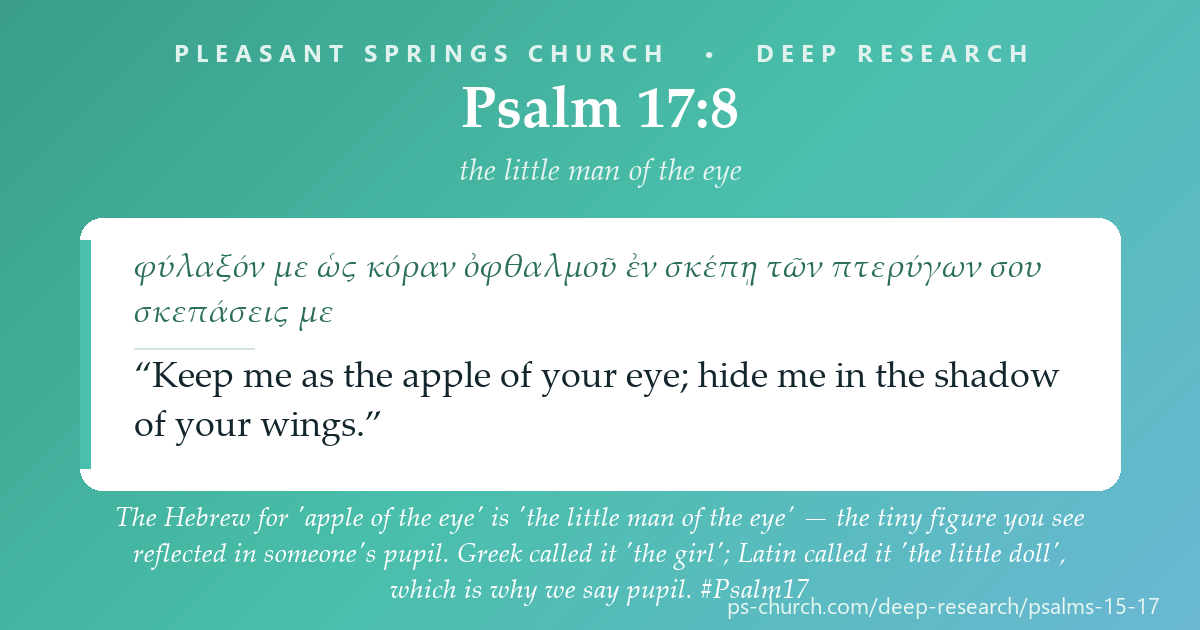
Psalm 17 asks to be guarded like the pupil of an eye — and the phrase is more charming than English lets on. The Hebrew is ʾîšōn baṯ-ʿāyin, literally “the little man of the daughter of the eye.” The pupil is called a little man because of the tiny reflected figure you see when you look closely into someone’s eye.
⚠️ And the Greek arrived at the same idea independently. Rahlfs has κόραν ὀφθαλμοῦ — and κόρη means girl, maiden as well as pupil. Latin did it a third time: pupilla, little doll, which is where the English word pupil comes from. Three languages, three small people, one anatomical feature — each apparently noticing the same reflection.
Psalm 16 sits between them, and the library treats its most famous verse elsewhere. You will not abandon my soul to Sheol is worked on the New Testament reference page, where the Greek reads decay for the Hebrew’s pit and Peter’s Pentecost argument depends on it. It is not re-argued here.
The Shape of the Passage
SequencePsalm 15’s list is worth reading slowly, because of what is missing from it. Nothing about offerings, purification, festivals or lineage. Every single item is about speech or money or how you treat a neighbour — truth in the heart, no slander, no reproach, honouring those who fear God, keeping a costly promise, no interest, no bribe. Asked who may approach God, the psalm answers entirely in terms of other people.
And Psalm 17 ends somewhere the psalm has not prepared you for. Fourteen verses of pursuit, and then: when I awake, I shall be satisfied with your likeness. The Hebrew word for awake is ordinary — it is what you do in the morning — and readers have long heard more in it than a morning. Rahlfs did not: he read it as God’s glory appearing, which removes the waking altogether. The page reports both and presses neither.
Psalm 16:10 and Acts 2 are treated on the New Testament reference page and are not re-argued here. This page reads the three psalms together.
Author
He answers a religious question with an ethical list. Asked who may come to the holy hill, he says nothing about sacrifice and everything about slander, interest and bribes. The answer would have surprised the person asking.
He sets a standard almost nobody meets. He swears to his own hurt and does not change — keeping a promise after it turns out to be expensive. The Greek read the phrase differently and produced a gentler requirement.
And he asks for the most reflexive protection he can name. Keep me as the little man of your eye — the thing you defend before you have decided to.
Audience
People arriving at a sanctuary. Psalm 15 has the shape of a liturgy at a gate — a question asked, an answer given. Whether it was actually used that way is inferred from its form, and the page says so.
People with no land. Psalm 16 uses allotment language throughout — portion, lot, boundary lines, inheritance. The same vocabulary as Psalm 119:57, and the same move.
And people being hunted at night. Psalm 17 is full of eyes, faces, wings and lions. It ends by looking forward to waking up.
Orient on entrance liturgies, on Miktam, and on lending at interest.
Search by topic: entrance liturgy; temple gates; miktam; usury and interest; apple of the eye; wings of God; vision of God.
Which articles are relevant?
- Anchor Bible Dictionary — “Entrance Liturgy,” “Temple,” “Usury,” “Oath,” “Psalm Titles.”
- Dictionary of the OT: Wisdom, Poetry & Writings (IVP) — “Liturgy,” “Ethics,” “Confidence, Psalms of,” “Imagery: Body.”
- NIDOTTE / TDOT — אִישׁוֹן (ʾîšōn, pupil), מִכְתָּם (miḵtām), גּוּר (gûr, to sojourn), תְּמוּנָה (təmûnāh, form).
- On the Greek — the NETS Psalms introduction. Psalm 15:4 and 17:15 are both places where the vocalisation of the Hebrew decides the meaning.
Bibliography surfaced:
- John Goldingay, Psalms 1–41; Robert Alter, The Book of Psalms.
- Gerald H. Wilson, The Editing of the Hebrew Psalter.
- Beale and Carson, Commentary on the NT Use of the OT — for Acts 2 and Psalm 16.
A question at a gate, a metaphor three languages found, and an unknown title.
The pupil of the eye is the most enjoyable thing on this page and it is entirely checkable.
Which parallels shed light on these psalms?
Psalm 15 has the shape of a gate liturgy. A question is put — who may come in? — and an answer is given in the form of requirements. Psalm 24:3–6 has the same structure, and Isaiah 33:14–16 asks a comparable question. Whether these were spoken antiphonally at an actual gate is a reasonable inference from their form and is not documented, and this page treats it as inference.
Lending at interest is prohibited to fellow Israelites (Exodus 22:25; Leviticus 25:36–37; Deuteronomy 23:19–20), and Psalm 15 puts it on a list of things that disqualify a person from the holy hill. The prohibition is about not profiting from a neighbour’s distress — which is the theme of the whole list.
And the title of Psalm 16 is another unknown. Miḵtām heads six psalms (16 and 56–60) and nobody is certain what it means — a golden psalm, an inscription, an atonement psalm, a silent prayer. Rahlfs renders it στηλογραφία, an inscription on a monument, which is a guess with a reason: the Hebrew consonants suggest engraving. Compare the two strategies at Psalms 6–8, where one unknown is rendered literally and another dropped.
- Psalm 24:3–6 and Isaiah 33:14–16 → Psalm 15. The same question and the same kind of answer. Isaiah’s version asks who can dwell with devouring fire.
- Exodus 22:25; Leviticus 25:36–37; Deuteronomy 23:19–20 → Psalm 15:5. The prohibition on interest.
- Deuteronomy 32:10 → Psalm 17:8. He kept him as the apple of his eye — the same phrase, of God guarding Israel in the wilderness, and in the very next line an eagle over its young. Psalm 17:8 pairs the same two images.
- Ruth 2:12 and Matthew 23:37 → Psalm 17:8. Under whose wings you have come to take refuge; as a hen gathers her chicks. The sheltering-bird image, twice more.
- Numbers 12:8 → Psalm 17:15. He beholds the form (təmûnāh) of the Lord, said of Moses. The same rare word.
The Hebrew of Psalm 17:8 is ʾîšōn baṯ-ʿāyin — literally the little man of the daughter of the eye. ʾĪšōn is a diminutive of ʾîš, man.
The reason is observational. Look closely into someone’s eye and you see yourself reflected in the pupil — a tiny person. The anatomy is named after the reflection.
⚠️ Rahlfs renders it κόραν ὀφθαλμοῦ — and κόρη in Greek means girl, maiden, as well as pupil. The same observation, made independently in another language.
And Latin made it a third time. Pupilla means little doll — the diminutive of pupa — and that is the direct ancestor of the English word pupil. Every time you use the anatomical term you are repeating an observation somebody made about a reflection.
English “apple of the eye” is the odd one out, and it is an old English idiom rather than a translation of anything — the pupil was thought of as a small round solid thing. Which is why the standard English rendering, while perfectly serviceable, loses the picture the Hebrew and Greek both carry.
What that does for the verse. Keep me as the little person reflected in your eye asks for two things at once — the reflexive, involuntary protection an eye gets, and the closeness of being the thing that is being looked at. The next line has a bird covering its young, which is the same request again.
A word for the pupil, and one that reads two ways.
Look someone in the eye and you will see why the Hebrew calls it a little man.
Counted here, not assumed:
- Hebrew and Rahlfs give Psalms 15, 16 and 17 five, eleven and fifteen verses — and so does English. No offset in any of the three, because each title is short enough to fold into verse 1. See Psalms 11–14 for why the offset is not automatic.
- At 15:4 the Hebrew consonants support both to his own hurt and to his neighbour. Rahlfs takes the second. Reported, not resolved.
- At 17:8 Hebrew, Greek and Latin all name the pupil after a small person. ʾîšōn (little man), κόρη (girl), pupilla (little doll) — the last being the origin of English pupil.
- At 17:15 Hebrew has when I awake and likeness; Rahlfs has when your glory appears. The waking disappears in the Greek.
- Psalm 15 lists ten or eleven requirements and not one is ritual. Checkable in any translation.
“The little man of the daughter of the eye” — the pupil, named for the miniature figure reflected in it. ʾĪšōn is a diminutive of man. Rahlfs has κόρη, which means girl as well as pupil, and Latin pupilla means little doll — the source of English pupil. Three languages, the same observation.
“He swears to his own hurt” — keeping a promise after it becomes costly. The very same consonants, pointed as ləhārēaʿ, give to his neighbour — and that is how Rahlfs read them: ὁ ὀμνύων τῷ πλησίον αὐτοῦ. Both fit a list about neighbourly conduct. Reported, not resolved.
An unknown term heading six psalms (16, 56–60). Proposed: a golden psalm, an engraved inscription, an atonement psalm. Rahlfs guesses στηλογραφία — a monument inscription, which at least has a rationale in the consonants. Compare Psalms 6–8, where he renders one unknown literally and simply omits another.
“Measuring line, lot, inheritance” — three land-allotment words in two verses. The lines have fallen for me in pleasant places; indeed I have a beautiful inheritance. The vocabulary is that of a surveyor dividing territory, used by someone whose portion is God. Compare Psalm 119:57, which makes the same move with ḥēleq.
“Form, likeness” — a rare and careful word, used of what Moses was permitted to see (Numbers 12:8) and of the likeness Israel did not see at Sinai (Deuteronomy 4:12, 15). To say I shall be satisfied with your təmûnāh is a considerable claim. Rahlfs reads δόξαν, glory, and turns the waking into an appearing.
A wilderness eye, a sheltering bird, and a form Moses saw.
Read Deuteronomy 32:10–11 and then Psalm 17:8. The two images arrive together in both.
Which cross-references matter?
- Deuteronomy 32:10–11 → Psalm 17:8. He kept him as the apple of his eye… like an eagle… spreading out its wings. The same two images side by side, of God guarding Israel in the desert.
- Psalm 24:3–6 and Isaiah 33:14–16 → Psalm 15. The same gate question, twice more.
- Deuteronomy 23:19–20 → Psalm 15:5. No interest from a brother.
- Numbers 12:8 and Deuteronomy 4:12, 15 → Psalm 17:15. Təmûnāh — the form Moses saw and Israel did not.
- Acts 2:25–31 → Psalm 16:8–11. Treated on the reference page, where the Greek decay carries Peter’s argument. Not repeated here.
- Matthew 23:37 and Ruth 2:12 → Psalm 17:8. The sheltering wings.
Three open questions.
Goldingay is careful on 15:4 and 17:15.
Commentaries & studies:
- John Goldingay, Psalms 1–41; Robert Alter, The Book of Psalms.
- Gerald H. Wilson, The Editing of the Hebrew Psalter.
- NETS Psalms, with Rahlfs — for 15:4, 16 title and 17:15.
Three things reported as unsettled:
- Whether 15:4 means to his own hurt or to his neighbour. Identical consonants; Rahlfs takes the second. Both suit the list.
- What miḵtām means. Six psalms carry it and nobody is sure. Rahlfs guesses inscription.
- How much 17:15’s when I awake carries. The Hebrew word is the ordinary one for waking; readers have long heard more in it, and Rahlfs removed the waking altogether. The page reports the readings and does not decide.
A list with no religion in it, and a very small person.
Name what you learned, why it matters, and one concrete response.
What should we carry away — and do?
- Asked who may approach God, the psalm answers entirely about other people. Truth, slander, promises, interest, bribes. Not one of the ten or eleven requirements is ritual. The gate to the holy hill turns out to be your neighbours.
- The hardest item on the list is the one about promises. He swears to his own hurt and does not change — keeping your word after it becomes expensive to keep. The Greek read the same letters as a gentler requirement, which tells you something about how hard the harder reading is.
- Three languages looked into an eye and saw a little person. Hebrew little man, Greek girl, Latin little doll — and the last is why you say pupil. The psalm is asking to be as close and as instinctively guarded as that.
- One concrete response. Look at Psalm 15’s list and find the item you are currently failing. It will not be a religious one.
Psalm 17:8 · to share
Hebrew + Greek (Rahlfs) + ESVEvery Deep Research page traces its passage across the whole sweep — the Old Testament, the Second-Temple world between the testaments (historical witnesses, not Scripture), and the New Testament. Follow the thread:
Pleasant Springs Church — Deep Research
Research method after Michael S. Heiser’s Bible Research Method (examine dictionaries → ancient literature → important words → textual connections → academic publications → share), with the Pleasant Springs “Author & Audience” foundation. Scripture set in the Hebrew, the Greek editions named on each page and the ESV (Old Testament), and the Greek New Testament and the ESV (New Testament), per the practice of Pleasant Springs Church. Psalms 15–17 research grounded in Goldingay (Psalms 1–41), Alter and Wilson. Text: Hebrew from the Masoretic text as printed in the editions consulted — Sefaria’s Miqra according to the Masorah; no critical apparatus was consulted for the Hebrew. Greek from Rahlfs’ Greek Psalter (CATSS digitization of Rahlfs 1931). The standing caution for this shelf applies: these pages say “Rahlfs’ Greek Psalter reads…” and never call a Greek reading early or late. ⚠️ Three divergences were verified directly in both columns and all three are reported without adjudication: 15:4, where identical consonants give either ləhāraʿ (to his own hurt) or ləhārēaʿ (to his neighbour) and Rahlfs takes the second; 16:4, where the Greek differs substantially from the Hebrew; and 17:15, where Hebrew when I awake… your likeness becomes when your glory appears and the waking disappears. The long reception of 17:15 as pointing past death is noted as reception and not asserted as the verse’s sense. The pupil-of-the-eye convergence is checkable in three languages: Hebrew ʾîšōn (diminutive of ʾîš, man), Greek κόρη (girl / pupil), Latin pupilla (little doll) — the last being the etymological source of English pupil, while English apple of the eye is noted as a native idiom rather than a rendering. Verse counts were checked in all three columns (5/11/15 throughout, no offset), consistent with the rule refined at Psalms 11–14 that short titles fold into verse 1. Miḵtām is reported as unknown. Psalm 16:10 and Acts 2 are deliberately not re-argued here, belonging to the reference page. The entrance-liturgy setting of Psalm 15 is labelled an inference from form. Typology is handled per the house position: what the text says, what the New Testament itself draws, and what we see from this side of the cross — with the seeing left to the reader.
Scripture quotations marked ESV are from the ESV® Bible (The Holy Bible, English Standard Version®), © 2001 by Crossway, a publishing ministry of Good News Publishers. ESV Text Edition: 2016. Used by permission. All rights reserved. The ESV text may not be quoted in any publication made available to the public by a Creative Commons license, and the ESV may not be translated in whole or in part into any other language. www.esv.org
|
Did this study bless you today? 💚 Give to Support PS Church100% of gifts go to the General Fund — thank you. |