Psalm 14:3 is where the Greek and Hebrew Psalters part company more sharply than anywhere else in the book. The Hebrew verse has eight words. Rahlfs' Greek verse has sixty. The first eight match; the other fifty-two have no Hebrew counterpart anywhere. And they are not random — they are five lines with known addresses elsewhere in Scripture: an open grave for a throat, the venom of asps, a mouth full of cursing, swift feet to shed blood, no fear of God. That is Romans 3:13–18, in exactly Paul's order, sitting inside a single verse of a psalm. There are two explanations and they run opposite ways: Paul found the verse already expanded, or Christian copyists filled the psalm out to match the epistle they knew. The second is the majority view — and a view is not a proof, so this page reports both. What is not in doubt is that the Hebrew has never carried these lines. Also here: the shortest lament in the Psalter, and a fool who is not an atheist. See the method →
Psalms 11:1–14:7 (selections)
Hebrew · Greek (Rahlfs’ Psalter) · ESVCounted directly: the Hebrew verse has eight words. Rahlfs’ Greek verse has sixty. The first eight correspond to the Hebrew. The remaining fifty-two have no Hebrew counterpart at all.
And they are not random. They are five lines assembled from elsewhere in Scripture — an open grave for a throat (Psalm 5:9), the venom of asps (Psalm 140:3), a mouth full of cursing (Psalm 10:7), swift feet to shed blood and the way of peace they have not known (Isaiah 59:7–8), and no fear of God before their eyes (Psalm 36:1).
⚠️ That is Romans 3:13–18, in exactly Paul’s order. Paul’s great chain of indictments in Romans 3:10–18 opens by quoting Psalm 14:1–3 and then runs straight on through these same five lines. In the Greek Psalter, the whole chain sits inside a single verse of Psalm 13.
There are two explanations, and they run in opposite directions.
• Paul found it there. A Greek Psalter already carrying the expanded verse — or a collection of testimony-texts assembled for such a purpose — would explain Romans 3 as a single quotation rather than a chain of six.
• It came from Paul. Christian copyists, knowing Romans 3 well, filled the psalm out to match the epistle. Harmonising an Old Testament text toward a New Testament quotation is a well-attested habit, and this is the largest candidate for it in the Psalter.
The second is the majority view among textual scholars, and this page does not present it as settled. What can be said flatly is that the Hebrew has never carried these lines, and that the Greek manuscript tradition is divided about them.
⚠️ One limitation stated plainly. Critical editions commonly mark material judged secondary with brackets. The digitization of Rahlfs used for this library preserves no brackets anywhere in the Psalms — checked; there are none in the file — so this page reports that the material stands in the edition as digitized, and makes no claim about how the printed page marks it.
This is the exact counterpart to the case worked on the New Testament reference page, where the traffic appears to run the other way. Together they are the best argument this library can offer for naming an edition and refusing to say “the Septuagint.”
The Shape of the Passage
SequencePsalm 14 has a twin. Psalm 53 is very nearly the same poem — the same opening, the same verdict, with a different divine name throughout and a different fourth verse. The Psalter contains the same psalm twice, and this library will treat Psalm 53 in its own place. That two versions of one poem could both be preserved says something about how carefully the collection was kept rather than tidied.
And Psalm 13 is worth noticing for its shape. Two verses of complaint, two of petition, two of trust — and nothing in between them changes the situation. The psalm does not report an answer. It reports a decision.
The verse-numbering convention is explained on Psalms 3–5. These four psalms show why it is not automatic — see the counts below.
Author
He quotes the advice he is rejecting. Psalm 11 opens with somebody else\u2019s counsel — flee like a bird — and the whole psalm is the refusal. The advice is not stupid; the arrows really are on the string.
He asks the same question four times in two verses. How long? How long? How long? How long? Psalm 13 does not vary the phrasing to be elegant.
And he ends Psalm 13 without an answer. But I have trusted — the turn comes with nothing resolved. The psalm reports a decision, not a rescue.
Audience
People being lied about. Psalm 12 is a psalm for a community where speech has stopped being reliable — everyone utters lies to his neighbour. Its answer is not better argument but a different kind of word.
People told to run. Psalm 11\u2019s flee like a bird to your mountain is what friends say when they are frightened for you. The psalm is for people deciding whether to stay.
And people who needed a short lament. Psalm 13 is six verses. Not every trouble needs a hundred and seventy-six.
Orient on textual criticism, on the fool, and on refining metal.
Search by topic: Septuagint text of Psalms; interpolation and harmonisation; nabal / fool in wisdom literature; refining silver; lament form; doublet psalms.
Which articles are relevant?
- Anchor Bible Dictionary — “Septuagint,” “Textual Criticism (OT),” “Fool,” “Metallurgy.”
- Dictionary of the OT: Wisdom, Poetry & Writings (IVP) — “Lament,” “Fool,” “Psalms: Text and Versions,” “Doublets.”
- NIDOTTE / TDOT — נָבָל (nāḇāl, fool), צָרַף (ṣārap, to refine), עַד־אָנָה (ʿaḏ-ʾānāh, how long).
- On the Greek — the NETS Psalms introduction, and any treatment of Psalm 13:3 (LXX) as the classic case of a long plus.
Bibliography surfaced:
- Emanuel Tov, Textual Criticism of the Hebrew Bible — on harmonisation and on how such pluses are assessed.
- Beale and Carson, Commentary on the NT Use of the OT — on Romans 3:10–18.
- John Goldingay, Psalms 1–41; Robert Alter, The Book of Psalms.
How a text grows, and what refining actually involved.
The plus at 14:3 is the substance of this page. Everything else is context for it.
Which parallels shed light on these psalms?
Refining silver was a repeated process, and the psalm knows it. Ore was heated so the lead and dross rose and could be drawn off, and the operation was performed again and again. Purified seven times is not a round number for “very pure” so much as a description of a process taken to completion. Rahlfs’ ἑπταπλασίως keeps the seven.
The nāḇāl is not unintelligent. The word describes moral and social failure rather than low ability — Nabal in 1 Samuel 25 is the type, a rich man who refuses hospitality and is called by the name. Rahlfs has ἄφρων, senseless, which keeps the sense that something has gone wrong with the judgement rather than the intellect.
And texts did grow. Marginal notes migrate into the body; a scribe who knows a familiar chain of verses may complete it; parallel passages get harmonised toward each other. None of this requires bad faith, and all of it leaves traces that can be examined. Psalm 13:3 in Greek is the largest such trace in the Psalter.
- Romans 3:10–18 → Psalm 14:1–3 + the plus. Paul’s chain, and the Greek psalm verse, contain the same six texts in the same order.
- Psalm 5:9; 140:3; 10:7; 36:1 and Isaiah 59:7–8. The sources of the five added lines. Each stands independently in its own place.
- Psalm 53 — the twin. Nearly the same psalm, with a different divine name throughout. The Psalter preserves both.
- 1 Samuel 25 → Psalm 14:1. Nabal, whose name is the word for fool, and whose wife says folly is with him.
- Malachi 3:2–3 → Psalm 12:6. He is like a refiner’s fire… he will purify the sons of Levi and refine them like gold and silver.
The facts first, and they are countable. Hebrew Psalm 14:3 has eight words. Rahlfs’ Greek Psalm 13:3 has sixty. The first eight match the Hebrew; the other fifty-two have no Hebrew counterpart in any surviving witness.
The added material is five lines with known homes elsewhere:
• τάφος ἀνεῳγμένος ὁ λάρυγξ αὐτῶν — Psalm 5:9
• ἰὸς ἀσπίδων ὑπὸ τὰ χείλη αὐτῶν — Psalm 140:3
• ὧν τὸ στόμα ἀρᾶς καὶ πικρίας γέμει — Psalm 10:7
• ὀξεῖς οἱ πόδες αὐτῶν… ὁδὸν εἰρήνης οὐκ ἔγνωσαν — Isaiah 59:7–8
• οὐκ ἔστιν φόβος θεοῦ ἀπέναντι τῶν ὀφθαλμῶν αὐτῶν — Psalm 36:1
Romans 3:13–18 quotes those five, in that order, immediately after quoting Psalm 14:1–3.
• Explanation one: Paul found it. If a Greek Psalter he used already carried the expanded verse, Romans 3:10–18 is one long quotation rather than a chain the apostle assembled.
• Explanation two: it came from Paul. Copyists who knew Romans 3 completed the psalm to match. Harmonisation toward a famous quotation is a documented scribal habit, and the Greek witnesses are divided over these lines.
The second is the majority position, and it is a position rather than a proof. What is not in doubt: the Hebrew has never carried these lines.
⚠️ And a limitation this page states rather than hides. Critical editions ordinarily bracket material judged secondary. The digitized Rahlfs used here contains no brackets anywhere in the Psalms — verified: there are none in the file — so this page reports only that the material stands in the edition as digitized, and says nothing about how the printed page presents it. That is the honest limit of what this library can see.
A fool who is not stupid, and a line that travels.
Count the words in Psalm 14:3 in your Hebrew and in a Greek text. The difference is the page.
Counted here, not assumed:
- Hebrew Psalm 14:3 has 8 words; Rahlfs’ Psalm 13:3 has 60. Counted directly. The 52-word difference is five lines drawn from Psalms 5, 10, 36, 140 and Isaiah 59 — the contents of Romans 3:13–18, in Paul’s order.
- The digitized Rahlfs used here contains no brackets anywhere in the Psalms. Checked across the whole file. So this page reports the material as standing in the edition as digitized and makes no claim about the printed page’s markings.
- The verse-number offset is not automatic with a title. Psalms 12 and 13 are offset (Hebrew 9 and 6 verses, English 8 and 5); Psalms 11 and 14 are not (7 verses in both). The short titles of 11 and 14 are folded into verse 1 rather than given a verse of their own. That is why the figure is 62 of 150 and not “every titled psalm.”
- At 11:1 the Greek agrees with the read form of a written/read pair, where at 119:147 it agrees with the written form. No consistent rule.
- Psalm 14 and Psalm 53 are near-duplicates. The Psalter preserves the same poem twice.
“Fool” — and it is a moral word, not an intellectual one. The nāḇāl is boorish, contemptuous of obligation, the sort of person who refuses hospitality and shames a guest. 1 Samuel 25 gives the type a name: Nabal. Rahlfs has ἄφρων, senseless. The verse is not about atheism as a philosophical position — it is about a way of living that has concluded God does not matter.
“Refined” and “purified” — both metallurgical. Silver was heated so that the dross rose to be drawn off, and the operation repeated. Seven times describes a process carried to completion, and Rahlfs keeps the number: ἑπταπλασίως. Set against a psalm about lying tongues, the point is that God’s words have had everything else burned out of them.
“How long?” Four times in two verses, unvaried. The psalm does not reach for synonyms. Rahlfs repeats ἕως πότε just as flatly. Psalm 13 is six verses long — the shortest full lament in the Psalter — and it spends a third of itself on one question.
“Flee!” — and the Masoretic tradition preserves two forms: a plural written and a singular read. Rahlfs has μεταναστεύου, a singular imperative — agreeing with what is read. Worth setting beside Psalm 119:147, where the Greek agrees with what is written instead. There is no consistent rule; each case has to be looked at.
“An opened grave” — the first of the five lines the Greek adds and the Hebrew does not have. It belongs properly to Psalm 5:9, where it stands in both languages. Paul uses it at Romans 3:13. Whether he took it from an expanded Psalm 14 or the expanded Psalm 14 took it from him is the question this page declines to settle.
One chain of indictments, and where each link lives.
Read Romans 3:10–18 with a reference Bible open. Every line has an address.
Which cross-references matter?
- Romans 3:10–12 → Psalm 14:1–3. Paul’s opening quotation, and it follows the Greek.
- Romans 3:13–18 → Psalm 5:9; 140:3; 10:7; Isaiah 59:7–8; Psalm 36:1. The five lines that also stand inside Greek Psalm 13:3.
- Psalm 53 → Psalm 14. The twin, with a different divine name and a different verse 5.
- 1 Samuel 25 → Psalm 14:1. Nabal — a man whose name is the psalm’s word for fool.
- Malachi 3:2–3 → Psalm 12:6. The refiner’s fire.
- Psalm 11:4 → Habakkuk 2:20. The Lord is in his holy temple. The same sentence, put to opposite uses — here as reassurance, there as a command to be silent.
The state of the question, and what would settle it.
Tov on the method; Beale and Carson on Romans 3.
Commentaries & studies:
- Emanuel Tov, Textual Criticism of the Hebrew Bible — on harmonisation and secondary expansion.
- Beale and Carson, Commentary on the NT Use of the OT — on Romans 3:10–18 and this plus.
- John Goldingay, Psalms 1–41; Robert Alter, The Book of Psalms.
- NETS Psalms, with Rahlfs — and note that the Göttingen Psalter, when it appears, will address precisely this kind of question.
Three things reported as unsettled:
- Whether the plus preceded Paul or came from him. The majority hold it secondary, harmonised from Romans — but the alternative, that Paul used a Psalter or a testimony-collection already carrying it, is not excluded. Not settled here.
- Whether Psalm 14 or Psalm 53 is prior. The two differ in divine name and in one verse. Argued both ways.
- How the printed Rahlfs marks the plus. The digitization carries no brackets, so this library cannot say — and the page therefore claims nothing about it.
A verse that grew, and why it matters that we can tell.
Name what you learned, why it matters, and one concrete response.
What should we carry away — and do?
- We can count. Eight Hebrew words, sixty Greek ones, and every added line has a known address elsewhere in Scripture. Nothing about this is hidden or hard to check — which is the opposite of what people usually assume about textual questions.
- Nothing is lost either way. The five added lines are all genuine Scripture standing in their own places, and Romans 3 says what it says regardless. The question is about the history of a page, not the content of a doctrine.
- The fool is not the atheist. Nāḇāl describes someone whose living has concluded God does not matter. Psalm 14 is not aimed at a philosophical position but at a way of behaving — and it says there is none who does good, which includes the reader.
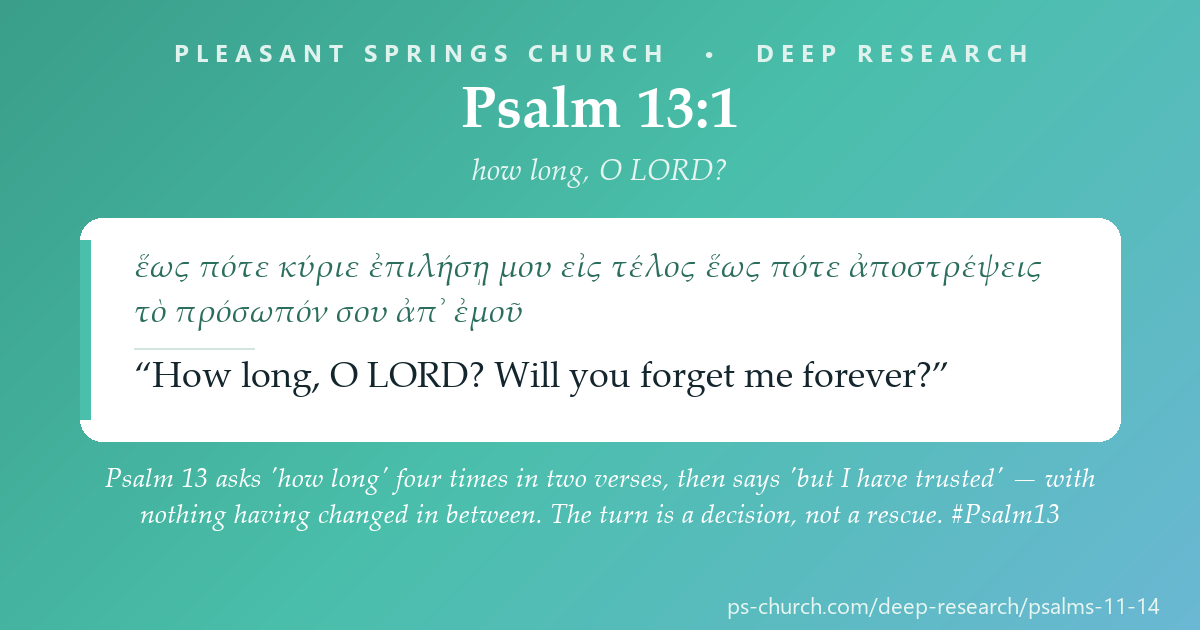
- One concrete response. Psalm 13 asks how long four times and then says but I have trusted — with nothing having changed in between. The turn is a decision, not a resolution. You are allowed to make it before the situation improves.
Psalm 13:1 · to share
Hebrew + Greek (Rahlfs) + ESVEvery Deep Research page traces its passage across the whole sweep — the Old Testament, the Second-Temple world between the testaments (historical witnesses, not Scripture), and the New Testament. Follow the thread:
Pleasant Springs Church — Deep Research
Research method after Michael S. Heiser’s Bible Research Method (examine dictionaries → ancient literature → important words → textual connections → academic publications → share), with the Pleasant Springs “Author & Audience” foundation. Scripture set in the Hebrew, the Greek editions named on each page and the ESV (Old Testament), and the Greek New Testament and the ESV (New Testament), per the practice of Pleasant Springs Church. Psalms 11–14 research grounded in Tov (Textual Criticism of the Hebrew Bible), Beale and Carson (on Romans 3:10–18), Goldingay and Alter. Text: Hebrew from the Masoretic text as printed in the editions consulted — Sefaria’s Miqra according to the Masorah; no critical apparatus was consulted for the Hebrew. Greek from Rahlfs’ Greek Psalter (CATSS digitization of Rahlfs 1931). The standing caution for this shelf applies: these pages say “Rahlfs’ Greek Psalter reads…” and never call a Greek reading early or late. ⚠️ The central claim was computed: Hebrew Psalm 14:3 contains 8 words; Rahlfs’ Psalm 13:3 contains 60. The 52-word plus is identified line by line with its sources (Psalm 5:9; 140:3; 10:7; Isaiah 59:7–8; Psalm 36:1) and matched against Romans 3:13–18, which quotes the same five in the same order directly after Psalm 14:1–3. Both explanations are stated fairly and neither is adopted: that Paul used a Psalter or testimony-collection already carrying the expansion, or that Christian copyists harmonised the psalm toward Romans. The page notes the second is the majority position while marking it a position rather than a proof, and states flatly that the Hebrew has never carried these lines. ⚠️ A limitation is disclosed rather than hidden: critical editions ordinarily bracket judged-secondary material, but the digitization used here contains no brackets anywhere in the Psalms — verified across the whole file — so the page reports only that the material stands in the edition as digitized and claims nothing about the printed page. The verse-numbering counts refine the rule given on Psalms 3–5: Psalms 12 and 13 are offset against English while Psalms 11 and 14 are not, because their short titles are folded into verse 1 — which is why the figure is 62 of 150 rather than every titled psalm. The 11:1 written/read pair is reported with Rahlfs siding with the read form, explicitly contrasted with 119:147 where he sides with the written form, to show there is no consistent rule. Typology is handled per the house position: what the text says, what the New Testament itself draws, and what we see from this side of the cross — with the seeing left to the reader.
Scripture quotations marked ESV are from the ESV® Bible (The Holy Bible, English Standard Version®), © 2001 by Crossway, a publishing ministry of Good News Publishers. ESV Text Edition: 2016. Used by permission. All rights reserved. The ESV text may not be quoted in any publication made available to the public by a Creative Commons license, and the ESV may not be translated in whole or in part into any other language. www.esv.org
|
Did this study bless you today? 💚 Give to Support PS Church100% of gifts go to the General Fund — thank you. |