Two psalms, or one? The Hebrew Bible prints two — Psalm 9 with a title, Psalm 10 with none. The Greek prints one, of thirty-nine verses. The arithmetic is exact: 21 verses plus 18 equals 39. Nothing is added or lost; the two traditions simply divide the same material in different places — and this is where the Greek Psalter begins running one behind the Hebrew, so that our Psalm 51 is its Psalm 50. What makes the question live is that a single alphabet runs across both. It starts cleanly, holds for a while, collapses for ten verses in the middle, and recovers just in time to finish. And the one letter that every reconstruction agrees on — the twelfth — falls on the first word of Psalm 10: why. The two psalms also change register completely. Psalm 9 is thanksgiving: the LORD sits enthroned forever. Psalm 10 opens why, O LORD, do you stand far away? No transition, no title, and in Greek not even a new psalm number. The alphabet fails exactly where the poem says the world's order has failed — in the ten verses describing a man getting away with it. See the method →
Psalms 9:1–10:18 (selections)
Hebrew · Greek (Rahlfs’ Psalter) · ESVTwo psalms, or one? The Hebrew Bible prints two — Psalm 9 with a title, Psalm 10 with none. Rahlfs’ Greek Psalter prints one, numbered 9, running to thirty-nine verses. The arithmetic is exact: Hebrew Psalm 9 has 21 verses and Psalm 10 has 18, and 21 + 18 = 39. Nothing was added or lost in either direction; the two traditions divide the same material in different places. And this is where the Greek Psalter’s numbering starts running one behind the Hebrew — from here to Psalm 147, our Psalm 51 is its Psalm 50.
The reason the question is live is that an alphabet runs across both of them. Psalm 9 begins with ʾalep and works forward — but not tidily, and not to the end. It holds, it staggers, it collapses for ten verses in the middle, and it recovers just in time to finish.
Between them the two psalms do something the Psalter rarely does: they change register completely. Psalm 9 is thanksgiving — I will give thanks… the Lord sits enthroned forever. Psalm 10 opens Why, O Lord, do you stand far away? The same poem, on the same alphabet, turns from praise to protest without a seam.
⚠️ The alphabet, checked letter by letter rather than taken on report. The longest strictly-alphabetical run across the two psalms is fifteen letters of twenty-two. But there is a catch that the commentaries usually pass over: there are sixteen different ways to pick a fifteen-letter run, and they disagree with each other at four points. The neat closing sequence often printed — qop, reš, šin, taw at 10:12, 14, 15, 17 — is one reconstruction among several, not something the text forces. The one thing every single reconstruction agrees on is lamed at 10:1 — the twelfth letter, falling on lāmāh, the first word of the psalm the Hebrew counts separately.
⚠️ The collapse is exactly ten verses long. Across 10:2–11 the letters mem, nun, samek, ayin, pe, ṣade should stand. The actual opening letters are bet, kap, reš, yod, ʾalep, ʾalep, yod, yod, yod, ʾalep — not one of the six. They are not hiding in the second half of the line either: taking the word after the main pause across those ten verses gives a different set again. Five letters begin no verse anywhere in either psalm: dalet, mem, samek, pe, ṣade. And two more appear but out of order — nun only at 9:17, wedged between ṭet and yod; ayin only at 10:13, after the qop.
⚠️ At the join, the Greek shows nothing at all. No title, no heading, no rubric, no gap. The verse numbering runs 21 → 22 unbroken. The one thing that does sit at the seam is the last διάψαλμα of the psalm — the Greek equivalent of selah — closing LXX 9:21, exactly where the Hebrew starts over. It is suggestive and it is not evidence. The Hebrew does mark a paragraph at 9:21 — but 144 of the 150 psalms carry that same mark at their close, so it is the ordinary convention and proves nothing on its own.
⚠️ And nobody knows what the title means. The Hebrew ʿal-mûṯ labbēn is usually left untranslated — Muth-labben — because it cannot be construed with confidence; the words look like death and for the son. Rahlfs’ Greek reads ὑπὲρ τῶν κρυφίων τοῦ υἱοῦ, “concerning the secrets of the son,” which construes the consonants quite differently. Both traditions are guessing, and this page says so rather than choosing.
The Shape of the Passage
SequenceWhat can be said precisely is how the alphabet behaves, and it is stranger than the usual summary. It is not a clean scheme with a hole in it. ʾAlep is doubled; four consecutive verses begin with waw; nun and ayin appear but in the wrong places; five letters never appear at all; and the words qûmāh YHWH — arise, O Lord — open both 9:20 and 10:12, so which of the two is “the qop line” cannot be determined from the text at all.
And the collapse is not random noise. It is exactly the ten verses (10:2–11) that describe the wicked man at the height of his confidence — boasting, cursing, lurking, saying God has forgotten. The alphabet fails precisely where the psalm says the order of the world has failed, and recovers at arise, O Lord. Whether the poet did that on purpose is not demonstrable — damaged transmission would look the same — and this page reports the shape without claiming the intention.
Psalms 1–2 opened the book with two untitled psalms bound by one word. Here two titled-and-untitled psalms are bound by an alphabet — and the Greek does not think they are two psalms at all.
Author
He is writing to a constraint, and the constraint shows. An acrostic forces word choice: the poet needs a word beginning with the right letter whether or not it is the word he wants. Where the scheme is loosest the sense is often tightest, which is what you would expect from someone letting content win an argument with form.
He turns from thanksgiving to protest without warning. Psalm 9 ends with God enthroned and the nations judged; Psalm 10 opens by asking why God is standing at a distance. No transition, no apology, and in the Greek not even a new psalm number. Whoever shaped this let the two moods sit inside one alphabet.
And the collapse falls in the right place. The ten verses where the letters fail are the ten that describe the wicked man unchecked. It may be design and it may be damage — the two are indistinguishable from the text — but a reader is entitled to notice where the seam falls.
Audience
People who had watched the confident go unpunished. Psalm 10 is unusually specific: the wicked man boasts of what he wants, curses, lurks near villages, and tells himself God has forgotten. It is not a portrait of wickedness in general but of one man getting away with it.
People who prayed the alphabet. An acrostic is a memory aid and a completeness claim — everything from A to Z. Praying through the letters is a way of saying you have left nothing out, which makes the missing letters here more conspicuous, not less.
And people for whom the two moods were one experience. Thanksgiving and protest are kept in separate psalms almost everywhere else. Here they share an alphabet, and the Greek tradition kept them in one psalm entirely.
Orient on acrostics, on psalm titles, and on the Greek Psalter's numbering.
Search by topic: acrostic psalms; alphabetic poems; psalm superscriptions; selah; Septuagint Psalter numbering; lament; the poor (ʿānî / ʿānāw).
Which articles are relevant?
- Anchor Bible Dictionary — “Acrostics,” “Psalm Titles,” “Selah,” “Poor,” “Psalms, Book of.”
- Dictionary of the OT: Wisdom, Poetry & Writings (IVP) — “Acrostic,” “Lament,” “Poetics,” “Psalms 1–41,” “Enemies.”
- NIDOTTE / TDOT — עָנִי (ʿānî, afflicted / poor), עָנָו (ʿānāw, humble), סֶלָה (selah), מְזִמָּה (məzimmāh, scheme).
- On the Greek — the NETS introduction to Psalms, and any account of the Greek Psalter’s numbering. This is the psalm where the offset begins.
Bibliography surfaced:
- John Goldingay, Psalms 1–41 — careful on the acrostic and honest about how broken it is.
- Robert Alter, The Book of Psalms — on what an acrostic costs a poet.
- Gerald H. Wilson, The Editing of the Hebrew Psalter — for the division question in the context of the book’s shaping.
What an acrostic is for, and a title nobody can read.
First the form. Then the superscription, which is a genuine dead end in both languages.
Which parallels shed light on these psalms?
Alphabetic poems are a real form with real purposes. There are several in the Hebrew Bible — Psalms 25, 34, 37, 111, 112, 119, 145, and the first four chapters of Lamentations. The form does two things at once: it aids memory, and it claims completeness — grief or praise from ʾalep to taw, with nothing left out. Comparable devices are known from Babylonian acrostics, though those usually spell out a name or a sentence rather than running the alphabet.
Which is why a broken acrostic is worth noticing. If the point of the form is completeness, then gaps are conspicuous by design of the form itself. But a caution the page keeps: damage and design look identical here. Lamentations 1–4 keep the scheme almost perfectly across far more verses, so it plainly could be done; that makes the failure here interesting and still does not tell us its cause.
And the title is a dead end in both traditions. The Hebrew ʿal-mûṯ labbēn looks like the words for death and for the son, which yields nothing usable; proposals include a tune name, an instrument, and a lost occasion. Rahlfs’ Greek Psalter read the consonants quite differently, giving ὑπὲρ τῶν κρυφίων τοῦ υἱοῦ — concerning the secrets of the son. Two ancient traditions, two different guesses, and no way to adjudicate between them. The honest report is that the phrase is unknown.
- Lamentations 1–4 — the most sustained acrostics in the Bible, and nearly regular. Proof that the form could be executed cleanly, which sharpens the question here without answering it.
- Psalms 25 and 34 — two more acrostics with irregularities of their own. Broken schemes are not unique to Psalms 9–10.
- Babylonian acrostic texts (Akkadian — witnesses, not Scripture) — where the initial signs spell a sentence or a name. The technique is regional; the alphabetic use is distinctively Hebrew, since it depends on having an alphabet.
- Psalm 14 and Psalm 53 — the fool says in his heart, there is no God, twice in the Psalter. Compare Psalm 10:4, which says it differently: not a denial that God exists but a conclusion that he does not look.
Three facts, none of which outranks the others.
(1) The Greek joins. Rahlfs’ Greek Psalter has one psalm of thirty-nine verses. At the point where the Hebrew starts a new psalm there is no title, no rubric, no space and no interruption in the numbering — it runs 21 to 22 and keeps going.
(2) The Hebrew divides. Psalm 9 has a title; Psalm 10 has none; and the Masoretic text marks a paragraph at the end of Psalm 9. But that last point carries less weight than it looks: 144 of the 150 psalms carry the same paragraph mark at their close, so its presence here is the ordinary convention rather than a verdict.
(3) The alphabet crosses the division. The letters run from Psalm 9 into Psalm 10 without restarting, and the one letter every reconstruction agrees on — lamed, the twelfth — falls on the first word of Psalm 10. A poem that begins again at ʾalep would not do that.
An asymmetry worth printing. The Psalter has one other place where the Greek merges two Hebrew psalms — Psalms 114 and 115. There, unusually, the Hebrew’s own paragraphing agrees with the Greek join: Psalm 114 is the only psalm outside the book-ending positions that lacks the closing mark. At 114/115 the two traditions agree about the seam. At 9/10 they do not. That is a genuine difference between the book’s two merge points — and it is a fact to lay in front of the reader, not a lever for deciding which division came first.
One word carrying a letter, one title nobody can read, and two words that appear twice.
Read 9:20 and 10:12 side by side — the same two opening words, in two different psalms by Hebrew reckoning and one by Greek.
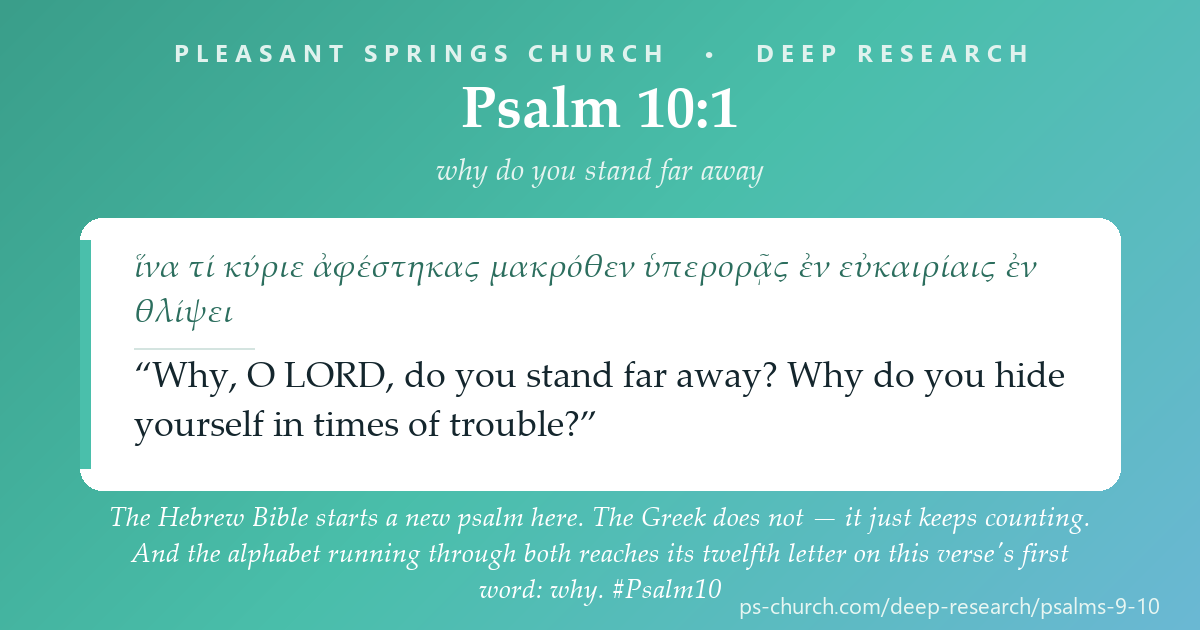
“Why?” — and it carries the twelfth letter of the alphabet. Every reconstruction of this acrostic, however they differ elsewhere, agrees that lamed falls here — on the first word of the psalm the Hebrew numbers separately. If the letters are running, then the poem does not restart at Psalm 10; it continues into it. Rahlfs has ἵνα τί and simply keeps counting: this is verse 22 of his Psalm 9.
The title, and nobody can translate it. The words look like death and for the son, which makes no sense as a heading; English versions transliterate it (Muth-labben) rather than pretend. Proposals: a tune name, an instrument, a lost occasion. Rahlfs’ Greek read the same consonants as something else entirely — ὑπὲρ τῶν κρυφίων, concerning the secrets, apparently from a root meaning hidden. Two ancient guesses, and this page reports both as guesses.
“Afflicted” and “humble” — two closely related words, and the Masoretic tradition marks a written-versus-read difference between them three times in these two psalms, running in both directions. The tradition itself found them hard to keep apart. Rahlfs does not discriminate at all, rendering πενήτων at each. The Greek cannot help decide, and this page says so.
“Ruins, waste places” — and the pointing is decisive: the vowel under the first letter is the one that gives ruins, not the one that would give swords. Rahlfs’ Greek reads ῥομφαῖαι, “swords.” The consonants are the same; the Hebrew text the translator worked from carried no vowels. This is the cleanest example in the two psalms of what most Hebrew/Greek differences actually are — not tampering, but two readings of an unpointed text.
“There is no God.” Not necessarily atheism. The clause sits inside a description of a man too proud to seek, and the sense is closer to God is not a factor than to God does not exist — seven verses later he says God has forgotten and hides his face, which assumes God is there. Rahlfs adds two words the Hebrew does not have — ἐνώπιον αὐτοῦ, before him — making it “God is not before him,” i.e. not in his sight. And the Greek has no counterpart for the Hebrew’s closing ‘all his thoughts’.
“Arise, O Lord.” The same two words open both 9:20 and 10:12 — and both are candidates for the qop line of the acrostic. Which one is “the” qop line cannot be determined from the text. That single fact is why the tidy reconstructions of this acrostic should be read as reconstructions. The phrase is old — it is what Moses says whenever the ark sets out (Numbers 10:35).
Counted here, not assumed:
- 21 + 18 = 39. Hebrew Psalm 9 has 21 verses, Psalm 10 has 18; Rahlfs’ Psalm 9 has 39, numbered continuously with no gaps. The mapping is exact: Hebrew 10:1 is Greek 9:22.
- The longest alphabetical run is 15 letters of 22 — but 16 different runs of that length exist, disagreeing at four points. Only lamed at 10:1 is on every one of them.
- Five letters begin no verse in either psalm — dalet, mem, samek, pe, ṣade — and nun and ayin appear only out of sequence. The collapse occupies exactly ten verses, 10:2–11.
- Five written-versus-read variants occur in these two psalms (9:13, 9:19, 10:10 twice, 10:12). Across the whole Psalter there are 60 such marked pairs in 57 verses, so this stretch is not unusual — nine psalms are denser. And a marked reading is an instruction from the tradition, not a sign of damage.
- The Hebrew marks a paragraph at the end of Psalm 9 — and at the end of 144 of the 150 psalms. It is the ordinary close, not a verdict on the division.
A cry Moses made, a fool in two other psalms, and the alphabet elsewhere.
Read Numbers 10:35 and then Psalm 9:20 and 10:12. Then read Psalm 10:4 beside Psalm 14:1.
Which cross-references matter?
- Numbers 10:35 → Psalms 9:20; 10:12. Arise, O Lord — what Moses said whenever the ark set out. The psalm asks God to do what he did in the wilderness, and asks it twice.
- Psalm 10:4 beside Psalm 14:1 and 53:2. The fool says in his heart, ‘There is no God’. Psalm 10 puts it differently and more precisely: the wicked does not deny God’s existence but concludes he does not look (10:11). Practical atheism, not theoretical.
- Psalms 25, 34, 37, 111, 112, 119, 145 and Lamentations 1–4 — the other alphabetic poems. Lamentations shows the form executed almost perfectly across far more verses, which is what makes the collapse here worth remarking on.
- Psalm 10:8–9 and Proverbs 1:11–12. Lying in ambush for the innocent, lurking to seize the poor. The same picture, and in Proverbs it is what the young man is warned to refuse to join.
- Romans 3:10–18 — Paul’s chain of quotations includes material from this psalm’s neighbourhood. Note that Paul quotes the Greek, and that his Psalm numbering is the Greek one; a reader checking his references against a modern Bible must allow for the offset that begins here.
Four questions this page leaves open.
Goldingay and Alter on the text; Wilson on the division.
Commentaries & studies:
- John Goldingay, Psalms 1–41 — the most useful English treatment of the acrostic’s irregularity.
- Robert Alter, The Book of Psalms — on the poetics and the cost of the form.
- Gerald H. Wilson, The Editing of the Hebrew Psalter — on divisions and seams in the book.
- NETS Psalms — for the Greek, and for the numbering that begins to diverge here.
Four things reported as unsettled:
- Whether these are one psalm or two. The Greek joins, the Hebrew divides, and the alphabet crosses the division. All three are facts and none settles the others; this page reports all three.
- Whether the broken acrostic is design or damage. The gaps fall exactly where the psalm describes the wicked unchecked, which is suggestive — and transmission damage would produce the same appearance. Not demonstrable either way.
- What ʿal-mûṯ labbēn means. Unknown in Hebrew; Rahlfs’ Greek construed it differently again. Both are guesses.
- Which letters belong to the “real” scheme. Sixteen equally long reconstructions exist and they disagree; the same two words head 9:20 and 10:12. The tidy version printed in many commentaries is a choice among them.
An alphabet that fails in the middle.
Name what you learned, why it matters, and one concrete response.
What should we carry away — and do?
- The form is a claim to completeness, and it does not survive the middle of the poem. An acrostic says everything, from first letter to last. Here six letters go missing across ten verses — the ten that describe the wicked man getting away with it. Whether or not the poet intended it, that is where the ordered scheme comes apart.
- Thanksgiving and protest share one alphabet. Psalm 9 ends with God enthroned; Psalm 10 opens by asking why he is standing far off. No transition, and in the Greek not even a new psalm. Scripture puts them in the same poem.
- The wicked man’s creed is not “there is no God.” It is God has forgotten; he hides his face; he will never see it (10:11). He does not deny that God exists. He concludes that God is not paying attention — which is a far more common position, and much harder to argue with.
- One concrete response. The poem does not end in the collapse. It ends with arise, O Lord — and with God as the one who hears the desire of the afflicted and does justice to the fatherless. Pray the second half without skipping the first.
Psalm 10:1 · to share
Hebrew + Greek (Rahlfs) + ESVEvery Deep Research page traces its passage across the whole sweep — the Old Testament, the Second-Temple world between the testaments (historical witnesses, not Scripture), and the New Testament. Follow the thread:
Pleasant Springs Church — Deep Research
Research method after Michael S. Heiser’s Bible Research Method (examine dictionaries → ancient literature → important words → textual connections → academic publications → share), with the Pleasant Springs “Author & Audience” foundation. Scripture set in the Hebrew, the Greek editions named on each page and the ESV (Old Testament), and the Greek New Testament and the ESV (New Testament), per the practice of Pleasant Springs Church. Psalms 9–10 research grounded in Goldingay (Psalms 1–41), Alter and Wilson. Text: Hebrew from the Masoretic text as printed in the editions consulted — Sefaria’s Miqra according to the Masorah; no critical apparatus was consulted for the Hebrew. Greek from Rahlfs’ Greek Psalter (CATSS digitization of Rahlfs 1931). The standing caution for this shelf applies: the asterisk method used in this library’s Job studies is unavailable in the Psalms, so these pages say “Rahlfs’ Greek Psalter reads…” and never call a Greek reading early or late. ⚠️ The acrostic was verified letter by letter rather than repeated: the longest strictly-alphabetical run is 15 letters of 22, but sixteen distinct runs of that length exist and they disagree at four points — so the tidy qop-reš-šin-taw close printed in many commentaries is one reconstruction, not something the text forces. The page states that the only element common to all sixteen is lamed at 10:1, and that qûmāh YHWH heads both 9:20 and 10:12, so which is “the qop line” is undeterminable. Five letters (dalet, mem, samek, pe, ṣade) begin no verse; nun and ayin occur out of sequence; the collapse occupies exactly ten verses, 10:2–11, and a negative control on second cola confirms the missing letters are not there either. The division question is reported three ways and adjudicated none: the Greek joins with no seam of any kind (numbering runs 21→22 unbroken); the Hebrew divides; and the alphabet crosses the division. The Masoretic paragraph mark at 9:21 is explicitly discounted as evidence, since 144 of 150 psalms carry it at their close — while the genuine asymmetry is reported, that Psalm 114, the Psalter’s other merge point, is the only non-book-boundary psalm lacking it. The superscription is reported as unknown in both traditions — Hebrew ʿal-mûṯ labbēn untranslatable with confidence, Rahlfs construing the consonants as concerning the secrets of the son — and no choice is made. 9:7 is given as the model case of what most Hebrew/Greek differences are: the pointing gives ruins, Rahlfs read swords, and the consonants are identical because the translator’s text carried no vowels. The three written-versus-read variants on ʿānî/ʿānāw are reported as running in both directions with Rahlfs not discriminating (the same Greek word at each), so the Greek cannot adjudicate. Whether the broken acrostic is design or transmission damage is named as not demonstrable. Typology is handled per the house position: what the text says, what the New Testament itself draws, and what we see from this side of the cross — with the seeing left to the reader.
Scripture quotations marked ESV are from the ESV® Bible (The Holy Bible, English Standard Version®), © 2001 by Crossway, a publishing ministry of Good News Publishers. ESV Text Edition: 2016. Used by permission. All rights reserved. The ESV text may not be quoted in any publication made available to the public by a Creative Commons license, and the ESV may not be translated in whole or in part into any other language. www.esv.org
|
Did this study bless you today? 💚 Give to Support PS Church100% of gifts go to the General Fund — thank you. |