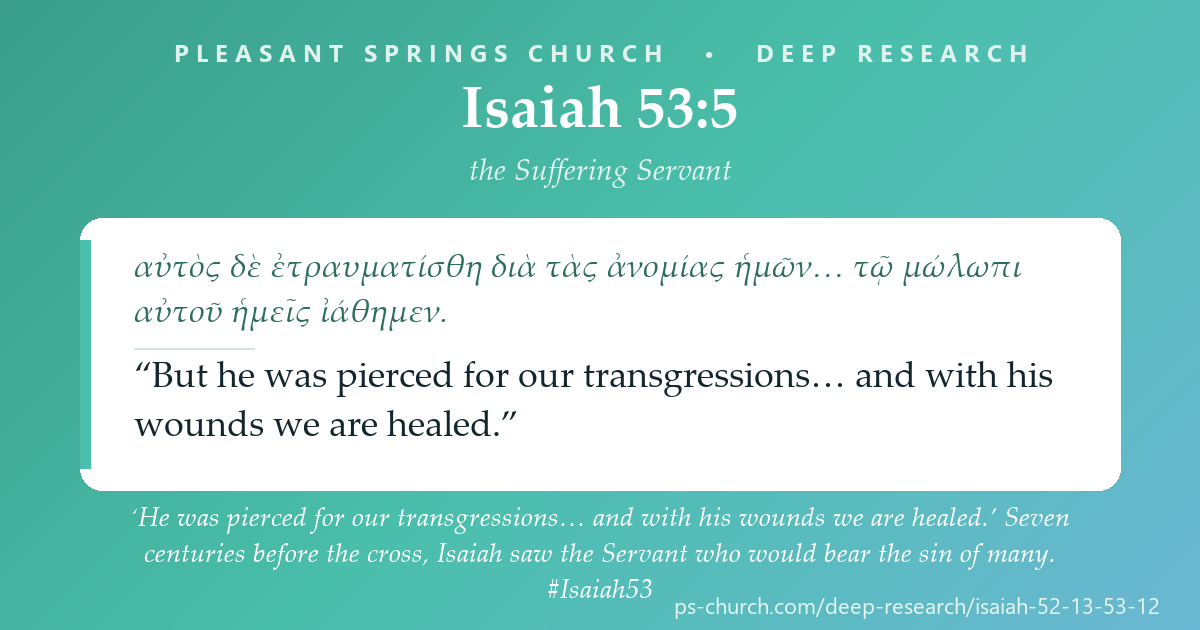
Seven centuries before the cross, Isaiah saw it: a Servant “pierced for our transgressions… crushed for our iniquities,” on whom “the Lord has laid… the iniquity of us all,” led “like a lamb to the slaughter.” It is the Old Testament’s clearest portrait of one suffering in the place of others — and when Philip found a man reading it, he “told him the good news about Jesus.” This study works Isaiah 53 from the guilt offering to the Lamb of God, the Servant who bore the sin of many. See the method →
Isaiah 53:3–7 (selections)
Hebrew · LXX · ESVThe Shape of the Passage
ConcentricThis is the last and greatest of Isaiah’s four “Servant Songs” (42; 49; 50; 52:13–53:12), set among the chapters of comfort to exiles (Isa 40–55). See also Isaiah 61.
Author
The prophet Isaiah gives, in the second half of the book (chs. 40–55), words of comfort to a people facing exile: the Lord will redeem them. Woven through these chapters are four “Servant Songs” about a mysterious figure who embodies Israel’s calling and yet is distinct from the nation. The fourth song rises to a climax no other Old Testament passage reaches: a Servant who suffers, dies, and bears the sins of the many — and is then vindicated and “exalted” (52:13).
Substitution, spelled out. The song’s logic is relentless and personal: he was pierced for our transgressions; the Lord laid on him the iniquity of us all. It is the Bible’s deepest pre-Gospel articulation of one dying in the place of sinners — and its explanation of how a holy God can justify the guilty.
Audience
Israel in exile — a people who knew their own guilt and God’s judgment, longing for comfort and return. Into that setting Isaiah speaks of a Servant whose suffering is not his own fault but theirs, borne for their peace. The identity of the Servant was debated — is he the nation, a righteous remnant, or an individual? — but the song insists he suffers for the people, distinct from them (53:8).
How they heard it. Second-Temple readers wrestled with the Servant; some read him corporately, some messianically, and one influential tradition kept a coming Messiah but transferred the suffering elsewhere — so deep was the scandal of a suffering deliverer. The New Testament makes the identification unmistakable: this Servant is Jesus, and his passion and vindication fulfill the song’s portrait of the Servant abased and then exalted.
Orient on the Servant Songs, atonement, and messianic prophecy.
Search by topic: Servant of the LORD, Servant Songs, atonement, substitution, Isaiah.
Which articles are relevant?
- Anchor Bible Dictionary — “Servant of the Lord,” “Servant Songs,” “Atonement,” “Isaiah.”
- Dictionary of the OT: Prophets — “Servant of Yahweh,” “Suffering,” “Messiah,” “Sacrifice and Atonement.”
- NIDOTTE / TDOT — עֶבֶד (ʿeḇeḏ, servant), אָשָׁם (ʾāšām, guilt/sin offering), פֶּשַׁע (pešaʿ, transgression), נָשָׂא (nāśāʾ, bear).
Bibliography surfaced:
- John Oswalt (NICOT), Alec Motyer (The Prophecy of Isaiah), Brevard Childs (OTL) on Isaiah.
- Studies of the Servant Songs and Isaiah 53’s reception; the substitution/atonement debate.
- Beale & Carson, Commentary on the NT Use of the OT (Acts 8; 1 Peter 2).
The scandal of a suffering deliverer, and the Servant’s identity.
Weigh who the Servant is, note the Second-Temple discomfort with a suffering Messiah, then follow the song into the passion.
Which parallels shed light on religion and worldview?
Who is the Servant? Isaiah uses “servant” earlier for the nation Israel (Isa 41:8; 49:3), yet in this song the Servant suffers for the people and is plainly distinct from them (“for the transgression of my people,” 53:8). Readers have proposed Israel, a faithful remnant, the prophet himself, or an individual Messiah. The song’s own logic — an innocent sufferer bearing others’ guilt, then vindicated beyond death — points past the nation to a person, whom the New Testament names as Jesus.
A stumbling block. The idea of a suffering deliverer was so difficult that some Second-Temple traditions kept a glorious Messiah but read the suffering as the nations’, or as Israel’s. The offense is old (1 Cor 1:23); yet the great Isaiah scroll from Qumran preserves the text, its substance unchanged, and the church found in it the very shape of the cross.
- The Great Isaiah Scroll (1QIsaᵃ) (Dead Sea Scrolls — a manuscript witness) — preserves Isaiah 53 in full, over a century before Christ; its few variants (e.g., the plus “light” at 53:11) agree with the LXX — the text the church reads is substantially the text they had.
- Targum of Isaiah 53 (rabbinic-era) — reads the Servant as messianic but redirects the suffering to Israel and the nations: a witness to how hard a suffering Messiah was to receive.
- b. Sanhedrin 98b (rabbinic-era) — a tradition linking the Messiah to Isaiah 53’s sufferings (“the leprous one”): the messianic reading was not unknown.
- Wisdom of Solomon 2–5 (Apocrypha — a witness, not Scripture) — the righteous sufferer mocked and then vindicated: a kindred theme in the Second-Temple world.
The New Testament reads Isaiah 53 as the script of the cross. When the Ethiopian official asked, “About whom… does the prophet say this?” Philip, “beginning with this Scripture… told him the good news about Jesus” (Acts 8:34–35). Peter draws on it at length: Christ “committed no sin… He himself bore our sins in his body on the tree… By his wounds you have been healed” (1 Pet 2:22–25). Matthew sees it in Jesus’ healings (Matt 8:17), Jesus applies its “numbered with the transgressors” to himself (Luke 22:37), and Paul’s “delivered up for our trespasses” (Rom 4:25) breathes its language. Here, centuries before the cross, is penal substitution in prophetic poetry: the innocent Servant pierced for our transgressions, the Lord laying on him our iniquity, so that by his wounds we are healed. And the song does not end in death: “he shall see his offspring… the will of the Lord shall prosper in his hand” (53:10) — resurrection and reward beyond the grave.
The vocabulary of piercing, bearing, and the guilt offering.
Watch “pierced,” the Lord “laying on” the iniquity, and the Servant who “bears” sin.
“Pierced / wounded” — run through; the Servant’s body broken for our transgressions (LXX ἐτραυματίσθη, “was wounded”). Cf. the pierced one of Zech 12:10; John 19:37.
“Caused to fall upon / laid on” — “the Lord laid on him the iniquity of us all”: the transfer of guilt to the Servant, the heart of substitution. (The LXX renders it “the Lord gave him over [παρέδωκεν] for our sins” — the very verb Paul echoes: “delivered up for our trespasses,” Rom 4:25.)
“Guilt / sin offering” — “when his soul makes an offering for guilt”: the Servant’s life given as the reparation-offering the law prescribed (Lev 5), now personal. Even “the will of the Lord to crush him” (53:10) names the Father’s saving purpose, freely embraced by the Servant who “poured out his soul to death” (53:12) — not divine cruelty.
“Bear / carry” — he “bore the sin of many”; the same verb as the scapegoat carrying iniquity away (Lev 16:22; see Leviticus 16).
How the New Testament reuses the Servant Song:
- Acts 8:32–35 — the Ethiopian reads Isa 53:7–8, and Philip preaches Jesus from it.
- 1 Peter 2:22–25 — “He committed no sin… he himself bore our sins in his body on the tree… By his wounds you have been healed” (Isa 53).
- Matthew 8:17; John 12:38; Romans 10:16 — “He took our illnesses” (53:4); “Lord, who has believed what he heard from us?” (53:1).
- Luke 22:37; Mark 10:45; Romans 4:25 — “numbered with the transgressors” (53:12); a ransom for many; “delivered up for our trespasses.”
From the guilt offering to the Lamb of God.
Trace the Servant’s bearing of sin back to the sacrifices and forward to the cross and the Lamb.
Which cross-references matter?
- Leviticus 16:20–22 — the scapegoat bearing iniquity away: the rite the Servant embodies in person (see Leviticus 16).
- John 1:29; 1 Corinthians 5:7 — “the Lamb of God who takes away the sin of the world”; “Christ, our Passover lamb” (see Exodus 12).
- Zechariah 12:10; John 19:37; Revelation 1:7 — “They will look on him whom they have pierced” (John 19:37; cf. Zech 12:10, “on me, on him whom they have pierced”).
- Acts 8:32–35; 1 Peter 2:22–25; Romans 4:25 — the Servant identified as Jesus, his death read as substitution.
- Philippians 2:6–11 — the humiliation-then-exaltation pattern of 52:13 (“he shall be… exalted”) sung of Christ.
No Old Testament passage is more central to the New Testament’s interpretation of Jesus’ death. The New Testament writers do not merely borrow phrases; they read Isaiah 53 as the interpretation of the cross. Peter’s catena (1 Pet 2:22–25) walks through the song verse by verse and lands its meaning on Christ’s substitutionary suffering and our healing. Luke has Jesus himself claim 53:12 (“numbered with the transgressors,” Luke 22:37), so that the identification begins with the Servant’s own lips. And the frame of the song — a Servant abased and then “high and lifted up” (52:13) — supplies the shape of the earliest Christian hymn (Phil 2:6–11). The result is that Isaiah 53 is not a proof-text pulled out of context but the Old Testament’s own theology of the cross, waiting for the One who would fulfill it — “he poured out his soul to death… yet he bore the sin of many” (53:12).
The scholarship on the Suffering Servant.
The commentators on Isaiah; the Servant-identity and atonement studies; Beale & Carson on the NT use.
Commentaries & studies:
- John N. Oswalt (NICOT), J. Alec Motyer (The Prophecy of Isaiah), Brevard S. Childs (OTL) on Isaiah.
- Studies of the Servant Songs and Isaiah 53’s reception (e.g., Bellinger & Farmer, eds., Jesus and the Suffering Servant).
- G. K. Beale & D. A. Carson, eds., Commentary on the New Testament Use of the Old Testament.
Interpretation notes worth keeping:
- Corporate and individual. Isaiah’s “servant” can mean Israel elsewhere, but this Servant suffers for the people and is distinct from them (53:8); the innocent-for-guilty logic points to an individual, whom the NT names as Christ.
- Substitution, not just example. “Pierced for our transgressions… the Lord laid on him the iniquity of us all” is transfer-of-guilt language; the Servant does more than model patience — he bears sin in the sinner’s place.
- Death and vindication. The song moves through death (“cut off out of the land of the living,” 53:8) to life (“he shall see… and be satisfied,” 53:10–11): the resurrection is written into the prophecy.
From the Servant’s wounds to your own healing.
Name what you learned, why it matters, and one concrete response.
What should we carry away — and do?
- He was pierced for us. The cross is not merely a tragedy to admire but a substitution to receive: he took the transgression, we take the peace. “By his wounds you have been healed.”
- Your guilt was laid on him. “The Lord has laid on him the iniquity of us all.” The sin you cannot carry, he carried. There is nowhere your guilt can hide that his wounds have not covered.
- The story ends in vindication. The Servant does not stay in the grave; he “sees his offspring” and is satisfied. The One who bore your sin now lives to share his life with you.
Step in response: take one specific guilt you keep rehearsing, and put it deliberately where Isaiah 53 puts it — on the Servant, pierced for that transgression — and receive the peace he bought. Then, freed, carry someone else’s burden this week in the pattern of the One who carried yours.
Isaiah 53:5 · to share
LXX + ESVEvery Deep Research page traces its passage across the whole sweep — the Old Testament, the Second-Temple world between the testaments (historical witnesses, not Scripture), and the New Testament. Follow the thread:
Pleasant Springs Church — Deep Research
Research method after Michael S. Heiser’s Bible Research Method (examine dictionaries → ancient literature → important words → textual connections → academic publications → share), with the Pleasant Springs “Author & Audience” foundation. Scripture set in the Hebrew, the Greek editions named on each page and the ESV (Old Testament), and the Greek New Testament and the ESV (New Testament), per the practice of Pleasant Springs Church. Isaiah 52:13–53:12 research grounded in Oswalt, Motyer, and Childs, with Beale & Carson on the New Testament use; the Servant-identity and atonement scholarship; Second-Temple material per the Great Isaiah Scroll, the Targum, and rabbinic tradition (read as witnesses, not Scripture).
Scripture quotations marked ESV are from the ESV® Bible (The Holy Bible, English Standard Version®), © 2001 by Crossway, a publishing ministry of Good News Publishers. ESV Text Edition: 2016. Used by permission. All rights reserved. The ESV text may not be quoted in any publication made available to the public by a Creative Commons license, and the ESV may not be translated in whole or in part into any other language. www.esv.org
|
Did this study bless you today? 💚 Give to Support PS Church100% of gifts go to the General Fund — thank you. |