On the night that made Israel a people, every household killed a lamb without blemish and painted its blood on the doorframe. When the Lord passed through Egypt in judgment, the blood was the sign: “when I see the blood, I will pass over you.” The firstborn lived because a lamb died in their place. This study works the Passover — Israel’s founding gospel — all the way to the table where Jesus said “this is my body,” and to the cross where “Christ our Passover” was sacrificed. See the method →
Exodus 12:1–14 (selections)
Hebrew · LXX · ESVThe Shape of the Passage
SequenceSame Author and audience as Exodus 3 — and the Passover is the founding act of redemption, the lens through which Israel — and the church — would forever read salvation.
Author
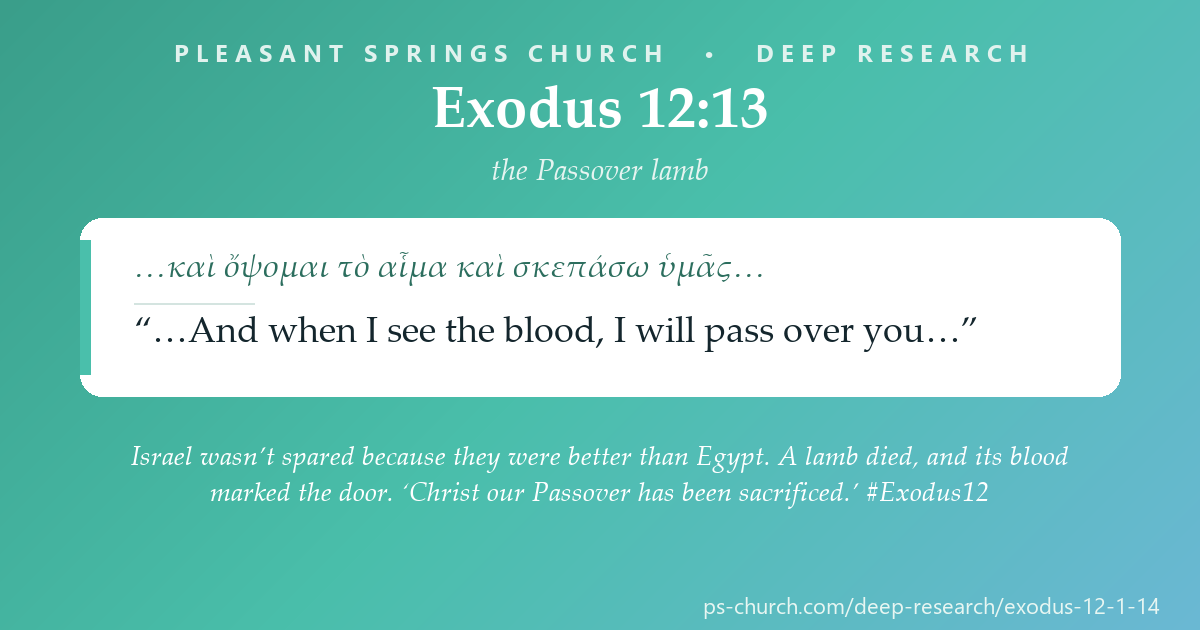
The Torah of Moses makes the night of deliverance a permanent ordinance. Each household takes a lamb without blemish, kills it at twilight, and paints its blood on the doorposts and lintel. When the Lord passes through Egypt to strike the firstborn, “when I see the blood, I will pass over you.” The firstborn of Israel are spared — not because they are better than the Egyptians, but because a lamb died in their place and its blood marked the door.
Substitution and memorial. The lamb’s blood is a sign; the household eats the lamb, girded for the journey; and the day becomes a memorial forever. Redemption is by blood, received by faith (marking the door), and remembered by feast.
Audience
Israel — who would keep this feast every year and, at its climax, hear the whole story retold: “we were slaves… and the Lord brought us out.” Passover is Israel’s gospel — the night that made them a people, rehearsed at every table.
How they heard it. No one is spared by merit; everyone needs the blood. The same judgment that falls on Egypt would fall on Israel — except for the lamb. And it is a family meal: redemption is received household by household, door by door, and passed to the children.
Orient on Passover, the lamb, and blood.
Search by topic: Passover/Pesach, lamb, blood, firstborn, unleavened bread, exodus.
Which articles are relevant?
- Anchor Bible Dictionary — “Passover,” “Lamb,” “Blood,” “Firstborn.”
- Dictionary of the OT: Pentateuch — “Passover,” “Sacrifice,” “Redemption,” “Feasts.”
- NIDOTTE / TDOT — פֶּסַח (pesaḥ), שֶׂה (śeh, lamb), דָּם (dām, blood), מַשְׁחִית (mašḥîṯ, destroyer).
Bibliography surfaced:
- Childs, The Book of Exodus (OTL); Durham, Exodus (WBC); Stuart, Exodus (NAC).
- Joachim Jeremias, The Eucharistic Words of Jesus; Roger T. Beckwith, Calendar and Chronology, Jewish and Christian — Passover and the Last Supper.
- Nahum Sarna, Exploring Exodus; Jon Levenson, The Death and Resurrection of the Beloved Son.
Blood on the door, and the Passover in the Second-Temple world.
Read the rite against ANE apotropaic blood-practices, then note the Second-Temple regulation and celebration of Passover — the feast Jesus kept.
Which parallels shed light on religion and worldview?
Blood on the threshold. The ancient world knew apotropaic (“danger-averting”) blood rites — smearing blood on doorways to ward off plague or hostile spirits. Passover uses the familiar gesture but transforms its meaning: the danger is the Lord’s own judgment, and the blood is the sign of a substitute lamb that God himself appointed. It is not magic against God but faith in God’s provided covering.
- Jubilees 49 (Pseudepigrapha — a witness, not Scripture) — an entire chapter of Passover regulation, dating and expanding the ordinance; shows how central the feast was.
- Wisdom of Solomon 18:5–25 (Apocrypha — likewise not Scripture) — a poetic retelling of the Passover night and the “destroyer,” personifying God’s all-powerful Word leaping down.
- Josephus, Antiquities 2.311–314; Philo, On the Special Laws 2.145–149 — first-century descriptions of the Passover lamb and feast, the very practice of Jesus’ day.
- The Passover Haggadah tradition — the ordered retelling (“in every generation each must see himself as if he came out of Egypt”): the liturgical world of the Last Supper.
The New Testament reads the Passover as fulfilled in Jesus. Paul says plainly, “Christ, our Passover lamb, has been sacrificed” (1 Cor 5:7). John the Baptist calls him “the Lamb of God” (John 1:29); Peter, “a lamb without blemish… his precious blood” (1 Pet 1:19). John notes that no bone of Jesus was broken “that the Scripture might be fulfilled” — the Passover rule of Exodus 12:46 (John 19:36). And the Last Supper — as the Synoptics present it — was a Passover meal (Luke 22:15; its timing relative to Passover is debated against John’s chronology, as noted below): Jesus took the bread and cup of the feast and made them the memorial of his own body and blood. The lamb slain so the firstborn might live is, at last, the Firstborn slain so we might live.
The vocabulary of the lamb, the blood, and the memorial.
Watch the “pass over / shelter” verb, the unblemished lamb, the blood-sign, and the forever-memorial.
“Passover” — from פָּסַח, to pass over / spare — and plausibly to protect (LXX σκεπάζω, “shelter”). The blood makes the door a place of safety, not judgment.
“A lamb without blemish” — unblemished, a year-old male: the standard of a perfect sacrifice, fulfilled in the sinless Christ (1 Pet 1:19).
“Blood” — put on the door as a sign; “when I see the blood…” The life given (Lev 17:11) stands between the household and death.
“The destroyer” — the agent of the tenth plague; passes over the blood-marked doors. Judgment is real, and the blood is the only shelter from it.
“Memorial” — a remembrance kept by feast forever. The Lord’s Supper is the church’s Passover memorial: “do this in remembrance of me” (Luke 22:19).
“Unleavened bread” — bread of haste and of purity; Paul makes it the image of the “new lump” cleansed of the leaven of sin (1 Cor 5:7–8).
How the New Testament reuses the Passover:
- 1 Corinthians 5:7–8 — “Christ, our Passover lamb, has been sacrificed… Let us therefore celebrate the festival… with the unleavened bread of sincerity and truth.”
- John 1:29; 19:36; 1 Peter 1:18–19 — “the Lamb of God”; no bone broken (Exod 12:46); ransomed “with the precious blood of Christ, like that of a lamb without blemish.”
- Luke 22:14–20; 1 Corinthians 11:23–26 — the Last Supper as Passover; the bread and cup made the memorial of Christ’s body and blood.
- Hebrews 11:28; Revelation 5:6–12 — “by faith he kept the Passover… the blood”; and the Lamb “standing, as though it had been slain,” worshiped forever.
From the doorpost blood to the blood of the Lamb.
Trace the lamb, the blood, and the memorial across the canon — then note the Beale & Carson trajectory at 1 Corinthians 5.
Which cross-references matter?
- Exodus 12:46; Numbers 9:12; Psalm 34:20 — “not one of his bones shall be broken”: the Passover rule John applies to the cross (John 19:36).
- Genesis 22:8 — “God will provide the lamb”: the promise the Passover advances and the cross fulfills.
- Isaiah 53:7; John 1:29 — the Servant “like a lamb led to the slaughter”; “the Lamb of God who takes away the sin of the world.”
- Leviticus 17:11; Hebrews 9:22 — “the life is in the blood”; “without the shedding of blood there is no forgiveness.”
- 1 Corinthians 5:7; Revelation 5; 12:11 — Christ our Passover; the Lamb slain; “they conquered him by the blood of the Lamb.”
The commentary’s treatment of “Christ our Passover” shows Paul reading the exodus as the template of redemption: as Israel was freed from Egypt by the blood of the lamb, the church is freed from sin and death by the blood of Christ — and therefore called to “keep the feast” by living as the cleansed, unleavened people. Every thread of Exodus 12 — unblemished lamb, substitutionary blood, no bone broken, memorial meal — is gathered onto Jesus, until the redeemed sing to “the Lamb who was slain” (Rev 5:12). The Passover was never only a memory; it was a promise waiting for its Lamb.
The scholarship on the Passover.
Childs and Sarna for the exegesis; Jeremias for Passover and the Supper; the studies on the destroyer and the blood rite.
Commentaries & studies:
- Childs (OTL), Durham (WBC), Stuart (NAC), Sarna, Exploring Exodus; Peter Enns, Exodus (NIVAC).
- Joachim Jeremias, The Eucharistic Words of Jesus; Baruch Bokser, The Origins of the Seder.
- Jon Levenson, The Death and Resurrection of the Beloved Son — firstborn, lamb, and substitution.
Interpretation notes worth keeping:
- The pesaḥ verb means “pass over” and, plausibly, “protect/hover over” (cf. Isa 31:5); the LXX’s σκεπάζω (“shelter”) captures the protective sense — the blood shelters the household.
- Substitution is at the core: the firstborn live because the lamb dies; the blood on the door is faith’s public mark — the pattern the NT reads straight into the atonement.
- Passover and the Supper — the Synoptics present the Last Supper as a Passover meal (debated against John’s chronology), and the church’s Eucharist as its memorial fulfillment.
From the blood-marked door to your own shelter.
Name what you learned, why it matters, and one concrete response.
What should we carry away — and do?
- Everyone needs the blood. Israel was not spared by merit but by the lamb. The same is true for us: our shelter is not our record but Christ’s blood on the door of our lives.
- Redemption is by substitution. A lamb died so the firstborn could live; the Lamb of God died so we could live. “Christ our Passover has been sacrificed” — the debt is paid.
- Remember, and pass it on. Passover was a family feast, rehearsed to the children. The Lord’s Table is our memorial — “do this in remembrance of me” — and the story is meant to be handed down.
Step in response: come to the Lord’s Table (or your own remembrance of the cross) this week as to a Passover — and shelter deliberately under the blood of the Lamb, not your own goodness. Then tell the story to someone younger in the faith.
Exodus 12:13 · to share
LXX + ESVEvery Deep Research page traces its passage across the whole sweep — the Old Testament, the Second-Temple world between the testaments (historical witnesses, not Scripture), and the New Testament. Follow the thread:
Pleasant Springs Church — Deep Research
Research method after Michael S. Heiser’s Bible Research Method (examine dictionaries → ancient literature → important words → textual connections → academic publications → share), with the Pleasant Springs “Author & Audience” foundation. Scripture set in the Hebrew, the Greek editions named on each page and the ESV (Old Testament), and the Greek New Testament and the ESV (New Testament), per the practice of Pleasant Springs Church. Exodus 12:1–14 research grounded in Childs, Durham, Stuart, Sarna, Jeremias, and Levenson; ANE apotropaic blood-rite background; Second-Temple Passover material per Jubilees 49, Wisdom 18, Josephus, and Philo (read as witnesses, not Scripture).
Scripture quotations marked ESV are from the ESV® Bible (The Holy Bible, English Standard Version®), © 2001 by Crossway, a publishing ministry of Good News Publishers. ESV Text Edition: 2016. Used by permission. All rights reserved. The ESV text may not be quoted in any publication made available to the public by a Creative Commons license, and the ESV may not be translated in whole or in part into any other language. www.esv.org
|
Did this study bless you today? 💚 Give to Support PS Church100% of gifts go to the General Fund — thank you. |