Yet one plague more. The nine wonders are spent, and the Lord foretells the last and heaviest: about midnight he himself will go out into Egypt, and every firstborn — from Pharaoh’s throne to the slave girl’s handmill — shall die, while against Israel “not a dog shall growl,” “that you may know that the Lord makes a distinction.” This study works Exodus 11:1–10 with gravity, not triumph: the sober justice of a warned judgment on a tyranny that drowned Hebrew infants, the “plundering” as delayed wages, and the distinction that sets up the Passover blood of chapter 12. See the method →
Exodus 11:1, 4, 5, 7, 10
Hebrew · LXX · ESVThe Shape of the Passage
InclusioThe tenth plague is announced before it is enacted — and announced with gravity, not glee. Read it as the sober climax of a contest that began when a tyrant ordered Hebrew infants drowned (Exodus 1:22).
Author
The Torah of Moses brings the plague narrative to its threshold. Nine wonders have fallen; Pharaoh has bargained (“go, but leave the flocks,” 10:24) and hardened, and now the Lord declares the last blow: “Yet one plague more… afterward he will let you go… he will drive you away completely” (11:1). The chapter is a foretelling — the deed itself waits for chapter 12 and the Passover — so that when it comes, no one can call it random. It is sentence after long trial: the just recompense of a regime that had made itself Israel’s executioner (1:16, 22).
The plundering as wages. Between announcement and threat the narrator inserts the “asking” (11:2–3; fulfilling the promise of the bush, 3:21–22): Israel is to request silver and gold of their Egyptian neighbors, and the Lord gives them favor — “Moses was very great in the land of Egypt” (11:3). This is not theft dressed up. It is back-pay: generations of unpaid, coerced labor settled at the exodus (cf. Deut 15:13–15, where a freed slave is never sent away “empty-handed”). The oppressor’s treasure follows the freed slave out the door — delayed justice, not plunder for plunder’s sake.
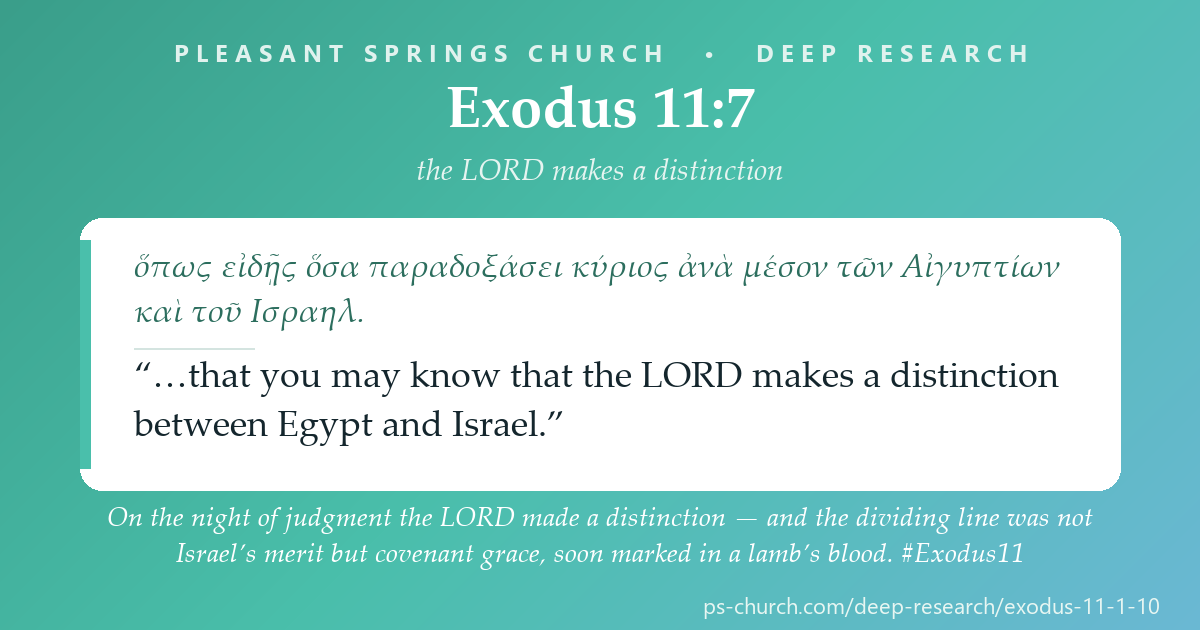
The sentence, and the distinction. Moses’ oracle (11:4–7) is measured and terrible: “About midnight I will go out” — the Lord himself, not a mere plague-force, moving through Egypt — and “every firstborn shall die, from the firstborn of Pharaoh who sits on his throne, even to the firstborn of the slave girl who is behind the handmill” (11:5): the whole social order, palace to millhouse, under one grief. “There shall be a great cry… such as there has never been, nor ever will be again” (11:6). Yet toward Israel, silence: “not a dog shall growl” (11:7) — the point is not Egypt’s ruin for its own sake but revelation and rescue: “that you may know that the Lord makes a distinction.” Moses leaves “in hot anger” (11:8) — the messenger’s own grief at a defiance that has run all the way to this.
Audience
Israel heard this passage as their own deliverance told from the far side of dread. The generation at Sinai, and every generation after at the Passover table, needed to know that the God who redeemed them was neither capricious nor weak: he had warned, repeatedly; he had distinguished, sparing Goshen through nine plagues; and when the last fell it fell on a named, warned, genocidal defiance — not on the innocent by lottery. The “distinction” (11:7) is the heart of it: the same night that was judgment on Egypt was salvation for Israel, and the difference was not Israelite merit but covenant grace, soon marked in lamb’s blood (12:13).
Handled with gravity. Scripture never lets Israel gloat here. The firstborn who die are real children, real households; “a great cry” is genuine anguish. The text sets it inside strict justice — the tyranny that drowned Hebrew sons now meets, at last, the death of its own sons (a measured, terrible correspondence, not a boast) — and even then names God-fearing Egyptians who had already believed the word and sheltered (9:20; and the “mixed multitude” who leave with Israel, 12:38). The plagues were also polemic against Egypt’s gods — the Nile (Hapi), the sun (Ra), Pharaoh’s own claimed divinity — each struck to unmask what it could not save (12:12, “on all the gods of Egypt I will execute judgments”). And the church reads the death of the firstborn soberly toward its answer: a firstborn Son given, a Passover Lamb slain, so that the cry of judgment could pass over a house marked by blood (held as devotional analogy, not the text’s own claim — 1 Cor 5:7; Heb 11:28).
Orient on the tenth plague, the firstborn, and the “plundering” of Egypt.
Search by topic: plagues of Egypt, firstborn, Passover, hardening of Pharaoh, despoiling / plundering of Egypt, judgment.
Which articles are relevant?
- Anchor Bible Dictionary — “Plagues of Egypt,” “Firstborn,” “Passover,” “Exodus, The.”
- Dictionary of the OT: Pentateuch — “Plagues,” “Firstborn,” “Hardening,” “Egypt.”
- NIDOTTE / TDOT — בְּכוֹר (bəkōr, firstborn), נֶגַע (nega‘, plague/blow), פלה (pālāh, set apart / make a distinction), חזק (ḥāzaq, be strong / harden).
Bibliography surfaced:
- Brevard Childs, The Book of Exodus (OTL); Douglas Stuart, Exodus (NAC); John Durham, Exodus (WBC).
- Nahum Sarna, Exploring Exodus; T. E. Fretheim, Exodus (Interpretation) — the plagues as creation/de-creation and as judgment on Egypt’s gods.
- Studies on the “despoiling” motif (Exod 3:21–22; 11:2–3; 12:35–36) and on the hardening of Pharaoh.
The firstborn, the night of dread, and Egypt’s gods unmasked.
Read the tenth plague against Egyptian ideas of the firstborn and divine kingship, then hear how Second-Temple Scripture retold the night of the destroyer.
Which parallels shed light on religion and worldview?
The firstborn and the throne. In Egypt the firstborn son carried the household’s future, and the firstborn of Pharaoh was heir to a throne whose occupant was called a god. To strike “from the firstborn of Pharaoh… to the firstborn of the slave girl” (11:5) is to strike Egypt at every level at once — and to strike the claim that Pharaoh’s line was divine and secure. The plagues as a whole read as polemic: the Nile turned to blood against Hapi, the darkness against Ra, and now the firstborn against the god-king himself — “on all the gods of Egypt I will execute judgments” (12:12). The gods that could not save are exposed; the Lord alone “goes out” (11:4).
The measure of the judgment. The reader is meant to remember chapter 1: a Pharaoh who commanded, “Every son that is born… you shall cast into the Nile” (1:22). The death of Egypt’s firstborn is not gratuitous cruelty but a grievous, exact recompense on a state that had made infanticide policy — long-warned, repeatedly deferred, and even now avoidable had Pharaoh relented. Scripture presents it as justice, and lets it be heavy: “a great cry… such as there has never been” (11:6).
- Wisdom of Solomon 18:5–19 (Second-Temple Scripture of the wider canon; witness) — a meditation on the night the “all-powerful word” leapt down as a stern warrior and the firstborn died: retribution measured to Egypt’s own drowning of Hebrew infants (Wis 18:5).
- Jubilees 49:2–6 (Second-Temple, witness — not Scripture) — retells the Passover night and “the powers of Mastema” sent against Egypt’s firstborn while Israel, blood-marked, is spared.
- Psalm 78:49–51; 105:36; 135:8; 136:10 — Israel’s own hymnody on “he struck down the firstborn of Egypt”: judgment remembered as covenant faithfulness (the plague-psalms).
- Josephus, Antiquities 2.313–314; Philo, Life of Moses 1.134–139 (Jewish witnesses, not Scripture) — the tenth plague retold for Greco-Roman readers.
The purpose the Lord gives for the whole contest is not wrath but revelation. To Pharaoh he had already said, “For this purpose I have raised you up, to show you my power, so that my name may be proclaimed in all the earth” (9:16) — the verse Paul takes up in Romans 9:17. The refrain of the plagues is “that you may know that I am the Lord” (7:5; 8:22; 9:14), and it lands here: “that you may know that the Lord makes a distinction” (11:7). The judgment on Egypt was, even for Egypt, a summons to knowledge — some heeded it (the God-fearing of 9:20; the mixed multitude of 12:38). Judgment and mercy were never rival purposes here; the same night divided them, and the dividing line was grace.
The vocabulary of the last stroke, the distinction, and the hardening.
Watch “one plague more,” the midnight “going out,” the firstborn from throne to millstone, the “distinction” verb, and the hardening verb the narrator now assigns to the Lord.
“One plague more” — nega‘ is a blow, stroke, affliction (also of leprous “plague”). The last of the strokes; after it Pharaoh will not bargain but expel.
“About midnight” — the hour of deepest dark and helplessness. Into it the Lord himself “goes out” (yōṣē’): not a blind force but the personal God in judgment.
“Firstborn” — the heir, the household’s strength and future (Gen 49:3). Struck “from throne to handmill,” the whole order at once — and answering Egypt’s own killing of Hebrew sons (1:22).
“Makes a distinction” — from pālāh, to separate, treat differently (cf. 8:22; 9:4). The Lord divides Egypt from Israel; the LXX reads παραδοξάσει, “deal wondrously.”
“And… hardened” — ḥāzaq, to make strong, firm. From 9:12 the text says the Lord hardened Pharaoh — judicial confirmation of a heart Pharaoh had first hardened himself (8:15, 32).
“With a casting-out” — the LXX intensifies “drive you away completely” (כָּלָה גָּרֵשׁ יְגָרֵשׁ) into σὺν παντὶ ἐκβαλεῖ… ἐκβολῇ: Pharaoh will utterly expel the people he refused to release.
How the rest of Scripture reads the hardening:
- Exodus 8:15, 32; 9:34 — Pharaoh hardens his own heart through the early plagues: real, culpable, self-chosen defiance.
- Exodus 9:12; 10:20, 27; 11:10; 14:8 — from the sixth plague on, the Lord hardens Pharaoh: judicial confirmation of a settled refusal, not the coercion of an unwilling man.
- Romans 9:17–18 — quoting Exod 9:16, Paul frames the hardening as God’s righteous freedom over a vessel that made itself fit for wrath — not the arbitrary reprobation of the innocent, but God’s just liberty over a self-hardened tyrant (held within Pharaoh’s real guilt).
- Romans 2:4–5; 1 Samuel 6:6 — presumption on patience “stores up wrath,” and Israel’s neighbors recall “why should you harden your hearts as the Egyptians… did?”
From the foretold night to the Passover, the sea, and the Lamb.
Trace the firstborn, the distinction, and the “going out” of the Lord forward to chapter 12 and on into the New Testament — devotional typology clearly labeled.
Which cross-references matter?
- Exodus 1:15–22 — Pharaoh’s command to kill the Hebrew sons: the crime the tenth plague answers in exact, sober measure.
- Exodus 12:1–14, 21–30 — the Passover: the foretold death enacted, and the blood on the doorposts by which the distinction is made and Israel’s firstborn redeemed (do not miss the substitute).
- Exodus 13:11–16; 14 — every firstborn of Israel thereafter belongs to the Lord (redeemed), and the contest ends at the sea.
- Psalm 78:49–51; 105:36–38; 136:10–15 — Israel’s hymnody remembers the smitten firstborn and the spoil carried out as covenant faithfulness.
- 1 Corinthians 5:7; Hebrews 11:28; Revelation 15:3 — “Christ our Passover lamb has been sacrificed”; faith that kept the Passover “so that the Destroyer… might not touch them”; and “the song of Moses… and of the Lamb.”
The chapter’s pivot is one word: “distinction” (11:7). All night long the Lord divides Egypt from Israel — and the very next chapter shows how: not by Israel’s superior worth, for Israel’s firstborn were as liable as Egypt’s, but by blood on the door (12:13, “when I see the blood, I will pass over you”). The distinction is grace made visible in a substitute. Held soberly and as devotional analogy — not as the text’s own literal claim — the church has long heard the deeper key here: the God who spared his people by a lamb’s blood would one day not spare his own firstborn Son (Rom 8:32), so that the judgment which fell at midnight in Egypt might pass over all who shelter under his blood. “Christ our Passover lamb has been sacrificed” (1 Cor 5:7). The gravity of Exodus 11 is not softened by this; it is answered. A real firstborn still dies — but at Golgotha it is God’s own, willingly given, so the great cry need never be ours.
The scholarship on the plague narrative and the hardening.
Childs, Durham, and Stuart for the exegesis; Fretheim and Sarna on the plagues as judgment on Egypt’s gods; the studies on the despoiling and the hardening.
Commentaries & studies:
- Brevard Childs, The Book of Exodus (OTL); John Durham, Exodus (WBC); Douglas Stuart, Exodus (NAC); Peter Enns, Exodus (NIVAC).
- Nahum Sarna, Exploring Exodus; Terence Fretheim, Exodus (Interpretation) — the plagues as de-creation and as polemic against Egypt’s gods.
- Studies on Pharaoh’s hardening (the interplay of “Pharaoh hardened” / “the Lord hardened”) and on Rom 9:17–18.
Interpretation notes worth keeping:
- The hardening is layered. Pharaoh hardens himself through the early plagues (8:15, 32; 9:34); from 9:12 the Lord hardens him — judicial confirmation of a will already set, not the overriding of an innocent. Divine sovereignty and Pharaoh’s real guilt are held together, not traded off.
- The “plundering” is wages, not theft. The “asking” (11:2–3; 12:35–36) settles generations of unpaid slavery; the vocabulary is of gift and favor, and the principle recurs at Deut 15:13–15 — a freed servant is never sent away empty.
- The death of the firstborn is warned, measured, and grave. It answers Pharaoh’s infanticide (1:22) in exact recompense; the narrative names God-fearing Egyptians (9:20) and a mixed multitude (12:38), refusing to caricature Egypt. It is judgment, not triumphalism.
- The purpose is knowledge. “That you may know” / “that my name may be proclaimed” (9:16; 11:7) makes the plagues revelatory, not merely punitive — a summons even to Egypt.
- Passover typology is devotional, not the literal sense. The firstborn given, the blood-marked door, the sheltered household — rich resonance with 1 Cor 5:7 and Heb 11:28, held as analogy built on real textual patterns, per this library’s house discipline.
From the foretold midnight to the blood that makes the distinction.
Name what you learned, why it matters, and one concrete response.
What should we carry away — and do?
- God warns before he judges. Nine plagues, repeated pleas, and a plain foretelling precede the last stroke. His judgment is never capricious; it falls on a warned, settled defiance — and it aims, even then, at knowledge: “that you may know.”
- The distinction is grace, not merit. Israel’s firstborn were no less liable; what divided them was covenant love, soon marked in blood (12:13). Where we are spared, it is mercy — to be received soberly, never smugly.
- The gravity points to the cross. A real firstborn dies at midnight in Egypt; a real Firstborn is given at Golgotha (Rom 8:32; 1 Cor 5:7), so the great cry of judgment can pass over all who shelter under his blood.
Step in response: hold the weight of this chapter without either flinching from God’s justice or gloating over it. Thank God that the “distinction” over your own life is grace, not merit; and let the memory of a foretold, warned judgment make you quick to heed his word today — and quicker to shelter, and to point others, under the blood of the true Passover Lamb.
Exodus 11:7 · to share
LXX + ESVEvery Deep Research page traces its passage across the whole sweep — the Old Testament, the Second-Temple world between the testaments (historical witnesses, not Scripture), and the New Testament. Follow the thread:
Pleasant Springs Church — Deep Research
Research method after Michael S. Heiser’s Bible Research Method (examine dictionaries → ancient literature → important words → textual connections → academic publications → share), with the Pleasant Springs “Author & Audience” foundation. Scripture set in the Hebrew, the Greek editions named on each page and the ESV (Old Testament), and the Greek New Testament and the ESV (New Testament), per the practice of Pleasant Springs Church. Exodus 11:1–10 research grounded in Childs, Durham, Stuart, Enns, Sarna, and Fretheim; the plagues read as judgment on Egypt’s gods (12:12) and as revelation (“that you may know,” 11:7; cf. 9:16 / Rom 9:17); Pharaoh’s hardening held as self-chosen (8:15, 32) then judicially confirmed by the Lord (9:12; 11:10; Rom 9:17–18) — God’s righteous freedom over a self-made vessel of wrath, not the reprobation of the innocent; the “plundering” (11:2–3) as delayed wages for unpaid slavery (cf. Deut 15:13–15); the death of the firstborn weighed with gravity as recompense on a genocidal tyranny (1:22) and as the setting for the Passover substitute (12:13; 1 Cor 5:7; Heb 11:28), held as devotional analogy per the house discipline for typology.
Scripture quotations marked ESV are from the ESV® Bible (The Holy Bible, English Standard Version®), © 2001 by Crossway, a publishing ministry of Good News Publishers. ESV Text Edition: 2016. Used by permission. All rights reserved. The ESV text may not be quoted in any publication made available to the public by a Creative Commons license, and the ESV may not be translated in whole or in part into any other language. www.esv.org
|
Did this study bless you today? 💚 Give to Support PS Church100% of gifts go to the General Fund — thank you. |