Exodus opens not with a deliverer but with a promise keeping itself: a handful of Jacob’s sons has become a swarming multitude, and “the land was filled with them.” A new king “who did not know Joseph” answers the blessing with slavery and, at last, murder — yet “the more they were oppressed, the more they multiplied.” Two midwives, Shiphrah and Puah, fear God more than the king and refuse to kill; and the Nile Pharaoh fills with drowned sons will, in the next chapter, carry a basket to safety. This study — the bondage in Egypt — works Exodus 1:1–22. See the method →
Exodus 1:7, 12, 17, 21, 22
Hebrew · LXX · ESVThe Shape of the Passage
SequenceExodus does not begin with a deliverer but with a demographic miracle and a tyrant’s dread — the covenant promise kept, and threatened, before God has said a word.
Author
The Torah of Moses opens the second book by stitching it to the first: “These are the names of the sons of Israel who came to Egypt” (1:1) repeats the roster of Genesis 46, and the seventy souls of Jacob’s house become the frame for what follows. Then a single verse changes the scale of the story: “the people of Israel were fruitful and increased greatly; they multiplied and grew exceedingly strong, so that the land was filled with them” (1:7). Its five verbs are not accidental — they gather up the creation mandate (“be fruitful and multiply and fill the earth,” Gen 1:28) and the patriarchal promise (Gen 12:2; 17:6; 47:27) and announce that God is keeping every one of them, quietly, in a foreign land. The blessing has outrun the promise-bearers’ awareness of it.
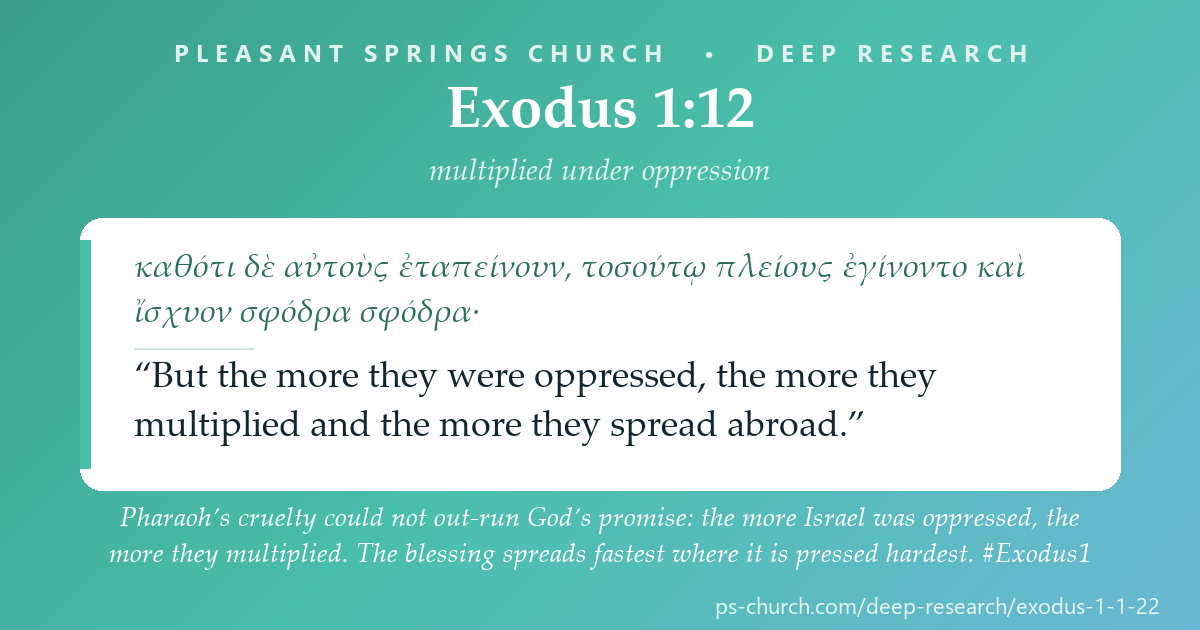
A king who did not know Joseph. The narrative’s hinge is a failure of memory: “there arose a new king over Egypt, who did not know Joseph” (1:8). The man to whom Egypt once owed its survival (Gen 41) is forgotten, and gratitude curdles into fear: “the people of Israel are too many and too mighty for us” (1:9). Pharaoh “deals shrewdly” — taskmasters, “heavy burdens,” the store-cities Pithom and Raamses (1:11) — and the irony is exquisite: “the more they were oppressed, the more they multiplied and the more they spread abroad” (1:12). The blessing cannot be crushed out; every hammer-blow only scatters more seed.
Shiphrah and Puah. When brute labor fails, Pharaoh turns to secret murder, ordering the Hebrew midwives to kill every newborn son at the birthstool. Two are named — a striking dignity, since the tyrant himself is never named — and “the midwives feared God and did not do as the king of Egypt commanded them, but let the male children live” (1:17). This is the Bible’s first recorded act of civil disobedience: the fear of God overruling the fear of the king. Asked to account for it, they answer evasively (the Hebrew women are vigorous and bear before a midwife arrives, 1:19); the narrator records their words without moralizing on them, and heaven’s verdict falls not on their tongues but on their reverence: “because the midwives feared God, he gave them families” (1:21). Pharaoh then escalates to open genocide — “every son… you shall cast into the Nile” (1:22) — and readers who know the next chapter feel the trap set for God spring shut on Pharaoh: the very river of death will become the cradle of the deliverer (Exod 2).
Audience
Israel — a people who knew slavery from the inside — heard their own origin in this chapter, and a pattern they would relive for centuries: the covenant people multiplying precisely under the pressure meant to erase them. What Egypt intended as extinction, God bent into fulfillment. The message is not that suffering is good, but that no empire’s dread and no decree can cancel a promise God has made; the God who “filled the land” with Israel while they wept under burdens is a God whose word runs faster than a Pharaoh’s cruelty.
The fear of God, and the persecuted church. For every later generation, the midwives frame the enduring question: whom will you fear? Confronted with an unjust command, Shiphrah and Puah chose the fear of God over the fear of the throne — and God honored it. And the chapter’s deepest logic (“the more they were oppressed, the more they multiplied”) becomes the signature of the people of God under persecution: the church, like Israel, has repeatedly grown fastest where it was pressed hardest. Note, too, the sober realism of the telling — deception and state violence are recorded, not endorsed; the Egyptians are not caricatured but shown gripped by a fear that makes ordinary people cruel. Scripture blesses courage and reverence, and leaves the rest honestly on the page.
Orient on the setting in Egypt, forced labor, midwifery, and the fear of God.
Search by topic: Exodus (book), Egypt / bondage, store-cities Pithom and Raamses, corvée labor, midwives, fear of God, civil disobedience.
Which articles are relevant?
- Anchor Bible Dictionary — “Exodus, Book of,” “Egypt,” “Pithom,” “Raamses,” “Slavery (OT),” “Midwife.”
- Dictionary of the OT: Pentateuch — “Exodus, Book of,” “Egypt,” “Slavery,” “Women,” “Fear of God.”
- NIDOTTE / TDOT — רָבָה (rābâ, multiply), עָצַם (ʻāṣam, be strong), עָנָה (ʻānâ, afflict), יָרֵא (yārēʾ, fear).
Bibliography surfaced:
- Brevard Childs, The Book of Exodus (OTL); Douglas Stuart, Exodus (NAC); John Durham, Exodus (WBC); Peter Enns, Exodus (NIVAC).
- Nahum Sarna, Exploring Exodus; studies of Egyptian corvée labor and the Ramesside store-cities.
- Studies on the Hebrew midwives, women in Exodus 1–2, and the theme of civil disobedience in Scripture.
Forced labor under a god-king, the birthstool, and the memory of the oppression.
Read the enslavement against Egyptian labor and royal ideology, then hear how the Second-Temple world and the New Testament remembered this chapter.
Which parallels shed light on religion and worldview?
The god-king and the corvée. Pharaoh was not merely a monarch but, in Egyptian ideology, a divine guarantor of order (ma’at) against chaos. Large-scale royal building — the mud-brick store-cities of 1:11, Pithom and Raamses of the Ramesside era — ran on state-imposed forced labor (corvée), the very machinery Israel is pressed into. Against that backdrop, Exodus stages a quiet subversion: the “order” the god-king imposes is disorder and death, and the real fruitfulness (the blessing of the true God) keeps breaking out where his policy tries to suppress it. The narrator even lets Pharaoh’s own dread indict him — he fears a slave people he is busy enslaving.
The birthstool and the midwife. Verse 16’s “when you see them on the birthstool” reflects real ancient obstetric practice (the אָבְנָיִם, a pair of birthing stones). Midwifery was a respected women’s vocation across the ANE; Pharaoh’s attempt to weaponize it — turning the guardians of birth into agents of death — is precisely what Shiphrah and Puah refuse.
- Egyptian labor and building projects — corvée (state forced labor) and mud-brick construction; the store-cities of the eastern Delta (cf. Pithom, Pi-Ramesse): the material world behind 1:11–14.
- Jubilees 46–47 (2nd c. BC; a witness, not Scripture) — retells the death of Joseph’s generation, the Egyptian oppression, and the setting of Moses’ birth.
- Josephus, Antiquities 2.9.1–2 (1st c. AD; a witness) — ascribes the drowning decree to a sacred scribe’s prophecy that a Hebrew child would humble Egypt; expands the oppression narrative.
- Wisdom of Solomon 18–19; Philo, Life of Moses 1 (Second-Temple Jewish witnesses) — meditate on the deliverance and the reversal of Egypt’s cruelty.
The engine of Exodus 1 is a divine irony the narrator will not let us miss: “the more they were oppressed, the more they multiplied and the more they spread abroad” (1:12). Pharaoh’s whole program — heavier burdens, then secret infanticide, then open genocide — is a staircase of escalating cruelty, and every step backfires. The blessing spoken over creation (Gen 1:28) and sworn to Abraham (Gen 12:2) has a momentum no empire can reverse; the harder it is pressed, the more it spreads, like seed scattered by the very blow meant to bury it. Israel would relive this pattern under Assyria and Babylon and Rome, and the church would inherit it as its own strange law — growing fastest where it is pressed hardest, so that a later Christian witness could say that the blood of the martyrs is seed (Tertullian, Apology 50 — a witness, not Scripture). This is not a promise that suffering is painless or that every tyrant fails on schedule; it is the assurance that God’s purposes are not at the mercy of the powerful. The Pharaoh who feared a slave people had already lost; he was fighting a promise, and promises kept by God do not lose. The chapter ends with a river full of drowned intentions — and, unknown to the king, a basket already being woven (Exod 2).
The vocabulary of blessing, oppression, and the fear of God.
Watch the creation-mandate verbs of v.7, the “strong/mighty” wordplay, the twice-stated “feared God,” and the Nile that turns from death to deliverance.
“Were fruitful and swarmed” — the verb šāraṣ (“teem, swarm”) is the word for the creatures multiplying in Genesis 1:20–21. Exodus 1:7 deliberately writes Israel’s growth in creation-mandate language: the blessing is being kept.
“Grew strong / mighty” (ʻāṣam) — the same root behind Pharaoh’s fear that Israel is “too mighty” (ʻāṣûm, 1:9). What God makes strong, the tyrant reads as threat.
“Midwives” — the participle of yālad (“to bear”); those who assist birth. Pharaoh tries to conscript the guardians of life into killing; Shiphrah and Puah refuse.
“Feared God” — twice named as the root of their defiance and the ground of their blessing. The fear of God dethrones the fear of the king (cf. Prov 1:7; Acts 5:29).
“Houses / households” — God “made them houses”: he gave the life-honoring midwives families of their own. (The LXX reads the midwives as the ones who “made themselves houses.”)
“The Nile” — Egypt’s river of life, turned by decree into an instrument of death. In the next chapter God turns it back: it becomes the cradle that carries Moses to safety (2:3–10).
How the rest of Scripture fills out the scene:
- Genesis 1:28; 9:1; 47:27 — “be fruitful and multiply”: Exodus 1:7 gathers the creation blessing and the Goshen fruitfulness into one sentence.
- Genesis 12:1–3; 15:5, 13–14; 17:6 — the promise of a great nation and the foretold sojourning and affliction: Exodus 1 is Genesis 15:13 coming true.
- Proverbs 1:7; 9:10; Acts 5:29 — “the fear of the Lord is the beginning of wisdom”; “we must obey God rather than men”: the midwives’ principle across the canon.
- Exodus 2:1–10 — the Nile-decree overturned: the river of death becomes the deliverer’s cradle (see the birth of Moses).
From a promise kept in Egypt to the whole story of deliverance.
Trace the multiplication, the oppression foretold to Abraham, the fear of God, and the Nile — then hear how the New Testament reads this chapter.
Which cross-references matter?
- Genesis 15:13–14; 46:3–4; 50:24 — God’s word to Abraham that his offspring would sojourn and be afflicted, and his promise to bring them up again: Exodus 1 opens the fulfillment.
- Genesis 12:2; 17:6; 22:17 — “I will make you a great nation”: the burdened multitude of Exodus 1 is the promised nation taking shape under pressure.
- Deuteronomy 26:5–7; Psalm 105:23–25 — Israel’s own confession: “the Egyptians treated us harshly… the Lord heard our voice”; God “made his people very fruitful and made them stronger than their foes.”
- Acts 7:17–19; Hebrews 11:23 — Stephen: “as the time of the promise drew near… the people increased… there arose over Egypt another king who did not know Joseph”; and Moses’ parents, “by faith… were not afraid of the king’s edict.”
The New Testament reads Exodus 1 as the moment the promise began to keep itself. Stephen, on trial for his life, tells the story exactly this way: “as the time of the promise drew near, which God had granted to Abraham, the people increased and multiplied in Egypt, until there arose over Egypt another king who did not know Joseph” (Acts 7:17–18). The multiplication is not an accident of demographics but the clock of the covenant running down toward deliverance — and the oppression is the labor pain of a nation being born. Hebrews then singles out the very courage this chapter honors: “by faith Moses, when he was born, was hidden three months by his parents… and they were not afraid of the king’s edict” (Heb 11:23) — the same holy defiance as Shiphrah and Puah, now named as faith. The pattern reaches its furthest horizon in Revelation 12, where a dragon stands before a woman to devour her child the moment it is born, and the child is caught up to God — John’s Exodus-1 in cosmic scale, the ancient decree behind every attempt to kill the promise in the cradle. Held soberly and not sensationalized, the line is clear: the God who filled Egypt with a promised people, who blessed two midwives for fearing him more than a king, is the God who guards his deliverer through the water — and who has already woven the basket before the decree is dry.
The scholarship on Exodus 1 and the setting of the bondage.
Childs and Durham for the exegesis; Sarna and the Egyptological background; the studies on the midwives and civil disobedience.
Commentaries & studies:
- Brevard Childs, The Book of Exodus (OTL); John Durham, Exodus (WBC); Douglas Stuart, Exodus (NAC); Peter Enns, Exodus (NIVAC); Nahum Sarna, Exodus (JPS) and Exploring Exodus.
- Studies of the store-cities (Pithom, Pi-Ramesse) and Egyptian corvée labor; discussions of the date and setting of the oppression.
- J. Cheryl Exum and others on the women of Exodus 1–2; studies of the fear of God and civil disobedience (Exod 1; Dan 3; Acts 5).
Interpretation notes worth keeping:
- The names of the midwives (1:15). Whether Shiphrah and Puah were Hebrew women or Egyptian midwives “of the Hebrews” is debated; the syntax and the “fear of God” motif favor Hebrews, but either way Scripture dignifies them with names while leaving Pharaoh anonymous.
- The midwives’ answer (1:19). The narrator reports their evasive reply without comment; the text blesses their reverence and refusal to kill (1:20–21), not offering a ruling on the words themselves. Deception is recorded, not commended — the house discipline for such scenes throughout this library.
- “He gave them families” (1:21). MT makes God the giver of “houses” (households/lineage) to the midwives; the LXX makes the midwives the builders of their own houses. Either way, the life-honoring are given life.
- The LXX pluses. LXX 1:11 adds a third store-city, On (Heliopolis); LXX 1:22 and the Samaritan add “to the Hebrews” (followed by the ESV). Minor textual growth, worth noting where the versions diverge.
From a promise kept under burdens to your own fear of God.
Name what you learned, why it matters, and one concrete response.
What should we carry away — and do?
- God keeps his word in the dark. Before a single miracle, before the bush, Israel is multiplying under the whip — the creation blessing and the promise to Abraham quietly coming true in a land of slavery. No empire’s dread can cancel what God has spoken.
- The more it is pressed, the more it spreads. “The more they were oppressed, the more they multiplied.” This is the signature of God’s people under persecution; do not read hardship as God’s absence.
- Fear God more than the king. Shiphrah and Puah refused an unjust command because they feared God — and he honored them. When a human authority commands what God forbids, reverence for God decides.
Step in response: name the “Pharaoh” you are tempted to fear — a boss, a crowd, a threat — and set the fear of God consciously above it this week. And where you feel pressed or diminished, remember the arithmetic of Exodus 1: the promise is not shrinking; it is spreading. Trust the God who was filling the land while his people wept.
Exodus 1:12 · to share
LXX + ESVEvery Deep Research page traces its passage across the whole sweep — the Old Testament, the Second-Temple world between the testaments (historical witnesses, not Scripture), and the New Testament. Follow the thread:
Pleasant Springs Church — Deep Research
Research method after Michael S. Heiser’s Bible Research Method (examine dictionaries → ancient literature → important words → textual connections → academic publications → share), with the Pleasant Springs “Author & Audience” foundation. Scripture set in the Hebrew, the Greek editions named on each page and the ESV (Old Testament), and the Greek New Testament and the ESV (New Testament), per the practice of Pleasant Springs Church. Exodus 1:1–22 research grounded in Childs, Durham, Stuart, Enns, and Sarna, with the Egyptological background of corvée labor and the Ramesside store-cities (Pithom, Raamses); Exodus 1:7 read as the creation mandate (Gen 1:28) and patriarchal promise (Gen 12:2; 17:6; 47:27) fulfilled, and Genesis 15:13–14 coming true; the midwives Shiphrah and Puah honored for the fear of God over the fear of the king (their evasive answer recorded, not commended); MT/LXX divergences noted (1:12 יִפְרֹץ / ἴσχυον; 1:21 God’s gift of “houses” / the midwives’ own; 1:22 “to the Hebrews” with the LXX and Samaritan); the chapter naming only הָאֱלֹהִים (“God”), the covenant name YHWH reserved for the bush (3:14–15); Jubilees 46–47 and Josephus Ant. 2 read as witnesses, not Scripture; and the New Testament reading (Acts 7:17–19; Heb 11:23; Rev 12) held soberly.
Scripture quotations marked ESV are from the ESV® Bible (The Holy Bible, English Standard Version®), © 2001 by Crossway, a publishing ministry of Good News Publishers. ESV Text Edition: 2016. Used by permission. All rights reserved. The ESV text may not be quoted in any publication made available to the public by a Creative Commons license, and the ESV may not be translated in whole or in part into any other language. www.esv.org
|
Did this study bless you today? 💚 Give to Support PS Church100% of gifts go to the General Fund — thank you. |