After eleven chapters of a world unravelling — fall, flood, Babel — the whole Bible turns on a single word: “Go.” God calls one old man to leave everything for a land not yet named, and pours out a sevenfold promise that climbs to a staggering climax: “in you all the families of the earth shall be blessed.” The great name Babel grasped for, God simply gives. This study works the pivot of Scripture — the call that makes Israel, and through Israel’s Seed, blesses the world. See the method →
Genesis 12:1–9 (selections)
Hebrew · LXX · ESVThe Shape of the Passage
SequenceSame Author and audience as Genesis 1:1 — and Genesis 12 is the great hinge of the Bible: from the scattered nations of Babel to one man through whom all of them will be blessed.
Author
The Torah of Moses pivots here from universal history (chs. 1–11) to the story of one family. The call is pure grace and pure demand: “Go… to the land that I will show you” — leave everything that anchors you (country, kindred, father’s house), for a destination not yet named. And then a sevenfold promise pours out, built on five “I will”s: a great nation, blessing, a great name, and — the climax — “in you all the families of the earth shall be blessed.”
The reversal of the curses. Genesis 3–11 was a spreading tide of curse (the ground, Cain, the flood, Babel). Now, five times in two verses, the word is bless. The great name Babel could not seize (11:4) God freely gives; the nations Babel scattered God means to gather — through Abram’s seed.
Audience
Israel — Abram’s descendants, hearing the charter of their existence: they are a people called for the sake of the world, not merely for themselves. Their election is a vocation — blessed to be a blessing to “all the families of the earth.”
How they heard it. Faith looks like Abram’s feet: “So Abram went” (v.4), leaving the known for the promised. And wherever he goes he builds altars and “calls on the name of the Lord” — planting worship in a land not yet his, staking the promise by faith.
Orient on the call, the promise, and the blessing of the nations.
Search by topic: Abraham, call/election, covenant, blessing, promised land, seed.
Which articles are relevant?
- Anchor Bible Dictionary — “Abraham,” “Blessing,” “Promise,” “Land.”
- Dictionary of the OT: Pentateuch — “Abraham,” “Blessing,” “Election,” “Nations.”
- NIDOTTE / TDOT — בָּרַךְ (bāraḵ, bless), גּוֹי (gôy, nation), זֶרַע (zeraʿ, seed), שֵׁם (šēm).
Bibliography surfaced:
- Wenham, Genesis 1–15 (WBC); Hamilton (NICOT); Sarna (JPS); Kenneth Mathews (NAC).
- T. Desmond Alexander, From Paradise to the Promised Land; Christopher Wright, The Mission of God — Abraham and the nations.
- Paul Williamson, Sealed with an Oath — the Abrahamic covenant.
The migrant patriarch, and the Second-Temple Abraham.
Set Abram’s call against the ANE world of migration and land-grant, then note the rich Second-Temple portrait of Abraham the first monotheist.
Which parallels shed light on religion and worldview?
Out of Ur. Abram’s journey traces a real migration route from lower Mesopotamia (Ur) up to Harran and down into Canaan. But the striking thing is why: not famine or trade or conquest, but the call of a God who grants land by promise rather than by the sword — and who binds a whole people’s destiny to one man’s faith.
- Jubilees 11–12 (Pseudepigrapha — a witness, not Scripture) — the famous legend of young Abram rejecting his father’s idolatry, reasoning his way to the one Creator, and burning the idol-house: the “Abraham the monotheist” tradition.
- Apocalypse of Abraham (Pseudepigrapha — likewise not Scripture) — expands Abram’s turn from idols into a visionary call narrative.
- Josephus, Antiquities 1.154–157 — Abraham reasoning to the one God from the order of the heavens; Philo, On Abraham — Abraham migrating away from Chaldean star-religion to the Maker beyond the cosmos.
- Acts 7:2–4 — Stephen’s summary: “The God of glory appeared to our father Abraham when he was in Mesopotamia, before he lived in Haran” — the call already at work in Ur.
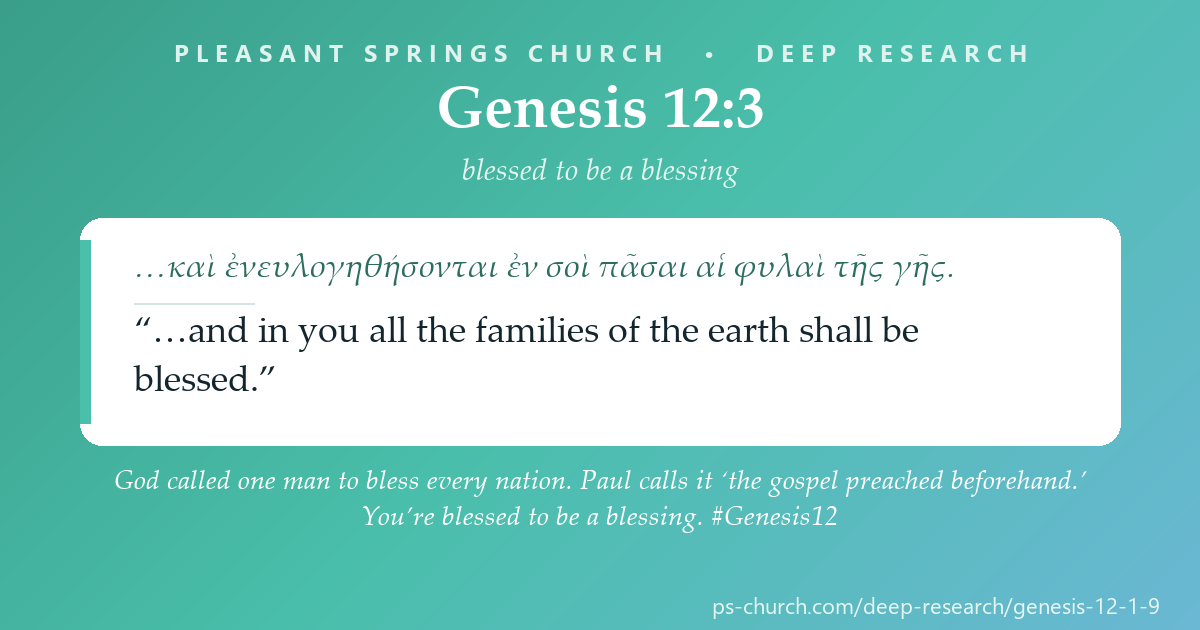
The climax of the call — “in you all the families of the earth shall be blessed” (12:3) — is the missionary heart of the whole Bible. Israel’s election was never for Israel’s sake alone; it was God’s strategy to reach the nations scattered at Babel. Paul calls this very verse “the gospel preached beforehand to Abraham” (Gal 3:8) — because the blessing to all nations comes through Abraham’s one Seed, Christ (Gal 3:16), in whom the promise is finally kept and the throng of Revelation 7:9 is gathered.
The vocabulary of call, blessing, and seed.
Watch the personal “go,” the fivefold blessing, the given “name,” and the global “families of the earth.”
“Go — for yourself” — an emphatic, personal command, used only here and at the Akedah (22:2). The bookends of Abram’s life of faith.
“Bless” — five times in two verses, reversing the curses of chs. 3–11. God’s answer to a cursed world is a river of blessing through one man.
“A great name” — God gives what Babel tried to seize (11:4). Reputation is a gift of grace, not a tower we build.
“The families of the earth” — the very peoples scattered at Babel (ch. 10–11). The scope of the promise is global from the first word.
“Shall be blessed” (or “bless themselves”) — the LXX and NT read it passively (ἐνευλογηθήσονται): the nations receive blessing in Abram’s Seed (Gal 3:8).
“Offspring / seed” — to whom the land is promised; the thread from 3:15 now narrowing to Abram, and finally to Christ (Gal 3:16).
How the New Testament reuses the call of Abram:
- Galatians 3:8, 16 — “the Scripture… preached the gospel beforehand to Abraham: ‘In you shall all the nations be blessed’”; and the promised “seed” is Christ.
- Hebrews 11:8–10 — “by faith Abraham obeyed… and he went out, not knowing where he was going”: the model of pilgrim faith.
- Romans 4:11–18 — Abraham the father of all who believe, Jew and Gentile; the promise received by faith.
- Acts 3:25; Matthew 1:1; Revelation 7:9 — “in your offspring shall all the families of the earth be blessed”: fulfilled in Jesus, son of Abraham, and the ransomed nations.
From the call of Abram to the blessing of the nations.
Trace the promise, the seed, and the blessing-to-the-nations — then note the Beale & Carson trajectory at Galatians 3.
Which cross-references matter?
- Genesis 11:1–9 — Babel’s failed “name” and scattered nations: the problem this call answers.
- Genesis 15; 17; 22:15–18 — the promise renewed and covenanted; “in your offspring shall all the nations be blessed” repeated as sworn oath.
- Genesis 3:15; 49:10 — the seed-thread narrowing from the woman to Abram to Judah to the coming King.
- Galatians 3:6–29; Romans 4 — the promise to Abraham as the charter of justification by faith and the inclusion of the nations.
- Isaiah 49:6; Acts 3:25; Revelation 7:9 — Israel a “light to the nations,” and the families of the earth blessed at last.
The commentary’s Galatians treatment shows Paul reading Genesis 12:3 as “the gospel in advance”: God’s promise to bless all nations in Abraham is fulfilled when Gentiles are justified by faith in Abraham’s Seed, Christ. The call of one man in Genesis 12 is thus the seedbed of the world mission — the scattered nations of Babel gathered back through Abraham’s offspring, until “every tribe and language and people and nation” is blessed (Rev 5:9). Election is for mission; blessing is for the world.
The scholarship on the Abrahamic call.
Alexander and Wright for the mission theme; Williamson for the covenant; the commentaries for the sevenfold promise.
Commentaries & studies:
- Wenham (WBC), Hamilton (NICOT), Sarna (JPS), Mathews (NAC), von Rad.
- T. Desmond Alexander, From Paradise to the Promised Land; Christopher J. H. Wright, The Mission of God.
- Paul Williamson, Sealed with an Oath; N. T. Wright on Abraham and the single-plan-through-Israel.
Interpretation notes worth keeping:
- The structure is a sevenfold promise (five “I will”s) rising to the climax “all the families of the earth” — the missional key to the whole Abraham narrative.
- “Be blessed” vs. “bless themselves” (12:3, the Niphal): grammatically debated, but the LXX and Paul read it passively (the nations receive blessing), which the NT treats as decisive.
- “Great name” answering Babel is widely noted: Genesis 12 is the deliberate counter-scene to Genesis 11 — grasped name and scattering vs. given name and blessing.
From the call to your own going.
Name what you learned, why it matters, and one concrete response.
What should we carry away — and do?
- Faith is feet. “So Abram went” — leaving the known for a land not yet shown. Trust obeys before it can see the destination (Heb 11:8).
- You are blessed to be a blessing. Every gift of God is given with the world in view. Election is a vocation; grace received is grace to be passed on.
- The name is a gift. What Babel grasped for, God freely gave Abram — and gives us in Christ. Stop building towers for your reputation; receive your name from the Father.
Step in response: name one “country, kindred, or father’s house” — a comfort or security you cling to — that God may be calling you to leave in trust; and take one concrete step this week to be a blessing to someone outside your circle, in the spirit of “all the families of the earth.”
Genesis 12:3 · to share
LXX + ESVEvery Deep Research page traces its passage across the whole sweep — the Old Testament, the Second-Temple world between the testaments (historical witnesses, not Scripture), and the New Testament. Follow the thread:
Pleasant Springs Church — Deep Research
Research method after Michael S. Heiser’s Bible Research Method (examine dictionaries → ancient literature → important words → textual connections → academic publications → share), with the Pleasant Springs “Author & Audience” foundation. Scripture set in the Hebrew, the Greek editions named on each page and the ESV (Old Testament), and the Greek New Testament and the ESV (New Testament), per the practice of Pleasant Springs Church. Genesis 12:1–9 research grounded in Wenham, Hamilton, Sarna, T. D. Alexander, C. J. H. Wright, and Williamson; Second-Temple portraits of Abraham per Jubilees 11–12, the Apocalypse of Abraham, Josephus, and Philo (read as witnesses, not Scripture).
Scripture quotations marked ESV are from the ESV® Bible (The Holy Bible, English Standard Version®), © 2001 by Crossway, a publishing ministry of Good News Publishers. ESV Text Edition: 2016. Used by permission. All rights reserved. The ESV text may not be quoted in any publication made available to the public by a Creative Commons license, and the ESV may not be translated in whole or in part into any other language. www.esv.org
|
Did this study bless you today? 💚 Give to Support PS Church100% of gifts go to the General Fund — thank you. |