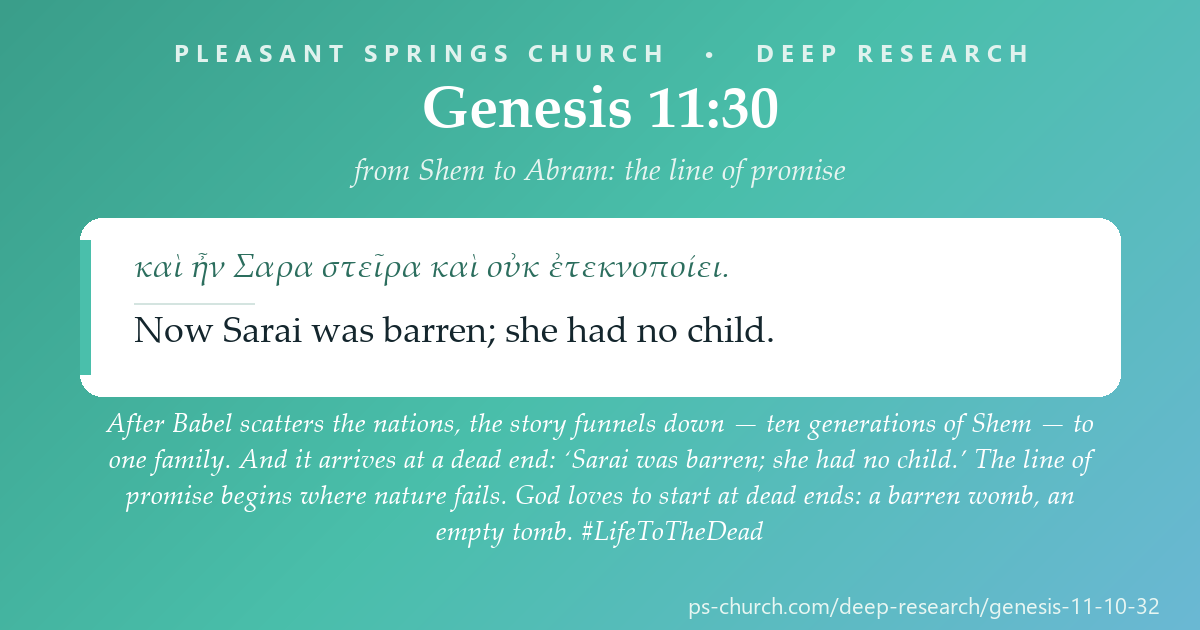
After Babel scatters the nations, the camera does the opposite of scatter: it narrows. A second genealogy of Shem runs down to Terah, the great lifespans shrinking, funneling out of all the seventy nations toward one family in Ur. And then, at the funnel’s narrow end, a devastating line: “Now Sarai was barren; she had no child.” The line of promise arrives at a dead end. Everything hangs on whether God will speak to this childless couple — which is exactly the word that opens the next chapter: “Go… and I will make of you a great nation.” This study works Genesis 11:10–32. See the method →
Genesis 11:10, 26, 30–32
Hebrew · LXX · ESVThe Shape of the Passage
Parallel panelsThis genealogy is the bridge from the primeval history (Genesis 1–11) to the story of Abraham (12–50). It looks backward to the flood and forward to the promise, funneling the whole human race down to one barren family — and setting up the greatest “but God” of the Old Testament.
Author
Moses gives a second Shemite genealogy (the first was the horizontal spread of Genesis 10; this is the vertical line of descent). It is built like the genealogy of Genesis 5 — X lived so many years, fathered Y, lived more years, had sons and daughters — but with one striking change: the tolling refrain “and he died” is dropped. Genesis 5 was a chapter about death; Genesis 11 is a chapter about life continuing, the promise-line pressing on. And the numbers tell their own quiet story: the lifespans, which stood near a millennium before the flood, now shrink steadily — Shem lives 600, but by Terah it is 205, and Abraham will live 175. The world after the flood is winding down toward the ordinary human span; the age of the giants is over. Into that diminishing world, God is about to do something new.
The funnel. The literary movement of Genesis 1–11 has been from the one to the many: one man becomes a race, one race becomes seventy nations scattered across the earth (ch. 10–11). Now, abruptly, the movement reverses. Out of all the nations, the text tracks a single line — Shem to Arphaxad to… to Terah — and then it stops on one household: Terah’s three sons, Abram, Nahor, and Haran. The whole vast panorama of the nations narrows to a single tent in Ur of the Chaldeans. This is the Bible’s method of election in miniature: God will bless the many through the one, and the story now zooms all the way in on the one.
A dead end — and a departure. And then the hammer falls. Of all the details Moses could give about Abram’s wife, he gives the one that changes everything: “Now Sarai was barren; she had no child” (11:30). The Hebrew is emphatic and stark. The line of promise, traced so carefully down ten generations, arrives at a woman who cannot conceive. Humanly speaking, it is over; there is no next generation. Terah, meanwhile, gathers the family and sets out from Ur “to go into the land of Canaan” — but he stops short, settling in Haran, and there he dies (11:31–32). The journey toward the promised land begins, stalls halfway, and ends in a grave. Everything hangs, now, on whether God will act — and the very next words are his: “Now the Lord said to Abram, ‘Go… and I will make of you a great nation’” (12:1–2). The promise of a nation is spoken to a childless couple. That is the point. From here on, the story runs on grace, not nature; on the power of God’s word, not the fertility of Abram’s house.
Audience
Israel — who traced their whole existence back to this barren couple — are being told the deepest truth about themselves: they exist only because God gives life to the dead and calls into being things that are not (Rom 4:17). Their father Abraham had “as good as dead” a body and a barren wife (Rom 4:19; Heb 11:11–12), and yet from him came descendants as many as the stars. A nation that remembered it began in Sarai’s barrenness could never boast that it made itself; it was, from the first, a miracle of grace.
The pattern of the gospel. Barrenness is one of the great recurring signs of the Old Testament — Sarah, Rebekah, Rachel, Hannah, the Shunammite, Elizabeth — and every time, the point is the same: the child of promise is God’s gift, not human achievement. The line runs through wombs that only God can open, until it comes at last to the ultimate sign, a virgin who conceives by the Spirit (Luke 1:34–37, where the angel echoes the promise to Sarah: “nothing will be impossible with God”). The whole logic is already here in Genesis 11:30. God delights to begin his greatest works at dead ends — a barren womb, an empty tomb — so that the glory is unmistakably his. The genealogy that funnels down to “she had no child” is not a story of failure; it is the setup for the God who makes the barren woman “the joyous mother of children” (Ps 113:9), and who out of one as good as dead brings a family more numerous than the stars.
Orient on genealogy, Shem, Terah, and barrenness.
Search by topic: genealogy, Shem, Terah, Ur of the Chaldeans, barrenness, election.
Which articles are relevant?
- Anchor Bible Dictionary — “Shem,” “Terah,” “Ur,” “Genealogy.”
- Dictionary of the OT: Pentateuch — “Genealogies,” “Abraham,” “Barrenness,” “Election.”
- NIDOTTE / TDOT — toledot (generations), ’aqarah (barren), yalad (father/bear), yashab (settle/dwell).
Bibliography surfaced:
- Gordon Wenham (WBC), Victor Hamilton (NICOT), Kenneth Mathews (NAC), Bruce Waltke, Nahum Sarna (JPS) on Genesis.
- Emanuel Tov, Textual Criticism (the MT/LXX chronology and the “Cainan” of Gen 11 LXX / Luke 3:36).
- Beale & Carson, Commentary on the NT Use of the OT (Romans 4; Hebrews 11).
The narrowing line, the shrinking years, and the barren wife.
Read the funnel from nations to family, the diminishing lifespans, and Sarai’s barrenness against their Ancient Near Eastern backdrop.
Which parallels shed light on religion and worldview?
From the nations to the one. The structure of the whole primeval history has been a rhythm of scattering: Adam’s race, Cain’s and Seth’s lines, the sons of Noah, the seventy nations, the confusion of Babel. Genesis 11:10–26 reverses the current. It is a “linear” genealogy — one son highlighted in each generation — where the Table of Nations was “segmented” into branches. The effect is a narrowing, a funneling of the world’s whole future down to a point. This is how the Bible tells the story of election: not that God loses interest in the nations (he has just mapped them all in ch. 10 and promised to bless them all in 12:3), but that he chooses to reach the many through the one. The zoom to Terah’s household is not a shrinking of God’s concern; it is the aiming of it.
The years wind down. The genealogy’s numbers carry a quiet theology. Before the flood, lifespans neared a thousand years (Gen 5); here they descend in stages — Shem 600, Arphaxad 438, on down to Terah’s 205, with Abraham’s 175, Isaac’s 180, Jacob’s 147, and finally Moses’ 120 (Deut 34:7) and the psalmist’s “seventy years, or eighty” (Ps 90:10). The vitality of the first world is ebbing; the age of legendary ages is closing. (The Hebrew, Samaritan, and Greek texts differ on the exact figures — the Septuagint again adds roughly a hundred years to many begettings, and even inserts an extra generation, “Cainan,” between Arphaxad and Shelah, a reading Luke 3:36 follows; this study gives the Hebrew figures the ESV translates and notes the divergence rather than blending the systems.) The point of the numbers is not a calculator’s chronology but a narrator’s theology: the world of long life is passing, and into that fading world God will plant an everlasting promise.
Barrenness — the recurring dead end. To an ancient audience, a genealogy existed to celebrate fruitfulness; its whole logic is “X fathered Y.” So the single line “Sarai was barren; she had no child” lands with the force of a slammed door. It is the anti-genealogy, the place where the fathering stops. And it is deliberate. The Bible will return to this dead end again and again — Rebekah, Rachel, Hannah, the Shunammite, Elizabeth are all barren — because barrenness is the perfect stage for grace. Where nature cannot produce the child, God can and does; the son who comes is unmistakably a gift. The whole covenant story is founded on the confession that Israel’s very existence is a miracle: a nation as many as the stars, brought out of a womb that was closed. The genealogy funnels to barrenness so that the next chapter can begin with a promise only God can keep.
- Genesis 12:1–3; 15:1–6; 17:15–19; 18:9–14; 21:1–7 — the call, the covenant, and the birth of Isaac to the barren Sarah: God keeping the promise at the dead end (see the call of Abram, the covenant).
- 1 Samuel 1:1–20; Luke 1:5–25, 34–37 — barren Hannah and barren Elizabeth; “nothing will be impossible with God”: the recurring sign fulfilled at the virgin’s conception.
- Romans 4:17–21; Hebrews 11:11–12 — God who gives life to the dead; Abraham’s “as good as dead” body and Sarah’s barrenness overcome by faith: the theology of the dead end.
There is a deliberate cruelty to the way Genesis ends its first great section. For ten chapters the story has been building — creation, fall, flood, the nations — and now it funnels down, with real narrative momentum, to the family through whom God will save the world. And precisely at the moment of arrival, when the reader expects the promise to be launched, the narrator drops a single flat sentence that seems to cancel everything: Sarai was barren; she had no child. It is as if the whole apparatus of election runs to its target and finds the target dead. And that, of course, is exactly the point. The Bible does not want us to think that God’s promise runs on the ordinary machinery of human fruitfulness, as though Israel were simply the natural product of an especially fertile ancestor. It wants us to know from the very first that this people, and this promise, exist against the grain of nature, by the sheer creative word of God. He chooses a barren woman to be the mother of nations, an old man to be the father of the faithful, a dead end to be the doorway of redemption — because he is the God who calls into existence the things that do not exist and gives life to the dead. Every barren womb in Scripture is a small rehearsal of the empty tomb; each one says, in its own way, that the life God gives is resurrection life, produced where human hope has run out. Genesis 11 ends at a closed womb and a fresh grave in Haran — and it is out of exactly that hopelessness that Genesis 12 begins, ‘Now the Lord said to Abram, Go… and I will make of you a great nation.’ The promise was never going to depend on Sarai’s body. It was always going to depend on God’s word.
The vocabulary of the narrowing line, the barren womb, and the halted journey.
Watch the linear “generations,” the dead-end “barren,” the stalled “settled,” and the name given not grasped.
“Generations.” The structuring formula of Genesis; here the linear genealogy of Shem (one line of descent) narrows the segmented Table of Nations (ch. 10) toward the one chosen family. The sixth toledot (11:27, Terah) opens the Abraham cycle.
“Barren.” The devastating single word at the funnel’s end, reinforced by “she had no child.” The line of promise reaches a dead end — the perfect stage for grace. The recurring sign (Rebekah, Rachel, Hannah, Elizabeth) that the child of promise is God’s gift, not human achievement.
“Ur of the Chaldeans.” Abram’s origin (the “Chaldeans” a later ethnonym for the region). The family sets out from Ur “to go into the land of Canaan” — the destination named even before God’s call (12:1) — but stalls in Haran. The LXX reads “the land of the Chaldeans” rather than the city name.
“And they settled.” Terah sets out for Canaan but settles (from yashab) in Haran, halfway, and dies there. The human journey toward the promise stalls; it will take God’s direct call to move Abram the rest of the way (12:1–5).
“Shem” (also the word for “name”). The covenant line runs through Shem (blessed in 9:26), narrowing to Abram — over against Babel’s builders who sought to make a “name” (shem) for themselves (11:4). God will instead make Abram’s name great (12:2): the name is given, not grasped.
“Cainan” — an extra generation the Septuagint inserts between Arphaxad and Shelah, absent from the Hebrew and Samaritan texts. Luke 3:36 follows the LXX and includes him. A classic instance of the New Testament’s use of the Greek genealogical tradition; widely judged a secondary reading.
How the rest of Scripture fills out the line of promise:
- Genesis 12:1–9; 15:1–6; 21:1–7 — the call, the counting of the stars, the birth of Isaac: the promise kept at the barren dead end (see the call of Abram, the covenant).
- Romans 4:16–25; Hebrews 11:11–12 — the God who gives life to the dead; from one “as good as dead,” descendants as the stars: the theology of Sarai’s barrenness (see justification by faith).
- Luke 1:5–37; 1 Samuel 1–2 — barren Elizabeth and Hannah; “nothing will be impossible with God”: the recurring sign consummated at the virgin’s conception.
- Luke 3:34–38 — Jesus’ genealogy running back through Terah, Shem, to Adam “the son of God”; Matthew 1:1–17 traces the royal line forward from Abraham: the line of Genesis 11 reaching the Messiah.
From a barren womb to the God who gives life to the dead.
Trace the line of promise from the funnel of Genesis 11 through the barren mothers to the virgin and the empty tomb.
Which cross-references matter?
- Genesis 10:1–32; 11:1–9; 12:1–3 — the nations, Babel, and the call: the funnel from all peoples to the one family and back out in blessing (see the Table of Nations, Babel, the call of Abram).
- Genesis 15:1–6; 17:15–19; 18:9–14; 21:1–7 — the covenant and the birth of Isaac to barren Sarah: the promise kept (see the covenant cut).
- Romans 4:16–25; Hebrews 11:11–12; Galatians 4:27 — the God who gives life to the dead; the barren woman who rejoices: the gospel pattern founded here.
- 1 Samuel 1–2; Luke 1:5–37 — Hannah and Elizabeth; the virgin’s conception; “nothing will be impossible with God”: the sign brought to its climax.
- Luke 3:34–38 — the genealogy of Jesus through Terah and Shem to Adam “the son of God”: this line reaching Christ.
Genesis 11:10–32 is one of the most important hinges in the whole Bible, precisely because it does not feel important. It is a genealogy, and it ends with a stalled journey and a death in a place called Haran. But everything before it and everything after it turns on this quiet paragraph. Behind it lies the whole tragedy of the primeval history — the fall, the flood, the scattering of the nations at Babel — a world drifting further and further from God, fragmenting into seventy tongues, gathering itself into proud empires. The great question left hanging at the end of Genesis 11 is: what will God do with this fractured world? Will he abandon it? Will he drown it again? And the genealogy is the narrator’s way of turning our eyes, patiently, to the answer — not a flood, not fire from heaven, but a family. Out of all the nations, God will take one man, and out of one man make one nation, and through that one nation bless all the families of the earth. The whole plan of redemption that fills the rest of Scripture is loaded, like a spring, into this narrowing list of names. And the last thing we learn before the plan is launched is that the woman at the center of it cannot have children. That is not an obstacle to the plan; it is the plan’s signature. God will save the scattered world through a child who should never have been born — and, at the last, through a Child born of a virgin and raised from a tomb. The bridge from the ruined world to the redeemed one runs straight through Sarai’s barrenness, because the God who builds it is the God who gives life to the dead.
The scholarship on Genesis 11:10-32.
The commentators on the Shem-to-Terah genealogy; the studies of the chronology, the “Cainan” of the LXX, and the barrenness motif.
Commentaries & studies:
- Gordon J. Wenham (WBC), Victor P. Hamilton (NICOT), Kenneth A. Mathews (NAC), Bruce K. Waltke, Nahum M. Sarna (JPS) on Genesis.
- Emanuel Tov, Textual Criticism of the Hebrew Bible (the MT/LXX chronology; the Gen 11 “Cainan” and Luke 3:36); studies of the barrenness motif.
- G. K. Beale & D. A. Carson, eds., Commentary on the NT Use of the OT (Romans 4; Luke 3).
Interpretation notes worth keeping:
- The funnel of election. The linear genealogy narrows the nations (ch. 10) to one family — God reaching the many through the one, not abandoning the many (12:3). The zoom is the aiming of God’s concern, not its shrinking.
- Barrenness as grace’s stage. “Sarai was barren” (11:30) is the deliberate dead end; the covenant begins where nature fails, so the child is manifestly God’s gift (Rom 4:17–21) — the recurring sign fulfilled at the virgin’s conception.
- Chronology: follow one text. The MT lifespans (which the ESV translates) descend steadily; the LXX adds ~100 years at many begettings and inserts “Cainan” (11:12–13), which Luke 3:36 follows — widely judged secondary (absent from the MT, the Samaritan Pentateuch, and Josephus, and treated by most as an inner-Greek development). Note the divergence; don’t blend systems or date-set.
- Name given, not grasped. Babel’s builders sought a “name” (11:4); God makes Abram’s name great (12:2) — the contrast the genealogy sets up.
- Ur and the stalled journey. Terah aims at Canaan but settles in Haran and dies; God’s call (12:1) completes the journey human initiative stalled.
From a dead end to the God who gives life to the dead.
Name what you learned, why it matters, and one concrete response.
What should we carry away — and do?
- God reaches the many through the one. The funnel to Abraham is not God losing interest in the nations he just mapped; it is the aiming of his blessing at them — through one family, for all the families of the earth.
- The promise begins at a dead end. The line of promise arrives at “she had no child.” God delights to start his greatest works where human hope runs out — a barren womb, an empty tomb — so the glory is unmistakably his.
- Grace, not nature, carries it. Israel began as a miracle; so does every child of Abraham by faith (Rom 4). You were not born of natural achievement but of the God who gives life to the dead.
Step in response: bring your own dead ends to the God of Sarai’s barrenness. Where a situation looks humanly closed — a hope, a relationship, a calling that seems to have no next generation — remember that this is exactly the kind of place where God has always loved to begin. He spoke “I will make of you a great nation” to a childless couple. Trust the word that begins at dead ends, and wait, like Abraham, for the God who calls into being the things that are not.
Genesis 11:30 · to share
LXX + ESVEvery Deep Research page traces its passage across the whole sweep — the Old Testament, the Second-Temple world between the testaments (historical witnesses, not Scripture), and the New Testament. Follow the thread:
Pleasant Springs Church — Deep Research
Research method after Michael S. Heiser’s Bible Research Method (examine dictionaries → ancient literature → important words → textual connections → academic publications → share), with the Pleasant Springs “Author & Audience” foundation. Scripture set in the Hebrew, the Greek editions named on each page and the ESV (Old Testament), and the Greek New Testament and the ESV (New Testament), per the practice of Pleasant Springs Church. Genesis 11:10–32 research grounded in Wenham, Hamilton, Mathews, Waltke, and Sarna, with Tov on the chronology and the LXX “Cainan”; the linear genealogy read as the funnel of election (the nations of ch. 10 narrowed to one family, God reaching the many through the one, 12:3); the dropped “and he died” refrain and the shrinking lifespans signaling the promise-line pressing on into a diminishing world (not for date-setting); “Sarai was barren” (11:30) as the deliberate dead end where grace begins (Rom 4:17–21; the recurring barrenness sign fulfilled at the virgin’s conception); the MT figures followed (per the ESV) with the LXX +100 chronology and the inserted “Cainan” (11:12–13; followed by Luke 3:36) noted as a divergent, widely-secondary reading rather than blended in; Babel’s grasped “name” contrasted with the name God gives Abram (12:2).
Scripture quotations marked ESV are from the ESV® Bible (The Holy Bible, English Standard Version®), © 2001 by Crossway, a publishing ministry of Good News Publishers. ESV Text Edition: 2016. Used by permission. All rights reserved. The ESV text may not be quoted in any publication made available to the public by a Creative Commons license, and the ESV may not be translated in whole or in part into any other language. www.esv.org
|
Did this study bless you today? 💚 Give to Support PS Church100% of gifts go to the General Fund — thank you. |