Under a night sky blazing with stars, God tells a childless old man his offspring will be past counting — and Abram believes. In one of the most important sentences in Scripture, God reckons that faith “as righteousness.” Then, as Abram sleeps, God alone — a smoking fire pot and a flaming torch — passes between the pieces of a cut covenant, taking the self-curse upon himself. This study works the covenant night that gives the gospel its charter: righteousness received by faith, guaranteed by God. See the method →
Genesis 15:1–21 (selections)
Hebrew · LXX · ESVThe Shape of the Passage
Parallel panelsSame Author and audience as Genesis 1:1 — and Genesis 15 turns the call of Abram into a sworn covenant, and gives the Bible its charter verse for righteousness by faith.
Author
The Torah of Moses stages the scene in two acts. First, the word: to a childless Abram, God renews the promise of a son and offspring “as the stars,” and Abram believes — and God reckons that faith “as righteousness” (15:6). Then the oath: God has Abram cut animals in two, and after dark a smoking fire pot and flaming torch — God’s own presence — pass alone between the pieces. In an ancient covenant, the parties walked the path of blood, invoking the animals’ fate on themselves if they broke faith. Here God walks it alone: the covenant’s keeping rests on God, not Abram.
Faith reckoned as righteousness. Abram does nothing but trust the promise — and that trust is credited to him as right standing with God. It is the taproot of the gospel: righteousness received, not achieved.
Audience
Israel — who knew covenant-cutting (כָּרַת בְּרִית, literally “to cut a covenant”) and the self-maledictory oath (Jer 34:18–20). They would feel the shock: God takes the oath upon himself, and lets Abram sleep. The covenant is grace.
How they heard it. Their whole standing rested not on their performance but on God’s sworn word to Abram. And the promise came with a shadow — four centuries of affliction in a land not their own (15:13) — and a light: God would judge that nation and bring them out. Even the exodus is written into this covenant night.
Orient on covenant, faith, and righteousness.
Search by topic: covenant, faith/belief, righteousness, imputation/reckoning, Abraham.
Which articles are relevant?
- Anchor Bible Dictionary — “Covenant,” “Faith,” “Righteousness (OT),” “Abraham.”
- Dictionary of the OT: Pentateuch — “Covenant,” “Abrahamic Covenant,” “Faith,” “Righteousness.”
- NIDOTTE / TDOT — אָמַן (ʾāman, believe), חָשַׁב (ḥāšaḇ, reckon), צְדָקָה (ṣəḏāqâ), כָּרַת (kāraṯ, cut).
Bibliography surfaced:
- Wenham, Genesis 1–15 (WBC); Hamilton (NICOT); Sarna (JPS); von Rad.
- Gerhard von Rad, “Faith Reckoned as Righteousness”; O. Palmer Robertson, The Christ of the Covenants.
- On the covenant ceremony: George Mendenhall / Gary Knoppers on ANE treaties; Paul Williamson, Sealed with an Oath.
The covenant-cutting ceremony, and the God who walks the blood alone.
Read the ceremony against ANE treaty-making and self-maledictory oaths, then note the Second-Temple retellings of this covenant night.
Which parallels shed light on religion and worldview?
“Cutting” a covenant. Across the ANE, treaties could be ratified by slaughtering animals as a dramatized self-curse: “may I become like these carcasses if I break my word” (the Mari texts; the Sefire treaties). The specific rite of passing between the pieces is more narrowly attested (a Hittite purification ritual; and Jeremiah 34:18–20, where God cites the very rite). The Hebrew idiom preserves the ceremony: one does not “make” but “cuts” (כָּרַת) a covenant.
The scandal of Genesis 15. The stunning move is who passes through. In the passing-between rite the bound or lesser party walks the path; here Abram is in a deep sleep, and only God — the smoking fire pot and torch — passes between the pieces. God takes the self-curse on himself, for both sides. The covenant cannot fail on Abram’s account, only on God’s — and God cannot lie (Heb 6:18).
- Jeremiah 34:18–20 — the covenant made “when they cut the calf in two and passed between its parts”: the biblical witness to the exact ritual behind Genesis 15.
- ANE treaty texts (Mari; Sefire; Hittite) — the animal-dismemberment oath and the passing-between rite: the cultural form God fills with grace.
- Jubilees 14 (Pseudepigrapha — a witness, not Scripture) — retells Genesis 15, dating the covenant and linking it to the feast of Shavuot.
- 4 Ezra 3:13–15; Apocalypse of Abraham (Pseudepigrapha — likewise not Scripture) — expand the covenant vision and Abram’s faith.
This is the gospel in the oldest ink. A covenant sealed by one party’s self-curse, taken by God for both, so that human failure cannot annul it — and a righteousness that comes not by walking the path but by believing the One who does. The smoking fire pot passing between the pieces is answered, centuries on, at a cross where God himself bears the curse of the broken covenant (Gal 3:13). Genesis 15:6 is why Paul can say God “justifies the ungodly” and “counts righteousness apart from works” (Rom 4:5–6): Abram simply trusted, and it was counted to him as righteousness — the pattern for everyone who believes in the God who raised Jesus (Rom 4:23–25).
The vocabulary at the heart of the gospel.
Watch the shield-who-is-the-reward, the “believed” and “reckoned” of v.6 (Paul’s words), and the “cut” covenant.
“Shield” — God himself as Abram’s defense and, in the same breath, his “reward”: the giver is the gift. The taproot of “you, O Lord, are a shield about me” (Ps 3:3).
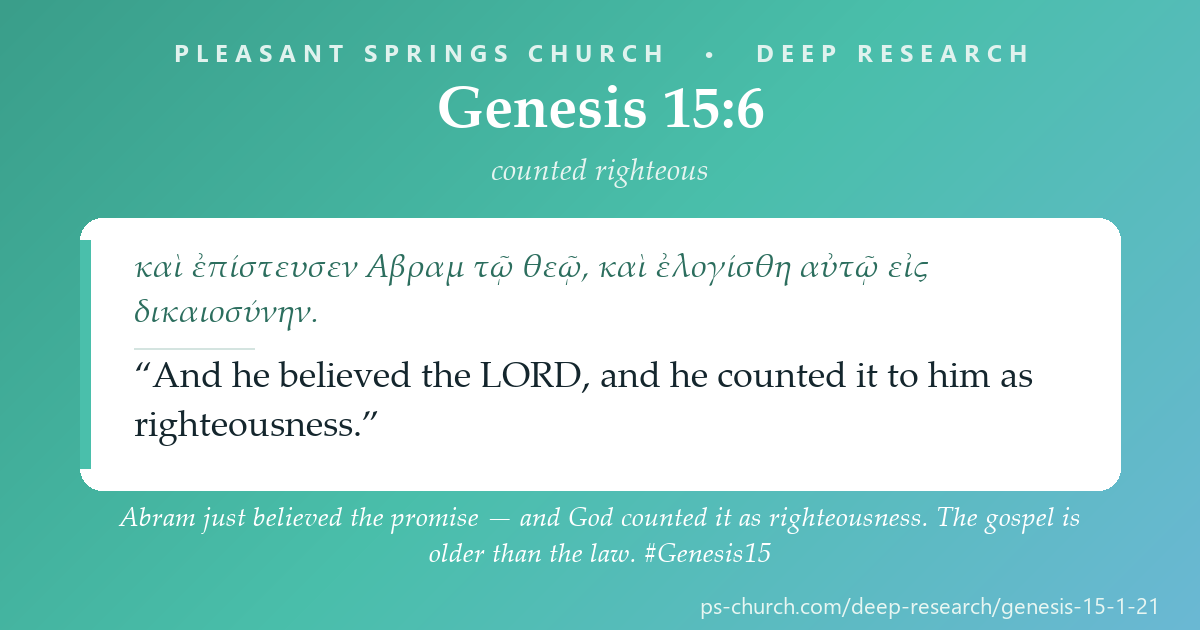
“He believed / trusted” — from אָמַן (whence “amen”): to rely, to say yes-and-amen to God’s promise. LXX ἐπίστευσεν; the root of NT “faith.”
“Reckoned / counted / credited” — an accounting term. LXX ἐλογίσθη; Paul’s λογίζομαι (Rom 4), the verb of imputed righteousness.
“Righteousness” — right standing, right relationship. Credited to Abram not for works but for faith: the gift at the heart of the gospel.
“To cut a covenant” — the literal idiom, from the dismembered animals. Covenant is sealed in blood and self-curse — here borne by God.
“Smoking fire pot…flaming torch” — the theophany (cf. Sinai’s fire and smoke, Exod 19:18) passing alone between the pieces: God binding himself.
How the New Testament reuses Genesis 15:6:
- Romans 4:3, 9, 22–25 — “Abraham believed God, and it was counted to him as righteousness”: Paul’s foundation text for justification by faith apart from works, for Jew and Gentile alike.
- Galatians 3:6–9 — “so Abraham ‘believed God…’ — so you see that it is those of faith who are the sons of Abraham.”
- James 2:21–24 — Abraham’s faith “was completed by his works” and the Scripture (15:6) fulfilled: living faith, not mere assent — the complement, not the rival, of Paul.
- Hebrews 6:13–18; 11:12 — God’s unchangeable oath to Abraham, and offspring “as many as the stars.”
From the covenant night to the cross.
Trace the reckoned-righteousness verse and the unilateral covenant — then note the Beale & Carson trajectory at Romans 4.
Which cross-references matter?
- Genesis 12:1–3; 17; 22:15–18 — the promise sworn, cut, and confirmed by oath across Abraham’s life.
- Jeremiah 34:18–20 — the “passing between the pieces” rite named in Scripture; Exodus 19:18 — the fire-and-smoke theophany echoed in the torch and fire pot.
- Romans 4; Galatians 3:6–18 — Genesis 15:6 as the charter of justification by faith and the promise-before-law.
- Galatians 3:13–14 — Christ “became a curse for us”: God bearing the covenant self-curse the fire pot foreshadowed.
- Hebrews 6:13–20 — God’s oath, “two unchangeable things,” the anchor of the soul: the security of the one-sided covenant.
The commentary’s Romans treatment shows Paul resting the entire doctrine of justification on Genesis 15:6: Abraham was reckoned righteous before circumcision (Gen 17) and before the law (Sinai), by faith alone — so the same gift is open to all who believe, uncircumcised Gentiles included. The covenant God cut alone in Genesis 15, taking the self-curse on himself, is kept at the cross, where “he was delivered up for our trespasses and raised for our justification” (Rom 4:25). The oldest promise and the finished work are one covenant of grace — received, from first to last, by faith.
The scholarship on the covenant and justification by faith.
von Rad on 15:6; the treaty scholars on the ceremony; Robertson and Williamson on the covenant theology.
Commentaries & studies:
- Wenham (WBC), Hamilton (NICOT), Sarna (JPS), von Rad (incl. “Faith Reckoned as Righteousness”).
- O. Palmer Robertson, The Christ of the Covenants; Paul Williamson, Sealed with an Oath.
- On λογίζομαι/imputation: the standard Romans commentaries (Cranfield, Moo, Schreiner) at Romans 4.
Interpretation notes worth keeping:
- 15:6 is a hinge for biblical theology: righteousness “reckoned” for faith, before circumcision and law — the exegetical ground Paul builds justification on. The Reformation read it rightly as imputed righteousness received by faith.
- The one-sided ceremony (God alone passing the pieces) is widely recognized as marking a one-sided, divinely guaranteed covenant — the self-maledictory oath borne by God (many read it as unconditional in its ultimate fulfillment).
- Paul and James both cite 15:6: Paul for faith apart from works of law, James for a faith that works. Read together, they describe one living, justifying faith — not two gospels.
From the covenant night to your own standing.
Name what you learned, why it matters, and one concrete response.
What should we carry away — and do?
- Righteousness is received, not achieved. Abram did nothing but trust the promise, and God credited it as right standing. The gospel is older than the law: we are justified by faith, not works.
- God walked the blood alone. He took the covenant self-curse on himself, so your standing rests on his faithfulness, not your performance — and God cannot lie (Heb 6:18).
- Faith that counts is faith that goes. Abram’s belief (Gen 15) and his obedience (Gen 22) are one life. Trusting God’s promise and following his word are not rivals but the same living faith (Jas 2:22).
Step in response: rest your standing before God today on his sworn word, not your record — say your “amen” to the promise as Abram did — and let that settled righteousness free you to obey without fear.
Genesis 15:6 · to share
LXX + ESVEvery Deep Research page traces its passage across the whole sweep — the Old Testament, the Second-Temple world between the testaments (historical witnesses, not Scripture), and the New Testament. Follow the thread:
Pleasant Springs Church — Deep Research
Research method after Michael S. Heiser’s Bible Research Method (examine dictionaries → ancient literature → important words → textual connections → academic publications → share), with the Pleasant Springs “Author & Audience” foundation. Scripture set in the Hebrew, the Greek editions named on each page and the ESV (Old Testament), and the Greek New Testament and the ESV (New Testament), per the practice of Pleasant Springs Church. Genesis 15 research grounded in Wenham, Hamilton, Sarna, von Rad, Robertson, and Williamson; ANE covenant-cutting parallels per the Mari and Sefire treaties and Jeremiah 34; Second-Temple material per Jubilees 14 and the Apocalypse of Abraham (read as witnesses, not Scripture).
Scripture quotations marked ESV are from the ESV® Bible (The Holy Bible, English Standard Version®), © 2001 by Crossway, a publishing ministry of Good News Publishers. ESV Text Edition: 2016. Used by permission. All rights reserved. The ESV text may not be quoted in any publication made available to the public by a Creative Commons license, and the ESV may not be translated in whole or in part into any other language. www.esv.org
|
Did this study bless you today? 💚 Give to Support PS Church100% of gifts go to the General Fund — thank you. |