When four kings carry off Lot, Abram — a shepherd, not a warlord — arms 318 men and rescues him. And on his return a mysterious figure steps out of nowhere: Melchizedek, “king of Salem” and “priest of God Most High,” who brings out bread and wine, blesses Abram, and receives a tithe. He appears in three verses and vanishes — a priest-king without recorded genealogy — and Psalm 110 and Hebrews will see in him a shadow of the eternal priesthood of Christ. Then Abram refuses Sodom’s spoil, so that only God can say, “I have made Abram rich.” This study works Genesis 14:1–24. See the method →
Genesis 14:14, 18–20, 22–23
Hebrew · LXX · ESVThe Shape of the Passage
SequenceGenesis 14 is the only chapter where Abram takes up arms — and its heart is not the battle but the strange priest-king who meets him afterward. Melchizedek appears, blesses, receives a tithe, and disappears, leaving a shadow that stretches all the way to Christ.
Author
Moses opens with a war of coalition kings — four against five — that sweeps through the cities of the plain and carries off captives, including Lot, who had settled near Sodom (13:12). Abram, called here for the first time “the Hebrew” (ha-’Ivri, the “crosser-over,” the outsider), does not shrug off his compromised nephew. He arms “318 trained men, born in his house,” pursues the raiders far to the north, and by a night attack routs them and brings back Lot and all the goods. The rescue is real and costly, and it sets up the two encounters that follow — with two very different kings.
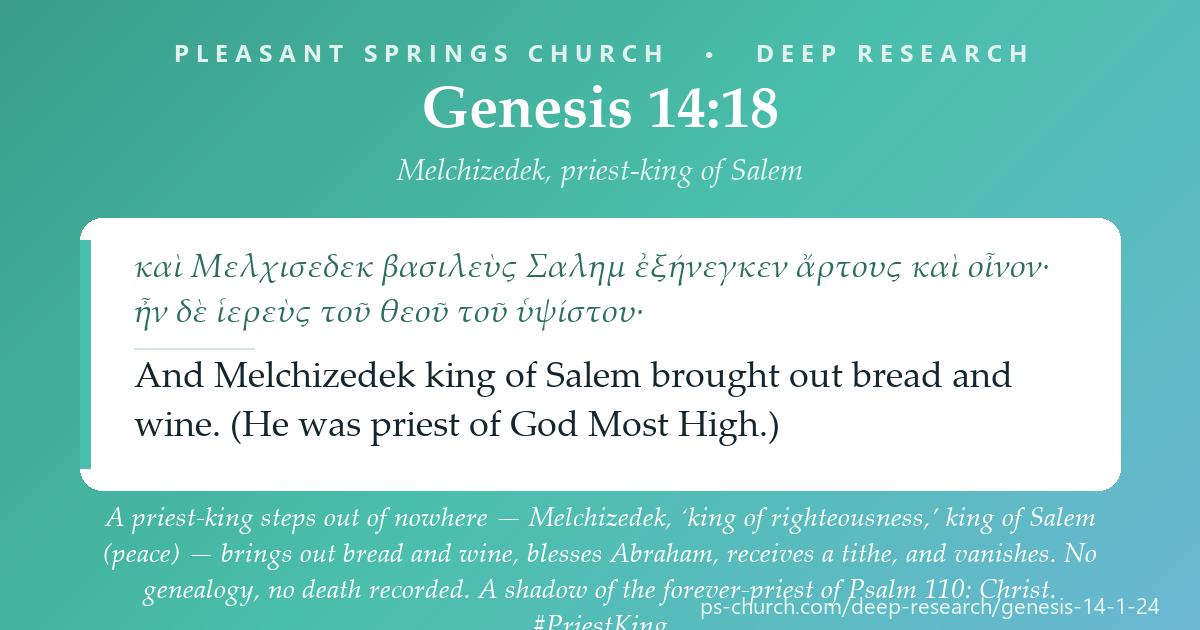
Melchizedek — the priest-king who appears from nowhere. As Abram returns, “Melchizedek king of Salem” comes out to meet him. His name means “king of righteousness”; “Salem” (an old name for Jerusalem, Ps 76:2) also puns on shalom, “peace.” He is “priest of God Most High” (El Elyon) — the first person in the Bible called a priest, and, astonishingly, a non-Israelite priest of the true God, worshiping the “Possessor of heaven and earth” long before Sinai. He does three things: he “brings out bread and wine” (refreshment for the weary victor, and a scene the church has long read with eucharistic overtones); he blesses Abram in God’s name; and he receives from Abram “a tenth of everything” — the first tithe in Scripture. Abram — the man to whom all the promises were given — bows to receive a blessing and pays a tithe. The greater blesses; the lesser is blessed (Heb 7:7).
A type, not a Christophany. Melchizedek is one of the Bible’s most tantalizing figures, and it is important to say clearly what he is and is not. Because he appears without recorded father, mother, or genealogy, and without record of birth or death, and because Psalm 110:4 hails the coming Messiah as “a priest forever after the order of Melchizedek,” Hebrews sees him as a striking type — a foreshadowing — of the eternal priesthood of the Son. But Hebrews is careful, and so must we be: it says Melchizedek was “made like the Son of God” and “resembling” him (Heb 7:3), not that he was the Son. He is a real Canaanite priest-king whom the text deliberately leaves shadowy so that he can serve as a picture of Christ; he is not a pre-incarnate appearance of Jesus. The picture is what matters: a priesthood older than Levi, not based on ancestry, unending — and therefore able to point to a priest whose office rests not on descent but on “the power of an indestructible life” (Heb 7:16).
Audience
Israel — a people whose priesthood came through Levi and Aaron — are shown, at the very foundation of their story, a priesthood that preceded and outranked their own. Their own father Abraham tithed to Melchizedek; Levi, “still in the loins of his ancestor” (Heb 7:9–10), tithed through him. The point is not to demean the Levitical priesthood but to make room, in Israel’s own Scriptures, for a greater one to come — the priest-king of Psalm 110, who unites in one person the offices of king (like David) and priest (like Aaron), which the law had kept strictly apart. When Jesus, of the tribe of Judah and not of Levi, is called our great high priest, this ancient chapter is where the door was opened.
The two kings and the guarded promise. Abram meets two kings on the same day, and his response to each is the sermon. To Melchizedek, priest of the Most High, he gives a tithe — gladly acknowledging God’s supremacy. To the king of Sodom, who offers him the plunder, he gives a flat refusal, sworn by oath: “I have lifted my hand to the Lord, God Most High… that I would not take a thread or a sandal strap… lest you should say, ‘I have made Abram rich.’” Abram will receive his wealth and blessing from God alone, not from the corrupt king of a doomed city, so that the source of his blessing can never be in doubt. Here, in Abram’s oath, is the same guarding of the promise we saw in Egypt: the blessing must be manifestly God’s gift, untraceable to any human hand. The man who tithed to God’s priest would take nothing from God’s enemy.
Orient on Melchizedek, priesthood, El Elyon, and the tithe.
Search by topic: Melchizedek, priest / priesthood, God Most High (El Elyon), tithe, Salem / Jerusalem.
Which articles are relevant?
- Anchor Bible Dictionary — “Melchizedek,” “Priest,” “God Most High,” “Tithe.”
- Dictionary of the OT: Pentateuch / Dictionary of the Later NT — “Melchizedek,” “Priesthood,” “Abraham.”
- NIDNTT / TDNT — kohen (priest), ma’aser (tithe), Μελχισεδεκ, ὁ ὕψιστος (the Most High).
Bibliography surfaced:
- Gordon Wenham (WBC), Victor Hamilton (NICOT), Kenneth Mathews (NAC), Bruce Waltke, Nahum Sarna (JPS) on Genesis.
- F. F. Bruce, Harold Attridge, Gareth Cockerill on Hebrews 7; studies of Psalm 110 and the Melchizedek traditions (incl. 11QMelchizedek).
- Beale & Carson, Commentary on the NT Use of the OT (Hebrews 5–7).
The priest-king, El Elyon, the tithe, and the coming order.
Read Melchizedek, “God Most High,” and the tithe against their Ancient Near Eastern and canonical backdrop.
Which parallels shed light on religion and worldview?
Priest and king in one man. In the ancient Near East, kings often held priestly roles, and city-rulers of Jerusalem bore names built on the element -tsedeq (“righteousness”; compare Adoni-zedek, Josh 10:1). Melchizedek fits this world — a Jebusite-era priest-king of the city that will become Jerusalem. But Israel’s own faith kept kingship (from Judah/David) and priesthood (from Levi/Aaron) rigidly separate; a king who tried to act as priest was struck down (King Uzziah, 2 Chr 26:16–21). So the memory of a legitimate priest-king of Salem, worshiping the true “God Most High,” became a seed of expectation: one day the two offices would rightly be joined. Psalm 110 makes the LORD swear to David’s greater Son, “You are a priest forever after the order of Melchizedek” — a royal figure who is also, and permanently, a priest.
‘God Most High,’ and Abram’s monotheism. Melchizedek blesses in the name of El Elyon, “God Most High, Possessor of heaven and earth.” “Elyon” was a title used across the region for a supreme god, and a skeptic might read this as Abram accepting a Canaanite deity. But the text closes that door decisively: when Abram swears his oath, he says, “I have lifted my hand to the Lord (YHWH), El Elyon, Possessor of heaven and earth” (14:22). Abram identifies Melchizedek’s “Most High God” with YHWH, his own covenant Lord — not blending two gods but recognizing the one true God worshiped, remarkably, by a Gentile priest. It is an early hint that God has never left himself without witness among the nations (cf. Acts 14:17), and that the God of Abraham is the God of all the earth.
The first tithe, and the greater priest. Abram “gave him a tenth of everything” — the Bible’s first tithe, given freely, before any law required it, as an act of worship acknowledging that the victory and the spoil belonged to God. Hebrews builds its whole argument on this scene. The one who gives the tithe and receives the blessing is the lesser; the one who receives the tithe and gives the blessing is the greater. So Melchizedek is greater than Abraham — and since Levi, the priestly tribe, was “still in the loins of Abraham,” the Melchizedek priesthood is greater than the Levitical (Heb 7:4–10). And the bread and wine he brought out have been heard, since the early church, as a faint foreshadow of the table where a greater priest-king would give his own body and blood. Melchizedek is a shadow; the substance is Christ.
- Psalm 110:1, 4 (LXX 109:1, 4) — “Sit at my right hand… You are a priest forever after the order of Melchizedek”: the psalm that reads this chapter messianically (see Psalm 110).
- Hebrews 5:6–10; 6:20–7:28 — Jesus a high priest “after the order of Melchizedek,” resembling the Son of God, a priesthood by “the power of an indestructible life”: the type fulfilled (see the great high priest).
- Genesis 14:22; Acts 14:17; 17:26–28 — Abram identifying El Elyon with YHWH; God’s witness among the nations: the one true God confessed by a Gentile priest.
The strangeness of Melchizedek is the point of him. He walks onto the stage of Scripture without introduction, blesses the father of the faithful, receives his tithe, and walks off, and we are told nothing of where he came from or where he went — no father, no mother, no genealogy, no birth, no death. In a book as obsessed with genealogies as Genesis, this silence is deafening, and it is deliberate. Hebrews seizes on it: because the text records no beginning of his days and no end of his life, Melchizedek stands in Scripture as a figure of a priest who simply is — a picture of a priesthood that does not depend on ancestry and does not pass away with death. But Hebrews is scrupulously careful with its language. It does not say Melchizedek had no father or mother, only that Scripture does not record them; it does not say he was the Son of God, but that he was ‘made like’ the Son, ‘resembling’ him. He is a type, an inspired portrait, not the reality itself. And that reserve protects something precious. The reality is Christ — the true priest-king of righteousness and peace, who really has no beginning of days, who really lives forever, whose priesthood really rests not on descent from Aaron but on his own indestructible life. Every ancient longing for a king who could also be a priest, for a priest who would never die, for a mediator whose office no death could interrupt, was answered not in the shadowy figure at Salem but in the risen Lord who ‘holds his priesthood permanently, because he continues forever.’ Melchizedek pointed; Jesus arrived.
The vocabulary of the priest-king, the tithe, and the guarded blessing.
Watch the name and city of Melchizedek, the first “priest,” the bread and wine, the first tithe, and Abram’s oath.
“My king is righteousness” / “king of righteousness.” The -tsedeq element marks the old Jerusalem royal names (cf. Adoni-zedek). Heb 7:2 exploits the meaning: “king of righteousness,” then “king of peace” (Salem/shalom) — the prototype of the eternal priest-king (Ps 110:4).
“King of Salem” — Salem = old Jerusalem (Ps 76:2), also punning shalom, “peace.” A priest-king of the city that would become the place of the temple and, at last, of the cross.
“Priest of God Most High” — the FIRST “priest” (kohen) in the Torah, and a non-Israelite worshiper of the true God before Sinai. El Elyon = “God Most High” (ordinary “God,” not the Tetragrammaton); Abram identifies him with YHWH (14:22).
“Bread and wine” — refreshment for the weary victor and a priestly act of blessing; read since the early church with eucharistic overtones (a faint foreshadow of the table of the greater priest-king, cf. Matt 26:26–29).
“A tenth / tithe” — the Bible’s first tithe, given freely before any law, acknowledging that the victory and spoil belong to God. Heb 7:4–10 makes Abram’s tithe prove Melchizedek greater than Abraham — and than Levi, “still in his loins.”
“Possessor / Maker of heaven and earth” — the title (LXX “who created heaven and earth”) confessing God’s sovereignty over all. It grounds Abram’s refusal of Sodom’s spoil: the Owner of everything, not the king of Sodom, is the source of his wealth.
How the rest of Scripture fills out Melchizedek:
- Psalm 110:1, 4 (LXX 109) — the priest-king enthroned at God’s right hand, “a priest forever after the order of Melchizedek”: the messianic reading (see Psalm 110).
- Hebrews 5:6–10; 6:20; 7:1–28 — the whole Melchizedek argument: greater than Abraham and Levi; a priest by an indestructible life; Christ our forever-priest (see the great high priest).
- Matthew 26:26–29; 1 Corinthians 11:23–26 — the bread and the cup of the greater priest-king: the table Melchizedek’s bread and wine faintly foreshadow (see the Last Supper).
- Zechariah 6:12–13; Hebrews 7:11–17 — the Branch who is “a priest on his throne”; the union of king and priest the law kept apart: fulfilled in Christ.
From a priest-king at Salem to the forever-priest at God's right hand.
Trace Melchizedek from Genesis through Psalm 110 to Hebrews — a type fulfilled in Christ.
Which cross-references matter?
- Psalm 110 (LXX 109) — the enthroned priest-king “after the order of Melchizedek”: the bridge from Genesis to the New Testament (see Psalm 110).
- Hebrews 5:6–10; 6:19–7:28 — Melchizedek “resembling the Son of God”; the greater, unending priesthood of Christ: the type interpreted (see Hebrews 4).
- Genesis 15; 22:15–18; Acts 14:17; 17:24–28 — the promise and oath to Abram; God’s witness among the nations: El Elyon confessed as the Lord (see the covenant cut).
- Matthew 26:26–29; Hebrews 9:11–14 — the bread and wine, and the priest who offered his own blood: the substance behind the shadow (see the Last Supper).
- 2 Chronicles 26:16–21; Zechariah 6:12–13 — king and priesthood kept apart, then rightly joined in the Branch: the office Melchizedek prefigures.
Two kings meet Abraham on the day of his victory, and the way he treats each of them is a small masterpiece of discernment that the whole rest of the Bible will echo. The king of Sodom — ruler of a city already marked as wicked, soon to be marked for fire — offers Abraham a very reasonable deal: keep the plunder, just give me back the people. It is Abraham’s by right of conquest; no one would fault him for taking it. And Abraham refuses it with an oath, because he will not let the king of a doomed city be able to say ‘I made Abram rich.’ He will receive his wealth from God or not at all. The other king, Melchizedek, offers Abraham nothing he could bank — only bread, and wine, and a blessing in the name of the Most High God — and to him Abraham gives a tenth of everything. Watch the pattern: from the world’s king, who offers riches, Abraham takes nothing; to God’s priest, who offers only blessing, Abraham gives generously. This is the instinct of faith, and it runs straight to the gospel. The believer learns to hold the wealth the world offers with an open, wary hand, refusing anything that would let the world claim credit for his blessing — and to pour himself out gladly before the priest-king who brings only bread and wine and the blessing of God Most High. For that priest-king, in the end, is not Melchizedek but the One he foreshadowed, who at another table brought out bread and wine and said, ‘This is my body, this is my blood,’ and blessed his people forever.
The scholarship on Genesis 14:1-24.
The commentators on the war and Melchizedek; the studies of the priest-king, Psalm 110, and Hebrews 7.
Commentaries & studies:
- Gordon J. Wenham (WBC), Victor P. Hamilton (NICOT), Kenneth A. Mathews (NAC), Bruce K. Waltke, Nahum M. Sarna (JPS) on Genesis.
- F. F. Bruce, Harold W. Attridge, Gareth L. Cockerill on Hebrews; studies of Psalm 110 and the Melchizedek traditions (11QMelchizedek; 2 Enoch).
- G. K. Beale & D. A. Carson, eds., Commentary on the NT Use of the OT (Hebrews 5–7).
Interpretation notes worth keeping:
- A type, not a Christophany. Hebrews says Melchizedek was “made like” / “resembling” the Son of God (7:3), not that he was the pre-incarnate Christ. He is a real Canaanite priest-king, deliberately left shadowy, serving as a picture — do not assert he “is” Jesus.
- The greater blesses the lesser. Abram’s tithe and reception of blessing make Melchizedek greater than Abraham — and, since Levi was “in his loins,” the Melchizedek priesthood greater than the Levitical (Heb 7:4–10); the point elevates Christ’s priesthood, not demeans Aaron’s.
- El Elyon = YHWH. Abram identifies Melchizedek’s “God Most High” with the Lord (14:22) — monotheism, not syncretism; a Gentile witness to the one true God. “God Most High” is ordinary “God,” not the Tetragrammaton (only 14:22 has YHWH; the LXX there omits it).
- Bread and wine. Refreshment and priestly blessing, read since the early church with eucharistic resonance — a faint foreshadow, offered carefully (the text’s primary sense is hospitality/blessing).
- The first tithe. Given freely before the law, as worship acknowledging God’s ownership; the ground of Hebrews’ argument (7:4–10).
From a shadow at Salem to the priest-king who is enough.
Name what you learned, why it matters, and one concrete response.
What should we carry away — and do?
- A priest older than Levi, pointing past Aaron. Before there was a temple or a law, a priest-king of righteousness and peace blessed Abraham — a shadow of the eternal priesthood of Christ, who is priest not by ancestry but by “the power of an indestructible life.”
- Give to God, take nothing from Sodom. Abram tithed gladly to God’s priest and refused the plunder of a doomed king — so that his blessing could be traced to God alone. Guard the source of your blessing.
- The bread and wine point to a table. The greater priest-king brought out not spoil but his own body and blood, and blessed his people forever. Melchizedek pointed; Jesus arrived.
Step in response: come to the priest-king who is the substance of the shadow. Where Melchizedek gave a passing blessing, Christ gives himself; where Abraham tithed of his spoil, offer him your whole self in worship. And learn Abram’s wary generosity: give freely to God, and refuse the world’s bargains that would let it claim credit for your blessing — so that of your life it may be said, not “the world made him rich,” but “the Lord, God Most High, Possessor of heaven and earth.”
Genesis 14:18 · to share
LXX + ESVEvery Deep Research page traces its passage across the whole sweep — the Old Testament, the Second-Temple world between the testaments (historical witnesses, not Scripture), and the New Testament. Follow the thread:
Pleasant Springs Church — Deep Research
Research method after Michael S. Heiser’s Bible Research Method (examine dictionaries → ancient literature → important words → textual connections → academic publications → share), with the Pleasant Springs “Author & Audience” foundation. Scripture set in the Hebrew, the Greek editions named on each page and the ESV (Old Testament), and the Greek New Testament and the ESV (New Testament), per the practice of Pleasant Springs Church. Genesis 14:1–24 research grounded in Wenham, Hamilton, Mathews, Waltke, and Sarna, with Bruce, Attridge, and Cockerill on Hebrews 7; Melchizedek read as a real Canaanite priest-king and a deliberate type (“made like” / “resembling” the Son of God, Heb 7:3) — NOT a pre-incarnate Christophany; the tithe and blessing making him greater than Abraham and (via Levi “in his loins”) than the Levitical priesthood (Heb 7:4–10), to elevate Christ’s priesthood, not demean Aaron’s; the union of king and priest (kept apart in Israel) prefigured here and fulfilled in the priest-king of Psalm 110; El Elyon (“God Most High,” ordinary “God”) identified by Abram with YHWH (14:22 — monotheism, not syncretism; the LXX omits the Tetragrammaton there); the bread and wine offered with eucharistic resonance held carefully alongside its primary sense of hospitality/blessing; the first tithe given freely before the law; small-caps Lord only at 14:22.
Scripture quotations marked ESV are from the ESV® Bible (The Holy Bible, English Standard Version®), © 2001 by Crossway, a publishing ministry of Good News Publishers. ESV Text Edition: 2016. Used by permission. All rights reserved. The ESV text may not be quoted in any publication made available to the public by a Creative Commons license, and the ESV may not be translated in whole or in part into any other language. www.esv.org
|
Did this study bless you today? 💚 Give to Support PS Church100% of gifts go to the General Fund — thank you. |