Back from Egypt, Abram is rich, and prosperity breeds strife. The promise-bearer does the opposite of grasping — he gives Lot first choice. Lot lifts up his eyes, sees the valley “like the garden of the Lord,” and takes it, pitching his tent toward Sodom, whose men were “great sinners.” He chose by sight, and it will cost him everything. Then, only after Abram released his rights, the Lord renews the promise: “Lift up your eyes… all the land… to you and to your offspring forever.” God fills the open hand. This study works Genesis 13:1–18. See the method →
Genesis 13:9–10, 13–15, 18
Hebrew · LXX · ESVThe Shape of the Passage
ConcentricIf chapter 12 showed Abram failing under fear, chapter 13 shows him rising in faith. Given the chance to grasp the best land by right of seniority, he lets it go — and God, who needs no help securing the promise, gives him all of it. The chapter contrasts two ways of seeing: Lot’s eyes, and God’s gift.
Author
Moses sets up the scene with irony: the very blessing of God — Abram is now “very rich” (kaved me’od, literally “very heavy”) — becomes the occasion of conflict, for the land cannot support both households’ flocks. Strife breaks out between the herdsmen. And here Abram acts nobly. Though he is the elder and the one to whom the land was promised, he refuses to stand on his rights: “Let there be no strife between you and me… for we are kinsmen. Is not the whole land before you? Separate yourself from me. If you take the left, I will go right; if the right, I will go left.” He hands the first choice to his nephew. It is faith in action: a man who truly believes God will give him the land can afford to be generous with it, because his security is not in the acre he grabs but in the God who promised.
Lot lifts up his eyes. Lot chooses by sight. He “lifted up his eyes” and saw the Jordan valley, “well watered everywhere… like the garden of the Lord, like the land of Egypt” (13:10). The comparisons are loaded and ominous. “Like the garden of the Lord” is an Eden allusion (the Septuagint makes it explicit: “like the paradise of God”) — and Eden is where a choice made by the eyes led to ruin. “Like the land of Egypt” recalls the place Abram has just barely escaped. And the narrator drops in a fact Lot’s eyes ignored: he “moved his tent as far as Sodom,” and “the men of Sodom were wicked, great sinners against the Lord” (13:13). Lot took the fertile valley and got Sodom with it. He walked by sight, toward the east (the direction of Eden’s exile and Babel), and the beautiful choice will end in fire and loss (ch. 19).
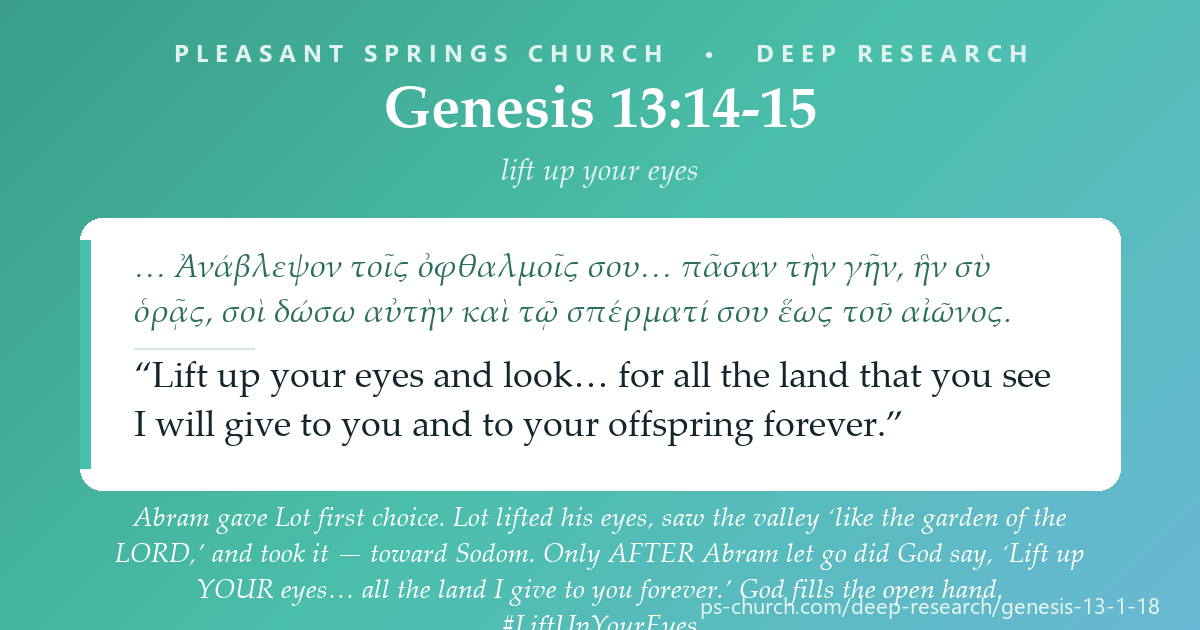
‘Lift up your eyes’ — the gift. Then comes the reward of Abram’s faith, and the timing is everything: “After Lot had separated from him, the Lord said to Abram, ‘Lift up your eyes and look… all the land that you see I will give to you and to your offspring forever’” (13:14–15). The same phrase Lot used to grab (“lifted up his eyes”), God now uses to give: “lift up your eyes.” What Lot seized for himself, God bestows on Abram as a gift — not one valley but the whole land, forever, with offspring as innumerable as “the dust of the earth.” And God tells him to “walk through the land” — a legal act of taking possession. Abram responds not by settling in the plush cities like Lot but by pitching his tent at Hebron and building “an altar to the Lord.” The man who released his rights answers grace with worship.
Audience
Israel — heirs of the land promised here — are taught how their inheritance was secured: not by grasping but by faith, and given by God as gift. The two men model two ways to live in the world. Lot walks by sight, choosing what looks best and drifting toward Sodom; Abram walks by faith, releasing his claim and receiving everything from God’s hand. The chapter quietly warns: the choice that dazzles the eyes may carry a hidden Sodom, and the way of open-handed trust may look like loss but end in inheritance.
The generous faith that anticipates Christ. Abram’s willingness to yield his rights for the sake of peace is a small foreshadowing of a greater self-emptying. He could have insisted; he chose instead to give way, trusting God for his portion. The New Testament will hold up the same posture as the mind of Christ, “who, though he was in the form of God, did not count equality with God a thing to be grasped, but emptied himself” (Phil 2:6–7). And it will name the true fulfillment of the land: Abraham was heir “not… through the law but through the righteousness of faith,” heir of the world (Rom 4:13), looking finally for “the city… whose designer and builder is God” (Heb 11:10). The one who let go of the valley was reaching, in the end, for a better country.
Orient on the land, strife, Sodom, and the promise.
Search by topic: land promise, Lot, Sodom, altar, walking by faith vs. sight.
Which articles are relevant?
- Anchor Bible Dictionary — “Abraham,” “Lot,” “Sodom,” “Land.”
- Dictionary of the OT: Pentateuch — “Land,” “Promise,” “Abraham,” “Altar.”
- NIDOTTE / TDOT — ’erets (land), zera’ (seed/offspring), nasa’ ’enayim (lift up the eyes), mizbeach (altar).
Bibliography surfaced:
- Gordon Wenham (WBC), Victor Hamilton (NICOT), Kenneth Mathews (NAC), Bruce Waltke, Nahum Sarna (JPS) on Genesis.
- Studies of the land promise, the Lot narratives, and the Eden allusions in Genesis 13.
- Beale & Carson, Commentary on the NT Use of the OT (Romans 4; Hebrews 11).
Grasping vs. giving, the eyes that choose, and the land as gift.
Read the strife, Lot’s choice, and the renewed promise against their Ancient Near Eastern and canonical backdrop.
Which parallels shed light on religion and worldview?
Land, water, and the ancient eye. In a semi-arid world, water was everything, and the well-watered Jordan plain would have looked like paradise to any herdsman. Lot’s choice is, on the surface, simply shrewd — take the best pasture. But Genesis frames it as a spiritual failure by loading his “lifting up the eyes” with echoes. In Eden, Eve “saw that the tree was good… a delight to the eyes” (3:6); at Babel and in Cain’s exile, movement was “eastward” (3:24; 4:16; 11:2) — and Lot “journeyed east.” The comparisons “like the garden of the Lord” and “like the land of Egypt” tie his choice to two places of ruin. The narrator is teaching that the eye is not a safe guide; what looks best may hide a Sodom, and the plain that seems like Eden lies “before the Lord destroyed Sodom and Gomorrah.”
Taking possession by walking. When God tells Abram, “Arise, walk through the land, its length and breadth, for I will give it to you” (13:17), he is using the language of an ancient legal act. In the Near East, one took formal possession of granted land by traversing it — walking its boundaries as an heir. God is not merely showing Abram the country; he is deeding it to him, inviting him to take title by faith. And note the contrast in how the two men settle: Lot “settled among the cities of the valley” and moved toward Sodom; Abram “moved his tent” and remained a sojourner, building an altar. The heir of the land lives in it as a pilgrim who worships, not a settler who grasps — the very posture Hebrews will praise: he “lived in tents… looking forward to the city that has foundations” (Heb 11:9–10).
The promise renewed by grace. The structure of the chapter preaches. Abram gives up his right to choose (13:9); Lot takes the best (13:11); and only then does God speak, expanding the promise beyond anything Abram surrendered. This is the divine pattern that runs through Scripture: those who humble themselves and release their grip are the ones God exalts and fills (Matt 23:12; Luke 14:11). Abram loses a valley and gains a world; Lot gains a valley and loses everything. The land was never Abram’s to seize; it was always God’s to give — and God gives it lavishly to the open hand.
- Genesis 3:6; 11:2; 19:1–29 — the eyes that “saw” and grasped; the eastward drift; the fire on Sodom: the echoes that darken Lot’s choice (see the serpent and the lie).
- Genesis 12:1–3, 7; 15:1–21 — the original land-and-offspring promise, here renewed and expanded, and later cut in covenant (see the call of Abram, the covenant cut).
- Matthew 23:12; Philippians 2:5–8; Hebrews 11:9–10 — the humbled exalted; the mind of Christ who did not grasp; the sojourner looking for the city: the faith Abram models (see He emptied himself).
The greatness of Abraham in this chapter is easy to miss because it looks like weakness. He is the older man and the man to whom God has promised the entire land; by every custom of the ancient world he has the right to the first and best choice. And he simply gives it away. He lets his younger nephew survey the whole country and take whatever he wants, and he accepts whatever is left. To a worldly eye this is folly — you do not surrender your advantage to a junior partner. But it is precisely the logic of faith. A man who truly believes that God will give him the land does not need to fight for the best parcel of it; his inheritance is guaranteed by a word more solid than any deed. So he can afford to be generous, to make peace, to let the other choose first, because his security rests not in what he can grab but in what God has promised to give. And the sequel proves the wisdom of it: the moment Lot has taken the fertile plain, God speaks to Abraham and gives him — not the leftover hills, but everything, the whole land as far as he can see, forever. The one who released his claim received infinitely more than the one who seized his. This is the deep grammar of the kingdom, which Jesus will state plainly: whoever humbles himself will be exalted; whoever loses his life will find it. Lot lifted up his own eyes and chose Sodom; Abraham let God lift up his eyes and was given the world. The open hand, in the economy of God, is the full one.
The vocabulary of releasing, seeing, and the land given.
Watch the “please separate,” the “lifted up his eyes” (grabbed vs. given), the hidden Sodom, and the altar of the open hand.
“Please separate.” Abram, the elder and promise-bearer, cedes first choice to Lot — faith in action: a man who believes God will give him the land can afford to be generous with it. Peace-making over rights-standing (cf. Matt 5:9; Rom 12:18).
“He lifted up his eyes” — Lot chooses by sight, echoing Eve who “saw… a delight to the eyes” (3:6). The same phrase God will use to give to Abram (13:14): what Lot grabs by sight, God bestows by grace.
“Like the garden of the Lord” — an Eden allusion (LXX makes it explicit, “the paradise of God”). The valley looks like Eden but hides a Sodom; the beautiful choice, made by the eyes, leads (as in Eden) toward ruin — “before the Lord destroyed Sodom.”
“Wicked and sinners” — the narrator’s verdict on Sodom (“great sinners against the Lord”), dropped in exactly as Lot pitches his tent that way. Lot took the fertile valley and got Sodom with it.
“To you… and to your offspring forever” — the land granted in perpetuity, only after Abram released his claim. Zera’ (“seed,” singular-collective) is the word Paul leverages (Gal 3:16); the heir is finally “heir of the world” by faith (Rom 4:13).
“An altar to the Lord” — Abram’s response to grace. Where Lot “settled among the cities,” Abram pitches his tent at Hebron and worships — the sojourner-heir who lives by faith (Heb 11:9–10), answering the gift with an altar.
How the rest of Scripture fills out the promise:
- Genesis 15:1–21; 17:8; 28:13–15 — the land-and-offspring promise cut in covenant and passed on: the grant of ch. 13 developed (see the covenant cut, Jacob’s ladder).
- Genesis 19:1–29; 2 Peter 2:7–8 — Sodom’s fire and Lot’s rescue: where Lot’s choice by sight led.
- Romans 4:13; Hebrews 11:8–10, 16 — heir of the world by faith; the sojourner looking for the city with foundations: the true horizon of the land (see justified by faith).
- Philippians 2:5–8; Matthew 5:5; 23:12 — the mind that does not grasp; the meek inherit the earth; the humbled exalted: the faith Abram embodies (see He emptied himself, the Beatitudes).
From an open hand to the inheritance of the world.
Trace the two ways of seeing — Lot’s toward Sodom, Abram’s receiving the land as gift — toward their end.
Which cross-references matter?
- Genesis 12:1–9; 15; 17:8 — the promise given, renewed, cut, and confirmed: the land as God’s gift by grace (see the call, the covenant).
- Genesis 19; 2 Peter 2:6–9; Luke 17:28–32 — Sodom destroyed; Lot delivered; “remember Lot’s wife”: the harvest of a choice by sight.
- Romans 4:13; Galatians 3:16, 29; Hebrews 11:8–16 — heir of the world; the “seed” who is Christ; the better country: the promise fulfilled in Christ and his people (see just and the justifier).
- Philippians 2:5–11; Matthew 5:5; 23:12; Luke 14:11 — the self-emptying mind of Christ; the meek and the humbled inheriting and exalted: the faith of the open hand (see Philippians 2).
- Revelation 21:1–22:5 — the garden-city God gives, surpassing the valley Lot chose: the true “garden of the Lord” at the end (see the new creation).
Genesis means for us to watch these two men side by side, because they are the first of a long line of biblical pairs who face the same crossroads and go opposite ways. Abram and Lot both stand before the whole land; both must choose how to live in it. Lot chooses the way that has governed the human heart since Eden: he looks, he sees what pleases him, he takes it. His eyes do his deciding, and his eyes are drawn to what is well-watered and green and prosperous — and blind to what the narrator sees clearly, that the beautiful valley is shadowed by a wicked city and stands under a coming judgment. Abram chooses the harder and stranger way: he releases his grip, lets the other choose, and waits to receive whatever God gives. And the outcomes are a parable of the two ways to be a human being. The man who lived by his eyes drifted, tent by tent, into Sodom, and had to be dragged out of the fire with nothing. The man who lived by faith was given the whole land, made the friend of God, and became the father of all who believe. Every reader stands where these two stood. The valley still glitters; the eyes still argue for the prosperous, self-securing choice; and the way of faith still looks, at the moment of decision, like giving up your advantage. But Genesis has already told us how the story ends. Lift up your eyes, God says — not to seize, but to receive.
The scholarship on Genesis 13:1-18.
The commentators on the separation of Abram and Lot; the studies of the land promise, the Eden echoes, and the Lot narratives.
Commentaries & studies:
- Gordon J. Wenham (WBC), Victor P. Hamilton (NICOT), Kenneth A. Mathews (NAC), Bruce K. Waltke, Nahum M. Sarna (JPS) on Genesis.
- Studies of the Abraham land promise, the Lot cycle, and the Eden/Egypt allusions in Genesis 13.
- G. K. Beale & D. A. Carson, eds., Commentary on the NT Use of the OT.
Interpretation notes worth keeping:
- Faith that releases rights. Abram cedes first choice though he is the elder and heir — not weakness but faith: the promise is guaranteed by God, so he can be generous. The humbled are exalted (Matt 23:12).
- Choosing by sight. Lot’s “lifted up his eyes” (13:10) echoes Eden (3:6) and the eastward drift (11:2); the valley “like the garden of the Lord” hides a Sodom. The eye is not a safe guide.
- The promise renewed after release. God speaks only after Abram lets go (13:14), giving him the whole land and offspring as dust — grace answering the open hand, not the grasping one.
- Possession by walking. “Walk through the land” (13:17) is a legal act of taking title; Abram takes it as a sojourner-heir who builds an altar, not a settler who grasps (Heb 11:9–10).
- The land’s horizon. The grant is fulfilled by faith — “heir of the world” (Rom 4:13), looking for the city with foundations (Heb 11:10) and the garden-city of Revelation 21–22.
From two ways of seeing to the inheritance of the open hand.
Name what you learned, why it matters, and one concrete response.
What should we carry away — and do?
- Faith can afford to be generous. Abram released the best land because his security was in God’s promise, not his grip. When your inheritance is guaranteed by God, you can let others choose first.
- The eye is not a safe guide. Lot chose what looked best and got Sodom with it. The glittering choice may hide a coming judgment; the way of faith may look like loss and end in the whole land.
- God gives to the open hand. The one who let go received everything; the one who grabbed lost it all. “Whoever humbles himself will be exalted.”
Step in response: where you are in a conflict over rights — land, money, position, the last word — consider the way of Abram: make peace, let the other choose first, and trust God for your portion. And beware the choice that only your eyes are urging; ask not “which looks best?” but “which is toward Sodom, and which is toward the altar?” Then answer God’s gifts, as Abram did, with worship.
Genesis 13:14–15 · to share
LXX + ESVEvery Deep Research page traces its passage across the whole sweep — the Old Testament, the Second-Temple world between the testaments (historical witnesses, not Scripture), and the New Testament. Follow the thread:
Pleasant Springs Church — Deep Research
Research method after Michael S. Heiser’s Bible Research Method (examine dictionaries → ancient literature → important words → textual connections → academic publications → share), with the Pleasant Springs “Author & Audience” foundation. Scripture set in the Hebrew, the Greek editions named on each page and the ESV (Old Testament), and the Greek New Testament and the ESV (New Testament), per the practice of Pleasant Springs Church. Genesis 13:1–18 research grounded in Wenham, Hamilton, Mathews, Waltke, and Sarna; Abram’s ceding of first choice read as faith that can afford generosity because the promise is God’s to give (Matt 23:12); Lot’s “lifted up his eyes” (13:10) as choosing by sight, echoing Eden (3:6) and the eastward drift (11:2), the valley “like the garden of the Lord” (LXX “paradise of God”) hiding a Sodom; the promise renewed only after Abram releases his claim (13:14, God’s “lift up your eyes” answering Lot’s grasp); “walk through the land” (13:17) as a legal act of taking possession; the grant fulfilled by faith as “heir of the world” (Rom 4:13) and the city with foundations (Heb 11:10); small-caps Lord only for the Tetragrammaton (13:4, 10, 13, 14, 18).
Scripture quotations marked ESV are from the ESV® Bible (The Holy Bible, English Standard Version®), © 2001 by Crossway, a publishing ministry of Good News Publishers. ESV Text Edition: 2016. Used by permission. All rights reserved. The ESV text may not be quoted in any publication made available to the public by a Creative Commons license, and the ESV may not be translated in whole or in part into any other language. www.esv.org
|
Did this study bless you today? 💚 Give to Support PS Church100% of gifts go to the General Fund — thank you. |