A fugitive with a stone for a pillow lies down in the dark — and heaven opens. Jacob dreams of a stairway joining earth to heaven, angels traveling up and down, and God himself promising, “I am with you… I will not leave you.” He wakes in awe: “this is the gate of heaven.” Where Babel built a tower to force its way up and failed, God freely opens the true gate — and the New Testament reveals it is a Person. This study works Jacob’s ladder from Bethel to the Son of Man. See the method →
Genesis 28:10–22 (selections)
Hebrew · LXX · ESVThe Shape of the Passage
ChiasmSame Author and audience as Genesis 1:1 — and at his lowest moment, a fugitive with a stone for a pillow, Jacob is met by the God of his fathers.
Author
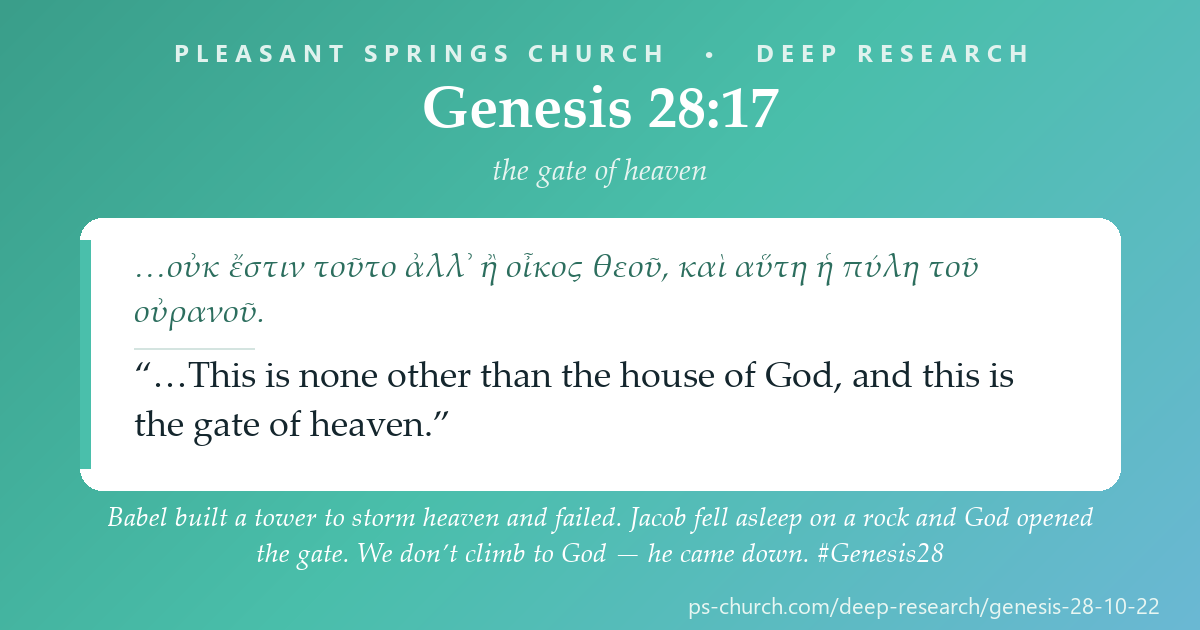
The Torah of Moses shows grace finding Jacob at rock bottom: fleeing his brother’s murderous anger, alone in the wilderness at nightfall. There God gives him a dream — a stairway joining earth to heaven, with angels traveling up and down, and the Lord himself renewing the Abrahamic promise: land, offspring “like the dust,” blessing to all families, and — new and tender — “I am with you… I will not leave you.” Jacob wakes in awe: “Surely the Lord is in this place, and I did not know it… this is the gate of heaven.”
The answer to Babel. Babel built a tower to force a way to heaven and make a name; God confused it. Here God freely opens the true gate — and it is a gift, not an achievement. Heaven touches earth where God chooses to come down.
Audience
Israel — who would worship at Bethel (“house of God”) and knew this as the founding vision of God’s presence with the patriarchs. To a people often in exile and on the run, the promise lands: God is with his own wherever they go, and will bring them home.
How they heard it. God meets us not because we have climbed to him but because he descends to us — at our lowest, in the wilderness, with a stone for a pillow. The place of the vision is “none other than the house of God”: wherever God reveals himself is holy ground and an open gate.
Orient on Bethel, the ladder, and the divine presence.
Search by topic: Bethel, ladder/stairway, dream theophany, sacred pillar, gate of heaven.
Which articles are relevant?
- Anchor Bible Dictionary — “Bethel,” “Jacob,” “Dreams,” “Pillar (Massebah).”
- Dictionary of the OT: Pentateuch — “Jacob,” “Sacred Space,” “Theophany.”
- NIDOTTE / TDOT — סֻלָּם (sullām, ladder), שַׁעַר (šaʿar, gate), מַצֵּבָה (maṣṣēḇâ, pillar).
Bibliography surfaced:
- Wenham, Genesis 16–50 (WBC); Hamilton (NICOT); Sarna (JPS).
- John Walton, Genesis (NIVAC) — the ziggurat/stairway background of the sullam.
- G. K. Beale, The Temple and the Church’s Mission — Bethel as sacred space and gateway.
The stairway of the gods, and the gate that answers Babel.
Read the ladder against Mesopotamian temple-architecture, then note the Second-Temple and Johannine development of the vision.
Which parallels shed light on religion and worldview?
The stairway. The Hebrew סֻלָּם pictures not a rung-ladder but a ramp or stairway — likely a ramp or stairway, evoking the shape of a Mesopotamian ziggurat, whose stairs were thought to let the gods descend to the temple at its foot. Genesis takes the ziggurat idea and transfigures it: the true stairway is God’s gift, and the traffic is God’s angels, moving at his bidding — the exact answer to Babel’s failed tower.
- Mesopotamian ziggurat texts — the temple-stairway by which the gods were thought to come down: the cultural form Genesis 28 fills with the true God’s free descent.
- Jubilees 27:19–27 (Pseudepigrapha — a witness, not Scripture) — retells the Bethel vision and Jacob’s vow.
- Targums on 28:12 (Neofiti, Ps-Jonathan — later rabbinic-era) — the angels ascend and descend to see Jacob, whose image/face is engraved on the heavenly throne: an early reading that makes Jacob the focal point of heaven’s attention.
- Philo, On Dreams 1.133–159 — allegorizes the ladder as the soul’s ascent and the ranks of angels: the Hellenistic-Jewish reading.
The New Testament’s reading is breathtaking. To Nathanael, Jesus says: “You will see heaven opened, and the angels of God ascending and descending on the Son of Man” (John 1:51) — alluding to Genesis 28:12 and putting himself where the ladder was. Jesus is the stairway, the “gate of heaven,” the one place where earth and heaven meet and the traffic of God flows. Babel could not build a way up; Jacob was given a gate; and the gate turns out to be a Person — “I am the way” (John 14:6), the one Mediator between God and men (1 Tim 2:5).
The vocabulary of stairway, presence, and gate.
Watch the unique “ladder,” the “I am with you,” the “house of God,” and the “gate of heaven” that answers Babel.
“Ladder / stairway” — a word found only here (hapax); likely a ramp like a ziggurat’s stair. The link between earth and heaven — fulfilled in Christ (John 1:51).
“Angels of God” — ascending and descending (ascending first: already at work on earth). Heaven’s active commerce with earth, under God’s hand.
“I am with you” — the heart of the promise, running to “Immanu-el” (Isa 7:14) and “I am with you always” (Matt 28:20).
“Bethel — house of God” — the place named for the presence. Wherever God reveals himself becomes his house and holy ground.
“The gate of heaven” — the true door Babel (“gate of god”) failed to force. Opened by God, embodied in Christ.
“Pillar” — Jacob’s stone set up and anointed with oil as a memorial of the vision: the first marker of a place where heaven touched earth.
How the New Testament reuses Jacob’s ladder:
- John 1:51 — “you will see heaven opened, and the angels of God ascending and descending on the Son of Man”: Jesus is the ladder of Genesis 28, the meeting-place of heaven and earth.
- John 14:6; 1 Timothy 2:5; Hebrews 10:19–20 — “I am the way”; the one Mediator; the “new and living way” opened into God’s presence.
- Matthew 28:20; Hebrews 13:5 — “I am with you always”; “I will never leave you”: Bethel’s promise made the church’s.
- Revelation 21:2–3, 22 — the city where “the dwelling place of God is with man” and its temple “is the Lord God the Almighty and the Lamb”: the gate of heaven flung wide forever.
From Bethel’s gate to the open heaven.
Trace the “gate of heaven,” the “I am with you,” and the mediator theme — then note the Beale & Carson trajectory at John 1.
Which cross-references matter?
- Genesis 11:1–9 — the tower that failed to reach heaven and became “babble”: the deliberate foil to Bethel’s given gate.
- Genesis 12:1–3; 35:1–15 — the Abrahamic promise renewed to Jacob, and Bethel revisited.
- Isaiah 7:14; Matthew 1:23 — “Immanuel, God with us”: the “I am with you” of Bethel becoming a name.
- John 1:51 — the angels on the Son of Man: Jesus the ladder; John 2:19–21 — his body the true temple/house of God.
- Revelation 4:1; 21:2–3 — the open door in heaven and the descent of God’s dwelling to earth: the gate of Bethel opened forever.
The commentary’s John treatment reads 1:51 as a direct claim on Genesis 28: Jesus replaces Bethel’s stairway as the locus of God’s presence — the true “house of God” and “gate of heaven.” Where Jacob found a place where heaven touched earth, the disciples find a Person. The whole Bethel theology — God present, the way opened, angels serving, “I am with you” — is gathered onto the incarnate Son, until in the end “the dwelling of God is with man” and the gate never closes (Rev 21:3, 25).
The scholarship on Bethel and the ladder.
Walton for the ziggurat/stairway background; Beale for the sacred-space theology; the commentaries for the narrative.
Commentaries & studies:
- Wenham (WBC), Hamilton (NICOT), Sarna (JPS), von Rad; John Walton, Genesis (NIVAC).
- G. K. Beale, The Temple and the Church’s Mission; C. Houtman, “What Did Jacob See in His Dream at Bethel?” (VT).
- On John 1:51: the standard John commentaries (Carson, Keener, Köstenberger).
Interpretation notes worth keeping:
- The sullām is a stairway/ramp (Walton), evoking the ziggurat — but with the theology inverted: God descends by grace, not summoned by human building.
- Bethel answers Babel — “gate of god” (Bab-ilu) that failed vs. the true “gate of heaven” that God opens: a widely noted and fruitful contrast.
- John 1:51 is the interpretive key: the NT is most often read as identifying the ladder with Christ (some read Jesus as the new Bethel), making Genesis 28 a Christ-centered text about mediated access to God.
From Bethel to your own wilderness.
Name what you learned, why it matters, and one concrete response.
What should we carry away — and do?
- God meets you at the bottom. Jacob had a stone for a pillow and a brother wanting him dead — and there heaven opened. God’s gate is often found in the wilderness, not on the mountaintop of our success.
- The gate is a gift, not a climb. Babel built and failed; Jacob slept and received. We do not ascend to God; he descends to us — finally in Christ, the ladder let down from heaven.
- ‘I am with you.’ The core of Bethel’s promise is presence — “wherever you go… I will not leave you.” It runs straight to “I am with you always” (Matt 28:20).
Step in response: in your own wilderness this week, look for the open gate — name one “stone for a pillow” place where God is nearer than you knew — and go to God not by climbing but through the Ladder he provided, Jesus, “the way.”
Genesis 28:17 · to share
LXX + ESVEvery Deep Research page traces its passage across the whole sweep — the Old Testament, the Second-Temple world between the testaments (historical witnesses, not Scripture), and the New Testament. Follow the thread:
Pleasant Springs Church — Deep Research
Research method after Michael S. Heiser’s Bible Research Method (examine dictionaries → ancient literature → important words → textual connections → academic publications → share), with the Pleasant Springs “Author & Audience” foundation. Scripture set in the Hebrew, the Greek editions named on each page and the ESV (Old Testament), and the Greek New Testament and the ESV (New Testament), per the practice of Pleasant Springs Church. Genesis 28:10–22 research grounded in Wenham, Hamilton, Sarna, Walton, and Beale; Mesopotamian ziggurat-stairway background; Second-Temple material per Jubilees 27, the Targums, and Philo (read as witnesses, not Scripture).
Scripture quotations marked ESV are from the ESV® Bible (The Holy Bible, English Standard Version®), © 2001 by Crossway, a publishing ministry of Good News Publishers. ESV Text Edition: 2016. Used by permission. All rights reserved. The ESV text may not be quoted in any publication made available to the public by a Creative Commons license, and the ESV may not be translated in whole or in part into any other language. www.esv.org
|
Did this study bless you today? 💚 Give to Support PS Church100% of gifts go to the General Fund — thank you. |