Jacob comes to a well in Haran and, for once, simply gives — rolling away the great stone, watering Rachel’s flock, weeping for joy. In love, he serves seven years that pass “as but a few days.” Then the reversal: on the wedding night Laban swaps in Leah, the elder, veiled in the dark, and morning brings the horror — “behold, it was Leah!” The deceiver of his blind father is deceived; the man who put the younger before the firstborn is told, “it is not done… to give the younger before the firstborn.” Sowing and reaping, God’s ironic and gracious providence, and the unloved wife whose son Judah will carry the promise. This study works Genesis 29:1–30. See the method →
Genesis 29:11, 14, 20, 25, 26
Hebrew · LXX · ESVThe Shape of the Passage
Type-sceneThe man who deceived his blind father in the dark, wearing another’s clothes, is deceived in the dark by another wearing the bride’s veil. Genesis does not moralize; it lets the mirror do the work.
Author
Moses lays this chapter directly against the two before it. In Genesis 27 Jacob, prompted by Rebekah, put on Esau’s garments and goatskins and deceived a father who could not see, stealing the blessing of the firstborn; Isaac trembled, “Your brother came deceitfully (be-mirmah), and he has taken away your blessing” (27:35). In Genesis 28, fleeing for his life, Jacob met God at Bethel — the ladder, the promise, the vow. Now, in Genesis 29, the schooling begins. Arriving at Haran, Jacob meets Rachel at a well — the Bible’s second betrothal type-scene (after Rebekah, 24; before Zipporah, Ex 2) — and the man who has always grasped now, for once, simply gives: he rolls the great stone away alone, waters her flock, and weeps for joy. He loves, and seven years feel like “a few days” (29:20). The narrator lets him savor it — and then springs the trap.
The deceiver deceived. Laban, no less a schemer than his nephew, exploits the dark and the veil to substitute the elder daughter, Leah, for the younger, Rachel. Jacob wakes to Scripture’s most economical horror: “in the morning, behold, it was Leah!” (29:25). His protest — “why then have you deceived me?” (rimmitani, the same root as the mirmah of 27:35) — is answered by Laban with an aphorism that could have been engraved over Jacob’s whole life: “it is not done in our country, to give the younger (ha-tze’irah) before the firstborn (ha-bekhirah)” (29:26). Jacob had done exactly that — put the younger before the firstborn, the bekhirah before the bekhorah — and the words fall like a verdict. This is not God endorsing Laban’s fraud; deception here is recorded and condemned, Laban’s greed exposed in the same breath. But the sovereign hand that never sanctions the sin still governs through it: Jacob reaps in the currency he spent (Gal 6:7), and is disciplined by a mirror he cannot look away from.
The loved and the unloved. Jacob serves seven more years and gets Rachel too, “and he loved Rachel more than Leah” (29:30). The wound in that sentence will shape the rest of Genesis — the ache of the unloved wife (29:31–35), the rivalry of the sisters, the favoritism that will nearly destroy Joseph. Yet the narrator has already tipped his hand: it is Leah, the unwanted one, whom God will visit first (“the Lord saw that Leah was hated,” 29:31), and from Leah’s fourth son, Judah — “this time I will praise the Lord” (29:35) — the royal, messianic line will come (49:10; Ruth 4:18–22; Mt 1:2–3). The chapter that begins with the loved wife ends by quietly seeding the promise in the tent of the unloved.
Audience
Israel — the nation descended from these very sons — heard its own family conceived in this chapter, with all its fault lines intact. The twelve tribes are born of a marriage founded on a fraud and strained by a rivalry, and Scripture does not airbrush it: Leah and Rachel, the wanted and the unwanted, Bilhah and Zilpah, jealousy and mandrakes and the counting of sons. Israel learned that it existed not because its founders were admirable but because God kept covenant through a tangle of sin and sorrow — and that the God who let Jacob taste his own deception was, in the same providence, building the tribes and hiding the scepter of Judah in the womb of the wife nobody chose.
Sowing, reaping, and the mercy underneath. For the church, Genesis 29 is the clearest early sounding of a law Paul will name outright: “God is not mocked, for whatever one sows, that will he also reap” (Gal 6:7). Jacob’s discipline is not vengeance but fatherly correction — the Lord loving a chosen man enough to let him feel, from the receiving end, what deceit does. And under the discipline runs mercy: the God who chose Jacob (Rom 9:10–13) does not abandon him to his reaping but works even Laban’s cheat toward the twelve tribes and, through despised Leah, toward the Messiah. The election is real and gracious; the human responsibility is real and painful; and the promise advances not by rewarding the strong but by remembering the unloved — “he has looked on the humble estate” (Lk 1:48) begins here, in a well-lit morning and a woman named Leah.
Orient on Haran, the betrothal type-scene, bride-price and marriage custom, Leah, Rachel, and Laban.
Search by topic: Haran / Paddan-aram, Laban, Leah, Rachel, marriage and bride-price (mohar), betrothal, wells, Jacob.
Which articles are relevant?
- Anchor Bible Dictionary — “Laban,” “Leah,” “Rachel,” “Haran,” “Marriage,” “Bride-Price.”
- Dictionary of the OT: Pentateuch — “Jacob,” “Marriage,” “Type-Scenes,” “Family.”
- NIDOTTE / TDOT — ramah (deceive), mirmah (deceit), bekhorah (birthright) & bekhirah (firstborn, fem.), ’ahev (love), sane’ (hate/be unloved).
Bibliography surfaced:
- Gordon Wenham (WBC), Victor Hamilton (NICOT), Kenneth Mathews (NAC), Bruce Waltke, Nahum Sarna (JPS) on Genesis.
- Robert Alter, The Art of Biblical Narrative (the betrothal type-scene; measure-for-measure design in the Jacob cycle).
- Studies of ancient Near Eastern marriage, bride-service, and the Nuzi/Mari family texts.
Bride-service, the veiled bride, and the well type-scene that turns on a trick.
Read the well scene, the marriage bargain, and the night-swap against ancient custom and the Jacob cycle’s deliberate symmetry.
Which parallels shed light on the world and the design?
Bride-service instead of bride-price. Marriage in the ancient Near East normally required a mohar, a bride-price paid to the woman’s father. Jacob arrives a refugee with empty hands, so he pays in the only coin he has — seven years’ labor (29:18), a bride-service arrangement attested in the wider ancient world and open to precisely the abuse Laban works on him. Custom gave the father the upper hand, and Laban, “my bone and my flesh” on his lips and profit in his eye, plays it ruthlessly: he collects the labor, then leverages the wedding feast and the “custom of the place” (29:26) to bind Jacob to a second seven-year term. What the narrative exposes is not a quaint usage but a schemer using law and love as instruments.
The veiled bride and the covering dark. How is such a substitution possible? Ancient wedding custom shrouded the bride: she was heavily veiled (cf. Rebekah, 24:65), the feast ran into night, and the bridal chamber was dark. Interpreters since antiquity have caught the exact reversal — Jacob had exploited his father’s blindness and the touch of a disguise (goatskins, Esau’s garments, 27:16, 23) to steal a blessing; now the dark and a veil and the failure of recognition are turned against him. Josephus frankly says Jacob was deceived “being in drink and in the dark” (Ant. 1.301–302). The design is not accidental. The Jacob cycle is built on measure-for-measure symmetry: the grasper of heels is grasped; the deceiver is deceived; the younger who displaced the elder is handed the elder in the younger’s place.
The well type-scene, bent toward reversal. A young traveler at a foreign well, a shepherdess drawing water, a feat of strength, a kiss and tears, a rush home, a welcome — every beat of the betrothal type-scene (Gen 24; Ex 2:15–21) is here, and an ancient audience would have felt the romance building toward a wedding. That is exactly why the swap lands so hard: the convention promises the beloved, and the plot delivers her sister. The Bible uses the familiar shape to spring an unfamiliar lesson — love is real, labor is light, and the man still reaps what he sowed. Providence writes in the grammar of ordinary custom (bride-service, veils, feasts, the rights of the firstborn), and the God who never blesses the fraud nonetheless rules the outcome all the way to the twelve tribes.
- Genesis 24:11–27; Exodus 2:15–21; John 4:1–30 — the betrothal-at-the-well type-scene, here bent toward reversal.
- Genesis 25:26; 27:1–36 — the heel-grasper and the deceit of the blind father: the sins the chapter mirrors back (be-mirmah, 27:35 ↔ rimmitani, 29:25).
- Jubilees 28:1–10; Josephus, Antiquities 1.301–302 — Second-Temple retellings of Laban’s swap (historical witnesses, not Scripture).
The genius of the Jacob narrative is its moral symmetry, and Genesis 29 is its hinge. Consider how precisely the wedding-night deception answers the blessing-theft of Genesis 27. There, a younger son impersonated the firstborn to fool a father who could not see, exploiting darkness of the eyes and the deceit of touch and clothing to obtain what was not his by birth. Here, an elder daughter is passed off for the younger to fool a bridegroom who cannot see, exploiting the darkness of night and the concealment of the veil so that the man who overturned the rights of the firstborn is himself made to honor them — ‘it is not done in our place to give the younger before the firstborn.’ The very word that condemned Jacob in his father’s tent, mirmah, deceit, returns on his own tongue as an accusation against Laban: rimmitani, ‘you have deceived me.’ The narrator offers no comment, no moral tag — the symmetry is the comment. And this is how the Bible characteristically teaches ethics: not by aphorism laid over the story but by a structure built into it, so that the reader feels the justice before he can name it. Jacob has met, in Laban, a mirror; and the God who chose him has arranged the mirror — not to destroy the chosen man but to break the deceiver in him and make, out of the breaking, a father of the tribes. What a man sows he reaps; and grace does its deepest work not by sparing us that harvest but by redeeming it.
The vocabulary of the trap: love that lightens labor, and deceit that circles home.
Watch the joy at the well, the kinship formula, the love that shrinks the years, the morning’s dreadful behold, and the deceit-words (rimmitani, bekhirah) that turn Jacob’s own sins into his sentence.
“And he wept” — the grasping man is undone by love and kinship; his first act at the well is strength (rolling the stone), his second is tears. For once Jacob takes nothing and simply gives (cf. the joy of arrival, Ps 126:5–6).
“My bone and my flesh” — the kinship-covenant formula (Gen 2:23; Judg 9:2; 2 Sam 5:1). On Laban’s lips it is warm welcome and, soon, cold leverage: family language weaponized for profit.
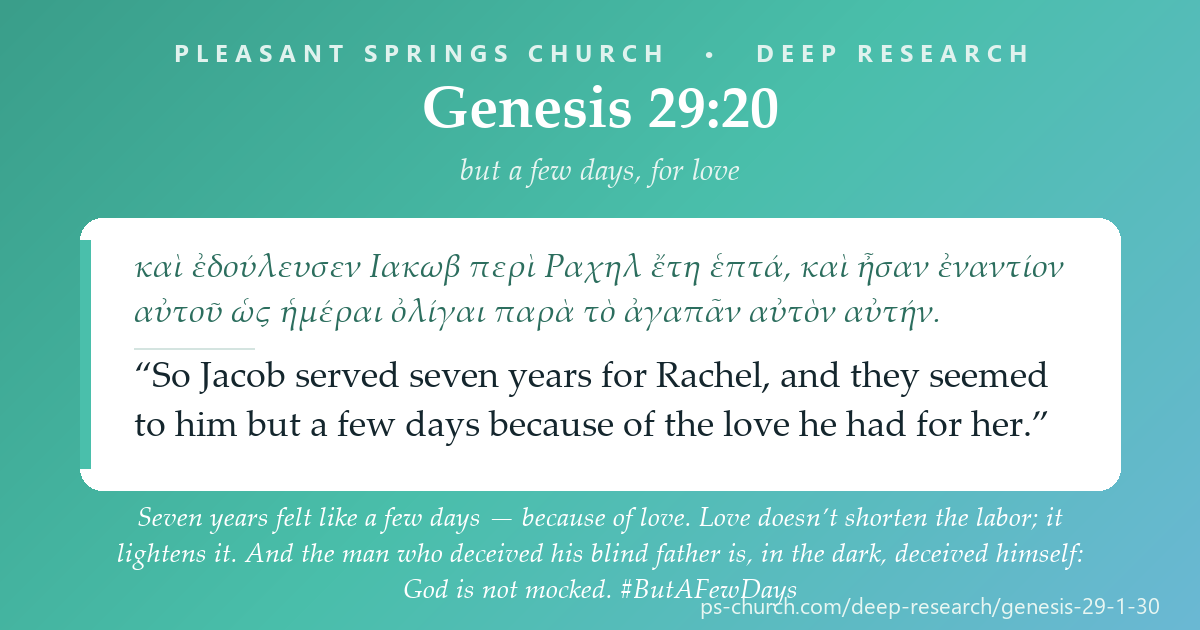
“Because of the love he had for her” — the reason seven years passed “as but a few days.” Love does not shorten the labor; it lightens it. A rare window into Jacob’s heart, and the Bible’s tenderest line on love that waits (cf. 1 Cor 13:7).
“And behold, it was Leah!” — the morning hinneh of dismay. The same particle of sudden discovery that runs through the cycle; Jacob who once answered his father’s blind touch now suffers his own failure to see.
“You have deceived me” — root ramah, cognate to mirmah, the very word Isaac used of Jacob: “your brother came deceitfully” (27:35). The deceiver hears his own indictment from the other side.
“The firstborn” (fem.) — Laban’s “younger before the firstborn” (ha-tze’irah lifne ha-bekhirah) rings against the bekhorah, the birthright Jacob seized (25:31–34; 27:36). An unwitting rebuke of Jacob’s whole career.
How the rest of Scripture fills out the scene:
- Genesis 27:35–36; 25:26, 31–34 — mirmah and the birthright: the deeds Genesis 29 answers, word for word (rimmitani; bekhirah / bekhorah).
- Galatians 6:7; Hosea 8:7; Obadiah 15; Judges 1:6–7 — sowing and reaping; the measure a man metes returned to him: the moral law the story enacts.
- Genesis 29:31–35; 49:8–10; Ruth 4:18–22; Matthew 1:2–3 — the Lord sees the unloved Leah; from her son Judah comes the scepter and the Messiah.
- Deuteronomy 21:15–17 — the law protecting the firstborn of the “unloved” (senu’ah) wife: the same word as Leah’s (29:31), and a quiet dignity restored.
From a well in Haran to the harvest law of Galatians and the tribe of Judah.
Trace the mirrored deception, the sowing-and-reaping law, and the unloved wife whose son carries the promise.
Which cross-references matter?
- Genesis 27:1–36 ↔ 29:15–26 — the blessing-theft answered by the bride-swap: darkness, disguise, mistaken identity, and the rights of the firstborn, exactly reversed.
- Genesis 31:6–42; 30:25–43 — Laban keeps cheating (wages changed ten times), and Jacob, now on the receiving end of trickery for twenty years, is refined by it.
- Galatians 6:7–9; 2 Corinthians 9:6; Job 4:8 — “whatever one sows, that will he also reap”: the New Testament naming of the law Genesis 29 dramatizes.
- Deuteronomy 21:15–17 — the Torah later shields the firstborn of the hated wife: God’s regard for the unloved, written into law.
- Genesis 29:35; 49:8–12; Ruth 4:18–22; Matthew 1:2–3; Hebrews 7:14 — Judah, Leah’s fourth son: the royal and messianic line springs from the wife Jacob did not choose.
It is essential to read Genesis 29 as the discipline of a chosen man, not the abandonment of him. Nothing in the chapter suggests that Jacob’s election is in doubt; the God of Bethel who promised ‘I am with you and will keep you wherever you go’ is present in every verse, precisely in the trouble. But election never cancels responsibility, and grace does not excuse the graceless from tasting what their conduct costs. Jacob had made deceit his instrument — against Esau, against Isaac — and now, for twenty long years, deceit will be the atmosphere he breathes: a father-in-law who swaps daughters, changes wages, and pursues him with grievances. This is not karma, an impersonal cosmic bookkeeping; it is fatherly correction, the Lord using Laban’s very sins to hold a mirror before a son he loves and refuses to leave as he is. And notice where the correction is aimed — not merely at Jacob’s comfort but at his character: the man who limps out of the far country in Genesis 33, weeping on Esau’s neck, is not the man who fled in Genesis 27. The night-swap of Leah is one of the first blows of that long, gracious hammering. Meanwhile the same providence that disciplines the father is quietly building the future: the unwanted wife becomes the mother of Judah, and the scepter that will not depart from between his feet is already, in the tears and the mandrakes of this bruised household, on its way. God writes straight with lines this crooked.
The scholarship on Genesis 29:1-30.
The commentators on the Jacob cycle; the studies of the type-scene, bride-service custom, and the narrative’s measure-for-measure ethics.
Commentaries & studies:
- Gordon J. Wenham (WBC), Victor P. Hamilton (NICOT), Kenneth A. Mathews (NAC), Bruce K. Waltke, Nahum M. Sarna (JPS) on Genesis.
- Robert Alter, The Art of Biblical Narrative and Genesis: Translation and Commentary (the type-scene; the Jacob cycle’s symmetry).
- Studies of ancient Near Eastern marriage, bride-service, and dowry custom (the Nuzi and Mari family texts).
Interpretation notes worth keeping:
- The mirror, not the sanction (29:23–26). Laban’s deceit is condemned, not endorsed; Jacob’s outrage is just. The narrative’s point is not that trickery is good but that Jacob is reaping his own — providence ruling through a sin it never approves.
- Laban’s aphorism (29:26). “The younger before the firstborn” is dramatic irony at its sharpest: the customary defense of primogeniture is spoken to the one man who trampled it. The reader hears the sentence Jacob cannot.
- Leah, not a footnote. The chapter’s apparent loser is its hidden heroine: God “saw” her (29:31), and through her come Levi (priesthood) and Judah (kingship and Messiah). Do not read her as mere obstacle to the romance.
- Love that waits (29:20). “A few days because of the love he had for her” is not naivety about labor but a true note on love’s power to make long service light — a text the church has rightly cherished (1 Cor 13:7; cf. Jn 15:13).
- Guarding the typology. Devotional readings (Leah/Rachel as law/grace, or as the unloved and loved brought into one house) can edify, but hold them as analogy resting on the plain sense — a disciplined family narrative of sin, discipline, and covenant mercy — not as the text’s literal claim.
From a swapped bride to the harvest law — and the mercy that redeems the reaping.
Name what you learned, why it matters, and one concrete response.
What should we carry away — and do?
- We reap what we sow. Jacob the deceiver is deceived; the man who put the younger before the firstborn is handed the elder in the younger’s place. God is not mocked (Gal 6:7) — and he loves us too much to spare us the mirror.
- Discipline is not rejection. The chosen man is not abandoned to his reaping; he is corrected within it. The God of Bethel stays present in the very trouble, hammering a grasper into a father of the tribes.
- God sees the unloved. The wife nobody chose is the one the Lord visits first — and from Leah comes Judah, and the Messiah. Providence advances not by rewarding the strong but by remembering the humble estate.
Step in response: name one place where you are, quietly, being “Jacob” — managing, angling, shading the truth to secure a blessing you could ask for honestly — and lay down the deceit before it circles back. Then name one “Leah” in your world: the overlooked, the unchosen, the one it costs nothing to ignore — and this week see them as God does, first. And if you are in a long season of service that feels like seven years, ask the Lord for the one thing that made Jacob’s light: love — for the labor becomes bearable only when the heart is fixed on the one it is for.
Genesis 29:20 · to share
LXX + ESVEvery Deep Research page traces its passage across the whole sweep — the Old Testament, the Second-Temple world between the testaments (historical witnesses, not Scripture), and the New Testament. Follow the thread:
Pleasant Springs Church — Deep Research
Research method after Michael S. Heiser’s Bible Research Method (examine dictionaries → ancient literature → important words → textual connections → academic publications → share), with the Pleasant Springs “Author & Audience” foundation. Scripture set in the Hebrew, the Greek editions named on each page and the ESV (Old Testament), and the Greek New Testament and the ESV (New Testament), per the practice of Pleasant Springs Church. Genesis 29:1–30 research grounded in Wenham, Hamilton, Mathews, Waltke, and Sarna, with Robert Alter on the betrothal type-scene (Gen 24; 29; Ex 2) and the Jacob cycle’s measure-for-measure design; the chapter read as the discipline — not the rejection — of a chosen man: the deceit of 27:35 (be-mirmah) returning on Jacob’s own tongue (rimmitani, 29:25) and Laban’s “younger before the firstborn” (29:26) ringing against the birthright he seized (25:31–34; 27:36); “a few days because of the love he had for her” (29:20) honored as love that lightens long labor; Laban’s fraud recorded and condemned, never sanctioned, while God’s sovereign and gracious purpose (Rom 9:10–13) advances through it toward the twelve tribes and, through despised Leah’s son Judah, toward the Messiah (29:35; 49:10; Mt 1:2–3); the sowing-and-reaping law named at Galatians 6:7; devotional Leah/Rachel typology held as analogy on the plain sense, per the house discipline.
Scripture quotations marked ESV are from the ESV® Bible (The Holy Bible, English Standard Version®), © 2001 by Crossway, a publishing ministry of Good News Publishers. ESV Text Edition: 2016. Used by permission. All rights reserved. The ESV text may not be quoted in any publication made available to the public by a Creative Commons license, and the ESV may not be translated in whole or in part into any other language. www.esv.org
|
Did this study bless you today? 💚 Give to Support PS Church100% of gifts go to the General Fund — thank you. |