Eleven of Jacob’s twelve sons are born in this passage — Benjamin, the twelfth, follows later (35:16–18) — and with them the tribes of Israel take shape, cradled in a house of rivalry, jealousy, and grace. The Lord begins with the unloved wife: “When the Lord saw that Leah was hated, he opened her womb, but Rachel was barren.” Leah names her pain into her sons until worship breaks through — “This time I will praise the Lord” — and calls him Judah, the tribe of the Messiah. Rachel cries, “Give me children, or I shall die!”; at last “God remembered Rachel,” and Joseph is born. A broken, polygamous home — recorded, never endorsed — through which God builds a people. This study works Genesis 29:31–30:24. See the method →
Genesis 29:31, 35; 30:1, 22, 24
Hebrew · LXX · ESVThe Shape of the Passage
InclusioThe twelve tribes of Israel are not born in a palace or a temple, but in the ache of two sisters married to one man — because God delights to build his people out of the very places we would hide.
Author
Moses tells the origin of the twelve tribes with unflinching honesty. Jacob, tricked into marrying Leah before the Rachel he loved (29:23–28), now keeps a household divided down the middle: one wife “loved,” one “hated” (29:30–31) — the Hebrew senu’ah meaning not enmity but the lesser-loved, the passed-over (the very case Deut 21:15–17 later legislates to protect). Into that imbalance the narrator sets the first surprise: “the Lord saw that Leah was hated,” and the Lord — not Jacob, not custom — opened her womb while the beloved Rachel stayed barren (29:31). God’s hand moves against the household’s grain, toward the overlooked.
Naming as prayer and wound. Moses lets us hear each mother name her children out of her own heart. Leah’s first three names are a diary of longing for a husband’s love: Reuben (“the Lord has looked upon my affliction… now my husband will love me,” 29:32), Simeon (“the Lord has heard that I am hated,” 29:33), Levi (“now my husband will be attached to me,” 29:34). Then something breaks open: with Judah she looks past the husband to the Giver — “This time I will praise (’odeh) the Lord” (29:35). From that unloved wife’s worship comes the royal, messianic tribe. Rachel’s names carry a different wound: envy (30:1), then a bitter victory in the surrogate sons of Bilhah — Dan (“God has judged me”) and Naphtali (“with mighty wrestlings I have wrestled with my sister,” 30:6–8). Leah answers through Zilpah with Gad and Asher; the mandrakes are traded for a night (30:14–16); Issachar, Zebulun, and Dinah follow.
‘God remembered Rachel.’ After chapters of rivalry, the tone changes to sheer mercy: “Then God remembered Rachel, and God listened to her and opened her womb” (30:22). The verb zakar (“remembered”) is covenant language — God remembered Noah (8:1), would remember his covenant (Ex 2:24), would remember Hannah (1 Sam 1:19). It never means God had forgotten; it means he now acts. Joseph’s name is a double wordplay of relief and hope: ’asaph, “God has taken away my reproach,” and yosef, “may the Lord add to me another son” (30:23–24) — the barren woman’s grief turned to a prayer for more.
Audience
Israel read here its own family tree, and it is not flattering. The nation of twelve tribes was conceived in favoritism, jealousy, surrogate wives, and a bargain over love-plants — a home no catechism would design. Yet Israel also read the deeper truth stitched through every birth: the Lord was the one opening and closing wombs (29:31; 30:2, 22), and he showed a settled bias toward the unloved and the barren. Leah the passed-over becomes the mother of Judah (kings, Messiah) and Levi (priests); Ruth’s elders will one day bless a bride as one who builds “the house of Israel” alongside “Rachel and Leah” (Ruth 4:11). God writes redemption straight through a crooked household — recording its sin without ever blessing it.
The God who sees, hears, and remembers. For the church, this passage is a lifeline to everyone who has ever felt second-choice or shut out. Its three great verbs belong to God: he saw Leah’s misery (29:31), he heard that she was hated (29:33), he remembered Rachel (30:22) — the same mercy that would later hear Hannah (1 Sam 1) and Elizabeth (Lk 1:24–25) and Mary’s song of the humble lifted up (Lk 1:48–52). Jacob’s frustrated cry — “Am I in the place of God, who has withheld from you the fruit of the womb?” (30:2) — states the doctrine almost against his will: children, and every good thing, are gifts God alone gives (Ps 127:3). And the whole tangled story bends toward Bethlehem: from Leah’s praise-child Judah comes the Lion of the tribe of Judah (Gen 49:9–10; Rev 5:5), so that the Messiah’s own genealogy runs through the unloved wife — grace choosing the overlooked, as it always does.
Orient on the matriarchs, the barren-wife motif, polygamy, and Israelite naming.
Search by topic: Leah, Rachel, twelve tribes, barrenness, polygamy / concubinage, birth and naming, Judah, Joseph, mandrakes.
Which articles are relevant?
- Anchor Bible Dictionary — “Leah,” “Rachel,” “Tribes of Israel,” “Marriage,” “Concubine,” “Names (Personal).”
- Dictionary of the OT: Pentateuch — “Jacob,” “Women,” “Family,” “Birth,” “Barrenness.”
- NIDOTTE / TDOT — sane’ (hate/love-less), ’aqarah (barren), zakar (remember), yadah (praise, → Judah), ’asaph / yasaph (gather / add, → Joseph).
Bibliography surfaced:
- Gordon Wenham (WBC), Victor Hamilton (NICOT), Kenneth Mathews (NAC), Bruce Waltke, Nahum Sarna (JPS) on Genesis.
- Studies of the barren-matriarch type-scene (Sarah, Rebekah, Rachel, Hannah) and of the birth-and-naming report form.
- Ancient Near Eastern marriage law (Code of Hammurabi §144–146; the Nuzi tablets) on the barren wife and the handmaid.
The unloved wife, the surrogate mother, and the God who opens the womb.
Read the rivalry, the surrogacy, and the naming-speeches against ancient family custom and the Bible’s theology of the God who gives life.
Which parallels shed light on religion and worldview?
The loved and the unloved wife. Polygamy was legal and common in the ancient world, and its bitterest fruit was exactly what Genesis records: a household split between a favored wife and a slighted one. Israel’s own law would later step in precisely here — Deuteronomy 21:15–17 protects the firstborn of “the unloved” (senu’ah, the same word as Leah’s) from a father’s favoritism. Genesis does not present Jacob’s divided home as an ideal; it shows the ache it breeds. And into that ache the narrator sets God’s counter-move: the Lord takes the side of the passed-over woman, opening Leah’s womb precisely because she is loved less (29:31). Scripture’s quiet judgment on favoritism is that God Himself favors its victim.
The barren wife and the handmaid. When Rachel, barren, gives her servant Bilhah to Jacob “that… even I may have children through her” (30:3), she is following a recognized ancient custom — the same one Sarah used with Hagar (16:2), and one attested in Mesopotamian marriage contracts (Code of Hammurabi §144–146; the Nuzi tablets), where a childless wife could provide a slave to bear on her behalf, the child counted as the wife’s “on the knees” (30:3). The narrative reports the practice without commending it: it comes freighted with the same jealousy and heartbreak that Hagar’s story carried. Here again is the house discipline of Genesis — the customs of the age are recorded faithfully, and their wounds are never hidden, but God’s purpose advances through them rather than being sanctioned by them.
Naming-speeches and the mandrakes. In the ancient Near East a name was a word about the world; Israelite birth-reports regularly pair a name with an explanatory speech built on a pun (a folk-etymology that carries the theology, not a lexicon entry). So Leah’s Reuben (re’u ben / “he has seen my affliction”), Judah (’odeh, “I will praise”), and Rachel’s Joseph (’asaph / yasaph) turn each cradle into a confession. Even the mandrakes (duda’im, 30:14–16) — a plant folklore prized as an aphrodisiac and fertility charm — are woven in with irony: the sisters bargain over the love-plant, yet the text is careful to say it is God who then opens the womb (30:17, 22), not the mandrakes. The old superstition is quietly overruled by the living God.
- Genesis 16:1–4; 21:1–3; 25:21 — Sarah & Hagar, Isaac promised, Rebekah’s prayed-for conception: the matriarchs and the God who opens the womb.
- Deuteronomy 21:15–17 — the law of the loved and the unloved (senu’ah) wife: Israel legislating against the favoritism Genesis 29 records.
- 1 Samuel 1:1–20; Luke 1:5–25, 46–55 — Hannah and Elizabeth: the barren-remembered pattern reaching toward Christmas and the Magnificat.
There is a theology hidden in the order of these births, and it runs against every human instinct. The husband loves Rachel; God opens Leah. The world’s eye is on the beautiful, chosen, barren favorite; God’s eye is on the plain, unchosen, fertile reject — ‘the Lord saw that Leah was hated.’ That single clause overturns the whole scale of value the household has been running on. And it is not sentiment: from this unloved wife will come Levi, the priestly tribe, and Judah, the royal and messianic tribe — the two lines through which Israel would meet God and its king. The favored Rachel waits years, and even then bears the son whose glory will be won only through betrayal, slavery, and prison. Genesis is teaching Israel, and us, to distrust the household’s scale entirely. God is not impressed by who is loved best, chosen first, or envied most; he moves, again and again, toward the one who has been passed over — the younger, the barren, the slave, the unloved — and makes her the mother of promise. The naming-speeches let us overhear two women in real pain, one aching to be loved, one aching to bear, and the narrator refuses to tidy either grief. But over both he writes the same three verbs: God saw, God heard, God remembered. That is the gospel in the nursery: not that the home was holy, but that the God who presided over it was faithful — and that he still builds his people, tribe by tribe and soul by soul, out of exactly the lives the world overlooks.
The vocabulary of the nursery: hated, praise, envy, remembered, and added.
Watch “hated” (loved-less), Judah’s “I will praise,” Rachel’s “envied,” Jacob’s “place of God,” the covenant “remembered,” and Joseph’s “taken away / add.”
“Hated” — not enmity but loved less, the passed-over wife (contrast “loved,” 29:30). The same word the law uses to protect the unloved wife’s son (Deut 21:15–17). God sides with her.
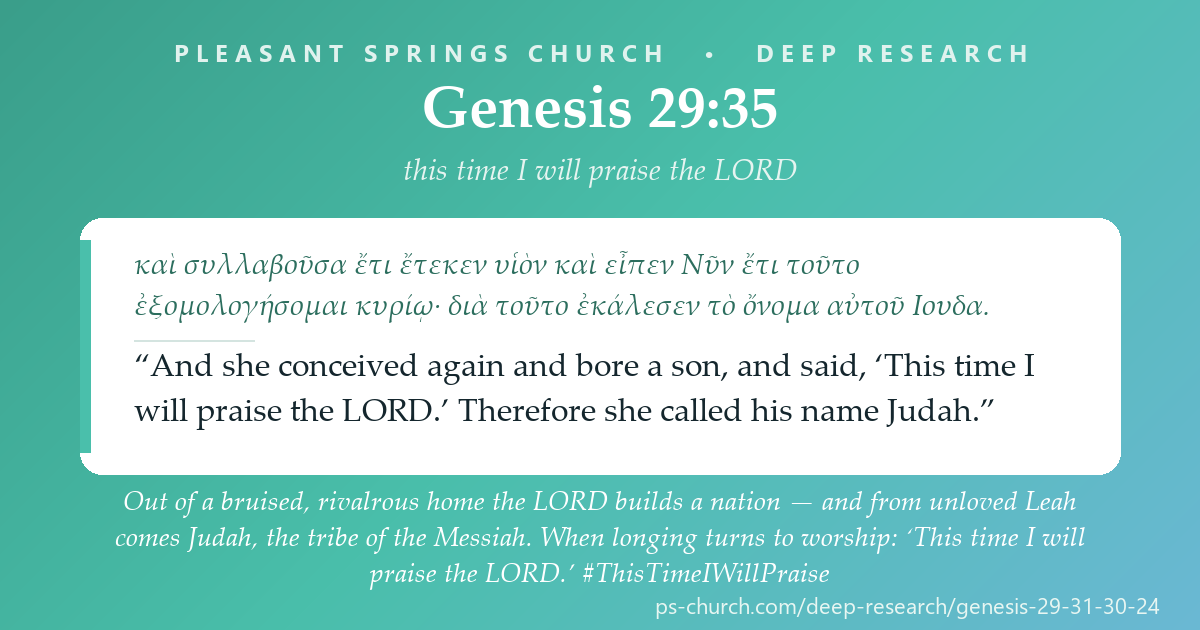
“I will praise” — from yadah, giving the name Judah (Yehudah). Leah’s fourth child turns longing into worship; from her praise comes the tribe of David and the Messiah (Gen 49:8–10; Mt 1:2–3).
“She envied” — Rachel’s jealousy of her fruitful sister, boiling over into “Give me children, or I shall die!” The rivalry is recorded plainly; the covenant grows through sinners, not saints.
“Am I in the place of God?” — Jacob’s angry retort states the doctrine sideways: only God gives “the fruit of the womb” (Ps 127:3). His son Joseph — born at the close of this passage (30:24) — will echo the phrase in grace (50:19).
“God remembered” — zakar, covenant remembrance: not that God forgot, but that he now acts (Gen 8:1; Ex 2:24; 1 Sam 1:19). The turning point from rivalry to mercy.
Joseph’s double name: God has taken away (’asaph) my reproach — and “may the Lord add (yasaph) another son.” Grief relieved becomes a prayer for more.
How the rest of Scripture fills out the scene:
- Genesis 49:8–10; Matthew 1:2–3; Revelation 5:5 — from Leah’s praise-child Judah come David’s scepter and the Lion of Judah: the unloved wife in the Messiah’s own line.
- Genesis 8:1; Exodus 2:24; 1 Samuel 1:19–20 — zakar, God “remembered”: covenant memory that acts — Noah, the enslaved, the barren Hannah, and here Rachel.
- Deuteronomy 21:15–17; Ruth 4:11 — the unloved (senu’ah) wife protected in law, and Leah honored beside Rachel as builder of “the house of Israel.”
- Psalm 113:9; 127:3; Luke 1:24–25, 46–55 — the barren given a home, children as God’s gift, and the Magnificat’s God who lifts the lowly: this passage’s theology sung.
From twelve cradles in Paddan-aram to the twelve tribes of the Lamb.
Trace the twelve sons, the messianic tribe of Judah, and the God-who-remembers toward their New Testament fulfillment.
Which cross-references matter?
- Genesis 35:16–26; 49:1–28 — Benjamin’s birth completes the twelve; Jacob’s deathbed blessing gathers the sons born here into the tribes — Judah’s scepter, Levi’s scattering, Joseph’s fruitfulness.
- Exodus 1:1–7; Numbers 1 — the twelve names of this nursery become the roll of a nation: the households of Leah, Rachel, Bilhah, and Zilpah multiplied into Israel.
- Genesis 30:22 ↔ 1 Samuel 1; Luke 1 — the barren-remembered pattern: Rachel, then Hannah, then Elizabeth — and Mary’s song of the humble exalted (see the God who leads the way home).
- Jeremiah 31:15; Matthew 2:18 — “Rachel weeping for her children”: the mother whose birth-cry opened here becomes, in the prophets, the voice of Israel’s grief and, at last, of hope beyond exile.
- Matthew 1:2–3; Revelation 7:4–8; 21:12 — Judah heads the Messiah’s genealogy; the twelve tribes’ names are sealed on God’s people and written on the gates of the city.
It would be hard to invent a less promising cradle for the people of God than the one Genesis actually describes. The twelve tribes are born to four women who never chose one another, in a marriage founded on a deception, amid a jealousy so raw that one sister flings at her husband, ‘Give me children, or I shall die,’ and he flings back, ‘Am I in the place of God?’ There are surrogate wives, traded love-plants, and naming-speeches that read like open wounds. And yet — this is the wonder — the narrator never moralizes and never despairs. He simply keeps naming the true actor. God saw Leah. God heard Leah. God remembered Rachel. The sons multiply not because the home is healthy but because the Lord is faithful to a promise older than the household’s sins. This is enormously freeing for the church. We are not asked to pretend our families are holy in order to believe God is at work in them; the tribe of Judah, from which the Messiah came, was carried in the womb of the wife nobody wanted, and named in a burst of praise from a woman starved for love. If God can build the line of Christ through this house, he can build his purposes through ours — not by blessing the sin, which he never does, but by refusing to abandon the sinners, which he never has. Every reader who has felt overlooked, second-chosen, or barren of what they most longed for is meant to find, in Leah’s praise and Rachel’s remembered prayer, the God who sees, hears, and remembers still.
The scholarship on Genesis 29:31-30:24.
The commentators on the birth narrative; the studies of the barren-matriarch motif, ancient marriage custom, and the naming-speeches.
Commentaries & studies:
- Gordon J. Wenham (WBC), Victor P. Hamilton (NICOT), Kenneth A. Mathews (NAC), Bruce K. Waltke, Nahum M. Sarna (JPS) on Genesis.
- Robert Alter on the birth type-scene and biblical naming; studies of the barren-matriarch motif (Sarah, Rebekah, Rachel, Hannah).
- Ancient Near Eastern law and custom on the barren wife and surrogate handmaid (Code of Hammurabi §144–146; the Nuzi tablets).
Interpretation notes worth keeping:
- ‘Hated’ is comparative (29:31, 33). Senu’ah means loved-less, not despised with hatred (cf. Deut 21:15; Mal 1:2–3; Lk 14:26, where “hate” likewise means “love less”). Leah is the passed-over, not the reviled — and God takes her side.
- The naming etymologies are theology, not linguistics. The puns (Reuben, Judah, Dan, Joseph) are folk-etymologies that voice each mother’s faith and pain; they are not strict philological derivations, and should be read for their confession, not dissected as lexicography.
- Polygamy and surrogacy are recorded, not endorsed. Bilhah and Zilpah’s childbearing follows a known custom (cf. Hagar, Gen 16); Genesis narrates its jealousy and cost without approval. God’s purpose runs through the sin it never sanctions — the house discipline throughout this library.
- The LXX at 30:24. Where the Hebrew reads “may the Lord (YHWH) add,” the Greek reads “may God (ὁ θεός) add” — a translator’s smoothing that does not alter the sense; the ESV rightly follows the Hebrew.
- Leah’s dignity, Rachel’s dignity. Neither sister is denigrated: Leah becomes mother of Judah and Levi and lies in the ancestral tomb (49:31); Rachel is loved to the end and wept for by the prophets (Jer 31:15). Scripture holds both women’s worth.
From an aching, rivalrous home to the God who sees, hears, and remembers.
Name what you learned, why it matters, and one concrete response.
What should we carry away — and do?
- God favors the overlooked. “The Lord saw that Leah was hated” — and moved toward her. If you feel second-choice, passed over, or unseen, the household’s scale is not God’s scale. He sees.
- Turn longing into praise. Leah named three sons out of her ache for love; with the fourth she looked past the gift to the Giver — “This time I will praise the Lord” — and from that praise came Judah. Worship is the doorway out of envy.
- God remembers. “God remembered Rachel” does not mean he had forgotten; it means he acted. He remembered Hannah, Elizabeth, and you. What looks like his silence is not his absence.
Step in response: take the place in your life where you feel unloved, unseen, or empty-handed — and do what Leah did: name it honestly to God, and then, with the very next breath, praise him. Not because the ache is gone, but because the God who saw Leah, heard her, and remembered Rachel is the same God bending toward you. Write down one way you have been “remembered” that you had stopped noticing — and thank him for it aloud this week. The tribe of the Messiah was born from an unloved woman’s ’odeh; your praise, too, is planting something you cannot yet see.
Genesis 29:35 · to share
LXX + ESVEvery Deep Research page traces its passage across the whole sweep — the Old Testament, the Second-Temple world between the testaments (historical witnesses, not Scripture), and the New Testament. Follow the thread:
Pleasant Springs Church — Deep Research
Research method after Michael S. Heiser’s Bible Research Method (examine dictionaries → ancient literature → important words → textual connections → academic publications → share), with the Pleasant Springs “Author & Audience” foundation. Scripture set in the Hebrew, the Greek editions named on each page and the ESV (Old Testament), and the Greek New Testament and the ESV (New Testament), per the practice of Pleasant Springs Church. Genesis 29:31–30:24 research grounded in Wenham, Hamilton, Mathews, Waltke, and Sarna, with Alter on the birth type-scene and biblical naming; the passage read as the origin of the twelve tribes — the Lord opening and closing the womb (29:31; 30:2, 22) with a settled bias toward the overlooked; “hated” (senu’ah, 29:31, 33) as loved-less, the case Deut 21:15–17 later protects; the naming-speeches (Reuben, Judah <’odeh>, Dan, Joseph <’asaph/yasaph>) as folk-etymology confessions of faith and pain; polygamy and surrogacy (Bilhah, Zilpah; cf. Hammurabi §144–146, Nuzi) recorded but never endorsed; zakar, God “remembered” Rachel (30:22; cf. 8:1; 1 Sam 1:19), and the barren-remembered pattern reaching to Hannah and Elizabeth; Judah’s praise-name carrying the line to David and Christ (Gen 49:8–10; Mt 1:2–3; Rev 5:5); the LXX’s “God” for the Hebrew “Lord” at 30:24 noted without altering the ESV.
Scripture quotations marked ESV are from the ESV® Bible (The Holy Bible, English Standard Version®), © 2001 by Crossway, a publishing ministry of Good News Publishers. ESV Text Edition: 2016. Used by permission. All rights reserved. The ESV text may not be quoted in any publication made available to the public by a Creative Commons license, and the ESV may not be translated in whole or in part into any other language. www.esv.org
|
Did this study bless you today? 💚 Give to Support PS Church100% of gifts go to the General Fund — thank you. |