The longest chapter in Genesis has no vision, no fire, no voice — and that is its message. An unnamed servant, sent to find a bride for Isaac, prays for hesed and is answered before he finishes speaking; his testimony becomes one of Scripture’s loveliest sentences of guidance: “the Lord has led me in the way.” Rebekah answers with Abraham’s own faith — “I will go” — and the chapter ends with the first “he loved her” in the Bible, and grief comforted. Ordinary providence carries the covenant to its next generation. This study works Genesis 24:1–67. See the method →
Genesis 24:7, 12, 27, 58, 67
Hebrew · LXX · ESVThe Shape of the Passage
Type-sceneGenesis gives its longest chapter not to creation or covenant or sacrifice, but to answered prayer on an ordinary errand — because most of a believer’s life is lived exactly there.
Author
Moses frames the chapter with the covenant’s next crisis: Sarah is buried, Abraham is “old, well advanced in years” (24:1), and Isaac — the entire future of the promise — is unmarried. The bride cannot be a Canaanite (24:3; the land’s peoples are under judgment and their gods would swallow the line), and Isaac must not be taken back to Mesopotamia (24:6 — the promise moves forward, never back). So Abraham, whose faith has finished its schooling, stakes the errand on a certainty: “the Lord, the God of heaven… will send his angel before you” (24:7). No angel ever visibly appears in the chapter — and yet every step falls into place as if escorted. That is precisely the narrator’s art: the promised angel works entirely through “coincidence,” timing, and a girl’s kindness at a well.
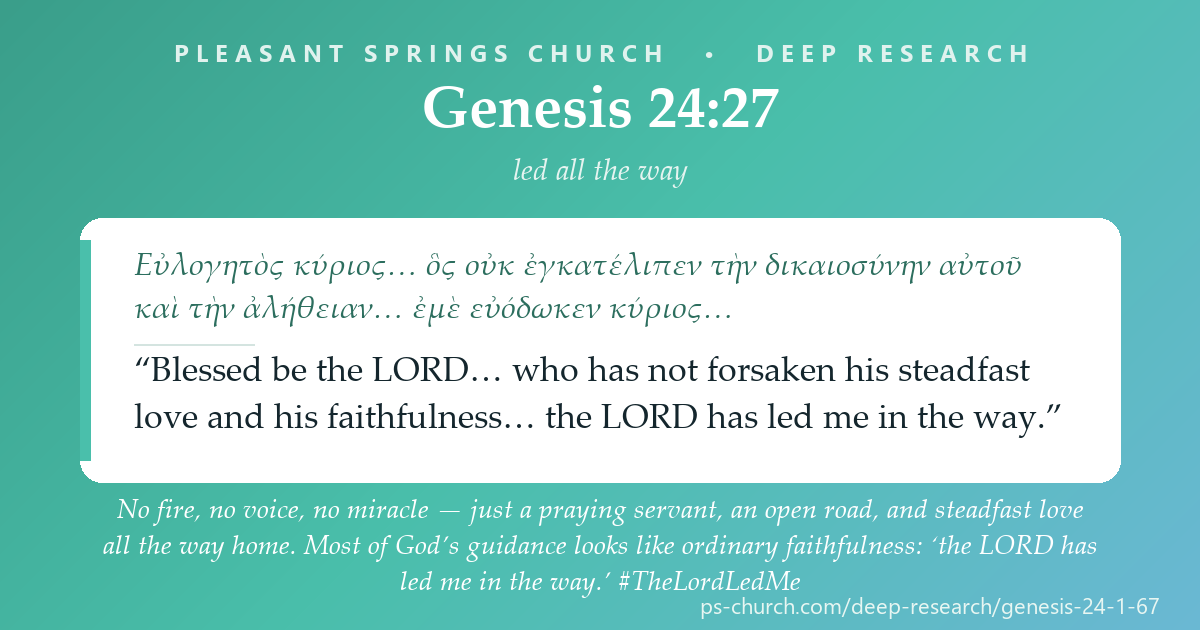
The praying servant. The chapter’s hero is never named (tradition guesses Eliezer, 15:2; the text says only “the servant”). His theology is flawless and entirely borrowed — “O Lord, God of my master Abraham” — and his method is the quiet pattern of a thousand believing errands since: he prays specifically (24:12–14), designs his test not for beauty but for character (a girl who would volunteer to water ten thirsty camels — hundreds of gallons drawn by hand — is a girl of extraordinary kindness and strength), watches in silence while God answers (24:21), and then worships before he negotiates: “Blessed be the Lord… who has not forsaken his hesed and his faithfulness… the Lord has led me in the way” (24:26–27). The answer comes “before he had finished speaking” (24:15; cf. Isa 65:24). And when hospitality sets a meal before him, he will not eat until the errand is told (24:33) — the servant’s heart wholly in his master’s business.
‘I will go.’ Rebekah is drawn with deliberate echoes of Abraham himself: asked to leave country, kindred, and father’s house for a land she has never seen, on the strength of a report about a God she is only just meeting, she answers in one Hebrew word: elekh — “I will go” (24:58; cf. 12:1–4). Her family’s blessing over her (“may your offspring possess the gate of those who hate him,” 24:60) unknowingly repeats the covenant oath of 22:17 almost word for word — Laban and company speaking better than they know. And the ending is one of Scripture’s gentlest: Isaac, meditating in the field at evening, lifts his eyes; Rebekah lifts hers; and the promise passes to a new generation not by spectacle but by love: “he loved her. So Isaac was comforted after his mother’s death” (24:67) — the first time Scripture says a man loved his wife.
Audience
Israel heard in this chapter the answer to a question every generation faces: how does the covenant survive the death of its giants? Not by new theophanies on demand, but by ordinary faithfulness — parents who care whom their children marry and what they worship (Deut 7:3–4 stands on Genesis 24:3), servants who pray on errands, young women whose kindness to strangers and animals reveals character, families who bless departures. The God of Abraham, Israel learned, is as sovereign in a well-side conversation as in fire on a mountain — and most of life is well-side conversation.
Guidance, hesed, and the greater errand. For the church, Genesis 24 is the Bible’s fullest single portrait of ordinary guidance: commit the errand to God (24:12), use sanctified judgment about character (24:14), watch and wait (24:21), and when the way opens, worship before you act (24:26) — “in all your ways acknowledge him, and he will make straight your paths” (Prov 3:5–6) is this chapter in a proverb. Its key word is hesed — prayed for (24:12), praised (24:27), invoked (24:49) — God’s covenant loyalty running like water under every scene. And the church’s teachers have long heard, softly, a further resonance — a father who will not have his beloved son without a bride; a servant sent into the far country to win her, speaking nothing of himself and everything of the son’s wealth and the father’s love; a bride who says “I will go” to a bridegroom she has not yet seen (1 Pet 1:8); a meeting, a love, a comfort. Held as devotional analogy rather than strict exegesis, the shape is hard to unsee: the Father seeks a bride for the Son, and the Spirit’s whole speech is “he will glorify me, for he will take what is mine and declare it to you” (Jn 16:14; 2 Cor 11:2; Rev 22:17).
Orient on betrothal customs, hesed, guidance, and the well type-scene.
Search by topic: marriage and betrothal, Rebekah, hesed / steadfast love, angel of the LORD, guidance, wells, Nahor / Aram-naharaim.
Which articles are relevant?
- Anchor Bible Dictionary — “Rebekah,” “Marriage,” “Betrothal,” “Aram-naharaim,” “Wells.”
- Dictionary of the OT: Pentateuch — “Rebekah,” “Marriage,” “Divine Guidance,” “Type-Scenes.”
- NIDOTTE / TDOT — chesed (steadfast love), ’emet (faithfulness), nachah (lead), qarah (cause to happen/“grant success”), mal’akh (angel/messenger).
Bibliography surfaced:
- Gordon Wenham (WBC), Victor Hamilton (NICOT), Kenneth Mathews (NAC), Bruce Waltke, Nahum Sarna (JPS) on Genesis.
- Studies of the betrothal type-scene (Gen 24; 29; Ex 2; and its echo in John 4) and of hesed in the Old Testament.
- Beale & Carson, Commentary on the NT Use of the OT (John 4; 2 Corinthians 11:2).
The unseen escort, the well-side test, and covenant loyalty on an errand.
Read the servant’s commission, the well scene, and the betrothal against ancient marriage custom and the Bible’s theology of providence.
Which parallels shed light on religion and worldview?
Marriage as covenant strategy. In the ancient world, marriage was the alliance of households, arranged by heads of families, sealed with gifts (the mohar and presents of 24:22, 53), and blessed with fertility wishes (24:60). Genesis 24 works within every convention of its age — and bends them all toward covenant. The bride must come from the ancestral kin not out of clannishness but because the line of promise cannot be absorbed into Canaan’s gods (24:3; cf. Deut 7:3–4); the decisive voice, remarkably, is given to the woman herself (“Let us call the young woman and ask her,” 24:57); and the whole transaction is soaked in prayer and praise from commissioning oath to final tent. Scripture’s quiet counter-culture: the ordinary machinery of family life, run entirely under the Lord’s hesed.
The angel you never see. Abraham promises an angelic escort (24:7, 40); the narrative shows none. What it shows instead is timing: the servant arrives at evening, “the time when women go out to draw water” (24:11), and “before he had finished speaking” (24:15) the right girl — of the right family, unmet and unknowable in advance — is standing before him exceeding his test. The Hebrew wink is the verb of his prayer: haqreh-na, “cause it to happen before me” (24:12) — literally, “make the ‘chance event’ occur.” What the world calls chance, the servant asks God to steer, and the chapter is the answer. This is the Bible’s doctrine of providence in narrative form: no less divine for being invisible, no less guided for feeling ordinary (Prov 16:9; 3:5–6; Ruth 2:3 — where Ruth “happens” upon Boaz’s field, the same theology told with the same smile).
The well and the test of character. Meetings at wells become a biblical type-scene — Isaac’s bride, Jacob and Rachel (29:1–12), Moses and Zipporah (Ex 2:15–21) — each betrothal beginning where a community’s daily life converges. The servant’s test deserves careful notice: he asks God not for the most beautiful girl at the well but for the one who, asked for a sip, offers to water ten camels — a task of perhaps an hour’s heavy labor for a stranger, unasked. He is testing for hesed in the girl to match the hesed he prayed down from God: generosity beyond obligation, strength in kindness, initiative in service — the very qualities the covenant household will need in its next matriarch (and which Rebekah’s decisive “I will go” confirms). When John’s Gospel sets the Messiah himself at a well at evening, asking a foreign woman for a drink (Jn 4:7), the old type-scene rises to its fulfillment: the Bridegroom, seeking worshipers, offering living water.
- Genesis 29:1–12; Exodus 2:15–21; John 4:1–30 — the betrothal-at-the-well type-scene, and its messianic transposition.
- Ruth 2:3–12; Proverbs 3:5–6; 16:9; Isaiah 65:24 — steered “chance,” straightened paths, answers before the asking: ordinary providence across the canon.
- Genesis 22:17 ↔ 24:60 — the family’s blessing unknowingly repeating the covenant oath: God’s words in unwitting mouths (see the binding of Isaac).
Genesis is a book of spectacular divine appearances — smoking fire pots, angelic visitors, voices from heaven — and then, at its longest stretch, it hands us a chapter in which God never appears, never speaks, and never works a single miracle. Nothing happens in Genesis 24 that a skeptic could not explain: an errand, a well, a courteous girl, good timing, a family negotiation, a wedding. And yet no attentive reader has ever doubted that God is the chief actor in every verse — the narrative is engineered so that we see him precisely where the characters cannot: in the timing (‘before he had finished speaking’), in the correspondence between prayer and event, in a pagan family conceding ‘the thing has come from the Lord’ (24:50). This is a deliberate education in providence. The God of the covenant does not govern only by interruption; he governs continuously, through the fabric of ordinary causes — travel schedules and watering hours, personalities and courtesies — so seamlessly that faith alone perceives him. That is why the servant’s posture, not the angel’s absence, dominates the chapter: he prays as if everything depends on God, works his errand as if everything depends on diligence, and worships the instant the two converge. Most of the Christian life is lived in Genesis 24 rather than Genesis 15 — no fire, no voice, just a way that opens under praying feet. The chapter teaches the church to walk it: commit, discern, watch, and when the Lord leads you in the way, bow your head first, and only then unpack the camels.
The vocabulary of the errand: hesed, the unseen angel, and the led way.
Watch the promised “angel before you,” the fourfold hesed, the steered “chance,” the shepherd’s “led,” Rebekah’s “I will go,” and the first “he loved her.”
“His angel before you” — promised twice (24:7; “his angel with you,” 24:40), visible never. The escort works entirely through timing and “chance”: providence is no less real for being invisible (Ps 91:11 · LXX 90:11; Heb 1:14).
“Steadfast love” — the chapter’s keyword: covenant loyalty in action. Prayed for, tested for in the bride, praised at the well. The LXX renders it ἔλεος (mercy) at 24:12 and, strikingly, δικαιοσύνη (righteousness) at 24:27 — hesed is love that does right by its commitments.
“Grant me success” — literally “cause it to happen before me”: the verb of chance events (qarah), aimed in prayer. The servant asks God to steer what the world calls coincidence — and the chapter is the answer (cf. Ruth 2:3).
“The Lord has led me in the way” — nachah, the shepherd’s leading verb (Ps 23:3; 77:20; 78:53). Guidance recognized in the rear-view mirror, and answered first with worship: “I bowed my head.”
“I will go” — one word, echoing Abraham’s lekh-lekha obedience (12:1–4): leaving country, kindred, and father’s house on the strength of a promise. Rebekah enters the covenant the way its founder did — by faith that walks.
“And he loved her” — the first time Scripture says a man loved his wife; and with it, comfort after death (“Isaac was comforted”). The covenant passes generations not by spectacle but by love in a tent (cf. Eph 5:25).
How the rest of Scripture fills out the scene:
- Psalm 23:3; 77:20; 78:53; Isaiah 58:11 — nachah, the shepherd’s leading: the servant’s testimony becomes Israel’s psalmody.
- Proverbs 3:5–6; 16:9; Isaiah 65:24; Ruth 2:3 — acknowledged ways made straight; answers before the asking; steered “chance”: the doctrine of Genesis 24 across the canon.
- Genesis 12:1–4; 22:17 ↔ 24:58, 60 — Rebekah’s “I will go” and her family’s unwitting covenant blessing: the promise renewing itself in a new generation (see the call of Abram).
- John 4:1–30; 16:14; 2 Corinthians 11:2; Revelation 22:17 — the Bridegroom at the well; the Spirit who speaks only of the Son; the church betrothed: the errand’s furthest horizon.
From a well in Aram to the Spirit and the Bride who say, 'Come.'
Trace the guided errand, the covenant bride, and the comfort toward their New Testament fulfillment.
Which cross-references matter?
- Genesis 15:2; 24:2 — the trusted servant “who had charge of all”: if tradition’s guess of Eliezer (15:2) holds, the one-time presumptive heir now joyfully securing the true heir’s future — service without self-interest.
- Genesis 25:19–28; 26:1–11 — Rebekah’s own story ahead: the barren wife prayed for, the oracle of two nations, the family’s repeated failures — the bride of hesed inherits the whole covenant drama.
- Deuteronomy 7:3–4; 2 Corinthians 6:14–7:1 — the theology of Genesis 24:3: marriage and worship intertwined; the covenant line kept from Canaan’s gods.
- John 4:1–30 — the betrothal type-scene fulfilled: the Bridegroom at a well at evening, asking for a drink, offering living water.
- 2 Corinthians 11:2; Ephesians 5:25–32; Revelation 19:7–9; 21:2; 22:17 — the church as the bride sought, won, loved, and brought home (see the bride adorned).
The most striking literary fact about Genesis 24 is that its hero has no name. The chapter is crowded with names — Abraham, Isaac, Rebekah, Bethuel, Laban, Milcah, Nahor — and at its center moves a man identified only as ‘the servant,’ who speaks the chapter’s best theology, prays its prayers, sees its answers, and then vanishes from Scripture without a genealogy or an epitaph. The anonymity is the portrait. Here is a man whose entire identity has been absorbed into his master’s interest: sent to win a bride not for himself but for the son, he speaks not one word about himself all chapter — his speech to Rebekah’s family is a long rehearsal of the master’s wealth, the master’s God, the master’s promise, and the son who has been given all that his father has (24:35–36). He refuses even dinner until the errand is done. The old teachers of the church loved to linger here, and carefully — not as strict exegesis but as a resonance the gospel makes irresistible: there is another Servant whose whole speech is the Son’s glory and not his own — ‘he will glorify me, for he will take what is mine and declare it to you’ — who woos a bride for the Beloved with testimony about riches she has not yet seen, and in whom she believes and loves and rejoices before the meeting (1 Pet 1:8). Whatever one makes of the figure, the calling it models is beyond dispute: the highest usefulness in the kingdom belongs to those content to be unnamed, whose every word makes the Son look wealthy, and whose errand ends with a bride brought home to a love that comforts every grief.
The scholarship on Genesis 24:1-67.
The commentators on the betrothal narrative; the studies of the type-scene, ancient marriage custom, and hesed.
Commentaries & studies:
- Gordon J. Wenham (WBC), Victor P. Hamilton (NICOT), Kenneth A. Mathews (NAC), Bruce K. Waltke, Nahum M. Sarna (JPS) on Genesis.
- Robert Alter on the betrothal type-scene; studies of hesed (Sakenfeld; Clark) and of ancient Near Eastern marriage and dowry custom.
- G. K. Beale & D. A. Carson, eds., Commentary on the NT Use of the OT (John 4; 2 Cor 11:2).
Interpretation notes worth keeping:
- The oath on the thigh (24:2, 9). An ancient gesture binding the oath to the master’s posterity — fitting, since the errand exists to secure the promised seed. Solemn, bodily, covenantal; not to be over-allegorized.
- The test (24:14). Not a fleece for private guidance so much as a character-discernment prayed over: the servant asks God to confirm hesed-shaped kindness, then still “gazed at her in silence to learn whether the Lord had prospered his journey” (24:21). Prayer and discernment cooperate; neither replaces the other.
- ‘The thing has come from the Lord’ (24:50). Laban and Bethuel — hardly saints (cf. Laban’s eye on the gold, 24:30) — still concede the providence. God’s leading can be legible even to the self-interested.
- Rebekah’s consent (24:57–58). In a world of arranged marriages, the narrative pauses to give the woman the deciding word — and she answers with Abraham’s own verb. Scripture’s regard for her agency and faith should not be read past.
- The devotional analogy. Father–Son–Servant–Bride readings (the Spirit wooing the church for Christ) are venerable and homiletically rich; hold them as resonance built on real textual patterns (Jn 4; 16:14; 2 Cor 11:2), not as the chapter’s literal sense — the house discipline for typology throughout this library.
From an ordinary errand to the hesed that leads all the way home.
Name what you learned, why it matters, and one concrete response.
What should we carry away — and do?
- Most guidance is ordinary. No fire, no voice — an errand, a prayer, a well, good timing. The angel goes before you unseen; providence is no less real for feeling like coincidence.
- Pray the errand, then watch. The servant committed the day to God’s hesed, tested for character rather than appearance, watched in silence, and worshiped before he negotiated. That order is the discipleship of decisions.
- Say ‘I will go.’ Rebekah entered the covenant with one walking word of faith — and the family blessing over her carried God’s own oath. When the way opens, go; love and comfort live on the far side of the going.
Step in response: take the decision you are currently facing and walk it through the servant’s order: commit it to God in specific prayer; discern by character and covenant, not appearance; watch in patient silence; and when the Lord leads you in the way, bow your head before you unpack the camels. Practice one act of ten-camel kindness this week — generosity beyond what was asked, for someone who cannot repay it. And if you are the one being asked to go, remember the Bridegroom you have not yet seen and love already (1 Pet 1:8): say elekh.
Genesis 24:27 · to share
LXX + ESVEvery Deep Research page traces its passage across the whole sweep — the Old Testament, the Second-Temple world between the testaments (historical witnesses, not Scripture), and the New Testament. Follow the thread:
Pleasant Springs Church — Deep Research
Research method after Michael S. Heiser’s Bible Research Method (examine dictionaries → ancient literature → important words → textual connections → academic publications → share), with the Pleasant Springs “Author & Audience” foundation. Scripture set in the Hebrew, the Greek editions named on each page and the ESV (Old Testament), and the Greek New Testament and the ESV (New Testament), per the practice of Pleasant Springs Church. Genesis 24:1–67 research grounded in Wenham, Hamilton, Mathews, Waltke, and Sarna, with Alter on the betrothal type-scene (Gen 24; 29; Ex 2; fulfilled at John 4); the chapter read as Scripture’s fullest portrait of ordinary providence — the promised angel (24:7, 40) working invisibly through timing and steered “chance” (haqreh-na’, 24:12; cf. Ruth 2:3; Prov 3:5–6; Isa 65:24); hesed as the fourfold keyword (24:12, 14, 27, 49; LXX ἔλεος / δικαιοσύνη), prayed for and tested for as character; Rebekah’s consent and her elekh (24:58) honored as Abraham-shaped faith, her family’s blessing (24:60) echoing the oath of 22:17; the first “he loved her” (24:67) closing grief with comfort; and the Father–Son–Servant–Bride reading held as devotional analogy on real textual patterns (Jn 4; 16:14; 2 Cor 11:2; Rev 22:17), not the literal sense — per the house discipline for typology.
Scripture quotations marked ESV are from the ESV® Bible (The Holy Bible, English Standard Version®), © 2001 by Crossway, a publishing ministry of Good News Publishers. ESV Text Edition: 2016. Used by permission. All rights reserved. The ESV text may not be quoted in any publication made available to the public by a Creative Commons license, and the ESV may not be translated in whole or in part into any other language. www.esv.org
|
Did this study bless you today? 💚 Give to Support PS Church100% of gifts go to the General Fund — thank you. |