Take your son, your only son, whom you love… and offer him.” The most wrenching command in Scripture sends Abraham up Mount Moriah with the promise-child and a knife. On the way, faith speaks a word truer than Abraham knew: “God will provide the lamb.” At the last instant the knife is stopped and a ram is caught in the thicket — a substitute, “instead of his son.” This study works the Akedah as the Old Testament’s deepest preview of the cross, where the Father did not spare his own beloved Son. See the method →
Genesis 22:1–19 (selections)
Hebrew · LXX · ESVThe Shape of the Passage
ConcentricSame Author and audience as Genesis 1:1 — and the Akedah (“binding”) is the climax of the Abraham story and one of the deepest foreshadowings of the cross in all Scripture.
Author
The Torah of Moses frames the scene as a test (22:1) — and piles on the pathos: “your son, your only son, whom you love… Isaac.” The command echoes the call of 12:1 with the same rare Hebrew “לֶךְ־לְךָ” (“go”): the two great tests bracket Abraham’s life. On the mountain, faith speaks the theme word: “God will provide the lamb” (יִרְאֶה, yireh). At the last instant God stops the knife and provides a ram “instead of his son” — substitution, in the plainest terms — and the place is named “the Lord will provide.”
No child sacrifice. The story that seems to move toward child sacrifice ends by forbidding it: Israel’s God does not want Isaac’s blood (unlike Molech, Lev 18:21). He tests the heart, provides the substitute, and swears the blessing.
Audience
Israel — surrounded by cultures that did sacrifice children to their gods, and worshiping at a temple on Mount Moriah (2 Chr 3:1), the very place. Every lamb they offered there stood in the shadow of this mountain: God provides the substitute.
How they heard it. Faith is tested, and faith obeys — but the God who tests is the God who provides. The knife is stopped; the ram is caught; the blessing to all nations is sworn by God’s own oath (22:16–18). And the deepest note waits for the New Testament: what God spared Abraham, God did not spare himself.
Orient on the Akedah, sacrifice, and the test of faith.
Search by topic: Akedah/binding of Isaac, sacrifice, Moriah, testing, substitution.
Which articles are relevant?
- Anchor Bible Dictionary — “Aqedah,” “Isaac,” “Sacrifice,” “Moriah.”
- Dictionary of the OT: Pentateuch — “Abraham,” “Sacrifice,” “Testing.”
- NIDOTTE / TDOT — נָסָה (nāsâ, test), רָאָה (rāʾâ, see/provide), עֹלָה (ʿōlâ, burnt offering), יָחִיד (yāḥîḏ).
Bibliography surfaced:
- Wenham, Genesis 16–50 (WBC); Hamilton (NICOT); Sarna (JPS).
- Jon Levenson, The Death and Resurrection of the Beloved Son — the Akedah in Jewish and Christian tradition.
- R. W. L. Moberly, The Bible, Theology, and Faith: A Study of Abraham and Jesus.
Child sacrifice refused, and the Akedah in the Second-Temple imagination.
Read the scene against the ANE practice of child sacrifice it repudiates, then follow the rich Second-Temple development of Isaac’s willing offering.
Which parallels shed light on religion and worldview?
Child sacrifice repudiated. Canaanite and Phoenician religion knew the sacrifice of firstborn children to gods like Molech and Baal (the Carthaginian tophet, which most scholars read as evidence of the practice — though the interpretation is debated). Genesis 22 walks its reader up to that horror — and God stops it, providing a ram. The point Israel’s later law makes explicit (Lev 18:21; Deut 12:31) is enacted here in story: the Lord tests faith, but abhors child sacrifice.
- Jubilees 17:15–18:19 (Pseudepigrapha — a witness, not Scripture) — frames the test as prompted by Mastema (a Satan figure, like Job 1) and dates it to Passover.
- 4Q225 (Pseudo-Jubilees) (Dead Sea Scrolls — not Scripture) — the Akedah with angels weeping and Mastema present; shows how vividly the scene was retold at Qumran.
- Josephus, Antiquities 1.222–236; 4 Maccabees 13:12; 16:20 (the latter Pseudepigrapha — not Scripture) — emphasize Isaac’s willing self-offering, a grown man consenting: the “merit of the Akedah” tradition.
- Targums on 22 — expand Isaac’s willingness and the atoning value of his binding; the date of this “atoning-Akedah” tradition relative to the New Testament is debated among scholars.
The Akedah is the Old Testament’s most piercing preview of the gospel — and the New Testament draws the line explicitly. Where God spared Abraham his beloved son, “God did not spare his own Son but gave him up for us all” (Rom 8:32 — the LXX’s οὐκ ἐφείσω of 22:12 turned toward God himself). Isaac carries the wood up the hill as Jesus carried his cross; a ram dies “instead of” the son as Christ dies in our place; and on Moriah, where the temple would stand, “the Lord provides” — finally, the Lamb (John 1:29). Abraham said God would provide the lamb; it took two thousand years to see how completely he meant it.
The vocabulary of test, substitution, and provision.
Watch the “beloved” son, the “will-provide” wordplay, the ram “instead of,” and the “did not spare” the NT turns on God.
“Tested” — God proves, not to learn, but to reveal and refine faith (Deut 8:2). Testing is not temptation to evil (Jas 1:13) but the crucible of trust.
“Only” — LXX ἀγαπητός, “beloved”: the very word the Father speaks over Jesus at his baptism (Mark 1:11) and transfiguration.
“Will see / provide” — from “to see”: God sees to it. The place is YHWH-yireh, “the Lord will provide” — on the mount, it shall be provided.
“Burnt offering” — the wholly-consumed sacrifice of consecration. The ram becomes the ʿōlâ “instead of” Isaac: substitution.
“Instead of his son” — the plainest substitution language: one dies in the place of another. The heart of atonement, enacted on the mountain.
“You did not withhold / spare” — LXX οὐκ ἐφείσω, echoed of God the Father in Romans 8:32: “he did not spare his own Son.”
How the New Testament reuses the Akedah:
- Romans 8:32 — “He who did not spare his own Son but gave him up for us all”: Genesis 22:12/16 (LXX ἐφείσω) applied to the Father.
- Hebrews 11:17–19 — “by faith Abraham… considered that God was able even to raise him from the dead, from which, figuratively speaking, he did receive him back”: resurrection faith.
- John 3:16; Mark 1:11 — “his only/beloved Son” (μονογενής/ἀγαπητός): the Isaac language gathered onto Jesus.
- James 2:21–23; John 8:56 — Abraham’s faith “completed by his works” on the mountain; and “Abraham rejoiced that he would see my day.”
From the ram in the thicket to the Lamb of God.
Trace the substitution, the beloved-son, and the provision themes — then note the Beale & Carson trajectory at Romans 8.
Which cross-references matter?
- Genesis 12:1–3; 15; 17 — the promise here confirmed by God’s oath (22:16–18; cf. Heb 6:13–18): the blessing to the nations secured.
- 2 Chronicles 3:1 — Solomon built the temple “on Mount Moriah”: every sacrifice offered where the ram was provided.
- Leviticus 18:21; Deuteronomy 12:31; Jeremiah 19:5 — child sacrifice condemned: Genesis 22 as the founding refusal.
- Isaiah 53:7; John 1:29; 1 Peter 1:19 — the Lamb led to slaughter, “the Lamb of God,” the “lamb without blemish”: Abraham’s “God will provide the lamb” fulfilled.
- Romans 8:32; Hebrews 11:17–19 — the Father who did not spare, and resurrection faith: the NT’s two great readings of the Akedah.
The commentary’s Romans treatment hears in “did not spare his own Son” a deliberate echo of Genesis 22: Paul casts the Father in Abraham’s role and the Son in Isaac’s — but with the knife not stopped. The Akedah is the pattern; the cross is the reality that surpasses it. Where Abraham received his son back by a kind of resurrection (Heb 11:19), the Father truly raised the Son he gave — and the “God will provide” of Moriah becomes the everlasting gift: “with him… all things” (Rom 8:32).
The scholarship on the Akedah.
Levenson and Moberly for the theology and reception; the commentaries for the narrative art.
Commentaries & studies:
- Jon D. Levenson, The Death and Resurrection of the Beloved Son; R. W. L. Moberly, The Bible, Theology, and Faith.
- Wenham (WBC), Hamilton (NICOT), Sarna (JPS), von Rad; Gerhard von Rad’s classic reading of ch. 22.
- Edward Kessler, Bound by the Bible — Jewish and Christian interpretation of the Akedah.
Interpretation notes worth keeping:
- The test is real, the outcome merciful. God never intended Isaac’s death (he forbids child sacrifice); the test reveals a faith that trusts God even with the promise-child — and is answered by provision.
- Substitution is explicit (“a ram… instead of his son,” 22:13): one of the clearest OT enactments of one life given in place of another.
- Second-Temple ‘merit of Isaac’ traditions (Isaac’s willing offering) form part of the interpretive background to NT atonement language, though the NT centers the willingness and the sacrifice on Christ.
From the mountain to your own surrender.
Name what you learned, why it matters, and one concrete response.
What should we carry away — and do?
- The God who tests is the God who provides. Faith may be asked to climb a hard mountain — but “the Lord will provide” is written into the very place. He never asks your Isaac in order to destroy you.
- Substitution is the shape of grace. A ram died “instead of” the son; the Lamb died instead of us. What Abraham was spared, God was not: he gave his own beloved Son.
- Hold your dearest with open hands. Abraham’s faith could give Isaac back to God because he trusted the God of resurrection (Heb 11:19). What you clutch in fear, you can release in trust.
Step in response: name your “Isaac” — the dearest thing you are tempted to trust or clutch more than God — and lay it on the altar in trust, believing the God who provides. Then look up: the true Lamb has already been given in your place.
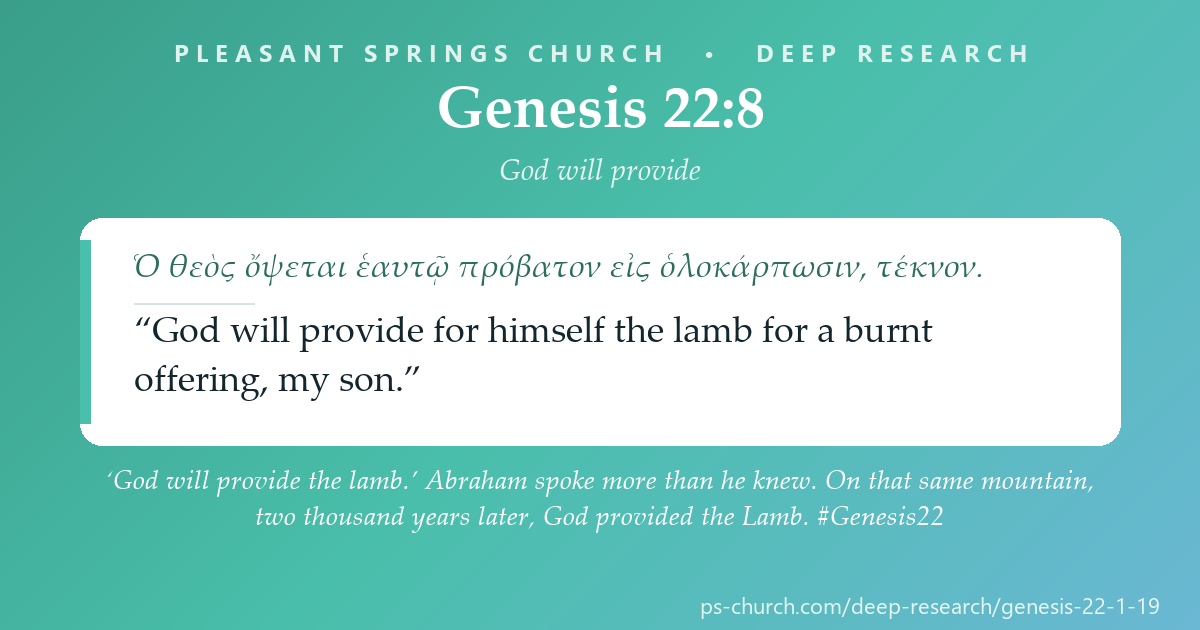
Genesis 22:8 · to share
LXX + ESVEvery Deep Research page traces its passage across the whole sweep — the Old Testament, the Second-Temple world between the testaments (historical witnesses, not Scripture), and the New Testament. Follow the thread:
Pleasant Springs Church — Deep Research
Research method after Michael S. Heiser’s Bible Research Method (examine dictionaries → ancient literature → important words → textual connections → academic publications → share), with the Pleasant Springs “Author & Audience” foundation. Scripture set in the Hebrew, the Greek editions named on each page and the ESV (Old Testament), and the Greek New Testament and the ESV (New Testament), per the practice of Pleasant Springs Church. Genesis 22 research grounded in Wenham, Hamilton, Sarna, von Rad, Levenson, Moberly, and Kessler; ANE child-sacrifice background per the Carthaginian tophet and Lev 18/Deut 12; Second-Temple Akedah material per Jubilees 17–18, 4Q225, Josephus, and the Targums (read as witnesses, not Scripture).
Scripture quotations marked ESV are from the ESV® Bible (The Holy Bible, English Standard Version®), © 2001 by Crossway, a publishing ministry of Good News Publishers. ESV Text Edition: 2016. Used by permission. All rights reserved. The ESV text may not be quoted in any publication made available to the public by a Creative Commons license, and the ESV may not be translated in whole or in part into any other language. www.esv.org
|
Did this study bless you today? 💚 Give to Support PS Church100% of gifts go to the General Fund — thank you. |