Twenty-five years after the call, four quiet words land: “the Lord visited Sarah” — as he had said, as he had promised, at the appointed time. The boy is named Isaac, “he laughs,” because God took the doubting laughter and handed it back as joy. The covenant line is fixed — “through Isaac shall your offspring be named” — yet God still hears the boy outside the line, and the chapter ends with a planted tree and a new name: El Olam, the Everlasting God. This study works Genesis 21:1–34. See the method →
Genesis 21:1–2, 6, 12, 17, 33
Hebrew · LXX · ESVThe Shape of the Passage
InclusioChapter 21 is the payoff of a quarter-century of narrative tension: the promise kept to the letter and the calendar — and, woven through the joy, the sober cost of the years the family spent helping God along.
Author
Moses writes the fulfillment with deliberate, drumming emphasis: the Lord visited Sarah as he had said; he did as he had promised; she bore a son at the time of which God had spoken (21:1–2). Every clause of the promise is checked off — the son, by Sarah, within the year (17:21; 18:10, 14). The verb “visited” (paqad) is one of the Old Testament’s great covenant verbs: God “visiting” his people to act on what he has spoken (50:24–25; Ex 3:16; Ruth 1:6; Lk 1:68). Abraham, one hundred years old, circumcises his son on the eighth day “as God had commanded him” (21:4; cf. 17:12) — prompt, exact obedience, the covenant sign administered to the covenant child. And the name seals the theme: Yitschaq, “he laughs.” The father who laughed in half-belief (17:17) and the mother who laughed behind the tent flap (18:12) now find God has taken their own laughter and handed it back transfigured: “God has made laughter for me” (21:6). The last laugh belongs to grace.
Two sons, one line of promise. The weaning feast turns to grief: Sarah sees Ishmael “laughing” (metsacheq — the same root as Isaac’s name, here with an edge of mockery, as Paul read it, Gal 4:29) and demands the slave woman’s son be cast out. The thing is “very displeasing” to Abraham — Ishmael is his son, loved (17:18) — and God’s answer holds both truths at once: do as Sarah says, “for through Isaac shall your offspring be named” (21:12) — the line of the covenant runs through the child of promise alone; and “I will make a nation of the son of the slave woman also, because he is your offspring” (21:13). Election is not favoritism of affection; the God who chooses Isaac still hears, saves, and blesses Ishmael.
The God who hears the boy. The wilderness scene is among the most tender in Genesis. The water is gone; the mother cannot watch her child die; and the text says — with a wordplay on Ishmael’s own name (“God hears”) — “God heard the voice of the boy” (21:17). The God of the covenant line is not deaf outside it. He opens Hagar’s eyes to a well, renews the promise (“I will make him into a great nation”), and stays with the boy as he grows (21:20). This is the second time God has met this family’s outsiders in the wilderness (cf. 16:7–14, the God who sees); mercy keeps finding the people the story seems to be leaving behind. The chapter then closes at Beersheba — a treaty, a well, a planted tamarisk, and a new divine name: El Olam, the Everlasting God (21:33). After a quarter-century’s wait, Abraham names God by the attribute the wait taught him: the God whose faithfulness has no expiration.
Audience
Israel received this chapter as their own birth certificate: the nation exists because God keeps dated promises to barren situations. Isaac’s birth is the pattern of everything Israel would ever need to believe — in Egypt (“God will surely visit you,” 50:24), in exile, in every barren season: the God of Abraham does what he says, when he said, even when every human calendar has expired. The eighth-day circumcision bound each generation into the same covenant sign given to Isaac; the “appointed time” (mo‘ed) taught them that God’s delays are schedules, not absences.
The children of promise. The New Testament reads this chapter twice, deeply. Paul hears in “through Isaac shall your offspring be named” the very grammar of grace: “it is not the children of the flesh who are the children of God, but the children of the promise” (Rom 9:7–8) — sonship by God’s word, not human descent or effort. And in Galatians 4:21–31 he sets the two mothers as an inspired allegory of two covenants: the son born “according to the flesh” (the family’s self-help project of ch. 16) against the son “born through promise” — and declares over every believer, “you, brothers, like Isaac, are children of promise” (Gal 4:28). Every Christian is a Genesis 21 baby: conceived by grace where nothing was possible, named with joy, heir by promise alone. And Sarah’s laughter became a song the church still sings — the barren woman’s joy (Isa 54:1; Ps 113:9), fulfilled at last in the virgin’s Son, for whom also “nothing will be impossible with God” (Lk 1:37).
Orient on Isaac, the divine visitation, weaning and inheritance, and El Olam.
Search by topic: Isaac, visitation (paqad), barrenness, Hagar / Ishmael, inheritance, Beersheba, El Olam, names of God.
Which articles are relevant?
- Anchor Bible Dictionary — “Isaac,” “Ishmael,” “Hagar,” “Beer-sheba,” “Names of God.”
- Dictionary of the OT: Pentateuch — “Isaac,” “Hagar,” “Election,” “God, Names of.”
- NIDOTTE / TDOT — paqad (visit), tsachaq (laugh), mo‘ed (appointed time), garash (drive out), ‘olam (everlasting).
Bibliography surfaced:
- Gordon Wenham (WBC), Victor Hamilton (NICOT), Kenneth Mathews (NAC), Bruce Waltke, Nahum Sarna (JPS) on Genesis.
- Studies of the barren-mother type-scene (Sarah, Rebekah, Rachel, Hannah, Elizabeth) and of Paul’s use of Genesis 21 (Romans 9; Galatians 4).
- Beale & Carson, Commentary on the NT Use of the OT (Romans 9:7; Galatians 4:21–31; Hebrews 11:11).
The visited womb, the weaning feast, and the everlasting God at the well.
Read the birth, the expulsion, and the Beersheba treaty against their ancient legal and religious world.
Which parallels shed light on religion and worldview?
The dated promise and the visited womb. The ancient world was full of birth-annunciations and miracle-child tales, but Genesis 21 stakes everything on something more exacting: a promise with a date on it (“at this time next year,” 17:21; 18:14), kept to the day. The triple “as he had said” of 21:1–2 is covenant bookkeeping — the narrator auditing God’s word and finding it exact. That is why paqad, “visited,” matters: in Scripture it is God arriving to do what he had announced — for Sarah here, for Israel in Egypt (Ex 3:16; 4:31), for Naomi’s Bethlehem (Ruth 1:6), until Zechariah sings it over the last of the barren-womb miracles: “Blessed be the Lord God of Israel, for he has visited and redeemed his people” (Lk 1:68, LXX ἐπεσκέψατο — the same verb the Greek of 21:1 uses for Sarah). The birth of Isaac established the pattern the Incarnation would complete.
The weaning feast and the two heirs. Weaning — at around age three — was a survival milestone the ancient family marked with a feast: the child had lived. It is at precisely this legal-social moment, with the heir publicly celebrated, that the question of the other son turns sharp. In the legal world of the patriarchs (reflected in cuneiform family law), the son of a slave-wife could share inheritance with the free wife’s son unless formally released; Sarah’s harsh-sounding demand — “the son of this slave woman shall not be heir with my son Isaac” (21:10) — is the era’s language for settling the succession, and God’s endorsement of it (21:12) is not cruelty toward Ishmael but clarity about the covenant: the line of promise cannot be a blended product of grace and self-help. Chapter 16 was the family’s attempt to build the future out of human resourcefulness; chapter 21 formally retires it — while God himself takes over Ishmael’s future with promises of his own (21:13, 18).
El Olam at the well. The chapter ends in a scene easy to skim: a water-rights treaty with Abimelech, seven ewe lambs, a place-name (“Well of the Seven / Well of the Oath”), a planted tamarisk, and worship. But the ending is the theology landing. For the first time, Abraham holds something durable in the land — a well, secured by oath — and he marks it not with a monument to himself but with a long-lived tree and a new divine name: El Olam, God Everlasting (21:33; LXX Θεὸς αἰώνιος). It is the name the wait taught him. Kings and treaties expire; the everlasting God had outlasted twenty-five years of impossibility and would outlast every empire Israel would ever fear (Isa 40:28: “the Lord is the everlasting God… he does not faint or grow weary”). Planting a slow-growing tree at the site was itself a sermon: this God can be trusted with the long term.
- Exodus 3:16; 4:31; Ruth 1:6; Luke 1:68 — the “visitation” verb: God arriving to keep his announced word, from Sarah’s tent to Zechariah’s song.
- Genesis 16:1–16; 17:15–21 — the self-help son and the promised son: the backstory the weaning feast settles (see Hagar and the God who sees and the covenant of circumcision).
- Isaiah 40:28; Psalm 90:1–2; 113:9 — the Everlasting God; the barren woman made a joyous mother of children: the names and songs born at Beersheba.
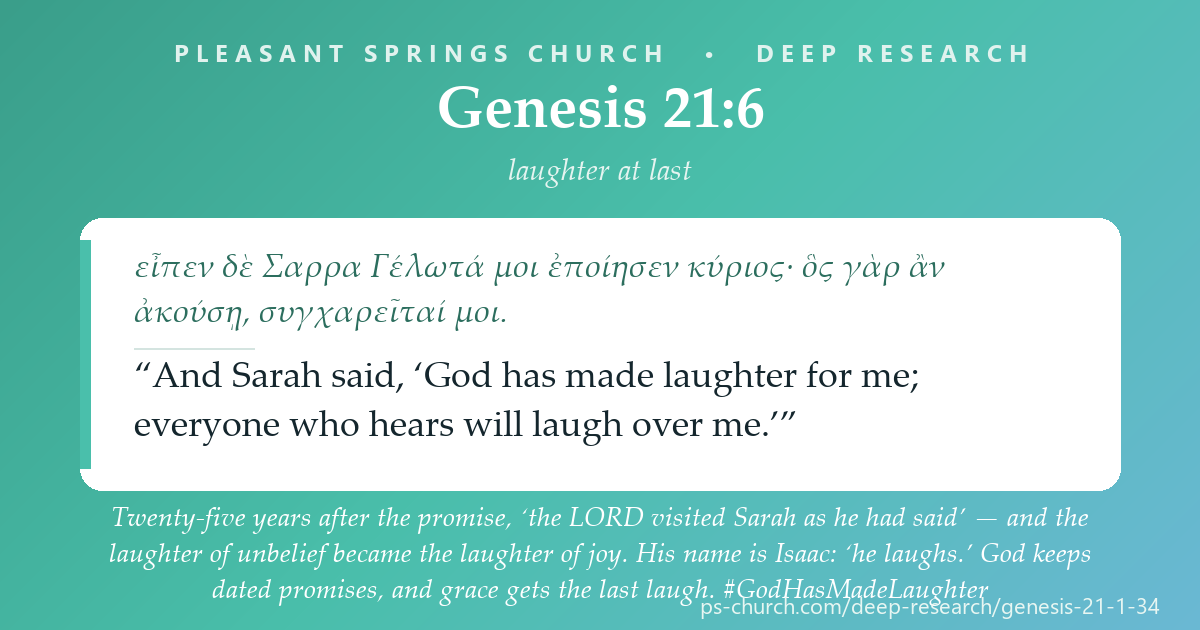
The name Isaac is the theology of the whole Abraham story compressed into a single word. Every laugh in the narrative has led here. Abraham fell on his face and laughed at the promise — a hundred-year-old father? — and God, unoffended, answered by putting the laugh into the boy’s name: you laughed; very well, his name is He-Laughs, and every time you call your son to dinner you will remember what you thought impossible. Sarah laughed at the tent door and denied it, afraid; yet when the child came, she did not hide the memory — she composed a psalm on it: ‘God has made laughter for me; everyone who hears will laugh over me.’ The laughter of unbelief has been transposed, without one note of scolding, into the laughter of joy. That is how grace deals with our incredulity: it does not shame the laugh; it outlasts it, fulfills the promise anyway, and then gives the laugh back cleansed, as worship. There is deep pastoral wisdom here. God is not brittle about our doubts. He can absorb the bitter laugh of the person for whom hope has died, and he is patient enough to wait twenty-five years to turn it into the other kind. The whole gospel makes the same shape: the world laughed at the promise once more, outside a garden tomb — and God, at the appointed time, had the last laugh, and invited everyone who hears to laugh with him. Blessed are you who weep now, said Isaac’s greater Son, for you shall laugh.
The vocabulary of the visitation, the laughter, and the everlasting Name.
Watch “visited,” the “appointed time,” the laughter in Isaac’s name, the naming of the offspring, the God who “heard,” and El Olam.
“Visited” — the covenant verb of God arriving to do what he announced (Ex 3:16; Ruth 1:6). The LXX’s ἐπεσκέψατο is the very verb of Zechariah’s Benedictus (Lk 1:68): Isaac’s birth begins the pattern the Incarnation completes.
“At the appointed time” — the promise had a date (17:21; 18:14), and God kept it to the day. Divine delays are schedules, not absences; the wait is part of the gift, so the son is unmistakably grace.
“He laughs / laughter” — the name absorbs the father’s laugh (17:17) and the mother’s (18:12) and hands them back as joy: “God has made laughter for me.” Grace does not shame the unbelieving laugh; it transposes it.
“Through Isaac shall your offspring be named” — the covenant line runs through promise alone, not flesh. Paul’s grammar of grace (Rom 9:7–8; Gal 4:28): “you, brothers, like Isaac, are children of promise.”
“God heard” — a wordplay on Ishmael’s own name (“God hears,” 16:11). The God who chooses Isaac still hears the boy outside the line: election narrows the covenant channel, never God’s compassion.
“The Everlasting God” (LXX Θεὸς αἰώνιος) — the name a 25-year wait taught Abraham, confessed while planting a slow-growing tamarisk at a treaty well: this God can be trusted with the long term (Isa 40:28).
How the rest of Scripture fills out the scene:
- Genesis 50:24–25; Exodus 3:16; Luke 1:68 — “God will surely visit you”: the verb of kept promises, from Beersheba to Bethlehem.
- 1 Samuel 1–2; Psalm 113:9; Isaiah 54:1; Luke 1:36–37, 46–55 — the barren-mother line: Sarah, Hannah, Elizabeth — and the songs their joy produced, up to the Magnificat.
- Romans 9:6–9; Galatians 4:21–31; Hebrews 11:11–12 — children of promise, not of flesh; by faith Sarah received power; from one man, “as good as dead,” descendants like the stars.
- Genesis 16:7–14; 25:12–18 — the God who sees and hears Hagar and Ishmael, and keeps his promises to them too (see the God who sees).
From Sarah's laughter to the children of promise.
Trace the visited womb, the named offspring, and the laughter toward their New Testament harvest.
Which cross-references matter?
- Genesis 17:15–21; 18:9–15 — the promise dated and doubted: the laughs that Isaac’s name preserves (see the covenant of circumcision and the Lord at Mamre).
- Genesis 22:1–19 — the son so long awaited, soon to be asked back: the chapter that tests everything this one gave (see the binding of Isaac).
- Romans 9:6–9 — “through Isaac shall your offspring be named” as the proof that God’s word has not failed: promise, not pedigree, makes children of God.
- Galatians 4:21–31 — the two mothers as two covenants; “you, brothers, like Isaac, are children of promise” — Paul’s inspired reading of the weaning-feast crisis.
- Luke 1:26–38, 68; 6:21 — the impossible birth, the visitation of God, and “blessed are you who weep now, for you shall laugh”: Sarah’s joy universalized in her greater Son.
The hardest scene in the chapter — a mother and boy sent into the wilderness with bread and a skin of water — is also the place where its theology becomes most precise, and most tender. The text refuses two easy errors. The first error would be to soften the election: to let Ishmael share the inheritance, to make the covenant line a blend of God’s promise and the family’s Egyptian workaround. God does not permit it. ‘Through Isaac shall your offspring be named’ — the purposes of God run through the son that grace alone produced, because the covenant must never be traceable to human contriving, or the gospel it carries would be corrupted at the root. Paul saw exactly this and built Romans 9 and Galatians 4 upon it. But the second error would be to conclude that the unchosen are unloved — and the narrative will not permit that either. It is to Hagar that the angel of God comes; it is the boy’s voice that God hears, and the narrator says so with a pun on his name, as if to insist: he is still Ishma-el, God-hears, even outside the tent of promise. God opens her eyes to the well, repeats the promise of nationhood, and — the quiet line that governs the boy’s whole future — ‘God was with the boy, and he grew up.’ Election in Scripture defines the channel through which blessing will reach the world; it does not ration the compassion of God. The line runs through Isaac precisely so that, in Isaac’s greater Son, the blessing can finally reach every Ishmael, every outsider, every child crying in a wilderness — heard.
The scholarship on Genesis 21:1-34.
The commentators on the birth narrative; the studies of the barren-mother type-scene, ancient family law, and Paul’s reading of the two sons.
Commentaries & studies:
- Gordon J. Wenham (WBC), Victor P. Hamilton (NICOT), Kenneth A. Mathews (NAC), Bruce K. Waltke, Nahum M. Sarna (JPS) on Genesis.
- Studies of the barren-mother type-scene; slave-wife and inheritance law in the cuneiform family-law tradition; the Beersheba treaty and well narratives.
- G. K. Beale & D. A. Carson, eds., Commentary on the NT Use of the OT (Rom 9:7; Gal 4:21–31; Heb 11:11–12).
Interpretation notes worth keeping:
- The triple ‘as he had said’ (21:1–2). The narrator audits the promise clause by clause — son, mother, date. The birth is presented as verification of the divine word, not merely a happy event; this is the chapter’s controlling idea.
- Ishmael’s ‘laughing’ (21:9). Metsacheq puns on Isaac’s name; the LXX adds “with her son Isaac.” Paul reads it as persecution-in-seed (Gal 4:29). Likely mocking play that threatened the heir’s standing — enough to force the succession question; don’t over- or under-read it.
- Sarah’s demand and God’s endorsement (21:10–12). Harsh in tone, legal in substance (settling inheritance), theological in effect (the line runs through promise alone). God simultaneously provides for Ishmael (21:13, 18, 20) — election without abandonment.
- ‘God heard the boy’ (21:17). The name-pun (Ishmael = God hears) is the narrator’s theology: the unchosen are not unheard. Note the parallel wilderness rescue of ch. 16 (the God who sees) — seeing and hearing, the two mercies of the outsider narratives.
- El Olam (21:33). Each of these naming scenes ties a revealed name to a lesson lived: El Elyon (14), El Roi (16), El Shaddai (17), El Olam (21) — the everlasting God, named at the end of the longest wait. The names accumulate into Israel’s doctrine of God.
From a 25-year wait to laughter at the appointed time.
Name what you learned, why it matters, and one concrete response.
What should we carry away — and do?
- God keeps dated promises. “As he had said… as he had promised… at the appointed time.” The wait was not absence; it was schedule — and the length of it made the gift unmistakably grace.
- Grace gets the last laugh. The doubting laughter (17:17; 18:12) came back transfigured as joy (21:6). God is not brittle about your doubts; he outlasts them, then turns them into worship.
- You, like Isaac, are a child of promise. Not flesh, not effort, not the family’s workaround — promise (Gal 4:28). And the God who chose the line still hears every Ishmael crying in the wilderness.
Step in response: name the promise you have waited longest on — and this week, worship like Beersheba: plant something slow (a habit of prayer, a scripture memorized, a tree if you like) as a confession that El Olam, the Everlasting God, can be trusted with your long term. If old doubt has left you a bitter laugh, hand it to the God who specializes in transposing laughter. And treat no one as outside his hearing — the wilderness scenes belong to his mercy too.
Genesis 21:6 · to share
LXX + ESVEvery Deep Research page traces its passage across the whole sweep — the Old Testament, the Second-Temple world between the testaments (historical witnesses, not Scripture), and the New Testament. Follow the thread:
Pleasant Springs Church — Deep Research
Research method after Michael S. Heiser’s Bible Research Method (examine dictionaries → ancient literature → important words → textual connections → academic publications → share), with the Pleasant Springs “Author & Audience” foundation. Scripture set in the Hebrew, the Greek editions named on each page and the ESV (Old Testament), and the Greek New Testament and the ESV (New Testament), per the practice of Pleasant Springs Church. Genesis 21:1–34 research grounded in Wenham, Hamilton, Mathews, Waltke, and Sarna; the triple “as he had said” (21:1–2) read as the narrator’s audit of the dated promise (17:21; 18:14), with paqad traced through Ex 3:16 and Ruth 1:6 to Luke 1:68 (LXX ἐπεσκέψατο); Isaac’s name held as the transposition of the unbelieving laughs (17:17; 18:12) into joy (21:6); the weaning-feast crisis read with the cuneiform slave-wife inheritance background and Paul’s inspired reading (Rom 9:6–9; Gal 4:21–31) — election defining the channel of blessing, never rationing compassion, as “God heard the boy” (21:17, punning Ishmael’s name) shows; Ishmael’s metsacheq (21:9) neither over- nor under-read; and El Olam (21:33) placed in the accumulating patriarchal name-revelations (El Elyon, El Roi, El Shaddai) as the name the long wait taught.
Scripture quotations marked ESV are from the ESV® Bible (The Holy Bible, English Standard Version®), © 2001 by Crossway, a publishing ministry of Good News Publishers. ESV Text Edition: 2016. Used by permission. All rights reserved. The ESV text may not be quoted in any publication made available to the public by a Creative Commons license, and the ESV may not be translated in whole or in part into any other language. www.esv.org
|
Did this study bless you today? 💚 Give to Support PS Church100% of gifts go to the General Fund — thank you. |