In the heat of the day the Lord comes to Abraham’s tent as three men, and Abraham runs to serve them — entertaining God unawares. Over the meal the promise is renewed: “Sarah shall have a son” — and when she laughs at the impossibility, the visitor asks, “Is anything too hard for the Lord?” Then God takes his friend into his confidence about Sodom, and Abraham intercedes: “Shall not the Judge of all the earth do what is just?” He bargains God down from fifty righteous to ten — and finds mercy running ahead of the asking. This study works Genesis 18:1–33. See the method →
Genesis 18:1–2, 10, 14, 25, 32
Hebrew · LXX · ESVThe Shape of the Passage
Parallel panelsChapter 18 has two movements: a visit that renews the promise of Isaac, and a conversation that reveals the heart of God’s justice and the boldness of covenant prayer. Together they show a God near enough to eat at a man’s table and great enough to judge the earth.
Author
Moses opens with a startling sentence: “The Lord appeared to him by the oaks of Mamre” (18:1). The narrator names the divine visitor before Abraham does — so that when Abraham “lifted up his eyes… and behold, three men,” we already know that the Lord himself has come, veiled in the appearance of travelers. Two of the three will go on to Sodom as “angels” (19:1); one is identified throughout as the Lord. Abraham, still seeing only guests, runs, bows, and pours out the lavish hospitality of the desert — water for the feet, a “morsel of bread” that turns into a feast of curds, milk, a whole calf, and fresh cakes. It is a picture the New Testament will hold up: “Do not neglect to show hospitality to strangers, for thereby some have entertained angels unawares” (Heb 13:2). Abraham welcomed God without knowing it, in the person of three dusty travelers.
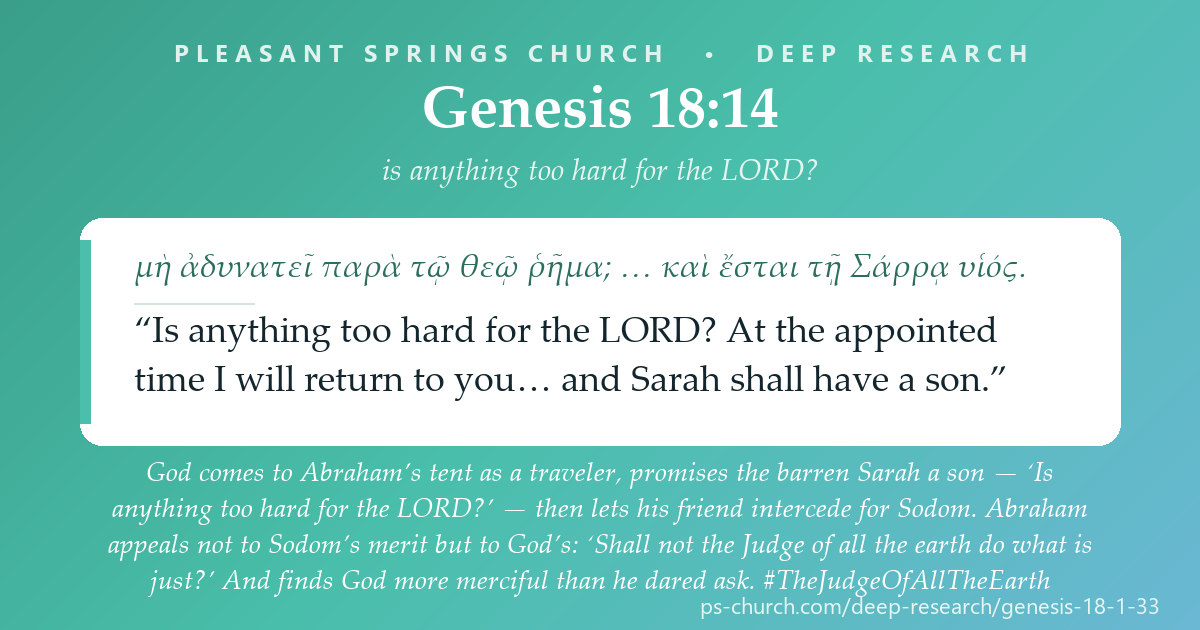
‘Is anything too hard for the Lord?’ Over the meal the promise is renewed with a deadline: “Sarah your wife shall have a son” — this time next year. Sarah, eavesdropping at the tent door and long past childbearing, laughs to herself at the sheer impossibility. And the visitor, who could not have heard a laugh that never left her heart, hears it — a quiet flash of divine omniscience — and asks the question on which the whole covenant hangs: “Why did Sarah laugh…? Is anything too hard for the Lord?” (18:14). The Hebrew word (pala’) means the wonderful, the extraordinary, the miraculous. The barren womb is exactly the place God delights to work, precisely because it is impossible — so that the son, when he comes, will be unmistakably a gift. The question echoes through Scripture, to Jeremiah in the ruins (“nothing is too hard for you,” Jer 32:17) and to Mary at the annunciation (“nothing will be impossible with God,” Luke 1:37).
The Judge takes his friend into his confidence. Then the tone shifts. “Shall I hide from Abraham what I am about to do?” (18:17). Because Abraham is God’s covenant friend (Isa 41:8; Jas 2:23), and because his calling is that his household “keep the way of the Lord by doing righteousness and justice” (18:19), God reveals his intention to judge Sodom for its grave outcry. And Abraham responds with one of the boldest prayers in the Bible — not fleeing the subject of judgment but pressing into it: “Will you indeed sweep away the righteous with the wicked?… Shall not the Judge of all the earth do what is just?” (18:25). Notice what Abraham is not doing. He is not doubting God’s justice; he is appealing to it, grounding his plea in God’s own character as the righteous Judge. And step by step — fifty, forty-five, forty, thirty, twenty, ten — God grants every reduction, without hesitation. The bargaining does not wear God down; it reveals that mercy was already running ahead of the asking. Abraham stops at ten; God would have spared the city for ten righteous. In the end there were not even ten — but Lot and his family were brought out (ch. 19), for “God remembered Abraham” (19:29). The intercessor’s prayer was heard.
Audience
Israel — called, like Abraham, to “do righteousness and justice” and to be a blessing to the nations — are shown here what it means to stand between a holy God and a guilty world. Abraham does not gloat over Sodom’s coming doom, nor does he excuse its sin; he pleads for mercy, appealing to the character of the Judge. This is the vocation of the covenant people: not to relish judgment on the wicked, but to intercede — to stand in the gap (cf. Ezek 22:30). And the chapter’s two halves belong together: the God who gives the impossible son is the God who judges the guilty city, and both flow from the same righteousness. Grace and justice are not at odds in him; they meet.
Bold prayer, grounded in God’s character. Abraham’s intercession is a model, but it must be read rightly. It is bold — he presses, he bargains, he keeps returning “let me speak just once more” — and yet it is drenched in humility: “I who am but dust and ashes… let not the Lord be angry” (18:27, 30). This is not a man manipulating God or changing a reluctant mind against its will; it is a friend invited into God’s counsel, appealing to God’s own justice and mercy, discovering as he prays that God is even more merciful than he dared to ask. That is the pattern of all true intercessory prayer: not twisting God’s arm, but pleading his promises and his character back to him, and finding that he was more willing to show mercy than we were to seek it. And it points to a greater Intercessor — the one righteous Man whose presence would have spared not a city but a world, who “always lives to make intercession” for us (Heb 7:25).
Orient on theophany, hospitality, intercession, and Sodom.
Search by topic: theophany, angel of the LORD, hospitality, intercession, Sodom, justice / righteousness.
Which articles are relevant?
- Anchor Bible Dictionary — “Theophany,” “Hospitality,” “Intercession,” “Sodom and Gomorrah.”
- Dictionary of the OT: Pentateuch — “Abraham,” “Theophany,” “Prayer,” “Justice and Righteousness.”
- NIDOTTE / TDOT — pala’ (be wonderful/too hard), tsedaqah u-mishpat (righteousness and justice), shofet (judge), paga’ (intercede).
Bibliography surfaced:
- Gordon Wenham (WBC), Victor Hamilton (NICOT), Kenneth Mathews (NAC), Bruce Waltke, Nahum Sarna (JPS) on Genesis.
- Studies of the Mamre theophany, the “angel of the LORD,” and the Abraham-Sodom intercession dialogue.
- Beale & Carson, Commentary on the NT Use of the OT (Hebrews 13; Luke 1; James 2).
The visit of God, the wonderful promise, and the just Judge.
Read the Mamre theophany, “too hard for the Lord,” and the intercession against their Ancient Near Eastern and canonical backdrop.
Which parallels shed light on religion and worldview?
Hospitality and the hidden God. In the ancient Near East, hospitality to travelers was a sacred duty; a stranger at your tent had a claim on your protection and provision, and to abuse a guest was among the gravest of sins. Genesis 18 and 19 are built as a deliberate contrast on exactly this point: at Mamre, Abraham lavishes hospitality on three strangers and unknowingly welcomes God; at Sodom, the men of the city surround Lot’s house to abuse the same visitors (19:4–9). The one who honored the strangers is honored with the promise of a son; the city that assaulted them is destroyed. And the New Testament draws the moral directly: “some have entertained angels unawares” (Heb 13:2). Abraham did not recognize his guests, and that is the point — he served them generously simply because they were strangers in need, and in serving them he served God. The way we treat the unrecognized stranger is, it turns out, the way we treat the Lord.
The wonderful promise. The renewed promise of a son to the aged, barren Sarah is deliberately framed as the impossible. Both Abraham (17:17) and Sarah (18:12) laugh; both know, by every human calculation, that it cannot be. And that is precisely why God gives it. The barren womb is one of the great recurring signs of the Old Testament — Sarah, Rebekah, Rachel, Hannah, the Shunammite, Elizabeth — and every time, the point is the same: the child of promise is God’s gift, not human achievement, and God works his greatest wonders where human hope has died. “Is anything too wonderful for the Lord?” is not a rebuke of Sarah’s doubt so much as an invitation to a larger faith — and it runs straight to the ultimate wonder, the virgin’s conception, where the angel echoes it word for word: “nothing will be impossible with God” (Luke 1:37). The God of the barren womb is the God of the empty tomb.
The Judge who does justice. Abraham’s intercession is theologically profound. He does not plead for the wicked to be spared regardless; he pleads that the righteous not be swept away with the wicked — and he grounds the plea in a conviction about God’s very nature: “Shall not the Judge of all the earth do what is just?” (18:25). The whole dialogue assumes that God is perfectly just and appeals to that justice; Abraham’s boldness rests on his confidence, not his doubt. And the outcome teaches a stunning lesson about God’s mercy: God is willing to spare a whole wicked city for the sake of ten righteous people in it. Sin does not simply cancel out righteousness; the presence of even a small righteous remnant has power to stay judgment. In the end there were not ten in Sodom — but there was one intercessor at Mamre whose prayer God honored by rescuing Lot (19:29). The chapter quietly points ahead to the day when the presence of one perfectly Righteous One would have power to spare not a city but the world.
- Genesis 19:1–29; Hebrews 13:2; Judges 6:11–24 — Sodom’s abuse of the visitors vs. Abraham’s hospitality; entertaining angels unawares: the honored and the guilty (see Lot toward Sodom).
- Genesis 17:17; 21:1–7; 1 Samuel 1; Luke 1:37 — the laughter, the birth of Isaac, the barren mothers, “nothing impossible with God”: the wonderful promise.
- Ezekiel 22:30; Exodus 32:11–14; James 5:16–18 — standing in the gap; Moses’ intercession; the prayer of a righteous person: the vocation of the intercessor.
Abraham’s conversation with God over Sodom is one of the boldest scenes in Scripture, and it repays careful watching, because it teaches us what intercession actually is — and what it is not. It is not Abraham trying to talk a reluctant, angry God into mercy against his better judgment. That misreads the whole exchange. From the start, God has chosen to tell Abraham what he is about to do; he draws his covenant friend into his counsel precisely so that Abraham will pray. And when Abraham prays, God grants every single request, instantly, without argument — fifty, forty-five, forty, thirty, twenty, ten — which means the mercy Abraham is reaching toward was there in God all along, waiting for him. The bargaining does not change God’s mind; it reveals God’s heart. What Abraham discovers, step by trembling step, is that God is more merciful than he dared to hope, willing to spare a whole guilty city for the sake of a tiny righteous remnant. And notice the ground of Abraham’s boldness. He does not appeal to Sodom’s merits — there are none — nor to his own. He appeals to God’s character: ‘Shall not the Judge of all the earth do what is just?’ He is confident in prayer not because he doubts God’s justice but because he trusts it utterly. That is the anatomy of all real intercession: we stand before God, not twisting his arm, but pleading his own character and promises back to him, and we find that he was more willing to be gracious than we were to ask. And this scene, of one man standing before the Judge to plead for the guilty, is a shadow of a greater intercession — the one righteous Man who ever lives to make intercession, and whose presence is enough to spare, not ten, but a multitude no one can number.
The vocabulary of the visit, the wonder, and the plea.
Watch the Lord who “appeared,” the “too wonderful,” “righteousness and justice,” the “Judge of all the earth,” and “dust and ashes.”
“The Lord appeared” — the narrator names the divine visitor before Abraham sees “three men” (18:2). A theophany: one of the three is the Lord; two go on to Sodom as angels (19:1). God comes veiled in the appearance of travelers (Heb 13:2).
“Is anything too hard for the Lord?” — pala’ = the wonderful, the extraordinary. God works his greatest wonders where human hope has died (the barren womb) so the gift is unmistakable; echoed at Jer 32:17 and Luke 1:37 (“nothing impossible with God”).
“Righteousness and justice” — the way of the Lord Abraham’s household is to keep, and the very standard by which Abraham then appeals to God over Sodom (18:25). The covenant people are called to do justice, not merely receive mercy.
“The Judge of all the earth” — Abraham grounds his plea in God’s own character: “Shall he not do justice (mishpat)?” He does not doubt God’s justice; he appeals to it. Bold prayer rests on confidence in God, not suspicion of him.
“Dust and ashes” — a wordplay of creaturely humility (echoing “dust,” 3:19). Abraham holds bold intercession and deep humility together: he presses God hard, yet knows he is nothing before him. (“Let not the Lord be angry” here = Adonai, ordinary “Lord.”)
“For the sake of the ten” — the bargaining ends not at zero but at a righteous remnant of ten, enough to spare the many. God grants every reduction: mercy runs ahead of the asking. There were not ten — but one intercessor was heard, and Lot was rescued (19:29).
How the rest of Scripture fills out the scene:
- Hebrews 13:2; 1 Peter 4:9; Matthew 25:35 — hospitality to strangers; entertaining angels unawares; “I was a stranger and you welcomed me”: the honor of hospitality.
- Genesis 21:1–7; Luke 1:37; Romans 4:18–21 — the impossible son given; “nothing impossible with God”; Abraham fully convinced God could do what he promised: the wonderful promise fulfilled.
- Exodus 32:11–14; Ezekiel 22:30; James 5:16; 1 Timothy 2:1 — Moses interceding; standing in the gap; the powerful prayer of the righteous: the vocation of intercession.
- Hebrews 7:25; Romans 8:34; 1 John 2:1 — Christ who always lives to intercede; our Advocate: the greater Intercessor to whom Abraham points (see the great high priest).
From a meal at Mamre to the Intercessor who spares a world.
Trace the theophany, the wonderful promise, and the intercession toward their fulfillment in Christ.
Which cross-references matter?
- Genesis 17:15–21; 21:1–7; 1 Samuel 1–2; Luke 1:26–38 — the promise of Isaac, the barren mothers, the annunciation: “is anything too hard for the Lord?” answered (see the covenant of circumcision).
- Genesis 19:1–29; 2 Peter 2:6–9; Jude 7; Luke 17:28–30 — the judgment of Sodom and the rescue of Lot “because God remembered Abraham”: the intercession honored.
- Exodus 32:11–14; Numbers 14:13–20; Ezekiel 22:30; James 5:16–18 — the great intercessors standing in the gap: the vocation Abraham models.
- Hebrews 7:25; Romans 8:34; 1 John 2:1–2; John 17 — the one Righteous Man whose intercession spares a multitude; the High Priestly prayer: the greater Intercessor (see Hebrews 4).
- Hebrews 13:2; Matthew 25:31–40 — welcoming the stranger and so welcoming the Lord: the hospitality of Mamre.
The deepest thing Genesis 18 teaches is not about Sodom at all, but about the relationship between righteousness and judgment in the moral order God governs. Abraham’s question — will you sweep away the righteous with the wicked? — assumes something the pagan world around Israel did not assume: that God is not a capricious force who strikes indiscriminately, but a Judge, bound by his own righteousness, who will never treat the innocent and the guilty alike. And God’s answers reveal something even more remarkable: not only will he spare the righteous, he will spare the wicked for the sake of the righteous among them. The presence of ten righteous people would have held back the judgment of a whole corrupt city. This is a stunning glimpse into how God runs his world — the righteous are not merely saved from judgment; their very presence is a preserving, sheltering thing, a salt that stays corruption, a light the darkness cannot quite overcome. In the end Sodom did not have its ten, and the fire fell. But the principle Abraham uncovered did not fail; it deepened and moved forward through the whole Bible, until it arrived at its ultimate form. For the day came when the world could not produce even one truly righteous person to shelter it — and so God provided one, his own Son, the one Righteous Man whose presence, and whose blood, could spare not ten in a city but a countless multitude from every nation. Abraham bargained God down to ten and stopped, not daring to ask for one. The gospel is the answer to the question he was too humble to ask: for the sake of the One, God will spare the many.
The scholarship on Genesis 18:1-33.
The commentators on the Mamre theophany and the intercession; the studies of the angel of the LORD, hospitality, and biblical justice.
Commentaries & studies:
- Gordon J. Wenham (WBC), Victor P. Hamilton (NICOT), Kenneth A. Mathews (NAC), Bruce K. Waltke, Nahum M. Sarna (JPS) on Genesis.
- Studies of the Mamre theophany and the “three men,” the Abraham-Sodom dialogue, and OT intercession; the tiqqun sopherim at 18:22.
- G. K. Beale & D. A. Carson, eds., Commentary on the NT Use of the OT (Hebrews 13; Luke 1; James 2).
Interpretation notes worth keeping:
- A theophany, held carefully. The narrator names the Lord (18:1) before the “three men” (18:2); one is the Lord, two go to Sodom as angels (19:1). A true divine self-manifestation; some see a foreshadow of the Son, but the text leaves the mystery open — don’t force a Trinitarian formula.
- ‘Too wonderful.’ Pala’ (18:14) = the miraculous; the barren womb is God’s chosen stage for the impossible, so the son is manifestly gift — echoed at Luke 1:37.
- Intercession, not manipulation. Abraham appeals to God’s own justice (18:25), grounded in confidence not doubt; God grants every step, revealing mercy that ran ahead of the asking. Bold prayer held with deep humility (“dust and ashes,” 18:27).
- Small-caps discipline. YHWH (small-caps Lord) at 18:1, 13, 14, 17, 19, 20, 22, 26, 33; but Abraham’s “O Lord” / “the Lord” in the plea (18:3, 27, 30, 31, 32) is Adonai — ordinary “Lord,” not small-caps.
- The remnant. God would spare the many for ten righteous — the preserving power of the righteous remnant; Lot rescued because “God remembered Abraham” (19:29). The tiqqun sopherim at 18:22 (a scribal reverence-emendation) is an optional, tentative footnote.
From a meal with God to a prayer that stands in the gap.
Name what you learned, why it matters, and one concrete response.
What should we carry away — and do?
- God is near enough to eat at your table. He came to Abraham as a traveler, welcomed with simple hospitality. The way we treat the unrecognized stranger is the way we treat the Lord (Heb 13:2).
- Nothing is too hard for the Lord. God works his greatest wonders where hope has died — a barren womb, an empty tomb. The impossibility is the point; the gift is unmistakably his.
- Intercession pleads God’s character. Abraham did not doubt God’s justice; he appealed to it — and found God more merciful than he dared ask. Bold prayer stands in the gap for the guilty.
Step in response: take up Abraham’s vocation — be an intercessor. Instead of relishing judgment on a corrupt world, stand in the gap and plead for it, grounding your boldness not in the world’s merit but in God’s character. And show hospitality to a stranger this week without asking who they are, remembering that some have welcomed angels — and the Lord himself — unawares. Then rest in the greater Intercessor: the one Righteous Man whose presence spares not ten but a multitude, who ever lives to pray for you.
Genesis 18:14 · to share
LXX + ESVEvery Deep Research page traces its passage across the whole sweep — the Old Testament, the Second-Temple world between the testaments (historical witnesses, not Scripture), and the New Testament. Follow the thread:
Pleasant Springs Church — Deep Research
Research method after Michael S. Heiser’s Bible Research Method (examine dictionaries → ancient literature → important words → textual connections → academic publications → share), with the Pleasant Springs “Author & Audience” foundation. Scripture set in the Hebrew, the Greek editions named on each page and the ESV (Old Testament), and the Greek New Testament and the ESV (New Testament), per the practice of Pleasant Springs Church. Genesis 18:1–33 research grounded in Wenham, Hamilton, Mathews, Waltke, and Sarna; the Mamre visit read as a true theophany — the narrator names the Lord (18:1) before the “three men,” one being the Lord and two the angels who go to Sodom (19:1) — held as Scripture presents it (some see a foreshadow of the Son) without forcing a Trinitarian formula; “is anything too hard/wonderful for the Lord?” (pala’, 18:14) as the barren-womb wonder echoed at Luke 1:37; Abraham’s intercession as bold prayer grounded in confidence in God’s justice (18:25), NOT manipulation — God granting every step and revealing mercy that ran ahead of the asking, held with deep humility (“dust and ashes,” 18:27), and pointing to the greater Intercessor (Heb 7:25); the Sodom sin treated soberly, without sensationalism; the righteous remnant’s preserving power (spare the many for ten); small-caps Lord only for the Tetragrammaton (18:1, 13, 14, 17, 19, 20, 22, 26, 33), while Abraham’s “Lord” in the plea (18:3, 27, 30, 31, 32) is Adonai, ordinary “Lord”; the 18:22 tiqqun sopherim noted tentatively.
Scripture quotations marked ESV are from the ESV® Bible (The Holy Bible, English Standard Version®), © 2001 by Crossway, a publishing ministry of Good News Publishers. ESV Text Edition: 2016. Used by permission. All rights reserved. The ESV text may not be quoted in any publication made available to the public by a Creative Commons license, and the ESV may not be translated in whole or in part into any other language. www.esv.org
|
Did this study bless you today? 💚 Give to Support PS Church100% of gifts go to the General Fund — thank you. |