The two angels who left Mamre reach Sodom at evening, and the city’s violence confirms the outcry. Judgment falls — but the chapter spends its length on a rescue: Lot lingers, and the angels seize his hand, “the Lord being merciful to him.” His wife looks back and is lost; and the narrator hands us the key — “God remembered Abraham, and sent Lot out of the midst of the overthrow.” Sodom had no ten righteous, but the intercession of chapter 18 was still honored. This study works Genesis 19:1–38 soberly — the mirror, the mercy, and the grip. See the method →
Genesis 19:1, 16, 24, 26, 29
Hebrew · LXX · ESVThe Shape of the Passage
LeitwortChapter 19 is the dark twin of chapter 18: the same visitors, two tables, two cities, two outcomes. It must be read soberly — not as a spectacle of someone else’s judgment, but as the story of a mercy that drags a lingering man out by the hand.
Author
Moses builds the chapter as a deliberate mirror of Mamre. The “two angels” are the two men who turned toward Sodom while the Lord stayed to hear Abraham’s plea (18:22). Lot “sitting in the gate” — the place of the city’s elders — shows how far the sojourner has settled in; and his hospitality genuinely echoes his uncle’s: he rises, bows, urges the visitors under his roof, makes them a feast. But then the city shows what the “outcry” meant: “the men of the city… both young and old, all the people to the last man” (19:4) surround the house demanding the guests for violent abuse. In the ancient world the guest under your roof was sacred; Sodom inverts the holiest duty of the ancient East into gang violence against strangers. Lot’s dreadful counter-offer of his own daughters (19:8) is narrated without approval — it is the measure of how deeply Sodom has bent him. The angels strike the mob blind, and the verdict is sealed: “we are about to destroy this place” (19:13).
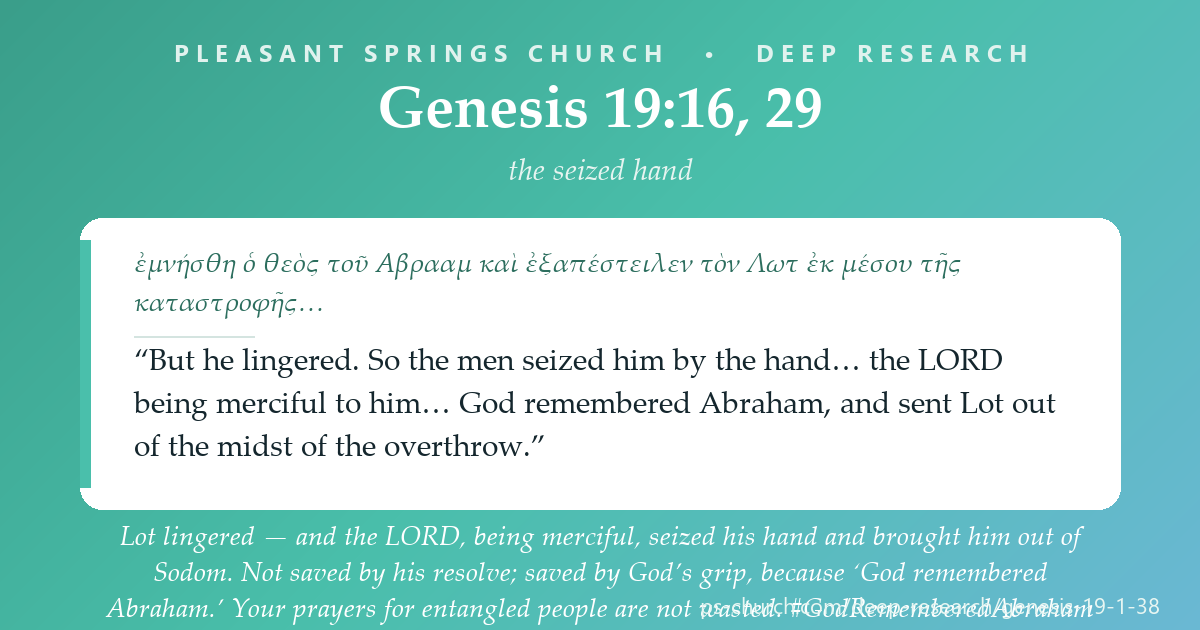
‘But he lingered.’ Verse 16 may be the most humanly telling line in the chapter. Dawn is coming, the fire is coming, the angels are pleading — and Lot hesitates, because everything he has is in Sodom. And then the gospel in miniature: “the men seized him by the hand… the Lord being merciful to him, and they brought him out.” Lot is not saved by his decisiveness — he has none; he even haggles over the escape route (“is it not a little one?”, 19:20). He is saved by God’s grip. Then the Lord rains “sulfur and fire from the Lord out of heaven” (19:24) — a strange double naming the church fathers pondered — and Lot’s wife, her heart still in the city, looks back and becomes a pillar of salt. Jesus would make her a two-word sermon: “Remember Lot’s wife” (Luke 17:32).
‘God remembered Abraham.’ Then the narrator steps back and hands us the key: “when God destroyed the cities of the valley, God remembered Abraham, and sent Lot out of the midst of the overthrow” (19:29). “Remember” (zakar) is covenant language — the same word that turned the flood (8:1). Lot was not delivered because he deserved it; he was delivered because one man stood before the Lord at Mamre and interceded (18:22–33). Sodom did not have its ten righteous — but Abraham’s prayer was still answered, in the rescue of the few. The chapter then closes in a cave, where Lot’s daughters, thinking the world has ended, make their father the instrument of a desperate scheme; Moab and Ammon are born. It is the sober end of a life that “moved his tent as far as Sodom” (13:12) — and yet grace outruns even this wreckage: from Moab will come Ruth, great-grandmother of David and an ancestress of the Messiah (Ruth 4; Mt 1:5).
Audience
Israel heard this on the plains of Moab — camped, literally, among the descendants of this chapter’s last verses, looking across at a land whose cities could go the way of Sodom (Deut 29:23). For them Sodom was the standing byword of judgment (Isa 1:9–10; Amos 4:11) — and the prophets aimed that byword not at the nations but at Israel: “Hear the word of the Lord, you rulers of Sodom!” Isaiah thunders — at Jerusalem. Ezekiel fills out the indictment in terms that should unsettle every comfortable generation: “this was the guilt of your sister Sodom: she and her daughters had pride, excess of food, and prosperous ease, but did not aid the poor and needy” (Ezek 16:49–50, with the abominations of Gen 19 named alongside). The sins of Sodom are uncomfortably ordinary before they are outrageous. The story is a mirror, not a telescope.
The rescue is the point. Peter reads the chapter as a promise: “the Lord knows how to rescue the godly from trials, and to keep the unrighteous under punishment until the day of judgment” (2 Pet 2:9) — and, astonishingly, he calls Lot “righteous Lot,” greatly distressed by what he lived among (2 Pet 2:7–8). God saw faith in Lot that the narrative barely lets us see — a comfort for every compromised believer being dragged out of something by the hand. And Jesus makes “the days of Lot” a pattern of the days of the Son of Man (Luke 17:28–30): ordinary life — eating, drinking, buying, selling, building — right up until the day the door shuts. His application is not “look at them” but “remember her”: the one who was almost out, and looked back. Judgment is real; mercy is real; and the safest place in the chapter is not the gate of Sodom or the little city of Zoar, but the grip of the God who remembers his covenant.
Orient on Sodom, the cities of the valley, hospitality violated, and divine judgment.
Search by topic: Sodom and Gomorrah, cities of the plain, hospitality, outcry, judgment (theophanic), Moab, Ammon.
Which articles are relevant?
- Anchor Bible Dictionary — “Sodom and Gomorrah,” “Hospitality,” “Dead Sea,” “Moab,” “Ammon.”
- Dictionary of the OT: Pentateuch — “Sodom and Gomorrah,” “Lot,” “Judgment,” “Cities of the Plain.”
- NIDOTTE / TDOT — za‘aqah (outcry), hafak (overthrow), chemlah (compassion/mercy), zakar (remember), malat (escape).
Bibliography surfaced:
- Gordon Wenham (WBC), Victor Hamilton (NICOT), Kenneth Mathews (NAC), Bruce Waltke, Nahum Sarna (JPS) on Genesis.
- Studies of the Sodom tradition across Scripture (Deut 29; Isa 1; Ezek 16; Amos 4; Jude 7; 2 Pet 2) and of ancient hospitality codes.
- Beale & Carson, Commentary on the NT Use of the OT (Luke 17; 2 Peter 2; Jude).
The violated guest, the overthrow, and the God who gets his people out.
Read the chapter against the ancient hospitality code, the “overthrow” tradition, and the canonical use of Sodom as a mirror for the covenant people.
Which parallels shed light on religion and worldview?
The violated guest. Across the ancient Near East — and the wider ancient world — the stranger under your roof held a sacred claim: to shelter a traveler was piety, to harm one was sacrilege. Genesis 18–19 are built on that code as a matched pair. At Mamre, strangers are honored and God is entertained unawares; at Sodom, the same visitors are marked for violent abuse by the whole city, “young and old… to the last man.” The offense of Sodom in this chapter is compound: predatory sexual violence and the shattering of the guest-bond — the strong of a whole city organized to prey on the vulnerable at their gate. That is why the prophets can widen the indictment without changing its heart: pride, prosperous ease, and contempt for the weak (Ezek 16:49–50) are the soil; the violence at Lot’s door is the flower. Scripture’s full witness holds both together (Ezek 16; Jude 7), and the study of judgment must be sober, because the mirror faces the reader.
The overthrow. The Hebrew memorializes the event with its own word-family: the hafekah, “the overthrow” (19:29), whose sister-form mahpekah the prophets reserve for Sodom’s end (Deut 29:23; Isa 13:19; Jer 50:40; Amos 4:11) — a catastrophe so total it became the Old Testament’s fixed image of final judgment: land turned to “brimstone and salt,” nothing sown, nothing growing. The region south of the Dead Sea — bitumen pits (14:10), sulfur, salt formations — wears the memory to this day. But notice what the narrative dwells on. It gives one verse to the fire and a whole morning to the rescue: the angels pleading, the lingering man, the seized hand, the negotiated refuge, the dawn walk to Zoar. The God of this chapter is not eager for the overthrow; he is the God who declares, “I have no pleasure in the death of the wicked” (Ezek 33:11), who delays judgment until the last righteous man is out, because “I can do nothing till you arrive there” (19:22).
‘God remembered’ — the covenant hinge. The narrator’s summary verse (19:29) reaches back to the flood: “God remembered Noah” (8:1), “God remembered Abraham.” In both, “remember” is not recollection but covenant action — God moving to save because of a prior commitment. And here the commitment runs through another man’s intercession: Lot is spared for Abraham’s sake, as the doomed plain had been offered mercy for ten righteous (18:32). Second-Temple readers drew the moral widely — Wisdom of Solomon holds up Lot’s rescue as Wisdom delivering “a righteous man” from the fire, with the pillar of salt left standing over the smoking plain as “a monument to an unbelieving soul” (Wis 10:7) — and the New Testament seals it: the rescue of Lot is the pattern-proof that “the Lord knows how to rescue the godly” (2 Pet 2:7–9). Judgment and salvation are not competing stories in Genesis 19; the second is the point of telling the first.
- Genesis 18:16–33; 13:10–13; 14:12–16 — the intercession, Lot’s drift toward Sodom, and the earlier rescue: the long backstory of 19:29 (see Abraham’s plea and Lot’s choice).
- Deuteronomy 29:23; Isaiah 1:9–10; Ezekiel 16:49–50; Amos 4:11 — Sodom as the prophets’ mirror, aimed at the covenant people themselves.
- Luke 17:28–33; 2 Peter 2:6–9; Jude 7 — the days of Lot, righteous Lot rescued, the sober New Testament use of the overthrow.
The theology of Genesis 19 hangs on two small clauses that are easy to read past. The first: ‘but he lingered.’ Everything we know about Lot comes to a point in that verb — the man who chose the well-watered plain, pitched his tent toward Sodom, took his seat in its gate, and now, with fire on the horizon and angels pulling at his sleeve, cannot quite bring himself to leave. He is not defiant; he is entangled. His wealth is there, his standing is there, his sons-in-law are there, and the roots have gone down so deep that even the mercy of God feels like loss. If the story ended with Lot’s own resolve, it would end in the fire. The second clause is why it doesn’t: ‘the men seized his hand… the LORD being merciful to him.’ Salvation in this chapter is not a wise man walking briskly out of danger; it is a hesitating, haggling, half-hearted man being physically dragged to safety by a God more committed to his rescue than he is. And behind the seizing hand stands a praying friend: ‘God remembered Abraham, and sent Lot out of the midst of the overthrow.’ Intercession, mercy, grip — that is the anatomy of Lot’s deliverance, and of ours. The warning of the chapter is real, and Jesus pressed it: the one who was almost out looked back, and was lost. But the comfort is just as real: there are people God will not let go of, even when they linger, because someone stood before him and prayed, and because he is the Lord, merciful.
The vocabulary of the lingering, the mercy, and the remembering.
Watch “he lingered,” the “mercy” that seizes, the “overthrow,” the salt stele, and the covenant “remembered.”
“But he lingered” — a drawn-out, stuttering verb form that sounds like the hesitation it names. With fire coming, Lot cannot let go of Sodom. The LXX reads “they were troubled” (ἐταράχθησαν) — either way, deliverance does not start with Lot’s resolve.
“The Lord being merciful to him” — chemlah, tender pity. The LXX: “because the Lord spared him” (ἐν τῷ φείσασθαι). The seized hand is the sacrament of this word: mercy that grips a lingering man.
“Sulfur and fire” — rained “from the Lord out of heaven,” with the strange double naming (“the Lord rained… from the Lord”) the fathers pondered. Judgment in Scripture is God’s own act — never blind nature, never chance.
“A pillar of salt” — LXX στήλη ἁλός, a salt stele, a monument. She was out of the city but the city was not out of her. Jesus’ two-word sermon: “Remember Lot’s wife” (Luke 17:32).
“God remembered” — zakar, covenant remembrance that acts (cf. 8:1, Noah; Ex 2:24). The narrator’s key to the whole chapter: Lot is delivered for Abraham’s sake — the Mamre intercession honored.
“The overthrow” — found only here; its sister-form mahpekah became the Old Testament’s fixed term for Sodom’s end (Deut 29:23; Isa 13:19; Jer 50:40), the standing image of final judgment. The smoking plain became Scripture’s permanent warning — and its backdrop for mercy.
How the rest of Scripture fills out the scene:
- Genesis 8:1; Exodus 2:24; Psalm 105:8, 42 — “God remembered” Noah, the covenant, Abraham: remembrance as saving action.
- Deuteronomy 29:23; Isaiah 1:9–10; Ezekiel 16:49–50; Amos 4:11 — Sodom as byword and mirror, aimed at the covenant people.
- Luke 17:28–33; Matthew 10:15; 11:23–24 — the days of Lot; “more bearable for Sodom” than for towns that refuse the Son: the mirror turned on the complacent.
- 2 Peter 2:6–9; Jude 7; Wisdom 10:6–8 — righteous Lot rescued; the Lord knows how to rescue the godly; the Second-Temple reading of the overthrow.
From the overthrow of Sodom to the rescue of the least deserving.
Trace the outcry, the overthrow, and the remembered covenant toward the New Testament’s sober hope.
Which cross-references matter?
- Genesis 13:10–13; 14:12–16; 18:16–33 — Lot’s drift, the first rescue, the intercession: the long arc that lands at 19:29 (see Lot’s choice, the first rescue, the plea for Sodom).
- Genesis 8:1; Exodus 2:24–25 — “God remembered”: the covenant verb that turns the flood, the bondage, and the overthrow.
- Ezekiel 16:49–50; Isaiah 1:9–17 — the full indictment of Sodom, preached to Jerusalem: pride, ease, neglect of the poor — and worse.
- Luke 17:28–33; 2 Peter 2:6–9; Jude 7 — the days of Lot, the rescue of the godly, the fire held up as warning — the New Testament’s sober double use.
- Ruth 4:13–22; Matthew 1:5 — from Moab, Ruth — the line of David and of the Christ: grace with the last word even over the cave at Zoar.
Every generation is tempted to read Genesis 19 as a story about somebody else. The prophets refused to allow Israel that comfort, and the New Testament refuses it to the church. When Isaiah wants to indict Jerusalem, he calls her rulers ‘rulers of Sodom’; when Ezekiel lists Sodom’s guilt, he begins not with the mob at the door but with pride, abundance of bread, and untroubled ease that would not lift a hand for the poor — sins that read like a description of any prosperous, comfortable, self-satisfied people. The abominations of that final night were the ripened fruit of a long, ordinary hardness. And when Jesus takes up the story, his warning lands not on the pagan cities but on Capernaum, on the towns that heard him and shrugged: it will be more bearable for Sodom on that day than for you. The mirror faces the reader — always. But the chapter is not only a mirror; it is a rescue. The same God who judges the plain spends the whole night getting one wavering household out of it, seizes a lingering man by the hand, grants his timid bargain for a smaller refuge, and does it all, the narrator says, because he remembered Abraham. There is no one in Genesis 19 who earns his deliverance. There is only intercession, and mercy, and the grip of God — which is exactly the shape of the salvation the gospel announces: a Righteous One who stands before the Judge for the guilty, and a God who, for his sake, sends his angels to bring the compromised and the hesitant and the barely-willing out of the city before the fire falls.
The scholarship on Genesis 19:1-38.
The commentators on the Sodom narrative; the studies of the outcry, the hospitality code, the overthrow tradition, and the Moab-Ammon notice.
Commentaries & studies:
- Gordon J. Wenham (WBC), Victor P. Hamilton (NICOT), Kenneth A. Mathews (NAC), Bruce K. Waltke, Nahum M. Sarna (JPS) on Genesis.
- Studies of the Sodom tradition (Deut 29; Isa 1; 13; Jer 23; 49–50; Ezek 16; Amos 4; Zeph 2) and of ancient Near Eastern hospitality and guest-protection.
- G. K. Beale & D. A. Carson, eds., Commentary on the NT Use of the OT (Luke 17; 2 Peter 2; Jude).
Interpretation notes worth keeping:
- The sin of Sodom, whole-Bible. Genesis 19 shows predatory sexual violence and the shattering of the guest-bond; Ezekiel 16:49–50 adds the soil it grew in — pride, excess, ease, neglect of the poor — and Jude 7 names the immorality. Hold the full witness; preach it soberly, without sensationalism, with the mirror facing the reader.
- ‘From the Lord… out of heaven’ (19:24). The double naming (“the Lord rained… from the Lord”) was noticed by ancient readers as a hint of plurality in God; hold it tentatively — a suggestive turn of phrase, not a proof-text.
- Salvation as God’s grip. “He lingered” + “the Lord being merciful” (19:16): Lot contributes hesitation and haggling; God contributes the rescue. 2 Peter 2:7–9 turns the episode into doctrine: the Lord knows how to rescue.
- Lot’s wife. Not punished for a glance but revealed by one: delivered in body, still Sodom’s in heart. Jesus’ use (Luke 17:31–33) targets divided hearts in the day of crisis — “whoever seeks to preserve his life will lose it.”
- 19:30–38, Moab and Ammon. Narrated without editorial comment — a sober close, not an occasion for scorn: Israel is later commanded to respect both nations’ lands (Deut 2:9, 19), and from Moab comes Ruth, ancestress of David and of the Christ (Ruth 4; Mt 1:5). Grace reaches into the wreckage.
From the fire that fell to the hand that would not let go.
Name what you learned, why it matters, and one concrete response.
What should we carry away — and do?
- Judgment is real — and the mirror faces us. The prophets aimed Sodom at Jerusalem, and Jesus aimed it at Capernaum. The sins that ripened into that night began as pride, plenty, and unconcern for the poor (Ezek 16:49).
- Mercy grips harder than we linger. Lot was saved hesitating, haggling, and half-hearted — “the Lord being merciful to him.” If God’s grip depended on our resolve, no one would reach Zoar.
- Intercession is honored. “God remembered Abraham, and sent Lot out” (19:29). Your prayers for people entangled in a doomed place are not wasted; heaven files them.
Step in response: pray by name this week for someone entangled where they should not stay — and let Genesis 19 set the tone: no scorn, no spectacle, just Abraham’s kind of pleading. Examine the ordinary soil of Sodom in your own life — pride, plenty, ease, a closed hand to the poor — and act on what you find. And “remember Lot’s wife”: when God is bringing you out of something, do not negotiate with the skyline. Walk on, and trust the hand that holds yours.
Genesis 19:29 · to share
LXX + ESVEvery Deep Research page traces its passage across the whole sweep — the Old Testament, the Second-Temple world between the testaments (historical witnesses, not Scripture), and the New Testament. Follow the thread:
Pleasant Springs Church — Deep Research
Research method after Michael S. Heiser’s Bible Research Method (examine dictionaries → ancient literature → important words → textual connections → academic publications → share), with the Pleasant Springs “Author & Audience” foundation. Scripture set in the Hebrew, the Greek editions named on each page and the ESV (Old Testament), and the Greek New Testament and the ESV (New Testament), per the practice of Pleasant Springs Church. Genesis 19:1–38 research grounded in Wenham, Hamilton, Mathews, Waltke, and Sarna; the sin of Sodom held with the whole-Bible witness (Gen 19’s violence and shattered guest-bond; Ezek 16:49–50’s pride, ease, and neglect of the poor; Jude 7) and preached soberly, mirror facing the reader (Isa 1:10; Luke 17); the “from the Lord… out of heaven” double naming (19:24) noted tentatively, not forced; salvation as God’s grip (“he lingered… the Lord being merciful,” 19:16) with 2 Peter 2:7–9’s “righteous Lot” honored; “God remembered Abraham” (19:29) read as the chapter’s covenant key (cf. 8:1); and the Moab-Ammon close (19:30–38) treated without scorn, with Deut 2:9, 19 and Ruth’s place in Messiah’s line (Ruth 4; Mt 1:5) letting grace speak the last word.
Scripture quotations marked ESV are from the ESV® Bible (The Holy Bible, English Standard Version®), © 2001 by Crossway, a publishing ministry of Good News Publishers. ESV Text Edition: 2016. Used by permission. All rights reserved. The ESV text may not be quoted in any publication made available to the public by a Creative Commons license, and the ESV may not be translated in whole or in part into any other language. www.esv.org
|
Did this study bless you today? 💚 Give to Support PS Church100% of gifts go to the General Fund — thank you. |