Twenty-five years after Egypt, Abraham tells the same half-truth in Gerar — on the very eve of Isaac’s conception. God intervenes alone: he comes to the pagan king in a dream, reveals a backstage mercy — “it was I who kept you from sinning against me” — and then, astonishingly, gives Scripture its first “prophet,” defined not by prediction but by prayer: “he will pray for you, and you shall live.” The man who failed is still God’s man; the promise moves, guarded, toward the appointed birth. This study works Genesis 20:1–18. See the method →
Genesis 20:3, 6–7, 11, 17
Hebrew · LXX · ESVThe Shape of the Passage
Ring compositionChapter 20 sits deliberately between the promise of Isaac (18:10) and his birth (21:1–2): at the last possible moment, the promise is endangered by the promise-bearer himself — and guarded by God alone.
Author
Moses lets the old failure repeat. In Gerar, on the southern edge of Canaan, Abraham falls back on the survival strategy of his Egypt years: “She is my sister” (cf. 12:10–20) — technically a half-truth (20:12), spiritually a collapse of faith, and this time catastrophically timed, for Sarah now carries the calendar of the promise: “about this time next year, and Sarah shall have a son” (18:14). The narrator does not soften it. The father of faith, fresh from interceding for Sodom, endangers his own wife and the covenant line out of fear — and his stated reason, “there is no fear of God at all in this place” (20:11), is disproven by the whole chapter, in which the pagan king behaves more honorably than the prophet. Scripture’s heroes are not airbrushed; grace, not their consistency, carries the story.
God guards what Abraham endangered. The rescue this time is all God’s. He comes to Abimelech “in a dream by night” — a mode of revelation the ancient world took with utter seriousness — and speaks as the Judge: “you are a dead man.” Abimelech protests his integrity, and God grants it — then pulls back the curtain on a mercy no one had seen: “it was I who kept you from sinning against me; therefore I did not let you touch her” (20:6). Behind the scenes, before anyone prayed, God had already restrained the sin — guarding Sarah, guarding Abimelech, and guarding the paternity of the son about to be conceived, so that no shadow could fall over Isaac’s birth. The God of the covenant does not merely forgive sins; he prevents ones we never know about.
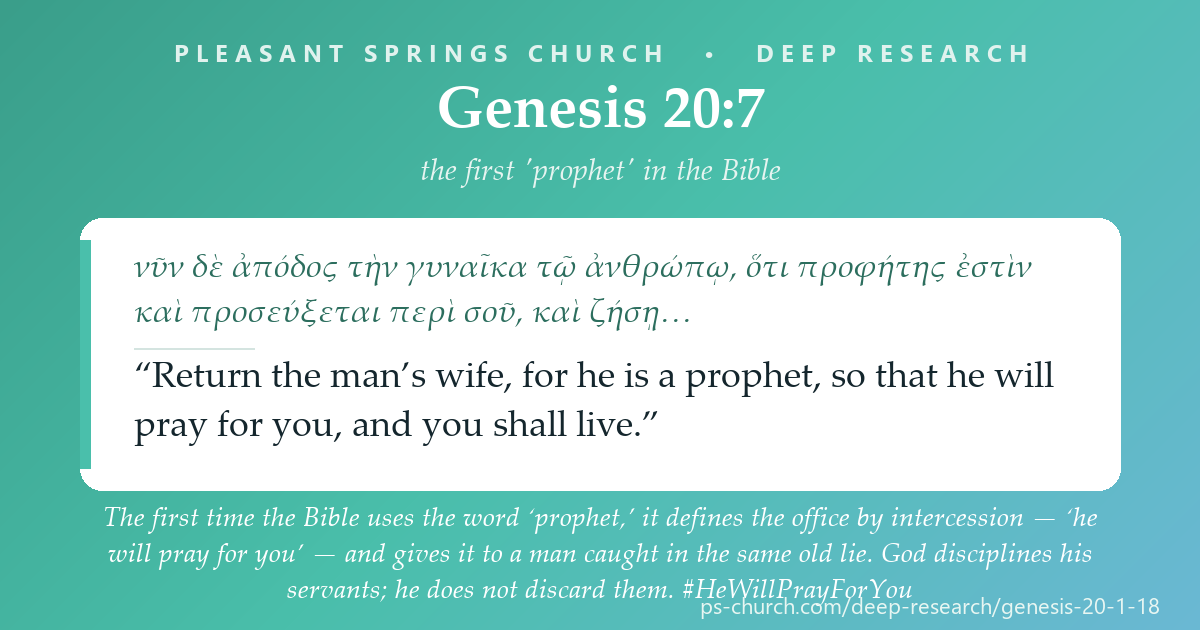
‘He is a prophet, and he will pray for you.’ Then the astonishment: the first time the Bible uses the word prophet (navi), it is applied to the man at his worst — and defined by intercession, not prediction. “Now then, return the man’s wife, for he is a prophet, so that he will pray for you, and you shall live” (20:7). God does not transfer the office to the better-behaved man in the story; he binds the pagan king’s healing to the flawed covenant man’s prayer. Abimelech restores Sarah with gifts and a public vindication of her honor (20:14–16); Abraham prays; God heals the closed wombs of Abimelech’s house (20:17–18) — and the writer leaves us the irony on purpose: the intercessor whose prayers open wombs is still waiting on the promise for his own. The very next verse answers it: “the Lord visited Sarah” (21:1).
Audience
Israel heard their own story in this one: the ancestor whose fear nearly forfeited the promise, and the God whose fidelity did not flinch. A nation about to live among Philistines and Canaanites needed exactly this theology — that the covenant’s security rests on God’s faithfulness, not the covenant people’s nerve; that God is at work restraining evil even among the nations (“I kept you from sinning”); and that pagans are not cartoons — Abimelech’s “integrity of heart” is real, granted by God himself, a sober reminder that the fear of God can be found where his people least expect it, and absent where they most presume it.
The comfort of the flawed intercessor. For every believer who has repeated an old sin — the same lie, the same fear, decades after the first time — Genesis 20 is severe mercy. Abraham’s failure is real and God does not excuse it; Abimelech’s rebuke of the prophet (20:9–10) stings because it is deserved. But the office is not revoked. God still says “he is a prophet,” still routes the king’s healing through the failer’s prayer, still keeps the promise on schedule. That is not indulgence; it is covenant. The gospel will say it plainly: “if we are faithless, he remains faithful — for he cannot deny himself” (2 Tim 2:13). And the chapter’s hidden mercy — sin restrained before it happens — teaches the church to thank God not only for pardons received but for falls prevented, the providences we will never see this side of glory.
Orient on Gerar, Abimelech, dreams, prophets, and the fear of God.
Search by topic: Abimelech, Gerar, dream (revelation), prophet, intercession, fear of God, wife-sister episodes.
Which articles are relevant?
- Anchor Bible Dictionary — “Abimelech,” “Gerar,” “Dreams,” “Prophet, Prophecy.”
- Dictionary of the OT: Pentateuch — “Abraham,” “Prophets, Prophecy,” “Wife-Sister Episodes,” “Fear of God.”
- NIDOTTE / TDOT — navi’ (prophet), chalom (dream), tom (integrity), chasak (withhold/keep back), palal (pray, hitpael), yir’at Elohim (fear of God).
Bibliography surfaced:
- Gordon Wenham (WBC), Victor Hamilton (NICOT), Kenneth Mathews (NAC), Bruce Waltke, Nahum Sarna (JPS) on Genesis.
- Studies of the three wife-sister episodes (12; 20; 26), of dream revelation in the ancient Near East, and of the rise of the prophetic office.
- Beale & Carson, Commentary on the NT Use of the OT (Romans 4; 2 Timothy 2).
Dream revelation, restrained sin, and the office defined by prayer.
Read the Gerar episode against ancient dream-revelation, the ethics of the guest-king, and the Bible’s theology of prevented sin.
Which parallels shed light on religion and worldview?
The God who speaks to pagan kings. In the ancient Near East, dreams were a recognized channel of divine speech, and kings above all expected the gods to address them so. Genesis works comfortably inside that world — God meets Abimelech where ancient royal theology expected a god to appear — but overturns its assumptions: it is not Abimelech’s god who speaks, but the God of Abraham, exercising effortless jurisdiction inside a Philistine court. The true God is no tribal deity; every throne room and every conscience lies open to him. He warns Pharaohs and Abimelechs, restrains them, reasons with them (“Lord, will you kill an innocent people?”, 20:4 — an echo of Abraham’s own question at 18:23–25), and holds them accountable to a moral standard they themselves half-know. What Abraham cynically assumed — “no fear of God in this place” — God refutes in person.
The theology of prevented sin. Verse 6 is one of Scripture’s rare glimpses backstage: “it was I who kept you from sinning against me.” Sin here is defined vertically — the wrong contemplated against Sarah would have been sin against God (cf. 39:9; Ps 51:4) — and God claims to have been actively restraining it before any human knew there was danger. This is the Bible’s doctrine of common grace in miniature: the world is not as evil as it could be, because God restrains — through conscience, providence, circumstance, even affliction (20:17–18 implies the household had already been struck). Every believer’s biography contains chapters titled ‘what God prevented’ that will only be read in glory.
The first ‘prophet,’ defined by intercession. When the word navi finally surfaces — after twenty chapters — it lands on Abraham, and its content is a job description in one clause: “he will pray for you, and you shall live.” Before the prophet is ever a foreteller, he is a go-between: one who stands in God’s council (18:17) and therefore can stand before God for others. That definition governs the whole office to come — Moses, the greatest prophet, is the greatest intercessor (Ex 32:11–14; Deut 9:25–29); Samuel counts prayer-failure as sin against the Lord (1 Sam 12:23); Jeremiah’s standing before God for the people defines his call (Jer 18:20; 27:18). And the line runs to its end in the Prophet like Moses, whose whole priest-prophetic life is summed up as “he always lives to make intercession” (Heb 7:25). That God attaches this office to Abraham at his worst is the scandal of grace on which the office rests.
- Genesis 12:10–20; 26:1–11 — the three wife-sister episodes: the same fear, the same fidelity of God (see Abram in Egypt).
- Genesis 39:9; Psalm 51:4 — sin defined as against God: the vertical dimension of 20:6.
- Exodus 32:11–14; 1 Samuel 12:23; Jeremiah 15:1; Hebrews 7:25 — the prophet as intercessor, from Abraham to Moses to the Christ.
It is one of the Bible’s most deliberate ironies that the word ‘prophet’ enters Scripture in the chapter where Abraham deserves it least. He is not standing on a mountain confronting kings with the word of God; he is cowering behind a half-truth, letting a king take his wife to save his own skin, repeating a failure twenty-five years old. Abimelech, the pagan, holds the moral high ground in every scene — he acts in integrity, he obeys the dream immediately, he rebukes the prophet with questions the prophet cannot answer, he restores Sarah with public honor. If God distributed offices by merit, this chapter would end with Abimelech promoted and Abraham dismissed. Instead God says the unthinkable: ‘he is a prophet, so that he will pray for you, and you shall live.’ The office holds because the office was never grounded in Abraham’s performance; it is grounded in God’s election and God’s call, which are irrevocable. And there is a mercy in this for the king too: God binds Abimelech’s healing to Abraham’s prayer, forcing reconciliation between the wronged and the wrongdoer — the offended king must receive his healing through the hands of the man who wronged him, and the failed prophet must rise from his failure and do his proper work. Grace restores both men at once, each through the other. That is how God still deals with his flawed servants: he does not pretend the failure never happened — the rebuke of Abimelech stands in the text forever — but neither does he revoke the calling. He disciplines, he restores, and he puts the intercessor back on his knees, which is where the office lives.
The vocabulary of the failure, the restraint, and the office.
Watch the old lie, the dream, the “integrity of heart,” the divine “I kept you back,” and the first “prophet” who “prayed.”
“She is my sister” — the old Egypt strategy (12:13), technically a half-truth (20:12), spiritually a collapse of trust, timed at the worst possible hour: the eve of Isaac’s conception. Old fears resurface; God’s fidelity does not.
“In a dream” — the ancient world’s expected channel of royal revelation. The God of Abraham speaks freely inside a Philistine court: no throne room, and no conscience, is outside his jurisdiction.
“Integrity of heart” — claimed by Abimelech, confirmed by God (LXX: “a pure heart,” καθαρᾷ καρδίᾳ). Real moral integrity can exist outside the covenant people — granted, God adds, by his own restraining hand.
“And I kept you back” — chasak, to withhold, restrain. The doctrine of prevented sin: before anyone prayed or knew, God was already restraining. Common grace, working backstage in every biography.
“Prophet” — the word’s first occurrence in Scripture, defined not by prediction but by intercession: “he will pray for you, and you shall live.” The office that runs through Moses and Samuel to the One who always lives to intercede (Heb 7:25).
“And he prayed” — the Bible’s first narrated act of prayer with the standard verb (palal, hitpael): promised at 20:7, performed here — and it is intercession for a pagan king. The failed man’s restored work: God heals Abimelech’s house through the prayer of the one who wronged it.
How the rest of Scripture fills out the scene:
- Genesis 12:10–20; 26:1–11 — the wife-sister episodes across two generations: inherited fears, unchanging faithfulness (see Abram in Egypt).
- Job 42:8–10; James 5:16 — “my servant Job shall pray for you”: God binding others’ restoration to a wounded intercessor’s prayer, as with Abraham.
- Psalm 105:12–15 — “Touch not my anointed ones, do my prophets no harm”: the psalmist’s reading of these very episodes.
- 2 Timothy 2:13; Romans 11:29 — “if we are faithless, he remains faithful”; “the gifts and the calling of God are irrevocable”: the doctrine beneath the unrevoked office.
From the guarded promise to the Intercessor who never fails.
Trace the restrained sin, the guarded seed, and the intercessor’s office toward their fulfillment.
Which cross-references matter?
- Genesis 18:10; 21:1–2 — the chapter’s frame: the promise dated, then kept — Sarah guarded untouched (20:6) so no shadow falls on Isaac’s paternity (see the promise at Mamre).
- Genesis 18:23–25 ↔ 20:4 — “Will you indeed sweep away the righteous with the wicked?” asked by Abraham, then echoed by Abimelech: God welcomes the appeal to his justice from covenant man and pagan king alike.
- Exodus 32:11–14; Deuteronomy 9:25–29; 1 Samuel 12:23; Jeremiah 27:18 — the prophet-as-intercessor line that begins at 20:7.
- Deuteronomy 18:15–19; Hebrews 7:25; 1 John 2:1 — the Prophet like Moses; the One who always lives to make intercession: the office’s destination (see the Prophet like Moses and the throne of grace).
- Romans 4:18–25 — the same Abraham “fully convinced” — Scripture holds the failing man and the faith-model together without contradiction: grace makes both true.
Read in sequence, the placement of this episode is the theology. The son has been promised by name and by date; Sarah, for the first time in her life, stands weeks from conceiving — and it is precisely now that Abraham’s old fear hands her to another man’s house. Everything the covenant carries — the seed, the blessing to the nations, the whole future the book has been building since chapter 12 — sits for one night in Abimelech’s palace, hostage to a lie. If the promise depended on the promise-bearer, it dies here. Instead, the narrative shows God throwing a hedge around the promise from every side at once: he afflicts the household so nothing can proceed, comes to the king in a dream with a death sentence, testifies himself to Sarah’s untouched state — the text is emphatic, so that no reader could ever doubt whose son Isaac is — and then requires the restoration to run through Abraham’s own restored prayer. Not one thread of the rescue is Abraham’s doing; the endangerment was his, the deliverance entirely God’s. That is the deep grammar of the covenant which Israel needed and the church still needs: the promises of God are not carried by the reliability of his people. They are carried by the God who watches over his word to perform it, who guards it against enemies, against accidents, and — most tenderly of all — against the failures of the very people to whom it was given.
The scholarship on Genesis 20:1-18.
The commentators on the Gerar episode; the studies of the wife-sister narratives, dream revelation, and the origins of the prophetic office.
Commentaries & studies:
- Gordon J. Wenham (WBC), Victor P. Hamilton (NICOT), Kenneth A. Mathews (NAC), Bruce K. Waltke, Nahum M. Sarna (JPS) on Genesis.
- Studies of the three wife-sister episodes (12; 20; 26) and their function; dream revelation in the ancient Near East; the semantics of navi’ and the prophetic office.
- The Genesis Apocryphon (1QapGen XX) — the Dead Sea Scrolls’ retelling of the Egypt episode, with Abram praying healing over Pharaoh: Second-Temple witness to the intercessor tradition.
Interpretation notes worth keeping:
- Not a doublet, a relapse. Critical scholarship often treats 12 / 20 / 26 as one tale thrice-told; the narrative reads them as a family pattern — the same fear resurfacing across decades and generations. Repeated sin is realism, not literary accident.
- The half-truth (20:12). Sarah as half-sister makes the lie technically defensible and morally worse: truth used as camouflage. Scripture’s ethics do not grade deception by its factual content.
- ‘I kept you from sinning’ (20:6). Divine restraint of sin — common grace — operating on a pagan king’s will without destroying his agency or his accountability (“now return the man’s wife”). Hold both truths; don’t collapse either.
- The first navi’ (20:7). The office enters Scripture defined by intercession and access to God’s council (cf. 18:17), not prediction — and lands on the man at his worst: grounded in election, not performance (Rom 11:29).
- ‘A thousand pieces of silver’ (20:16). Abimelech’s payment is a public legal vindication of Sarah’s honor (“a covering of the eyes”), ensuring no one could later question her — or Isaac’s legitimacy. The narrative closes every loophole around the promised birth.
From an old fear repeated to a calling that would not let go.
Name what you learned, why it matters, and one concrete response.
What should we carry away — and do?
- Old fears resurface; God’s fidelity does not. Twenty-five years after Egypt, the same lie — and the same God, guarding the promise his servant endangered. The covenant is carried by his faithfulness, not our nerve.
- Thank God for prevented sins. “It was I who kept you from sinning against me” (20:6). Behind every biography stands a restraining mercy we will only read about in glory.
- The calling survives the failure. The Bible’s first “prophet” is named in the chapter of his worst hour — and defined by intercession. God disciplines his servants; he does not discard them (2 Tim 2:13).
Step in response: name the old fear that still scripts your worst decisions — and bring it into the light before God rather than managing it with half-truths. Thank him deliberately for the falls he has prevented, seen and unseen. And if failure has convinced you your usefulness is over, let Genesis 20 correct you: get back to the work the calling actually consists of — pray for someone, today, including anyone your failure has wounded. The office lives on its knees.
Genesis 20:7 · to share
LXX + ESVEvery Deep Research page traces its passage across the whole sweep — the Old Testament, the Second-Temple world between the testaments (historical witnesses, not Scripture), and the New Testament. Follow the thread:
Pleasant Springs Church — Deep Research
Research method after Michael S. Heiser’s Bible Research Method (examine dictionaries → ancient literature → important words → textual connections → academic publications → share), with the Pleasant Springs “Author & Audience” foundation. Scripture set in the Hebrew, the Greek editions named on each page and the ESV (Old Testament), and the Greek New Testament and the ESV (New Testament), per the practice of Pleasant Springs Church. Genesis 20:1–18 research grounded in Wenham, Hamilton, Mathews, Waltke, and Sarna; the wife-sister episodes (12; 20; 26) read as a recurring family pattern rather than a critical doublet; Abraham’s half-truth (20:12) judged by Scripture’s own ethics, with the pagan king’s “integrity of heart” (20:5–6) taken at God’s word; the theology of prevented sin (“I kept you from sinning,” 20:6) held as common grace restraining without erasing agency; the first navi’ (20:7) defined by intercession and council-access (18:17), grounded in election not performance (Rom 11:29; 2 Tim 2:13); the “thousand pieces of silver” (20:16) as public vindication sealing Sarah’s honor and Isaac’s legitimacy on the eve of 21:1; and the office traced through Moses, Samuel, and Jeremiah to the Prophet who ever lives to intercede (Deut 18:15–19; Heb 7:25).
Scripture quotations marked ESV are from the ESV® Bible (The Holy Bible, English Standard Version®), © 2001 by Crossway, a publishing ministry of Good News Publishers. ESV Text Edition: 2016. Used by permission. All rights reserved. The ESV text may not be quoted in any publication made available to the public by a Creative Commons license, and the ESV may not be translated in whole or in part into any other language. www.esv.org
|
Did this study bless you today? 💚 Give to Support PS Church100% of gifts go to the General Fund — thank you. |