Between the Old Testament and the New lies a whole library the apostles grew up reading — and few books open that world like the Book of Jubilees. It retells Genesis and Exodus as a revelation to Moses on Sinai, dictated by an angel, and it shows us how Jews in Jesus’ own century heard the story of creation and covenant. This study gives Jubilees the same careful research-method treatment as the canon — as a witness to be weighed, not Scripture to be obeyed. See the method →
The Book of Jubilees (c. 160–150 BC) is a Second-Temple Jewish retelling of Genesis 1 through Exodus 24, framed as a revelation given to Moses at Sinai and dictated by “the angel of the presence.” It is not Scripture for us: it belongs to the “Pseudepigrapha,” though it was prized at Qumran (some fifteen copies) and is canonical in the Ethiopian Orthodox Church. We study it the way we study the ancient Near-Eastern texts — as a window into the world of the Bible, one of the clearest witnesses to how Jews in Jesus’ own era read Genesis. We read it critically: gratefully for the light it throws on the New Testament’s world, but testing everything by the canon, and noting where it adds to, or departs from, Scripture.
Jubilees — Prologue & 1 (selections)
Geʻez · EnglishThe Shape of the Passage
InclusioWith an extrabiblical book the Author & Audience question is even more important than usual: knowing who wrote Jubilees, when, and why is what lets us weigh it rightly.
Author
Jubilees is anonymous and pseudonymous: it presents itself as revelation to Moses, but scholars date it to about 160–150 BC, a generation after the Maccabean revolt. The writer was almost certainly a priestly, Torah-zealous Jew — close in outlook to the community that later gathered at Qumran — who claims Mosaic-Sinai authority (and the dictation of “the angel of the presence,” 1:27; 2:1) precisely to press his program.
Genre. It is a classic example of “rewritten Scripture” — retelling Genesis–Exodus while smoothing difficulties, dating everything by a fixed calendar, and pushing later laws back into the age of the patriarchs.
Audience
Jews living under intense Hellenizing pressure in the second century BC, when Greek customs and a Greek-style calendar threatened Torah identity. To them Jubilees is a rallying manifesto: keep the covenant, the Sabbath, and circumcision; do not intermarry with the nations; and keep the feasts by the true 364-day solar calendar — not the lunar reckoning the writer opposes.
How they heard it. By setting all of this in Moses’ mouth at Sinai and on “heavenly tablets,” the book claims that its calendar and separatism are not innovations but the oldest, angel-attested order of the world. That claim is exactly what a modern reader must weigh — and is why we read it as witness, not as Scripture.
Get the lay of the land on Jubilees, the Pseudepigrapha, and the Qumran calendar.
For an extrabiblical book, the dictionaries of background are the top tier.
Which articles are relevant?
- Anchor Bible Dictionary — “Jubilees, Book of” (VanderKam), “Pseudepigrapha,” “Calendars (Ancient Israelite and Early Jewish).”
- Dictionary of New Testament Background (IVP) — “Jubilees,” “Rewritten Bible,” “Dead Sea Scrolls,” “Apocalypticism.”
- Eerdmans Dictionary of Early Judaism — “Jubilees,” “Enoch, Books of,” “Angels.”
Bibliography surfaced:
- James C. VanderKam, The Book of Jubilees (Guides to Apocrypha & Pseudepigrapha) and his critical edition & commentary.
- James L. Kugel, A Walk Through Jubilees; Michael Segal, The Book of Jubilees: Rewritten Bible, Redaction, Ideology and Theology.
- R. H. Charles, The Book of Jubilees (1902/1913) — the classic English edition (public domain).
Jubilees among its Second-Temple neighbors — and how it rewrites Genesis.
Compare Jubilees with the other “rewritten Scripture” works, the Enoch literature, and the Qumran calendar texts — the very library the New Testament writers grew up around.
Which parallels shed light on the world of the text?
Rewritten Scripture. Jubilees stands beside the Genesis Apocryphon (1QapGen), the Temple Scroll, and Pseudo-Philo’s Biblical Antiquities — all retelling the biblical story with additions. Knowing this genre keeps us from mistaking Jubilees’ expansions for the text of Genesis itself.
The calendar war. Jubilees’ insistence on a 364-day solar calendar matches the Astronomical Book of 1 Enoch and the Qumran calendar scrolls — a fierce Second-Temple dispute (solar vs. lunar reckoning of the feasts) invisible in most English Bibles but everywhere in this literature.
Jubilees is saturated with angels — the angel of the presence dictating the book, angels created on day one (Jub 2), and (in Jub 5) an expanded retelling of the Watchers of Genesis 6:1–4, drawn from 1 Enoch. This is the same supernatural worldview the apostles simply assume: Peter and Jude speak of the angels who sinned and are kept in chains (2 Pet 2:4; Jude 6), and Jude 14–15 openly quotes 1 Enoch. That the NT writers knew and used this literature does not make it Scripture — but it shows why reading Jubilees helps us hear them.
The load-bearing terms of Jubilees’ program.
Because Jubilees survives mainly in Geʻez, we watch concepts as much as single words — jubilee-reckoning, the mediating angel, the heavenly tablets, and the calendar.
Hebrew יוֹבֵל, the fiftieth-year release (Lev 25). Jubilees dates all history in 49-year “jubilee” units of seven weeks of years — hence the book’s name.
The exalted angel who dictates the book to Moses (Jub 1:27; 2:1) — the claimed channel of its authority. Cf. Isa 63:9, “the angel of his presence saved them.”
Jubilees’ recurring image: law, history, and calendar all pre-written on tablets in heaven — a bid to present its whole program as eternal and fixed.
The book’s calendar: exactly 52 weeks, so every feast falls on the same weekday every year — and never on a Sabbath. The banner of its reform.
The verse that reaches toward the gospel — Jubilees 1:23:
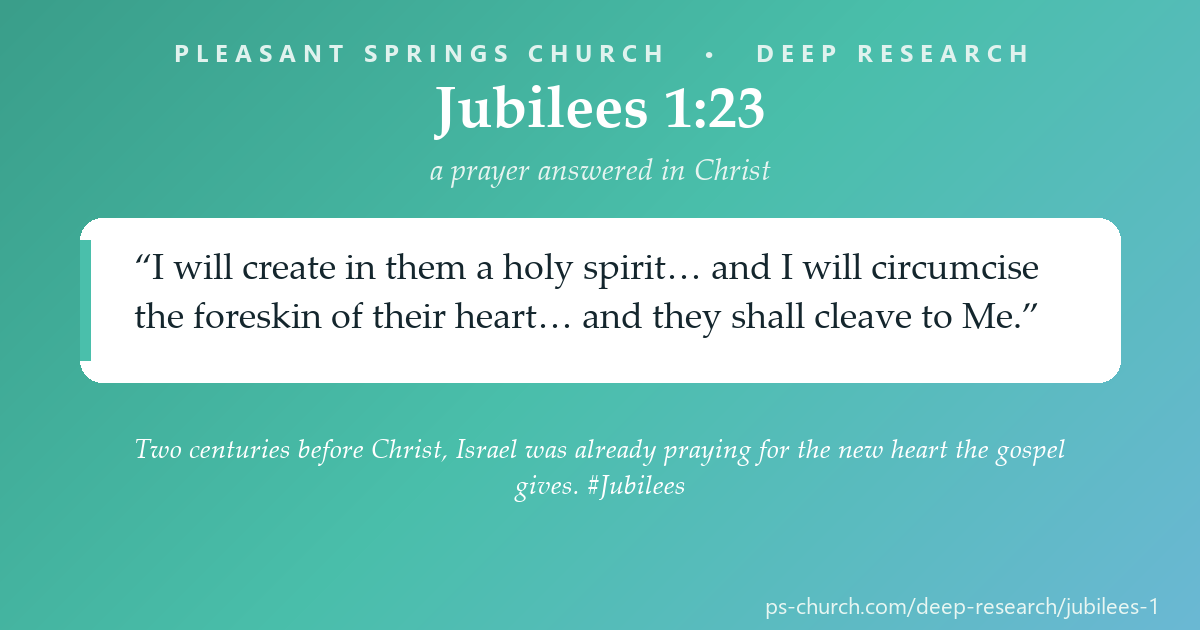
Amid its separatism, Jubilees voices a strikingly evangelical hope. In 1:23 God promises to “create in them a holy spirit… and circumcise the foreskin of their heart… and they shall cleave to Me.” This is the Second-Temple period praying back the great prophetic promises of an inward covenant — and it lands only a step from what the New Testament announces as fulfilled in Christ and the Spirit.
Where Jubilees touches the canon — behind it and after it.
Trace the biblical passages Jubilees rewrites, and the New Testament ideas that share its air.
Which connections matter?
- Exodus 24:12–18 — Moses summoned up Sinai for the tablets: the scene Jubilees expands into its whole frame.
- The new heart: Jubilees 1:23 gathers up Deuteronomy 30:6 (circumcised heart), Jeremiah 31:31–34 (new covenant), and Ezekiel 36:26–27 (new heart and spirit) — the very promises the NT declares kept in 2 Corinthians 3, Hebrews 8, and Romans 2:29.
- Genesis 1:1 and Day One (1:2–5) — Jubilees 2 retells creation, adding the angels of day one: read our Genesis studies alongside our Jubilees 2 study to see exactly what Jubilees adds.
- The light of day one (Jubilees 2) — and the Light in person: John 1:1–5, where the Word who made all things — seen and unseen — shines in the darkness.
- The Watchers (Jubilees 5; Genesis 6:1–4; 1 Enoch) → 2 Peter 2:4; Jude 6, 14–15.
That the New Testament echoes and even quotes this literature (Jude and 1 Enoch) shows the apostles knew it well — but the church never received Jubilees or 1 Enoch as Scripture. The right posture is the Berean one (Acts 17:11): read it eagerly for light on the biblical world, and test everything against the canon. Where Jubilees magnifies Christ’s world — the reality of the unseen realm, the longing for a new heart — it helps us; where it binds consciences to a calendar or adds to the Word, we let Scripture correct it.
The scholarship that opens Jubilees up.
Go to the specialists on Jubilees, the Pseudepigrapha, and the Dead Sea Scrolls.
Editions & studies:
- James C. VanderKam, The Book of Jubilees (critical text & commentary; and the shorter Guide) — the standard.
- James L. Kugel, A Walk Through Jubilees; Michael Segal, The Book of Jubilees; O. S. Wintermute’s translation in Charlesworth, The Old Testament Pseudepigrapha, vol. 2.
- R. H. Charles, The Book of Jubilees or the Little Genesis (1902) — foundational, public domain.
Text & transmission notes:
- The complete text survives only in Geʻez (Ethiopic), translated from a Greek version of a Hebrew original; Hebrew fragments at Qumran confirm the Hebrew original and a second-century-BC date.
- Its high standing at Qumran (and canonical status in Ethiopia) is a caution against reading later canon boundaries back onto the Second-Temple period — the edges of “Scripture” were still being drawn.
What an old, non-canonical book gives a disciple today.
Name what you learned, why it matters, and one concrete response.
What should we carry away — and do?
- Context is a gift. Jubilees lets us overhear how Jews read Genesis two centuries before Christ — angels, calendar, covenant — which makes the New Testament’s world less strange and its claims sharper.
- The hunger for a new heart is ancient. Jubilees 1:23 was praying for what the gospel gives: a cleansed spirit and a circumcised heart. We read its longing as answered in Christ.
- Discernment, not fear. The right response to extrabiblical books is neither to worship them nor to hide from them, but to test them by Scripture — the Berean way (Acts 17:11).
Step in response: read Jubilees 1:23 next to Ezekiel 36:26–27 and 2 Corinthians 3 — watch a second-century-BC prayer for a new heart become, in the gospel, a promise kept — and thank God you live on this side of it.
Jubilees 1:23 · a prayer answered in Christ
EnglishEvery Deep Research page traces its passage across the whole sweep — the Old Testament, the Second-Temple world between the testaments (historical witnesses, not Scripture), and the New Testament. Follow the thread:
Pleasant Springs Church — Deep Research
Research method after Michael S. Heiser’s Bible Research Method (examine dictionaries → ancient literature → important words → textual connections → academic publications → share), with the Pleasant Springs “Author & Audience” foundation. Scripture set in the Hebrew, the Greek editions named on each page and the ESV (Old Testament), and the Greek New Testament and the ESV (New Testament), per the practice of Pleasant Springs Church. Jubilees studied as a Second-Temple witness, not as Scripture; text from R. H. Charles (1913, public domain); scholarship after VanderKam, Kugel, and Segal. Read critically and tested by the biblical canon.
Scripture quotations marked ESV are from the ESV® Bible (The Holy Bible, English Standard Version®), © 2001 by Crossway, a publishing ministry of Good News Publishers. ESV Text Edition: 2016. Used by permission. All rights reserved. The ESV text may not be quoted in any publication made available to the public by a Creative Commons license, and the ESV may not be translated in whole or in part into any other language. www.esv.org
|
Did this study bless you today? 💚 Give to Support PS Church100% of gifts go to the General Fund — thank you. |